Weekend links 623

blot.jpg

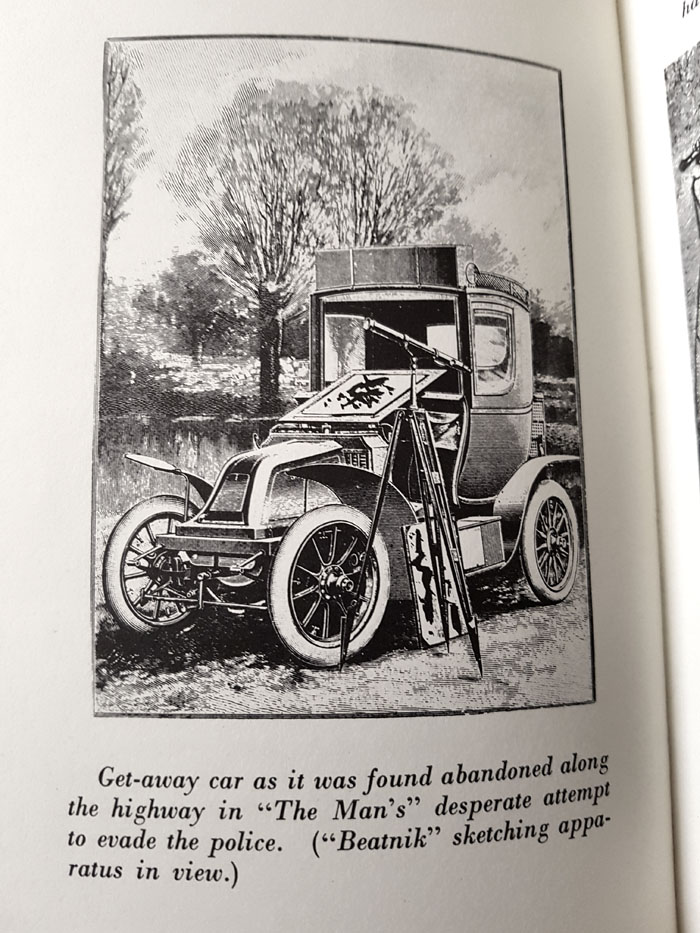
A symmetrical ink blot from Gobolinks, or Shadow Pictures for Young and Old (1896) by Ruth McEnery Stuart & Albert Bigelow Paine, a book where the blots are much more interesting than the interpretative verses that accompany them.

• “…within a year, they were on The Tube, performing their German-language extrapolation of Throbbing Gristle’s Discipline to a visibly nonplussed audience.” Alexis Petridis on the return of Propaganda. The group’s debut album, A Secret Wish (previously), has long been an obscure object of desire round here.

• RIP Alan White, drummer in Yes for much of the 1970s (see Sound Chaser for details), and also—although nobody mentioned this at the time—the originator of the drum sounds sampled on a Fairlight for Beat Box by the Art Of Noise.

• “For the anthropologist Stewart Guthrie, pareidolia is not a fringe phenomenon: it is at the core of religious experience.” Hunter Dukes on the interpretation of ink blots.

• “…self-righteousness is the one thing that I don’t agree with,” says John Waters. “We used humour to fight when I was young.”

• New music: October Cut Up by Black Glass Ensemble, and New Witness by Michael Begg.

• Also RIP Shiv Kumar Sharma, master of the santoor.

• “Scientists recreate Cleopatra’s favourite perfume.

Simon Fisher Turner’s favourite albums.

• At Dennis Cooper’s: Len Lye Day.

Cleopatra’s Barge (1962) by Alex North | Cleopatra’s Needle (1963) by Ahab And The Wailers | Cleopatra King Size (2002) by Jah Wobble & Temple Of Sound

Victor Valla book covers

valla01.jpg

Lancer Books, 1971.

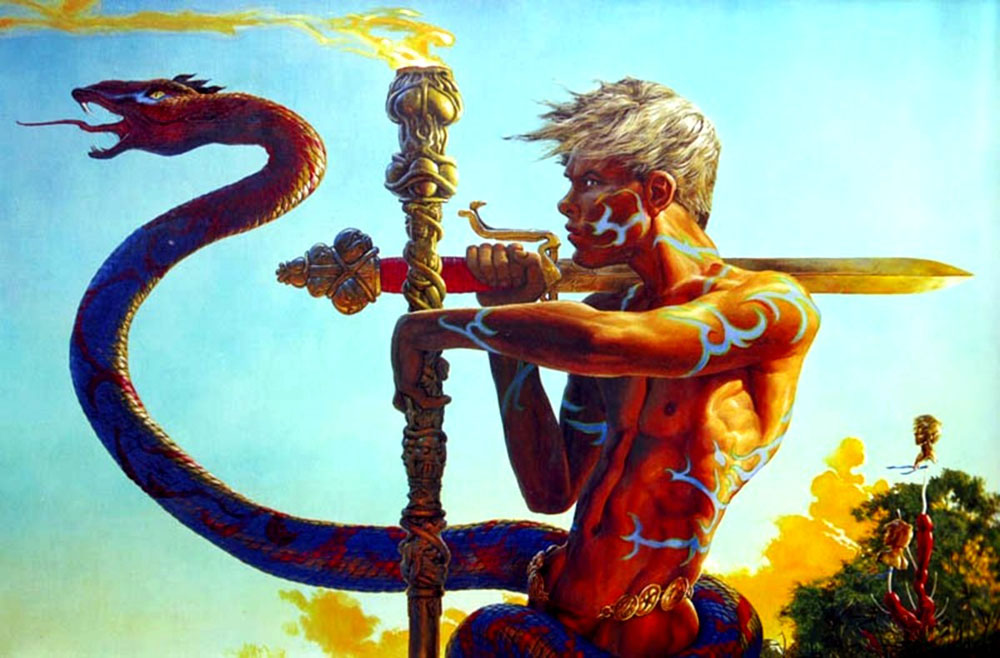
Victor Valla’s cover for The Dunwich Horror has appeared here before, and his cover for The Colour Out of Space is very familiar, but I hadn’t gone looking for anything else of his until this week. There isn’t much to be found on genre titles, just the rest of these covers plus a handful of undistinguished paintings for Gothic dramas and Dracula novels. His Lovecraft and Derleth covers are the kind of thing I always like to see more of, however, being less illustrations of story details than renderings of the feelings the story generates when you read it. This is especially the case with The Colour Out of Space, a story that suggests far more than it shows, and whose central motif—a colour alien to the Earth—is impossible to depict at all. In the 1970s it was easier to get away with this on paperback covers; Lovecraft was still a niche author and there wasn’t the legacy of imagery there is today. Incidentally, the Richard Lupoff book below isn’t as anomalous as it may seem if you know that Lupoff later wrote a novel, Lovecraft’s Book, with HPL as one of the main characters.

valla02.jpg

Lancer Books, 1971.

valla10.jpg

Beagle Books, 1971.

valla05.jpg

Beagle Books, 1971.

valla03.jpg

valla06.jpg

Beagle Books, 1971.

valla07.jpg

Beagle Books, 1971.

valla04.jpg

Beagle Books, 1971.

valla08.jpg

Beagle Books, 1971.

valla09.jpg

Beagle Books, 1971.

Elsewhere on { feuilleton }
The book covers archive
The illustrators archive
The Lovecraft archive

Weekend links 622

balbi.jpg

Testa Anatomica (1854) by Filippo Balbi.

The New School of the Anthropocene is “…an experiment. But it is also an act of repair. In partnership with October Gallery in London, we seek to reinstate the intellectual adventure and creative risk that formerly characterised arts education before the university system capitulated to market principles and managerial bureaucracy… (more)”

• “Every once in a while, you come across old music that generates a shock of new excitement.” Geeta Dayal on Oksana Linde whose electronic compositions are being released in a retrospective collection next month.

• More Walerian Borowczyk: Anatomy of the Devil, a collection of Borowczyk’s short stories, newly translated into English by Michael Levy, and with a cover design by the Quay Brothers.

• Washing machines, garden snails, and plastic surgery: A stroll through the Matmos catalogue. Related: “Why scientists are turning molecules into music.”

• Coming soon from Strange Attractor: Boogie Down Predictions, Hip Hop, Time and Afrofuturism, edited by Roy Christopher.

• At Spoon & Tamago: Exploring Japan’s historical landmarks and shrines in the middle of streets.

• New music: Adrian Sherwood Presents: Dub No Frontiers, music by female dub artists.

Winners of the 2022 Milky Way Photographer of the Year.

• A Vision In Many Voices: The art of Leo and Diane Dillon.

Molecular Delusion (1971) by Ramases | DNA Music (Molecular Meditation) (1985) by Riley McLaughlin | Pop Molecule (Molecular Pop 1) (2008) by Stereolab

Weekend links 621

foghorn.jpg

Holmes’s fog-horn apparatus, 1875.

• “Have scientists designed the perfect chocolate?” According to Betteridge, the answer would have to be “no”, even more so when the scientists only seem to have reinvented the Flake which Cadbury have been making since 1920. But the story does tell you something about “edible metamaterials” and even “edible holograms”.

• “In The Foghorn’s Lament, I talk about someone called The Fogmaster, who apparently used to do guerrilla foghorn performances…his ringtones are still available.” Jennifer Lucy Allan on foghorns past and present.

• “The story of Les Rallizes Dénudés is almost that of fan fiction. Fans know some basic details and the rest is conjecture and imagination.” Patrick St. Michel explores the occluded history of the Japanese rock band.

The Wharton completist may recognize some of the raw material for these stories in her earlier works. For instance, she used the Greek myth of Demeter and Persephone in a 1912 verse play before finding its subtle final expression in “Pomegranate Seed,” in which the ghostly letters keep the New York lawyer figuratively tethered to the underworld. And a 1926 volume of poems contained an experimental riff on a dead woman returning home on All Souls’ Day, published over a decade before Wharton revisited the holiday in her final short story. The ghost story form transforms both these familiar materials and her evergreen themes: Once some donnée becomes a ghost story, what may have been just an amusing character study acquires a participatory element, since readers must meet her halfway in becoming scared. To do so involves truly contemplating what exactly it is in these texts—and it is never the literal ghosts—that elicits a chill.

Krithika Varagur on Edith Wharton’s ghosts

Gaspar Noé’s favourite films. Elsewhere, Noé and Dario Argento talk about Noé’s latest feature, Vortex, while later this month Arrow are giving Enter the Void an overdue UK blu-ray release.

• Gay utopia: recent photographic portraits by Matthew Leifheit of Fire Island.

• Yogaville, 1993: more historic film of Alice Coltrane performing.

• At Dennis Cooper’s: The Maysles Brothers Day.

Sugar Chocolate Machine (1967) by The Beatstalkers | Chocolate Machine (1993) by Sandoz | Chocolate Jesus (1999) by Tom Waits

Moderne Malereien, 1903

seder01.jpg

A few months ago I turned up a collection of decorative animal designs by Anton Seder, a German artist, designer and art teacher. Moderne Malereien is a sequel to this in which Seder applies his somewhat overwrought Art Nouveau style to the world of interior design, with suggestions for a variety of elaborate murals. Animals are also present in some of these plates, especially fish; Seder had a fondness for aquatic organisms. Similar designs may be found in the pages of Kunstgewerbe in Elsass-Lothringen, a short-lived journal which Seder co-edited from 1900 to 1906.

seder02.jpg

seder03.jpg

seder04.jpg

seder05.jpg

Continue reading “Moderne Malereien, 1903”