Worlds Beyond Time

worlds1.jpg

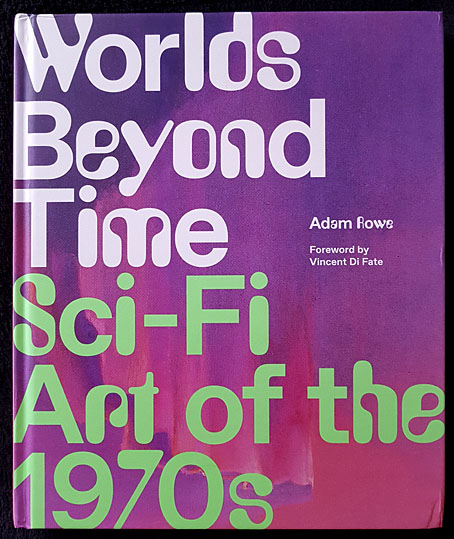
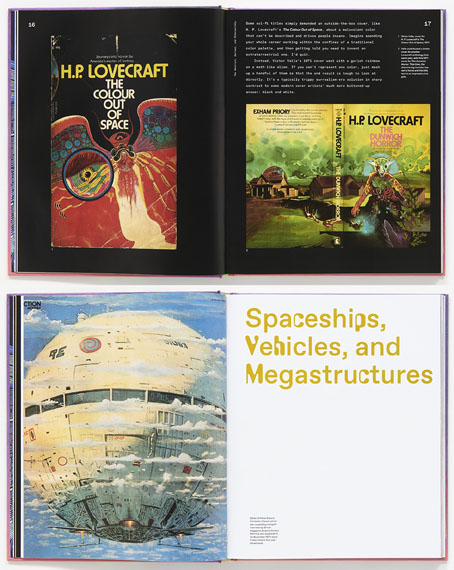
Or yesterday’s tomorrow today. Adam Rowe’s book arrived in the post this weekend, a little bumped at the corners (art books often suffer at the hands of the postal services) but very welcome all the same.

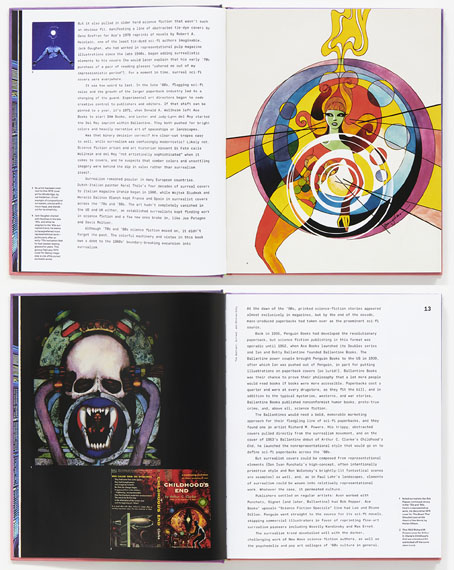
In the 1970s, mass-produced, cheaply printed science-fiction novels were thriving. The paper was rough, the titles outrageous, and the cover art astounding. Over the course of the decade, a stable of talented painters, comic-book artists, and designers produced thousands of the most eye-catching book covers to ever grace bookstore shelves (or spinner racks). Curiously, the pieces commissioned for these covers often had very little to do with the contents of the books they were selling, but by leaning heavily on psychedelic imagery, far-out landscapes, and trippy surrealism, the art was able to satisfy the same space race–fuelled appetite for the big ideas and brave new worlds that sci-fi writers were boldly pushing forward.
worlds2.jpg

In Worlds Beyond Time: Sci-Fi Art of the 1970s, Adam Rowe—who has been curating, championing, and resurrecting the best and most obscure art that 1970s sci-fi has to offer on his blog 70s Sci-Fi Art—introduces readers to the biggest names in the genre, including Chris Foss, Peter Elson, Tim White, Jack Gaughan, and Virgil Finlay, as well as their influences.
worlds3.jpg

One of my own formative influences was Visions of the Future (1976), a large-format book edited by Janet Sacks that recycled material from NEL’s Science Fiction Monthly magazine to present a guide to British SF art in the 1970s. In many ways the book was a rather poor collection—the reproductions aren’t good, not all the artists are first-rate, and a few have nothing to do with SF or “the future” at all—but it was important to me for the many artist interviews which confirmed that you could make some kind of living producing this type of art. Adam Rowe’s book is like a superior sequel to Visions of the Future, with miniature biographies for many of the artists, plus a look at the recurrent themes he’s explored on his 70s Sci-fi Art Tumblr. There’s a lot in here I hadn’t seen before. I’m grateful he’s found space for Paul Kirchner’s Dope Rider, a typically Surrealist Kirchner comic strip, and one I never got to see when it was running in the pages of High Times. Kirchner’s The Bus was a favourite, however, being a regular in the pages of Heavy Metal magazine. Kirchner has never been very science fictional either but Worlds Beyond Time is a more flexible title than Visions of the Future, one that can embrace imaginative possibilities that aren’t limited to spaceships, planets and futuristic cities.

Elsewhere on { feuilleton }
The book covers archive
The illustrators archive

Previously on { feuilleton }
Corgi SF Collector’s Library
Foss, Jodorowsky and low-flying spacecraft
Crank book covers
Do You Have The Force?
The artists of Future Life
Science Fiction Monthly
The fantastic and apocalyptic art of Bruce Pennington
Roger Dean: artist and designer
Weekend links 684

okamoto.jpg

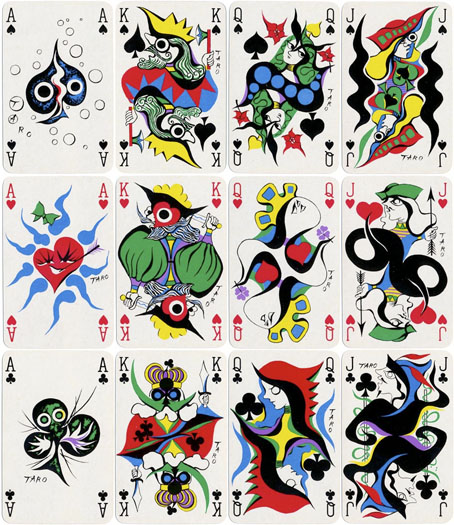
Playing cards designed in 1977 by Taro Okamoto.

• “This practice of looking does not prioritise academic or historical perspectives on art. It is divorced from the artist, the industry and the formal study of the arts. By paying attention to the form, title and other perceptible ‘clues’ in the work, this practice is primarily interested in using the intuitive, sensory, suggestive and aleatory to engage in conversation with a creative work. The point is not to develop an answer, an interpretation that ‘settles’ the ‘question’ of the painting, or to intellectualise the work in terms of form, style, history or the concerns of the artist. Rather, in this practice, a piece of art or writing becomes a test or opportunity for working one’s imagination—an exercise in making associations.” Aparna Chivukula on choosing art over wellness apps.

• “But with the discourse about the limitations of moralizing steadily growing, the question of an alternative naturally arises. The critics of self-righteousness and trauma mongering are for the most part not calling for a return to the amoral ironism that governed the Nineties and early Aughts—the sensibility that surely gave rise, at least in part, to the overgrowth of didacticism that followed. But if not this, then what? Where do we go from here?” Anastasia Berg on “the aesthetic turn”.

• “…by choosing ordinary creatures, the fabulist naturalises the stories in a world that is close to hand, which helps the writer communicate opinions that are often subversive.” Marina Warner on Kalilah wa-Dimnah and the animal fable.

• Coming soon from Strange Attractor: Austin Osman Spare, a revised and expanded edition of Phil Baker’s excellent biography of the artist/occultist.

• At Rarefilmm: The Marat/Sade (1967), Peter Brook’s film (previously) of the 1965 Broadway production of Peter Weiss’s play.

• New music: Hostile Environment by Creation Rebel, and Tone Maps by Field Lines Cartographer.

• Mixes of the week: Isolatedmix 122 by Mary Yalex, and XLR8R Podcast 810 by Zaumne.

• At Dennis Cooper’s: Pierre Clementi Day.

Sade Masoch (1968) by Bobby Callender | On Sadism (1979) by Material | Sadistic (1995) by Stereolab

Weekend links 682

barbier.jpg

La Voie Lactée (1921) by George Barbier.

• Fun news of the week: “The Taylor Swift vinyl haunted by Britain’s weirdest musicians.” The “weirdness” is tracks from Happy Land: A Compendium of Electronic Music from the British Isles 1992–1996 which have been mispressed onto Swift’s latest, the re-recorded Speak Now. One of the offending pieces is Soul Vine (70 Billion People) by Cabaret Voltaire, a relatively understated instrumental from the Plasticity album which features samples from the Demon with a Glass Hand episode of The Outer Limits. “It’s possibly the most subversive thing we’ve ever done,” says Stephen Mallinder. Adventurous Swifties looking to broaden their horizons are advised to try The Crackdown next.

• “For McCarthy, violence is the signature of God: God, who cannot be seen, who is only indicated by an absence, who no amount of experimenting or observing will reveal, but whose existence is in evidence all around us, every day, through the apocalyptic and apophatic violence that makes up the very stuff of the world.” JC Scharl on the violent faith of Cormac McCarthy.

• Strange news of the week: Reclusive guitarist Master Wilburn Burchette (age 84) was found dead in a house with the body of his younger brother (age 76) after decades spent avoiding anyone showing an interest in his music. Numero Group, the label behind the recent reissues of Burchette’s albums, posted an interview from 2018.

Takrar by Waref Abu Quba is “an experimental film that celebrates the timeless and intricate beauty of ancient craftsmanship. Filmed in Istanbul, the film takes us on a mesmerizing journey into the past, paying homage to Islamic, Ottoman, Greek, and Byzantine art forms.”

• “Could an industrial civilization have predated humans on Earth?” Probably not, but if it was in the deep past how would we know? Joel Froelich investigates.

• At Dennis Cooper’s: Visual evidence from almost every museum devoted to prestidigitation in the world (for Derek McCormack).

• At Spoon & Tamago: Osaka celebrates Star Festival with river of 40,000 LED lights evoking the Milky Way.

• At Unquiet Things: Even more sneak peeks from The Art of Fantasy.

• Mix of the week is DreamScenes – July 2023 at Ambientblog.

• At The Daily Heller: Sign writing and glass engraving.

Out Of Limits (1963) by The Marketts | Trip Through The Milky Way–An Electronic Panorama (1969) by Raymond Moore | Milky Way (1971) by Weather Report

Weekend links 681

hunter.jpg

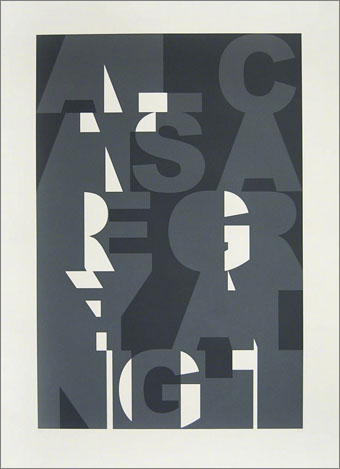
All Cats are Grey At Night (2009) by Kenny Hunter.

“They found ways to do the impossible”: Hipgnosis, the designers who changed the record sleeve for ever. Lee Campbell talks to Anton Corbijn about Squaring the Circle, Corbijn’s documentary about the Hipgnosis design team. Peter Christopherson is shown in the accompanying photo but Campbell doesn’t mention him at all, despite his having been an equal partner with Storm Thorgerson and Aubrey Powell from the mid-70s on. Many of those famous covers were photographed by Christopherson’s camera.

• A new book by Stephen Prince at A Year In The Country: “Lost Transmissions weaves amongst brambled pathways to take in the haunted soundscapes of electronica, the rise of the occult in the 1970s, cinema and television’s dystopian dreamscapes and hauntological work which creates and gives a glimpse into parallel worlds…”

• New music: Ambient Bass Guitar by John von Seggern, and Sturgeon Moon/Beaver Moon by Missing Scenes.

• How Samuel R. Delany Reimagined Sci-Fi, Sex, and the City.

• Mix of the week: Tranquility by A Strangely Isolated Place.

Galerie Dennis Cooper presents…Snow Globalists.

• The Strange World of…African Head Charge.

• Steven Heller’s font of the month is Baudot.

Nights on Earth.

Transmission (1979) by Joy Division | Clandestine Transmission (1994) by Richard H. Kirk | Transmission (1996) by Low

Franz von Bayros’s Inferno

bayros01.jpg

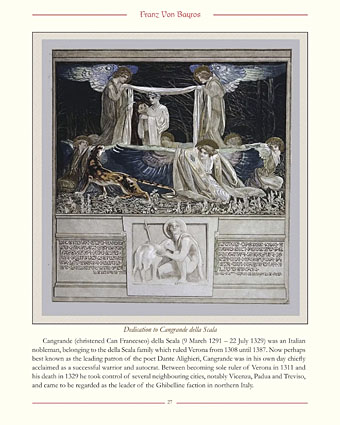
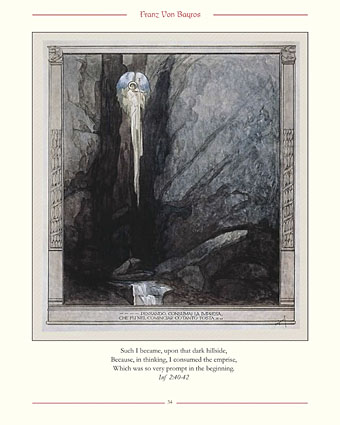
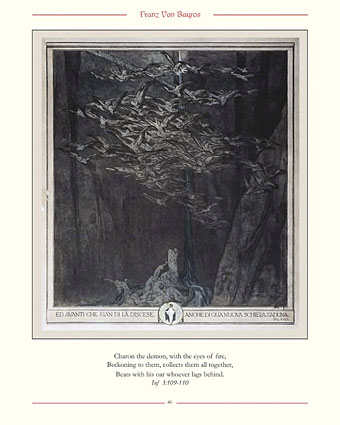
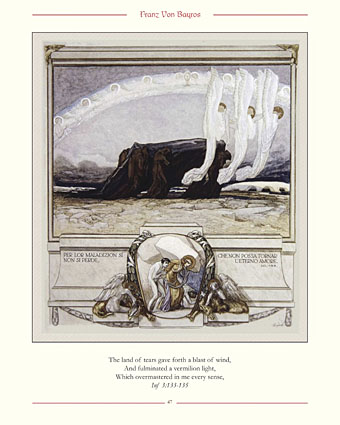
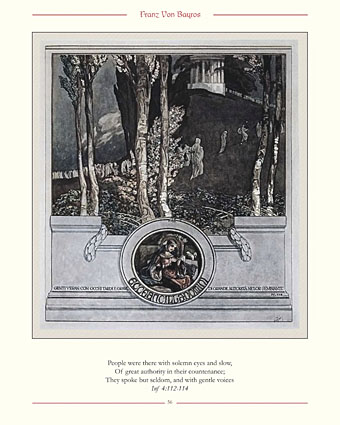
Viennese artist Franz von Bayros (1866–1924) is unusual among illustrators in that his erotic art tends to be easier to see today than his less scandalous commissions. Such is the case with his illustrations for Dante’s Inferno, some of which I’d seen before but never as many as in a book which arrived recently at the Internet Archive. This is a home-made presentation that uses the Longfellow translation of the Inferno for the text. Bayros can’t compete with the sombre spectacle of Gustave Doré’s illustrations but he depicts some of the less dramatic moments that Doré’s full-page engravings avoid, while also placing a number of his drawings in the same monumental frames he liked to use for his pornographic art.

bayros02.jpg

bayros03.jpg

bayros04.jpg

bayros05.jpg

Continue reading “Franz von Bayros’s Inferno”