Psychedelic vehicles

further.jpg

Further: the second version of Ken Kesey’s Merry Prankster bus.

The word psychedelic, like surreal before it, slipped from its original meaning through appropriation. Humphrey Osmond’s neologism was first coined in drug-related correspondence with Aldous Huxley in 1957 and was specifically intended to describe the “mind-manifesting” quality of the hallucinogenic drug experience. The drug-inspired art and music which came after the experiments of the Fifties quickly assumed a gaudy and chaotic aspect derived from the intense visual abstractions of LSD trips. Huxley in The Doors of Perception (1954) rejected these fractal visions as trivial and distracting—he was more concerned with the deeper spiritual revelations—but a new way of seeing in a new era required a new label. Art and design which is vivid, florid, multi-hued and quite often incoherent is where the term psychedelic is most commonly applied today.

Of the three vehicles here, only Ken Kesey’s bus can be regarded as psychedelic in Osmond’s sense, this being the renovated school bus which travelled the United States in the mid-Sixties dispensing free LSD to those it met along the way. These events were recounted in Tom Wolfe’s The Electric Kool-Aid Acid Test (1968) and the creators of last year’s Milk, Gus Van Sant and Dustin Lance Black, have a film in preparation based on Wolfe’s book. Milk was a film about gay rights campaigner Harvey Milk, and Ang Lee (director of Brokeback Mountain) has a new film of his own due shortly, Taking Woodstock, which concerns Elliot Tiber, the gay organizer of the Woodstock Festival of 1969. Both stories bracket the psychedelic era. Is this coincidence or do I detect something in the air? But I digress….

porsche.jpg

For the chaotic and decorative nature of the psychedelic style, look no further (so to speak) than Janis Joplin’s 1965 Porsche. I saw this in 2005 at Tate Liverpool when it was touring with the Summer of Love exhibition of psychedelic art. One of  Joplin’s very last recordings before her death in 1970 was a birthday song for John Lennon so it’s perhaps fitting that the third vehicle here is Lennon’s lavish Rolls-Royce. His 1965 limousine came originally in black livery but two years later he decided he wanted it painted like a gypsy caravan. There’s a great page about the car here including details of its decoration, created in consultation with Marijke Koger of Dutch design group The Fool.

rolls.jpg

In a small way these three vehicles encapsulate the psychedelic period, from optimistic, proselytising origins following the revelations of hallucinogenic drugs to decline into a mannered, highly-commercialised graphic style. Ken Kesey died in 2001 but his second bus is still active while the cars are now museum pieces. Perhaps the real psychedelic spirit prevails after all.

See also: George Harrison’s Mini Cooper

Previously on { feuilleton }
Dutch psychedelia
The art of LSD

Steampunk redux

steampunk2.jpg

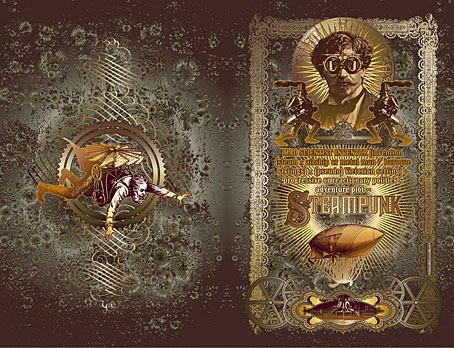
The Steampunk design I created last year for Modofly (based on a formula by writer Jeff VanderMeer) is given a new lease of life with this colour version. Modofly produce decorated Moleskin books with a range of designs from some very talented artists. Previous graphics were laser-etched onto the boards but they’re now able to print in full colour which is obviously to everyone’s advantage. This is available now in two different book formats. And while we’re on the subject, a reminder of Dana Mattock’s incredible Steampunk Frankenstein casemod at Flickr. His photos of my Steampunk print are now posted.

I’m planning more designs for Modofly and would have had some ready now had the past few months not been so hectic. In a similar mode (as it were), I’m also planning some T-shirt designs for Kingstrike. More about these later.

Previously on { feuilleton }
Steampunk framed
Steampunk Horror Shortcuts

Hip Gnostics and more Moore

gnostic.jpg

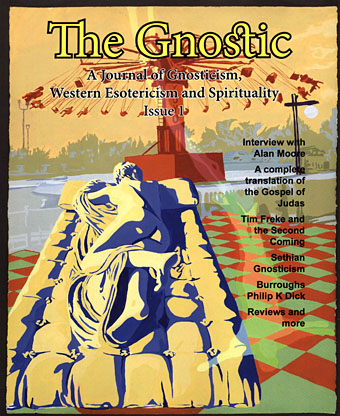
Coincidence abounds: on Wednesday I was following a few referral URLs to see who’d been linking here and was led to a Lexic.us page about hermaphrodites which in turn had me looking again at the wonderful Borghese Hermaphroditus in the Louvre. Thursday’s postal delivery brought issue 1 of The Gnostic which prominently features the Louvre sculpture on its cover. Inside there’s my portrait of William Burroughs illustrating a piece about Burroughs’s Gnostic identification by Sven Davisson. (I linked to another essay on the same theme in 2007.) The Gnostic is an excellent publication which, the Alan Moore interview aside, I’ve only skimmed through so far. Alan’s piece is very enlightening since the discussion stays fixed around religion, science and the occult and includes the most thorough extrapolation I’ve seen to date of his long work in progress, Jerusalem. There’s also a transcript of part of his William Blake piece from 2001, Angel Passage. If you want to know more I suggest you order a copy ($12 / £8 / €9) from Bardic Press.

Coincidence further abounds as this arrived just as Pádraig Ó Méalóid publicly announced his discovery of the long-lost and unpublished third issue of Alan Moore’s Big Numbers. This was Alan’s self-published “real life” comic series from 1989 which got off to a great start then fatally collapsed when artist Bill Sienkiewicz, then his replacement, Al Columbia, both dropped out of the project. It’s one of the great lost projects of contemporary comics and seeing the third issue sustaining the quality of the first two is deeply frustrating.

The last piece of Moore news concerns The Mindscape of Alan Moore once again which is now available to buy through iTunes. $9.99 will only get you the feature-length documentary, however. If you buy the double-disc DVD you also get my groovy interface design and an extra disc of interviews with major comic artists.

Update: Alan Moore has certainly ruled the week in this household with the delivery on Friday of The Extraordinary Works of Alan Moore, a new edition of George Khoury’s book-length autobiographical interview with Alan, and an essential purchase for anyone with more than a cursory interest in Alan’s life and work. The book features copious artwork examples by many Moore collaborators including my CD designs and the cover for the forthcoming Moon & Serpent Bumper Book of Magic.

Previously on { feuilleton }
William Burroughs: Gnostic visionary