Carleton Watkins in Yosemite

watkins1.jpg

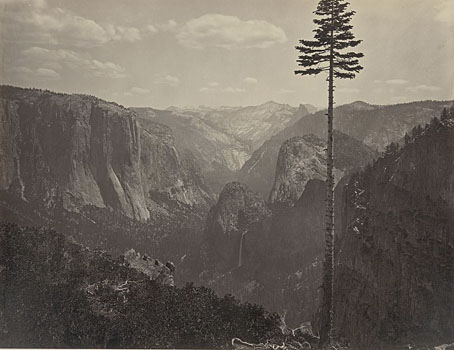
Yosemite Valley (c. 1865).

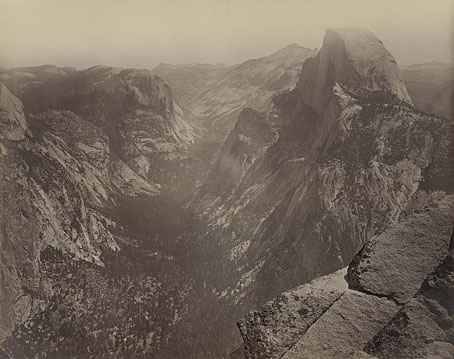
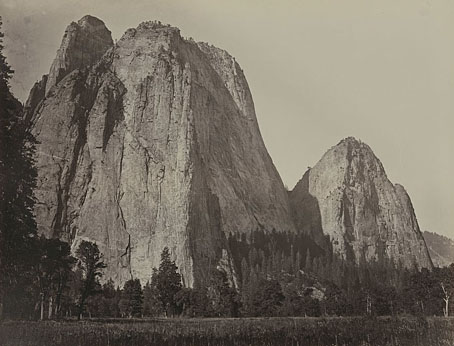
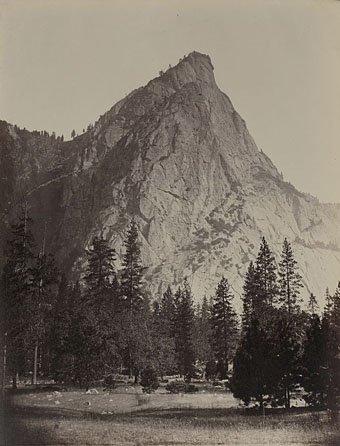
The Getty Museum recently published a large and expensive ($195) volume collecting all the surviving photographs by one of the pioneers of landscape photography, Carleton Watkins (1829–1916). The most important of Watkins’ many photos of California in the mid-19th century are those taken in the Yosemite Valley, a series of views which helped persuade Abraham Lincoln to preserve the area as a national park. The pictures here are from the Watkins collection at the Library of Congress where many of the images can be downloaded as huge (200mb) tiffs. The LoC also has a number of stereograph views. The quality of these pictures is quite stunning when you consider that the photographic medium was only about thirty years old. To capture many of these views Watkins had to cart a bulky glass-plate camera up and down mountain trails.

Carleton Watkins, The Complete Mammoth Photographs edited by Weston Naef & Christine Hult-Lewis can be ordered direct from the Getty Museum. There’s also an earlier study by Weston Naef, Carleton Watkins in Yosemite.

watkins4.jpg

Half Dome, Yosemite Valley (c. 1865).

watkins2.jpg

Cathedral Rock, Yosemite Valley (c. 1865).

watkins3.jpg

Front view, Three Brothers, Yosemite (c. 1865).

Previously on { feuilleton }
Dead Roads

The art of Ronald Searle, 1920–2012

searle01.jpg

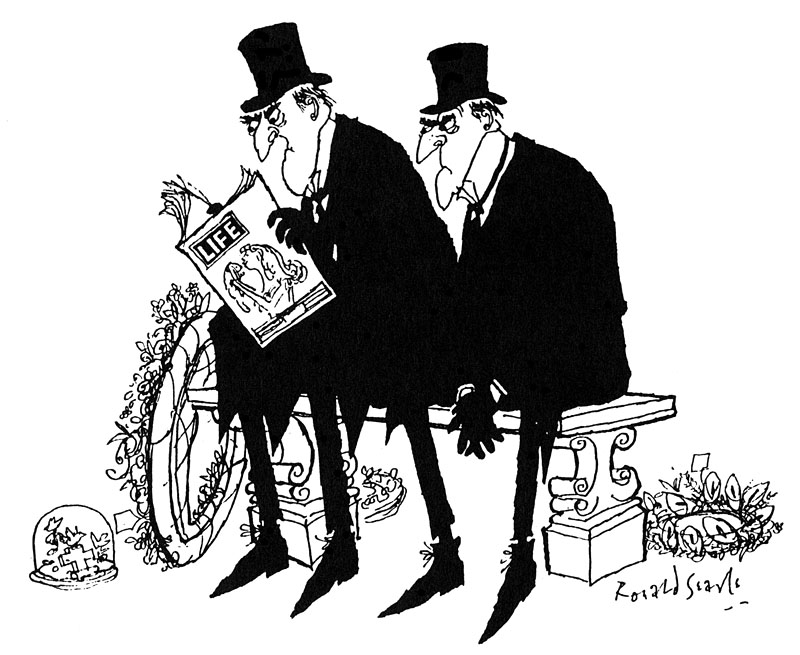
Undertakers. From Punch magazine (undated).

I started trying to draw like Ronald Searle when I was about eight. So there was Jabberwocky and Ronald Searle I was turning into by the time I was thirteen. You know, I was determined to be Lewis Carroll (giggles) with a hint of Ronald Searle.

John Lennon, 1968

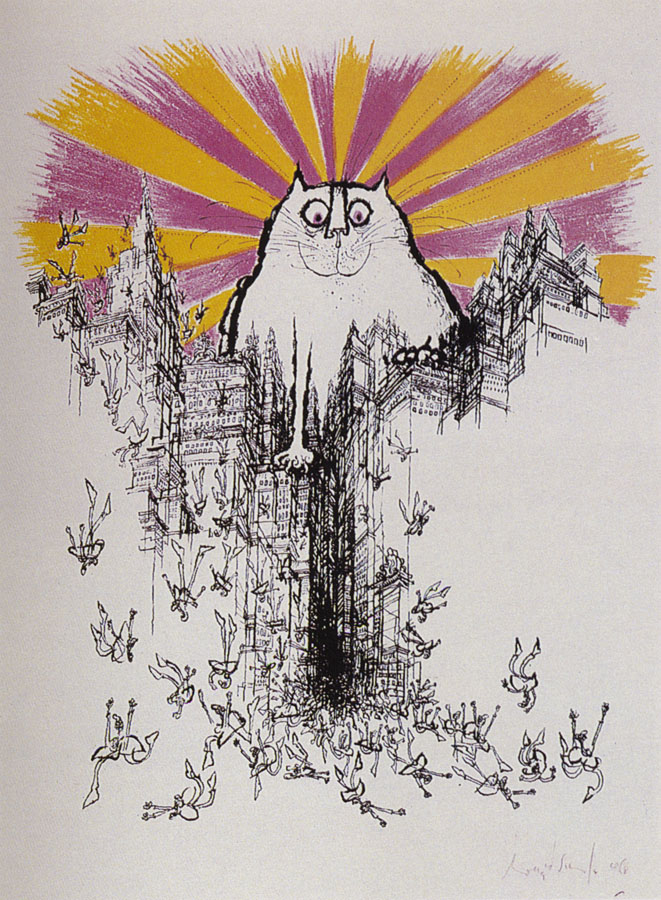
Does the late Ronald Searle need any introduction? Everyone knows he created the anarchic schoolgirls of St Trinian’s in the 1940s, although their exploits had the greatest audience in the films based on Searle’s cartoons rather than the original drawings. Searle’s work first came to my attention through reprints of the Molesworth books he produced with Geoffrey Willans in the 1950s—Down with Skool! (1953), How to be Topp (1954), Whizz for Atomms (1956) and Back in the Jug Agane (1959)—a masculine riposte to St Trinian’s which allowed for a broader range of humour than the slapstick and short-skirted salaciousness the films drifted into. The Molesworth books are perhaps best appreciated at age 11 as this LRB review notes; looked at with older eyes all I see is a portrait of a rigidly class-bound nation whose boarding schools, gowned masters, “maters” and “paters” could only inspire affection in the Etonians currently attempting to govern Britain. But the drawings remain a treat: wiry and mordant with flashes of a viciousness that make Searle the godfather of Gerald Scarfe and Ralph Steadman.

searle.jpg

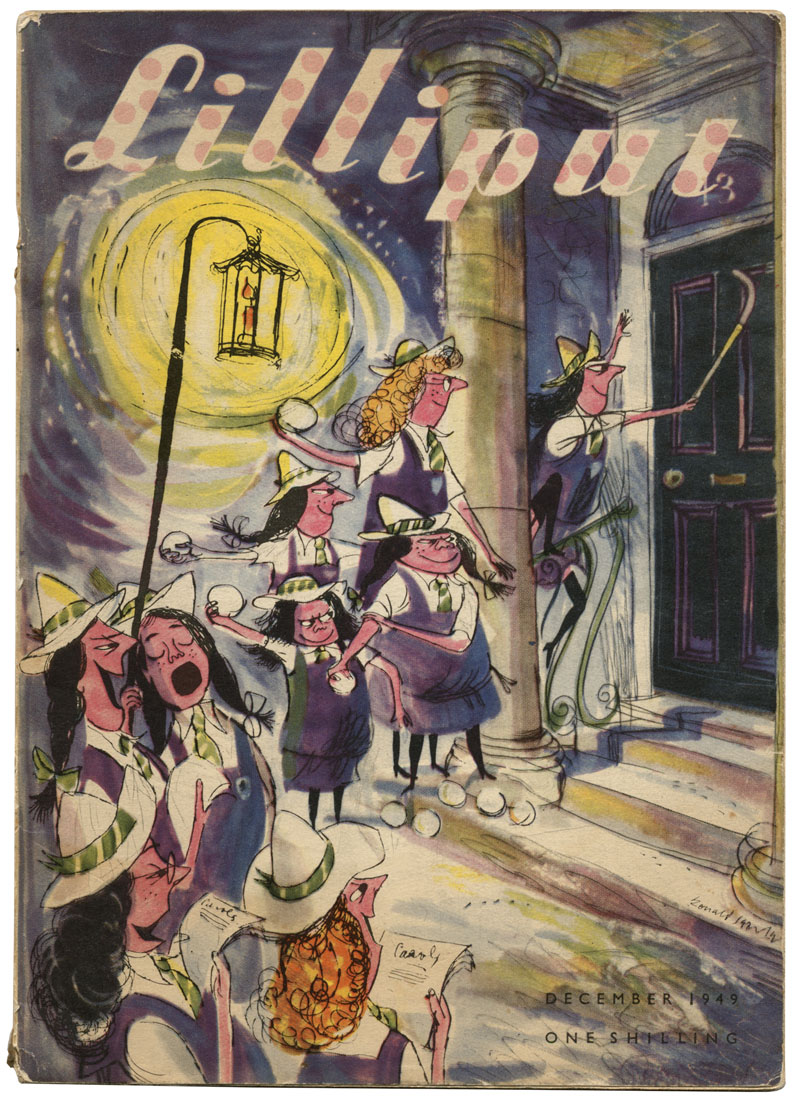
The girls of St Trinian’s, Lilliput magazine, December 1949.

Given Searle’s influence on generations of newspaper cartoonists it’s no surprise that the British papers are being free with the plaudits. Links to various stories follow. The images here are taken from earlier posts or pulled from my bookshelves. The illustration of Engelbrecht below is from the Savoy Books edition of Maurice Richardson’s The Exploits of Engelbrecht which I designed in 2010.

Guardian obituary | Telegraph obituary | NYT obituary
• Ronald Searle in pictures: Telegraph | Guardian
Ronald Searle: a life in pictures by Steve Bell.
Mike Leigh: ‘Ronald Searle was my inspiration’.
Ronald Searle: Now let’s have some fizz: Gerald Scarfe remembers his friend and childhood hero.
Ronald Searle was our greatest cartoonist – and he sent me his pens, says Martin Rowson.

Other links:
Perpetua, the Ronald Searle tribute
Searle at VTS
Winespeak at BibliOdyssey

searle03.jpg

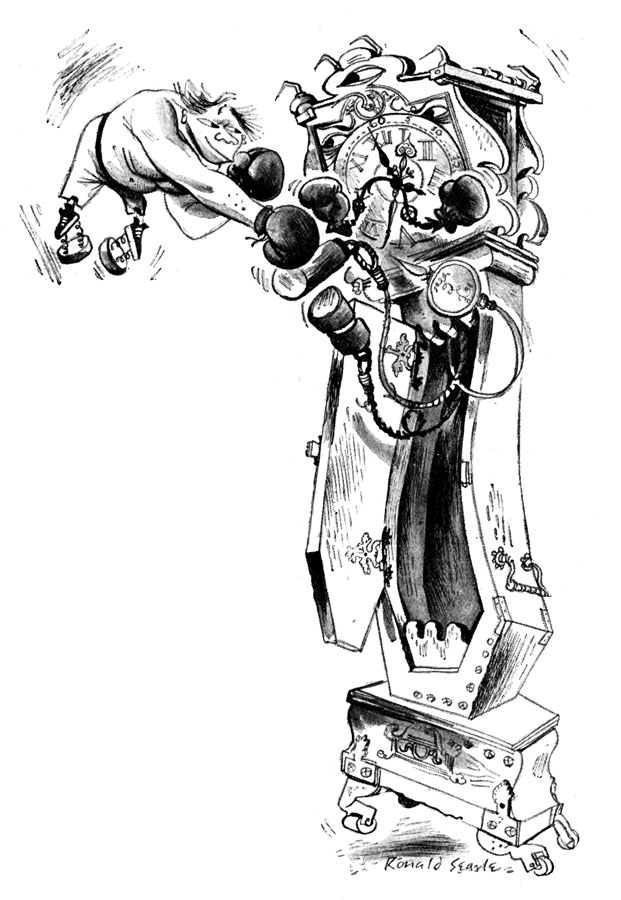
Engelbrecht versus Grandfather Clock. From The Exploits of Engelbrecht (1950) by Maurice Richardson.

molesworth.jpg

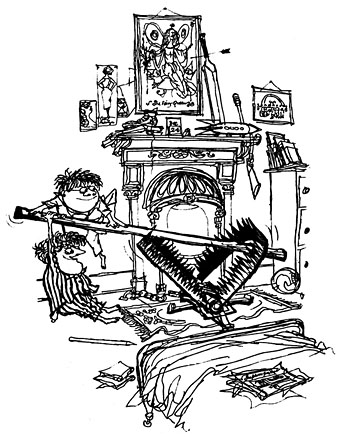
“A trap for dere Santa”. From How to be Topp (1954) by Geoffrey Willans and Ronald Searle.

searle02.jpg

The Coming of the Great Cat God (1968).

Elsewhere on { feuilleton }
The illustrators archive

Previously on { feuilleton }
Engelbrecht lives to fight another day
Ronald Searle book covers
Engelbrecht again

Weekend links: 2012 edition

life1912.jpg

The Hand of Fate, Life magazine, October, 1912. Artist unknown.

In Search of Barney Bubbles: the great graphic designer is profiled on BBC Radio 4, Monday, 2nd January. And speaking of album cover designers, Cool Hunting talked to Storm Thorgerson about his work.

• FACT mix 310 is a hugely eclectic two-parter from Moon Wiring Club. Grab it while it’s still available. And there’s also Solstmas 2011/2: The Final Countdown, a mix by El Minko Misterioso.

• One of the music events of the new year will be the release of Captain Beefheart’s Bat Chain Puller album. Pre-order it here.

In 1972, at the age of thirty-one, [Fred] Halsted released L.A. Plays Itself, a film which drew upon Kenneth Anger’s surrealist eroto-expressionism, and went way beyond Anger’s sublimated homoeroticism to explicitly portray gay male S/M sex. In 1969, when Halsted first decided to make a sexually explicit film, he decided to create a part for himself, and then be that part.

Halsted Plays Himself by William E. Jones reviewed at Lambda Literary

• Lunar Rover: An interview with Steve Moore and extract from Somnium.

Battersea Power Station, a graveyard of architectural schemes.

Editors might admire a fine book, but are overridden by marketing and accounting departments who now have the final say. I know of a novel that wasn’t accepted by one publisher after the manuscript was first submitted to W.H. Smith, who said that it wouldn’t sell enough.

Jenny Diski on the state of fiction publishing in the UK

• EU copyright on James Joyce‘s works ended at midnight.

Dressed to Kill: Dispelling the Myths of Men in Drag.

The Geology of the Mountains of Madness

Mandala of the Day

Chomeography

The Floppy Boot Stomp (1978 mix) by Captain Beefheart and the Magic Band.

Harry Clarke and the Elixir of Life

clarke1.jpg

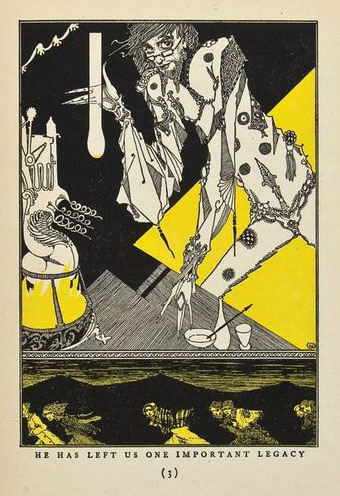
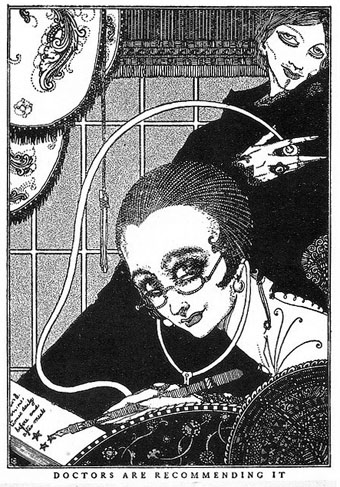
A little something for the season of strong drink. Harry Clarke’s books command high prices in their original editions yet two of the costliest items in the Clarke bibliography are a pair of promotional booklets the artist illustrated for Jameson & Son’s Irish Whiskey: A History of a Great House in 1924, and Elixir of Life a year later. Given the quality of Clarke’s work for these publications it’s a shame they remain out of print; I’m sure I’m not the only Clarkeophile who’d be happy to buy a facsimile edition.

clarke2.jpg

Elsewhere on { feuilleton }
The illustrators archive

Previously on { feuilleton }
Cardwell Higgins versus Harry Clarke
Modern book illustrators, 1914
Illustrating Poe #3: Harry Clarke
Strangest Genius: The Stained Glass of Harry Clarke
Harry Clarke’s stained glass
Harry Clarke’s The Year’s at the Spring
The art of Harry Clarke, 1889–1931

Richard Williams’ Christmas Carol

williams1.jpg

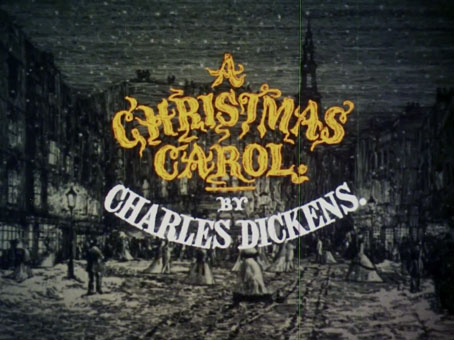
It’s easy to loathe the teeth-grinding sentimentality of Charles Dickens’ seasonal tale, as well as its subtext which isn’t so far removed from Emperor Ming’s instruction to his cowed populace in Flash Gordon: “All creatures shall make merry…under pain of death.” Yet as a ghost story I prefer A Christmas Carol to the sketchier The Signal-Man, and I’ve always enjoyed this memorable 1971 adaptation from the animation studio of the great Richard Williams.
williams2.jpg

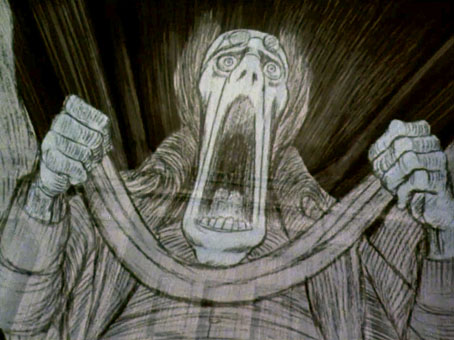
Marley’s ghost.

Williams is best known today for his role as animation director on Who Framed Roger Rabbit? but prior to this he’d distinguished himself as creator of the florid title sequence for What’s New, Pussycat? (1965), and the animated sections—done in the style of 19th-century engravings and political cartoons—for Tony Richardson’s The Charge of the Light Brigade (1968). Williams’ Christmas Carol owes a similar debt to Victorian graphics, not only to the original story illustrations by John Leech, but also to Gustave Doré’s views of Victorian London, scenes which had earlier influenced the production design for David Lean’s adaptation of Oliver Twist. Williams’ film crams Dickens’ story into 25 minutes but nonetheless manages to maintain the tone of the original to a degree which eludes many feature-length travesties, especially those in which the nightmare squalor of Victorian London is reduced to a shot or two of dressed-down extras. Dickens had first-hand experience of the squalor: Kellow Chesney’s The Victorian Underworld (1970) quotes at length from one of the journeys Dickens took (under police escort) through the notorious St Giles rookery, and his ghost story was intended as much as a warning to the complacency of middle-class Victorian readers as a Christmas celebration.
williams3.jpg

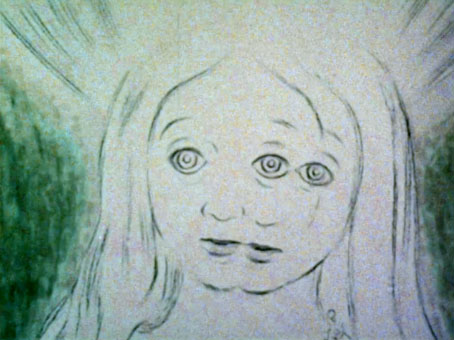
The Ghost of Christmas Past.

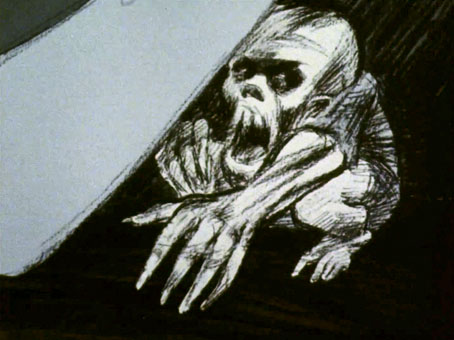
For me the crucial moment in any adaptation comes when the Ghost of Christmas Present shows Scrooge the figures of Ignorance and Want: in most film versions these tend to be a pair of well-fed child actors in rags and make-up; Williams shows us two grim spectres that owe more to Gerald Scarfe than Walt Disney. Williams is also truer to the ghosts themselves: Dickens describes Jacob Marley unfastening his jaw which falls open then remains that way while he proceeds to speak to his former friend; the Ghost of Christmas Past is the androgynous figure from the story with its ambiguous nature also shown by its shimmering indeterminate outline.
williams4.jpg

Ignorance.

Any animated drama relies on its voice actors, and Williams was fortunate to have Alistair Sim (as Scrooge) and Michael Hordern (as Marley) reprising their roles from the 1951 film version, while Michael Redgrave narrates the tale. The film used to be a seasonal fixture of British television, and may still be for all I know (I haven’t owned a TV for years). For the time being it’s on YouTube, of course, with a full-length version here that’s blighted by compression artefacts but is watchable enough. 2012 is the Dickens bicentenary so expect to hear a lot more about the author and his works in the coming year.

Update: The version linked to originally has been deleted. No matter, there’s a much better copy here (for now).

As usual I’ll be away for a few days so the { feuilleton } archive feature will be activated to summon posts from the past below this. Have a good one. And Gruß vom Krampus!

Previously on { feuilleton }
“Who is this who is coming?”