The Garden of Adompha

adompha1.jpg

…the growths of that garden were such as no terrestrial sun could have fostered, and Dwerulas said that their seed was of like origin with the globe. There were pale, bifurcated trunks that strained upwards as if to disroot themselves from the ground, unfolding immense leaves like the dark and ribbed wings of dragons. There were amaranthine blossoms, broad as salvers, supported by arm-thick stems that trembled continually.

And there were many other weird plants, diverse as the seven hells, and having no common characteristics other than the scions which Dwerulas had grafted upon them here and there through his unnatural and necromantic art.

These scions were the various parts and members of human beings. Consummately, and with never failing success, the magician had joined them to the half-vegetable, half-animate stocks on which they lived and grew thereafter, drawing an ichor-like sap. Thus were preserved the carefully chosen souvenirs of a multitude of persons who had inspired Dwerulas and the king with distaste or ennui. On palmy boles, beneath feathery-tufted foliage, the heads of eunuchs hung in bunches, like enormous black drupes. A bare, leafless creeper was flowered with the ears of delinquent guardsmen. Misshapen cacti were fruited with the breasts of women, or foliated with their hair. Entire limbs or torsos had been united with monstrous trees. Some of the huge salver-like blossoms bore palpitating hearts, and certain smaller blooms were centered with eyes that still opened and closed amid their lashes. And there were other graftings, too obscene or repellent for narration.

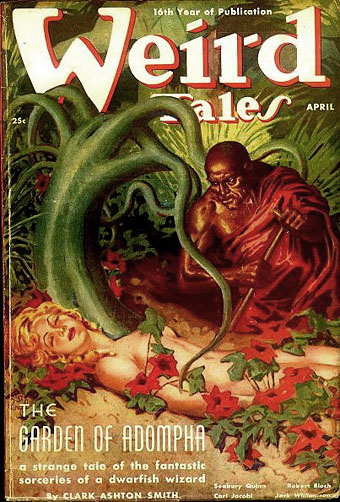
Thus Clark Ashton Smith in The Garden of Adompha, one of the stories in the author’s Zothique cycle which was first published in Weird Tales in April, 1938. Zothique was Smith’s contribution to the Dying Earth subgenre, sixteen stories set on the last continent in the final days of the Earth, and a home to no end of sorcery and cruelty. I’ve always enjoyed this subgenre, especially in the hands of Jack Vance whose later Dying Earth stories show the influence of Zothique, so these are some of my favourites among Smith’s prodigious output. The Garden of Adompha is a particularly grotesque piece, concerning the sequestered garden of the title to which King Adompha has undesirables removed. Once there his wizard, Dwerulas, drugs the victims and grafts parts of their bodies to the garden’s hothouse plants. Virgil Finlay’s cover painting downplays the horror somewhat, and Dwerulas’s supine prey, Thuloneah, looks like a very typical American girl, but then for a story that reads like a pulp equivalent of Octave Mirbeau it’s surprising it made the cover at all.

adompha2.jpg

Re-reading some of Smith’s stories over the past week, The Garden of Adompha among them, there’s been the additional pleasure of searching for illustrations from their original publication. I knew that Virgil Finlay had painted this cover, one of the few cover features Smith received from Weird Tales, but Alistair Durie’s Weird Tales (1979) collection only has a monochrome reproduction. The always reliable Golden Age Comic Book Stories not only has a copy of Finlay’s original painting but also the interior illustration which looks like a litho drawing rather than the artist’s more usual scratchboard. The most recent book collection featuring the story was The Collected Fantasies Of Clark Ashton Smith Volume 5: The Last Hieroglyph (2010) from Night Shade Books. (I would have linked to the publisher’s page but their site seems to be broken.)

Update: Golden Age Comic Book Stories changed its name then vanished altogether. The picture links here have been updated.

adompha3.jpg

Previously on { feuilleton }
Vathek illustrated
The Vengeance of Nitocris
The House of Orchids by George Sterling
Haschisch Hallucinations by HE Gowers
Odes and Sonnets by Clark Ashton Smith
The King in Yellow
Clark Ashton Smith book covers

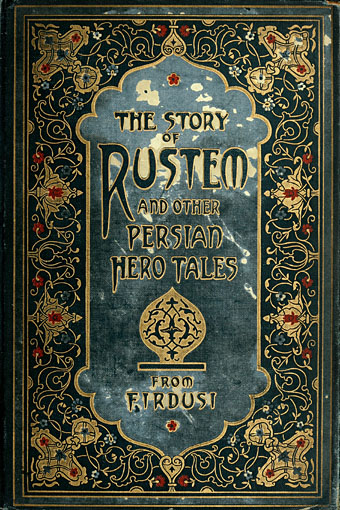
The Story of Rustem and Other Persian Hero Tales

rustem01.jpg

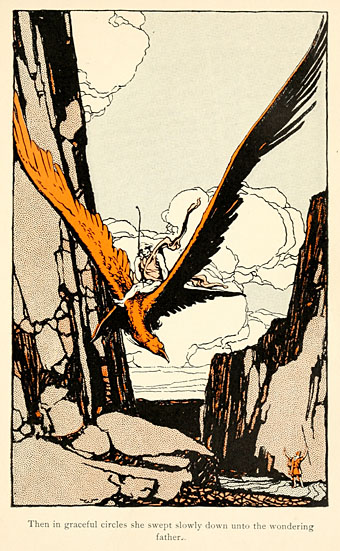
This edition of Elizabeth D. Renninger’s retelling of Persian folk tales dates from 1909, the tales in question being adapted for children from the epic poetry of Hakim Abu’l-Qasim Ferdowsi Tusi, aka Ferdowsi or Firdusi as he’s credited here. Names translated from Persian or Arabic often vary from one book to the next, and that’s the case in this volume with the heroic figure of Rostam (or Rustam) being rendered as Rustem. Likewise in the story of albino warrior Zal, the great bird he encounters, here named the Simurgh, can also be found written as Simorgh, Simurg or Simoorg which often makes searching for information about these stories (or their illustrators) difficult.

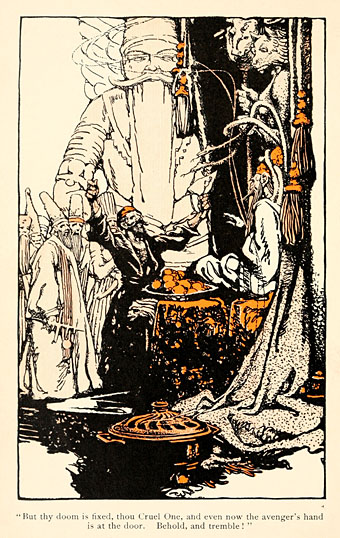
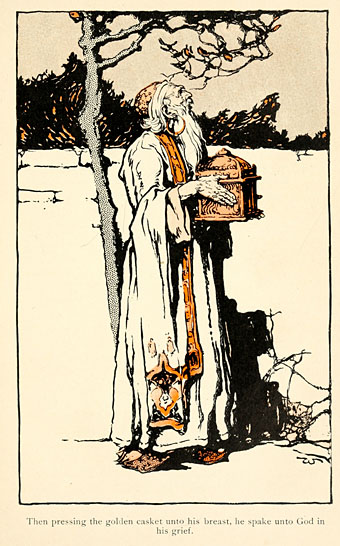
The illustrations are by JLS Williams, and it’s a shame there aren’t more of them since I like the bold style and heavy blacks. Williams is listed mostly for his magazine illustration so I can’t say whether he did any other book work. The Story of Rustem may be read online here or downloaded here. Rustem doesn’t meet the Simurgh in this collection but he did in this splendid drawing by Patten Wilson.

rustem02.jpg

rustem03.jpg

rustem04.jpg

Continue reading “The Story of Rustem and Other Persian Hero Tales”

De Profundis

deprofundis.jpg

De Profundis (2012).

The title is nothing to do with Oscar Wilde’s famous epistle from prison, but then that should be obvious looking at my latest piece of tenebrous artwork. “De Profundis” means “From the depths” which in this case is applied to another piece with a Cthulhu theme. I made a decision earlier this year that my calendar design for 2013 would comprise a collection of all my Cthulhu portraits to date, from The Call of Cthulhu on. I didn’t have 12 pictures, however, so I’m currently making up the numbers between other jobs. This is the first completed piece which steals a background from the illustrations by Alphonse de Neuville and Édouard Riou for Jules Verne’s Twenty Thousand Leagues Under the Sea (1871). The voyagers in the Nautilus encountered some fearsome creatures but nothing quite like this. I can’t say at the moment when the calendar will be ready but I’m hoping to have it finished before the end of the month.

Elsewhere on { feuilleton }
The Lovecraft archive

Weekend links 125

cme.jpg

Coronal Mass Ejection from the surface of the Sun, August 31st, 2012.

• “Most of the main parts were recorded in a single day using Vangelis’s famous technique: try to play as many synths as possible at once.” Simon Drax on the prolific musical output of Zali Krishna. The new Krishna opus is Bremsstrahlung Sommerwind, free to download at the Internet Archive.

• The Northants International Comics Expo (N.I.C.E.) opens on September 22nd. Among the many attendees there will be Mr Alan Moore making his first convention appearance since 1987.

• “Isolated for one night in a boat overlooking the Thames, Geoff Dyer explores representations of reality through the lens of Joseph Conrad’s Heart of Darkness.”

Now seems the right time to revisit this secret archive of public broadcasting. It’s an antidote to the celebrity-led, format-driven nature of so many arts documentaries made today. It shows that it’s possible to produce TV that is both populist and experimental. And it also refutes the cliché that the 1970s was a decade only of crisis and downturn. “Feminism, political theatre, Ways of Seeing: I wasn’t thinking, ‘what a terrible time’. It was very dynamic, activist, political. Creatively it was very exciting. Yet all they show on those television retrospectives are episodes of Top of the Pops.”

Sukhdev Sandhu talks to Mike Dibb, the director of Ways of Seeing.

• From 1999: Colm Tóibín reviews A History of Gay Literature: The Male Tradition by Gregory Woods.

What We See: a song by Julia Holter & Nite Jewel with a film by Delaney Bishop & Jose Wolff.

Rick Poynor on The crash test dummy: from subcultural fringes to pop culture mainstream.

In his 1973 book on Joyce, Joysprick, Burgess made a provocative distinction between what he calls the “A” novelist and the “B” novelist: the A novelist is interested in plot, character and psychological insight, whereas the B novelist is interested, above all, in the play of words. The most famous B novel is Finnegans Wake, which Nabokov aptly described as “a cold pudding of a book, a persistent snore in the next room.” The B novel, as a genre, is now utterly defunct; and A Clockwork Orange may be its only long-term survivor.

Martin Amis on A Clockwork Orange, fifty years on. My old post about the film’s record shop scene continues to be one of the most popular pages here.

• Wild Boys: David Bowie and William Burroughs in 1974, hand-coloured by DB.

Alfred Kubin‘s illustrations for Haschisch (1902) by Oscar AH Schmitz.

• Revolution off: industrial ruins photographed by Thomas Jorion.

• Tetrahedra of Space: 22 pulp illustrations by Frank R. Paul.

The Blue Boy Studiolo: a Tumblr.

Marina Warner visits Hell.

• The art of Casey Weldon.

RainyMood.com

Third Stone From The Sun (1967) by The Jimi Hendrix Experience | Sunrise In The Third System (1971) by Tangerine Dream | 3rd From The Sun (1982) by Chrome.

Skull, 1983

skull.jpg

Mention yesterday of pencil drawing prompted me to dig out this item from one of my old portfolios. It was drawn shortly after I was given a somewhat battered human skull by a student nurse (hello, Victoria, wherever you are), an object I sketched on a number of occasions before eventually making it into the finger-slashing fetish object below which appeared recently in the The Thackery T. Lambshead Cabinet of Curiosities. The drawing dates from 1983—I remember listening to the Art of Noise EP Into Battle whilst working—and it’s unusual for me in showing the drawn object alone on a sheet of paper with no attempt made to place it in a scene. It’s also a slightly misjudged rendering; this ink drawing from a year later shows a more careful representation of the skull’s proportions, spoiled a little by the pointless and unconvincing seascape I placed behind it.

skull2.jpg