Man is the Animal: A Coil Zine

coil.jpg

Death is centrifugal / Solar and logical / Decadent and symmetrical / Angels are mathematical / Angels are bestial / Man is the animal —Fire Of The Mind by Coil

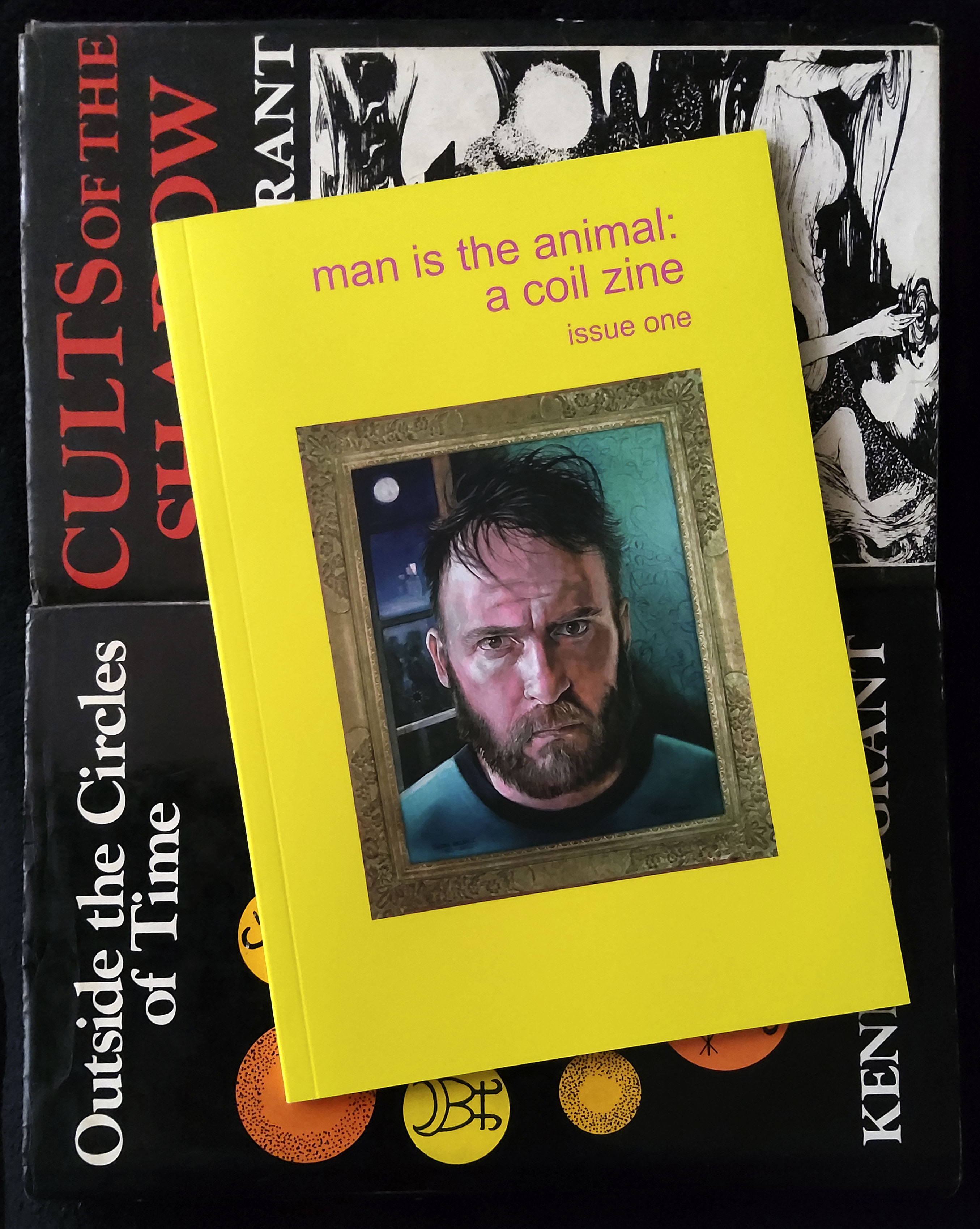
In the post this week from Temporal Boundary Press, issue 1 of Man is the Animal: A Coil Zine. A timely publication, given the persistent and increasing interest in Coil, and one whose essays are all of a quality belied by the “zine” label which usually suggests something more fannish and trivial. This is a pleasing object even before you look inside, a perfect-bound A5 booklet with full-colour printing throughout, and a cover painting by Val Denham, an artist with Coil associations that reach back through the Some Bizzare period to art for Marc Almond and Throbbing Gristle. Denham also contributes one of the written pieces, Jhonn is Unbalanced, a touching memoir of Geoff Rushton/John (Jhonn) Balance. Among the other entries is a piece by Benjamin Noys, a writer whose previous studies have included an examination of the connections between my own art for the Reverbstorm comic series and the weird fiction of HP Lovecraft. Noys takes a similar approach here, finding reflections of Coil obsessions in the symbolism of alchemical magic and the weird fiction of Arthur Machen.
grant.jpg

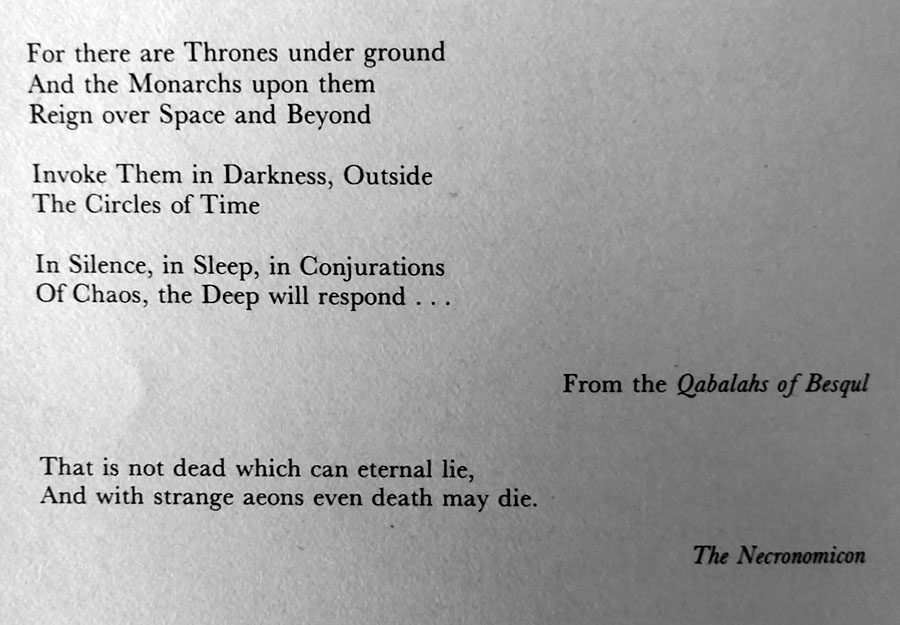
Epigraph from Outside the Circles of Time by Kenneth Grant.

The weird fiction of HP Lovecraft was a Coil obsession, and Lovecraft receives the most attention in a great piece by Andy Sharp which takes its cue from the appearance in Titan Arch of lines from the epigraph for Outside the Circles of Time, an occult study by magus and scholar Kenneth Grant. The latter was another Lovecraft obsessive—no doubt one of the first, given his age—whose books are littered with references to both Lovecraft and Machen. I spotted the Coil/Grant connection many years ago (although quite some time after Love’s Secret Domain was released), and acknowledged the link in two pages in The Haunter of the Dark, one of which reprints Grant’s epigraph, while the other is a picture with the title In Spaces Between, a line from Titan Arch which is also a reference to the Necronomicon extract in The Dunwich Horror: “The Old Ones were, the Old Ones are, and the Old Ones shall be. Not in the spaces we know, but between them, they walk serene and primal, undimensioned and to us unseen.” Sharp does more than merely acknowledge this web of connections, he delves into Grant’s dense treatise in search of further correspondences. I’ve not read Grant’s book for many years but this essay makes me think I ought to look at it again. By coincidence (or is it? etc), both Love’s Secret Domain and Outside the Circles of Time have been reissued this year, the Grant book by Starfire Publishing.

Contents:
The Vision and the Voice: Esoteric Dimensions of Coil’s Vocals by Hayes Hampton
A Hauntology of Coil by Sean Oscar
Are You Loathsome Tonight?: Coil’s Transformations by Benjamin Noys
The Horseman Betrays His Steed by Cormac Pentecost
The Spaces Between: Outside the Circles of Time and Love’s Secret Domain by Andy Sharp
Jhonn is Unbalanced by Val Denham

Previously on { feuilleton }
Dreaming Out of Space: Kenneth Grant on HP Lovecraft
Peter Christopherson Photography & The Art of John Balance Collected
The White People by Arthur Machen
Val Denham album covers
Kenneth Grant, 1924–2011
Peter Christopherson, 1955–2010
The Angelic Conversation

The Devourer Below

devourer.jpg
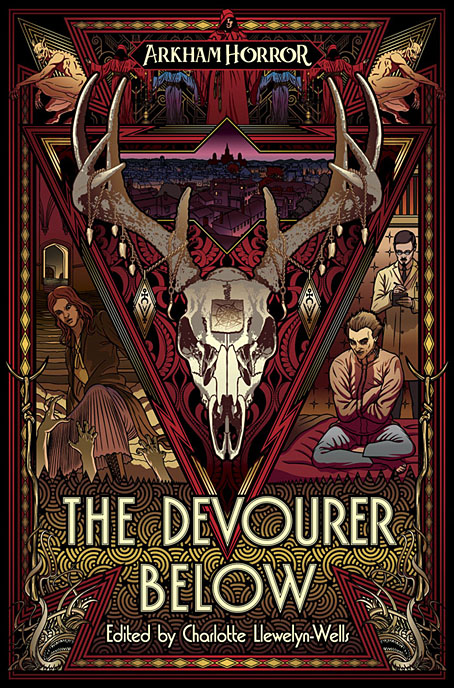
Another week, another cover design. This is the third cover of mine for the Arkham Horror line from Aconyte Books, a fiction series which complements the Lovecraftian Arkham Horror game:

Something monstrous has come to Arkham, Massachusetts. There have always been shadows here, but now a new hunger has risen from the depths and threatens those who dwell here. But there are heroes too—people who stand up and fight to stem the tide, even when it costs them everything. Explore eight shocking new tales of occult horror, captivating mystery, and existential fear—from a zealous new heroine to conniving cultists, bootleg whiskey to night terrors, and fiends that crawl from open graves. A nightmare has fallen across Arkham, and it will devour all.

As with the earlier titles I’ve worked on, The Last Ritual and Litany of Dreams, the general style is Art Deco in keeping with the period in which the game and the stories are set. The new cover worked out especially well thanks to the brief which suggested extending the triangle that appears on the previous covers so that it became a frame for a deer skull bedecked like a ritual artefact. This created a little more space for the requisite character panels, the figures here being an underworld investigator and a lycanthropic asylum inmate, both of whom feature in the game. The brief also requested that Arkham be represented somewhere, so I spent a lot of time drawing a view over the gambrel rooftops of the haunted town, only to shrink the panel down to a size which loses much of the detail. It may be a miniature view but it’s like one of those special effects shots you see in a film, something you know must have taken a lot of work to achieve but which is only visible for a few seconds; a minor presence that adds to the texture of the whole. And the view of nocturnal architecture provides a further link with the previous covers.

The Devourer Below will be available in ebook and US paperback in July, with a UK paperback following in September.

Elsewhere on { feuilleton }
The Lovecraft archive

Previously on { feuilleton }
Litany of Dreams
The Last Ritual

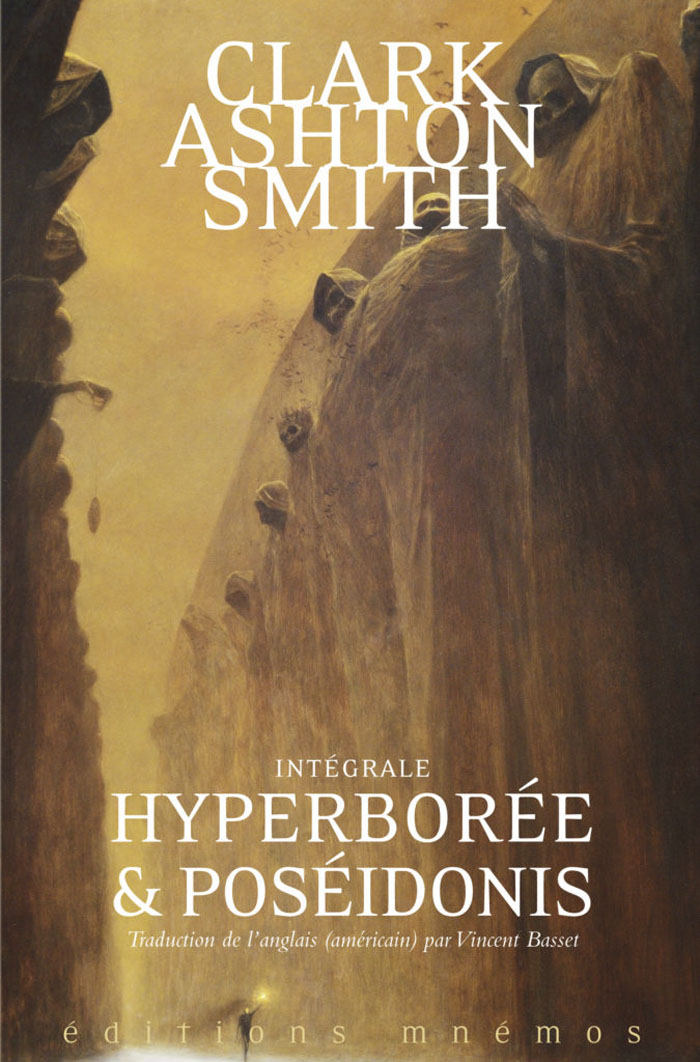
Beksiński at Mnémos

mnemos2.jpg

More book covers. Mnémos is a French publisher of horror, fantasy and science fiction some of whose recent titles have their covers filled with paintings by the great Polish artist Zdzisław Beksiński. The pairings of book and picture aren’t always ideal but I appreciate the impulse to choose art from other sources than genre artists. Omni magazine adopted a similar approach in its early issues, matching stories and science features with paintings by artists who are often grouped together as Fantastic Realists: Mati Klarwein, Ernst Fuchs, HR Giger, Bob Venosa, De Es Schwertberger and others. Beksiński’s work was less visible in the late 1970s than that of his contemporaries but one of his (always untitled) paintings did appear in a 1993 issue of the magazine.

mnemos1.jpg

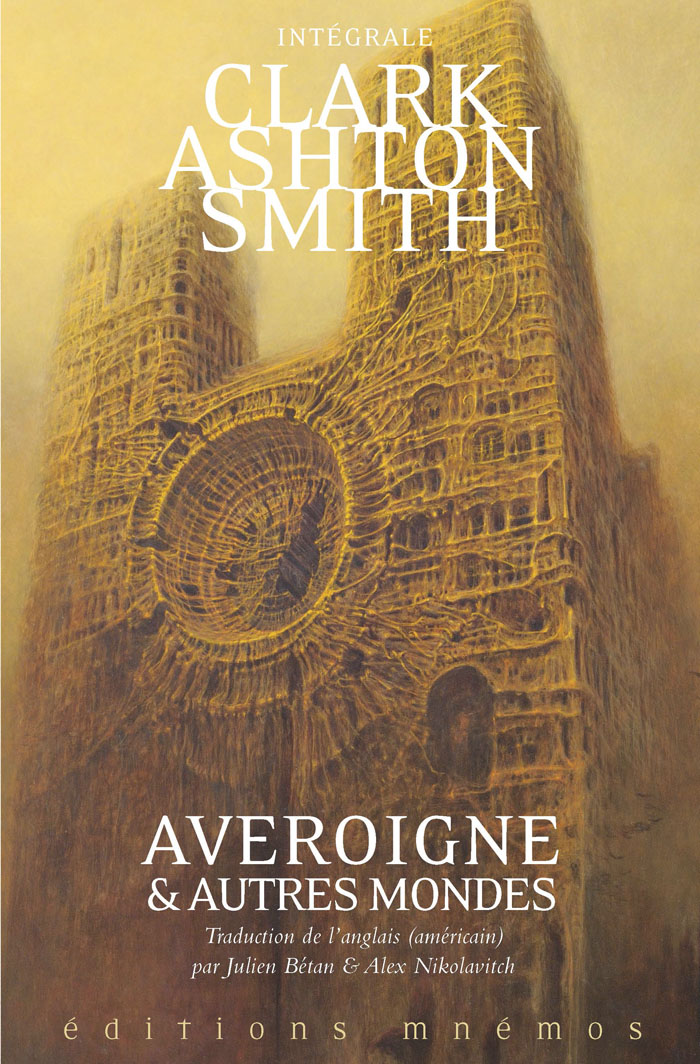
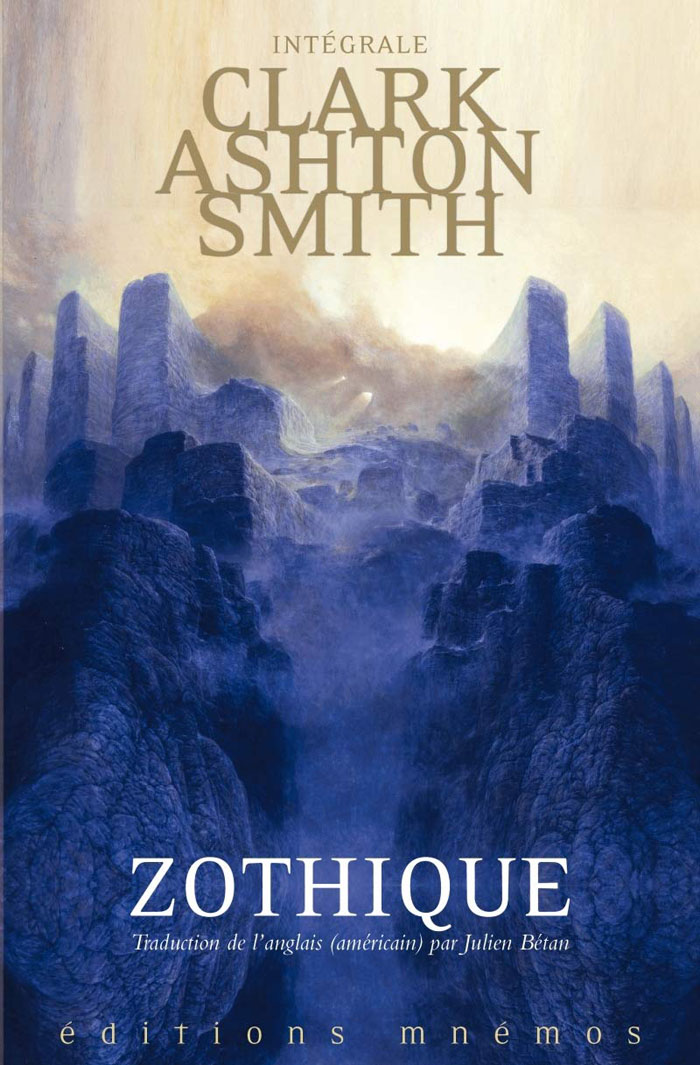
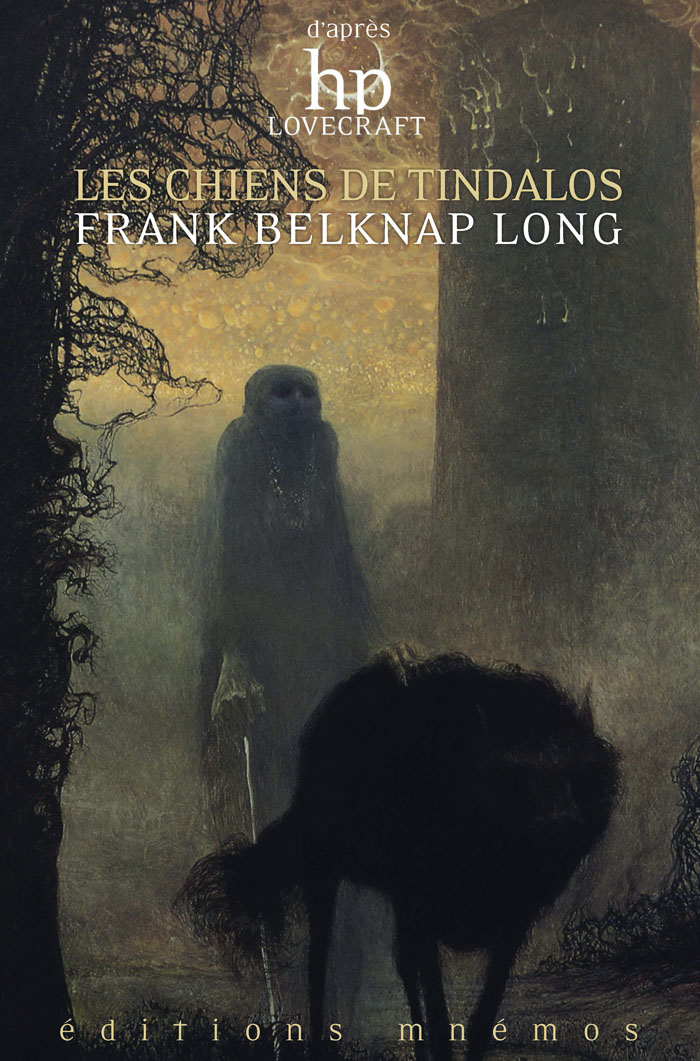
Of the Mnémos covers the one for the collection of Averoigne stories by Clark Ashton Smith is the most immediately fitting, Averoigne being an invented region of France that suits a painting of a Gothic cathedral turned fibrous and fungal. The painting for Zothique, on the other hand, could easily be used for HP Lovecraft’s At the Mountains of Madness, while the dog-like creature on the cover of the Frank Belknap Long collection is nothing like the author’s trans-dimensional hounds. Mnémos have given Lovecraft his own Beksiński covers in a seven-volume collection of translated fiction, Lovecraft, l’intégrale prestige, but there doesn’t seem to be a page anywhere that shows the individual books.

mnemos4.jpg

What the artist would have made of all this attention may be gauged by comments like this one from The Fantastic Art of Beksiński (1998): “Meaning is meaningless to me. I do not care for symbolism, and I paint what I paint without meditating on a story.”

mnemos3.jpg

For more about the anti-symbolist, see The Cursed Paintings of Zdzisław Beksiński by Marek Kepa.

Elsewhere on { feuilleton }
The book covers archive
The fantastic art archive

Previously on { feuilleton }
Cosmic music and cosmic horror

Ghost Box and The Infinity Box

yuggoth.jpg

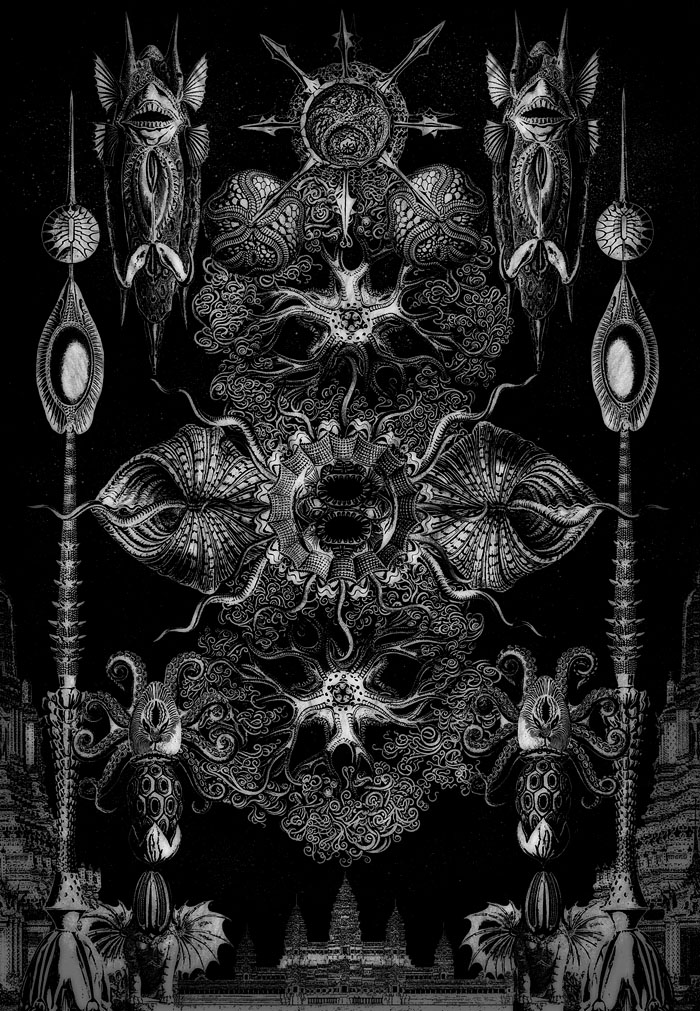
It’s less of a surprise than it may seem to go searching for the source of a quote only to find yourself immediately faced with one of your own artworks. The posts here go back almost 15 years, and when so many of them cover niche interests any attempt to further explore a particular niche can circle back to something I’ve already posted. The latest example is an unusual one, however. The picture above is the Haeckel collage I created for the Starry Wisdom collection of Lovecraftian fiction in 1994, a piece that was later digitally refashioned for The Haunter of the Dark book. The quote I was pursuing is as follows:

“Inside the infernal box are impossible spaces, dark screens and mirrors, terrible traces of light, calcified thought forms and endless idiot mutterings. The switch is thrown and the magnetic coils begin to generate their obscene flickering images. This contraption might have been conceived by the Old Ones long before it was assembled by human hands.”
—The Infinity Box, Alan Causley & MB Devot

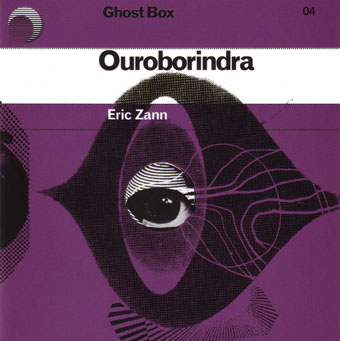
The description appears together with a dialogue extract from Nigel Kneale’s The Stone Tape on the fourth Ghost Box release, Ouroborindra (2005) by Eric Zann, a one-off album of spooky sample soundscapes created by a pseudonymous Jim Jupp in between his Belbury Poly albums. All the Ghost Box releases feature significant quotes, most of which are genuine extracts from stories, novels, non-fiction works, etc. The description of the Infinity Box raised my suspicion about its authenticity when the only references to either it or Causley and Devot are in listings for the Eric Zann album. My Yuggoth collage appears on this page which further compounds the confusion by making it seem that my art is somehow connected to Causley and Devot and their mysterious box. This isn’t a complaint but it doesn’t help clarify the situation. Alan Causley has no credits anywhere outside the quote but there is another Causley, the celebrated poet, Charles, whose poems are sampled on later Ghost Box releases by The Focus Group, aka Ghost Box co-founder Julian House. Scrutiny of the other Ghost Box albums reminded me that quotes from MB Devot’s writings appear elsewhere on the early releases but I hadn’t bothered to look up the name until now.

ouroborindra.jpg

It’s often the case with posts such as this that mild curiosity turns into deeper intrigue. The web of connections becomes more tangled on the first Ghost Box release, Sketches And Spells by The Focus Group, which has a Devot quote from a text with the apt title The Tangled Beams, and a final track with the title Starry Wisdom. Devot is described by reviewers as either a fictional writer or an authentic scholar, the latter designation being supported by a Wikipedia page. Wikipedia may be prone to errors but it isn’t known for fake entries so this was a surprising discovery; Devot is also referenced on the page for parapsychologist TC Lethbridge who happens to be another source of Ghost Box quotes. Suspicion returns when you try to search for any of Devot’s listed publications, none of which turn up in WorldCat or similar catalogues. One of the Wikipedia print sources is an issue of Fortean Times from 1989 but there’s nothing about Devot listed in the contents of that issue. Issue 53 was a crop circle special, however, so it certainly fits the Ghost Box interest in the paranormal as it manifests in the British countryside. We now know that crop circles were man-made, not the product of flying saucers or other phenomena, so this may be fitting as well.

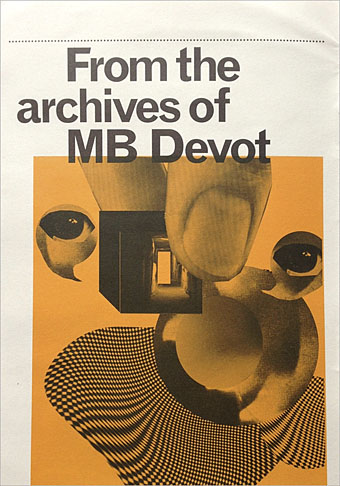
devot.jpg

I would have left the search there but I did find one further Devot connection that I might otherwise have missed. Folklore and Mathematics is the title of a one-off Ghost Box periodical published in 2007 for people subscribed to the label’s mail order service. It’s a typically fine Julian House artefact that complements the Sketches And Spells album in both its title and its graphics. Inside we find “From the archives of MB Devot”, and discover another reference to the Infinity Box. Apparently the black-and-white graphics that cover all the early Ghost Box discs are vibration patterns—”verberations”—created by Devot’s occult apparatus.

otherwhere.jpg

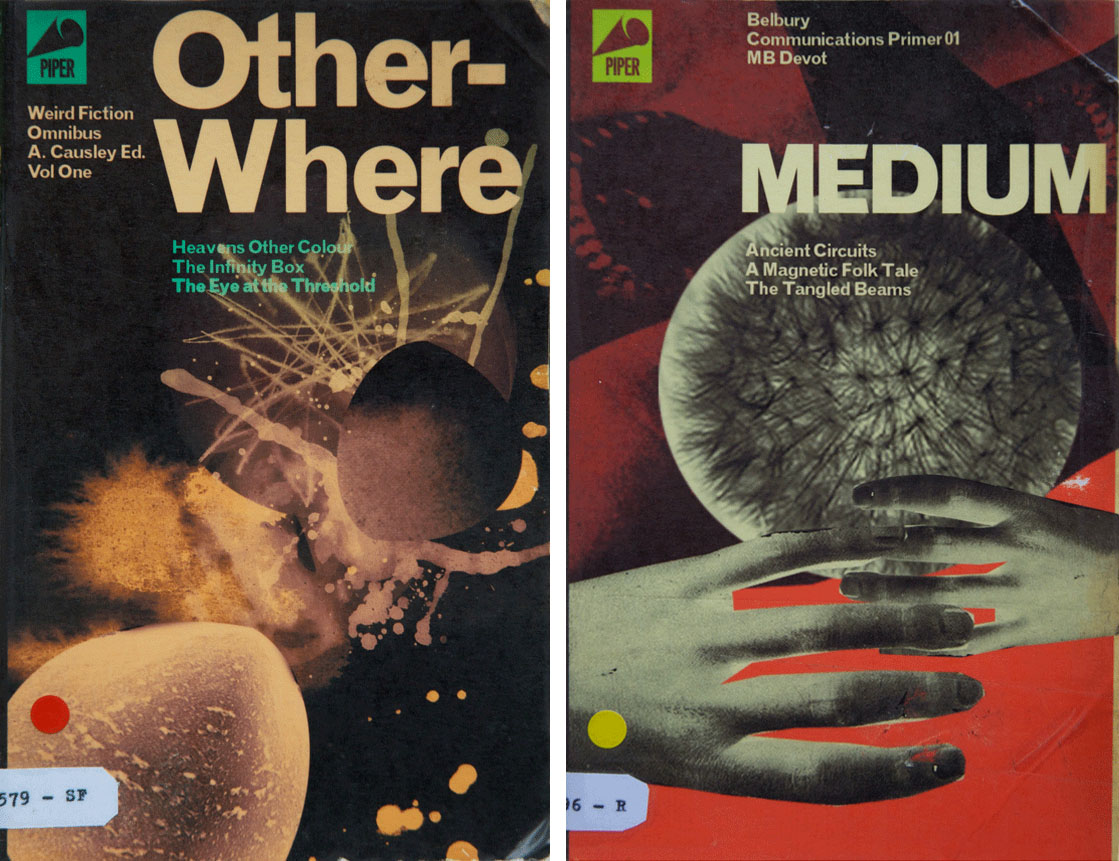
I wrote above that “any attempt to further explore a particular niche can circle back to something I’ve already posted” so I wasn’t too surprised to have all these explorations finding their way back here. In 2009 Julian House exhibited three invented books as part of The New Spirit Happening, an exhibition of Ghost Box-related work at the Architect’s Gallery in Teddington. I posted two of the covers after the exhibition but couldn’t recall who the books were credited to. The authors are—inevitably—”A. Causley” and “MB Devot”, and the volumes feature by-now familiar phrases: “The Tangled Beams”, “The Infinity Box”. Also more Lovecraftian verberations: “Heavens Other Colour”, “The Eye at the Threshold”. So Causley and Devot have been lurking here for the past decade, in which case having my artwork attached to their names no longer seems like an arbitrary association. “Inside the infernal box are impossible spaces, dark screens and mirrors…”. Indeed there are.

Previously on { feuilleton }
Unearthly tones
Owls and flowers
The White People by Arthur Machen
Stone Tapes and Quatermasses
The Ghost Box Study Series
A playlist for Halloween: Hauntology
Forbidden volumes
The Séance at Hobs Lane
Ghost Box

Cosmic music and cosmic horror

hyperborea.jpg

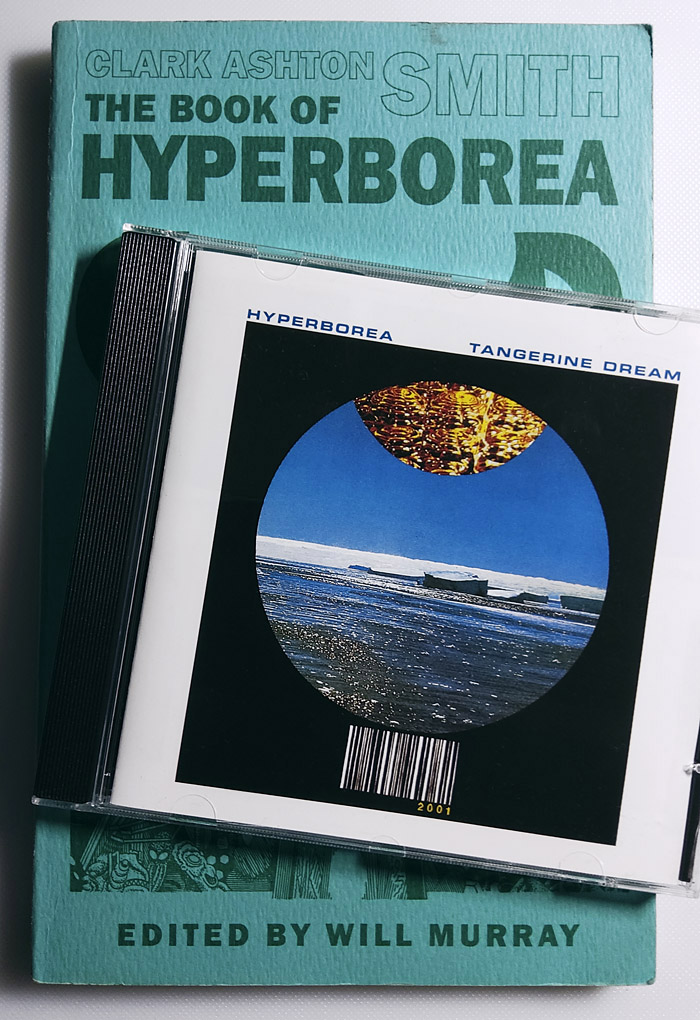
Track titles by Tangerine Dream (again) if they were stories or chapters in a book of weird fiction:

– Alpha Centauri
– Ultima Thule
– Origin Of Supernatural Probabilities
– Mysterious Semblance At The Strand Of Nightmares
– Sorcerer
– Abyss
– Stratosfear
– Choronzon
– Remote Viewing
– Hyperborea

Clark Ashton Smith’s tales of the northern continent of Hyperborea were Cthulhu Mythos fantasies with a sardonic CAS twist. The connection with Tangerine Dream is most likely coincidental, the name being one that Smith borrowed rather than invented, but I enjoy the intersection all the same. The title of TD’s first single, Ultima Thule, refers to another remote northern realm. If you’re reaching for associations, as I invariably am, then it’s also worth mentioning Haunted Island by an affiliated group, Agitation Free. The last track on their 2nd album features a partial recitation of Dream-Land by Edgar Allan Poe that includes the words “from some ultimate dim Thule”; the keyboard player in Agitation Free was Michael Hoenig who was briefly a member of Tangerine Dream in 1975. As for Choronzon, this was a demon that Aleister Crowley claimed to have tangled with in the Algerian desert in 1909. The malevolent and chaotic nature of the entity, together with its unavoidably Lovecraftian epithet of “the Dweller in the Abyss”, places it close to the Mythos god of “nuclear chaos”, Azathoth, although the music that bears the Dweller’s name doesn’t convey any of these qualities. Tangerine Dream’s Choronzon is an uptempo piece of electro-pop that Virgin optimistically released as a single in 1981. For a group with a long history of eccentric title choices this maybe isn’t so surprising.

soundtracks.jpg

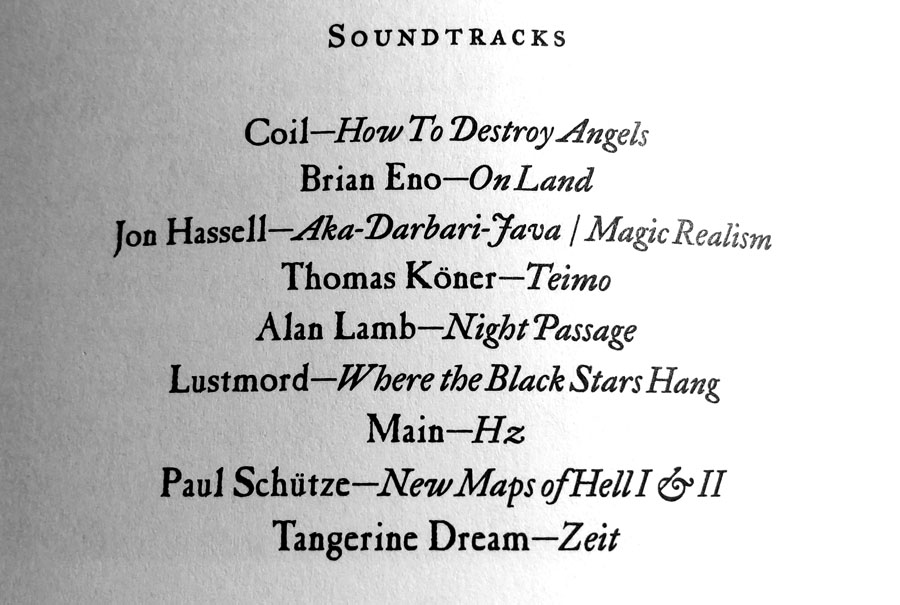
Tangerine Dream feature on another cosmic-horror music list that I suggested as soundtracks for The Haunter of the Dark in 1999. (The Lustmord somehow lost a couple of words from its title.) Most of these are drone works, and several were released after I’d drawn most of the pages, but I was listening to Zeit and Rubycon during many late-night work sessions, the latter especially while drawing The Call of Cthulhu. Discovering weird fiction and spacey electronica simultaneously caused the two things to become inextricably connected, and besides which there wasn’t much else to be found in the music world of the late 1970s that complemented such stories to the same degree. Rubycon offered satisfying associations, from the liquid green of the cover art (Cthulhu always suggests the colour green), to the predominantly sinister, minor-key music within. When the sequencers in Rubycon: Part 2 give way to the sounds of waves breaking on a shoreline this only reinforces the suitability of the album as a Cthulhoid soundtrack.

space.jpg

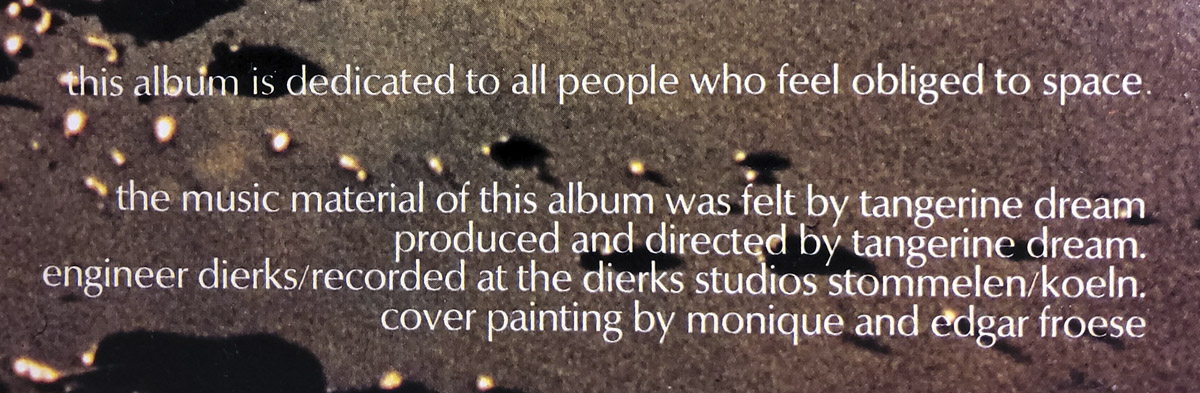
The dedication from Alpha Centauri as printed in the Virgin double-disc reissue with the Atem album. It’s never been clear whether the “space” referred to is a noun or a verb.

If you’re looking for cosmic-horror soundtracks today then you’re spoiled for choice, there are numerous examples, from the general—the occulted universe of Dark Ambience—to the very specific. I enjoy the drones, obviously, but the Berlin School still has something to offer so long as the key remains a minor one and the titles avoid New Age vapidity. See this mix for further examples.

Previously on { feuilleton }
Tangerine Dream in concert
Drone month
Pilots Of Purple Twilight
Synapse: The Electronic Music Magazine, 1976–1979
A mix for Halloween: Analogue Spectres
Edgar Froese, 1944–2015
Synthesizing
Tangerine Dream in Poland
Hodgsonian vibrations
White Noise: Electric Storms, Radiophonics and the Delian Mode