Weekend links 212

non-format.jpg

Poster for the recent Ballard-themed Only Connect Festival of Sound in Oslo. Design by Non-Format.

Bulldozer by Laird Barron was my favourite piece in Lovecraft’s Monsters, the recent Tachyon anthology edited by Ellen Datlow that I designed and illustrated. So it’s good to hear that Nic Pizzolato, writer of the justly-acclaimed HBO series True Detective, is among Barron’s readers. True Detective, of course, created a stir for referencing Robert Chambers’ weird fiction in a police procedural. The series is out now on DVD and Blu-ray, and I can’t recommend it too highly.

• Citation-obsessed Wikipedians don’t believe Hauntology is a genuine musical genre, a sentiment which will probably surprise some of its practitioners. Whatever the merits of the argument, I rather like the idea of a musical form that resists strict definition.

• “This year, in order to do things differently, I will make a conscious effort to separate the man from his writing.” Giovanna Calvino, daughter of Italo Calvino, remembers her father.

With ideology masquerading as pragmatism, profit is now the sole yardstick against which all our institutions must be measured, a policy that comes not from experience but from assumptions – false assumptions – about human nature, with greed and self-interest taken to be its only reliable attributes. In pursuit of profit, the state and all that goes with it is sold from under us who are its rightful owners and with a frenzy and dedication that call up memories of an earlier iconoclasm.

Alan Bennett delivers a sermon.

Zarina Rimbaud-Kadirbaks, aka Dutch Girl In London, reviews the Chris Marker exhibition that’s currently running at the Whitechapel Gallery, London.

• Exteriorizing the Inner Realms: Christopher Laursen talks to Phantasmaphile and Abraxas magazine‘s Pam Grossman about occult art, past and present.

• The Beast is back: Erik Davis talks to Gary Lachman about his new book, Aleister Crowley: Magick, Rock and Roll, and the Wickedest Man in the World.

• The body as factory: anatomy of a New Scientist cover image. Rick Poynor on the recurrent use of a familiar visual metaphor.

• Mix of the week without a doubt is FACT Mix 445 by Stephen O’Malley, a three-hour behemoth.

• Jennifer in paradise: Photoshop developer John Knoll on the story of the first Photoshopped image.

• The trailer for Grandfather of Gay Porn, a documentary about Peter de Rome by Ethan Reid.

Giorgio’s Theme is a new piece of electronic music by Giorgio Moroder.

Agender, a series of androgynous photo-portraits by Chloe Aftel.

• RIP Little Jimmy Scott

Evil Spirits

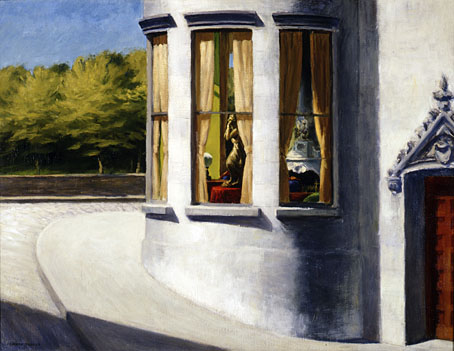
Chase (1978) by Giorgio Moroder | Call Me (1980) by Blondie | The Apartment (1980) by Giorgio Moroder

June

june10.jpg

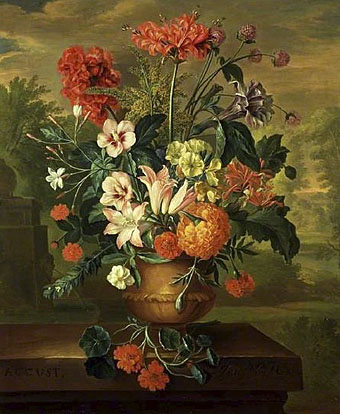
Twelve Months of Flowers: June (no date) by Jacob van Huysum.

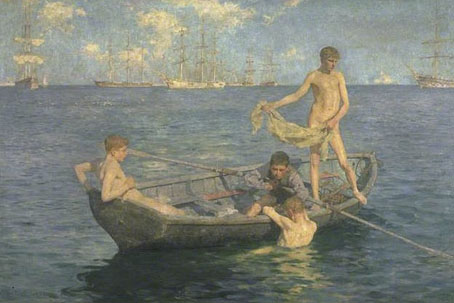
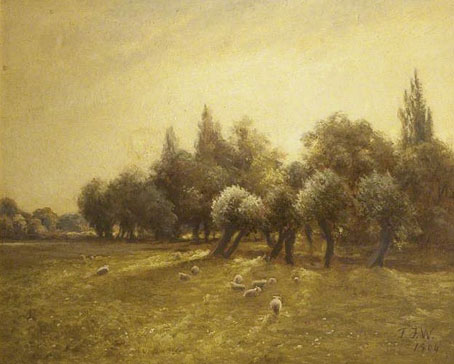
The month of June in paintings is overburdened by bland pastoral scenes and views of battles, the summer months being favourable ones for warfare. Pastoral content is still present in the following selection albeit with an attempt to show some variety. Leighton’s Flaming June is the most famous picture here. It’s also the most popular of the artist’s paintings, understandably so given its radiating an atmosphere of luscious (and possibly inadvertent) eroticism that he seldom achieved elsewhere.

june03.jpg

From Croham Fields, Croydon, Surrey, Just before the First Thunderstorm, Tuesday 28 June 1892 (1892) by William Henry Hope.

june07.jpg

June in the Austrian Tyrol (1892) by John MacWhirter.

june02.jpg

Flaming June (1895) by Frederic Leighton.

Continue reading “June”

Victor Vasarely album covers

vasarely05.jpg

Terretektorh / Nomos Gamma (no date; late 60s) by Iannis Xenakis.

Xenakis and Victor Vasarely are paired again on this album cover from the late 1960s. Given how often record companies have used abstract artwork on the sleeves of classical recordings, especially those by 20th-century composers, you’d expect there to be more examples. There may well be but Discogs (always the easiest place to search) only turns up the following examples.

vasarely01.jpg

Chamber Concerto For 11 Instruments / Symphonic Variations (no date) by
Neils Viggo Bentzon / The Royal Danish Orchestra conducted by Jerzy Semkow.

vasarely04.jpg

Kontakte For Electronic Sounds, Piano And Percussion / Refrain For Three Instrumentalists (1968) by Aloys Kontarsky, Christoph Caskel, Karlheinz Stockhausen.

vasarely06.jpg

David Bowie (1969) by David Bowie.

I confess that until I began searching for Vasarely covers I hadn’t known that this was an early example. That’s partly down to David Bowie’s second album (the first in his official canon) having been reissued for years in a different cover with Bowie’s face filling the sleeve. The album reissues in 1999 restored the original design, one of the artist’s Folklore Planetaire series. The credit is to “Vaserelli”.

Continue reading “Victor Vasarely album covers”

Vasarely, a film by Peter Kassovitz

vasarely.jpg

I’ve always liked Victor Vasarely’s brand of Op-Art so this short film from 1960 would be of interest even without the addition of a score, Neg-Ale, by Iannis Xenakis. Considering the stature of the composer the music fails to add much at all so it’s no surprise to read at Ubuweb that Xenakis later withdrew it from his catalogue. Kassovitz’s film is worth watching for Vasarely’s artworks, however, especially some three-dimensional creations I hadn’t seen before.

Previously on { feuilleton }
Escher and Schrofer

The art of Fay Pomerance, 1912–2001

pomerance1.jpg

The Sixth Palace of Hell (1945).

Fay Pomerance’s painting of Lilith makes a startling appearance in a book I have about the history of magic symbols, and it’s that appearance which prompts this post since I’ve never seen her work given any attention elsewhere. This seems surprising when women artists, and artists whose concerns encompass mysticism or the occult, are receiving greater attention than ever before.

pomerance2.jpg

The Union of Isis and Osiris (1959).

Pomerance was British, and had the misfortune to be working during a lengthy period when expressions of the imagination or unorthodox spirituality in visual art were regarded as suspect or even disreputable. Her work also stands apart from any of the prevailing movements which provide such convenient labels for those art critics and writers who dislike anything that won’t fit into one of their boxes. The Lilith picture shows an obvious debt to another British artist who stands apart from the crowd: William Blake. The BBC’s Your Paintings site has a few of Pomerance’s larger works from the collection at Durham University, including the Sphere of Redemption below which is painted on a fibreglass globe, but for the moment there isn’t a dedicated site representing her art.

pomerance3.jpg

The Temptation (date unknown).

pomerance4.jpg

The Sphere of Redemption (date unknown).