Steinlen’s cats

steinlen1.jpg

Chat Noir poster (1896).

We had Louis Wain yesterday so it only seems right to follow with the other notable cat artist of the period, and also the one whose work I prefer, Théophile Alexandre Steinlen (1859–1923).

Steinlen’s designs for the Montmartre cabaret, Le Chat Noir, of which there are many variations, are dismayingly ubiquitous in contemporary Paris, so much so that you quickly tire of his haloed feline when wandering the streets. Parisians regard Steinlen’s posters the way Londoners regard pictures of Beefeaters; they’re part of the background noise of the capital city, intended solely for tourists. A shame because it really is a splendid cat.
steinlen2.jpg

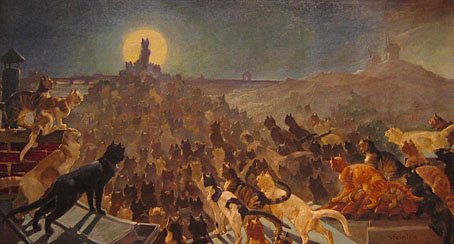
The Apotheosis of the Cats (c. 1890).

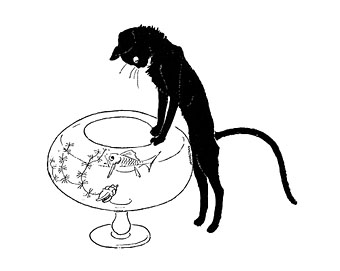
Steinlen’s cat pieces run the gamut of styles and variations, from delicate life studies and bronze sculptures to works such as the three-metres wide mural above depicting the advent of some ultimate feline deity. Among his many drawings he produced a number of marvellous cartoon sequences like the one below featuring cats fighting, playing and generally getting into trouble. Some of these can be found on Flickr here and here.

For more Steinlen, including his non-feline works, there’s Steinlen.net.
steinlen3.jpg

The End of a Goldfish.

Elsewhere on { feuilleton }
The illustrators archive

Previously on { feuilleton }
Louis Wain at Nunnington Hall
The Boy Who Drew Cats
8 out of 10 cats prefer absinthe
Monsieur Chat

David Trautimas

trautimas.jpg

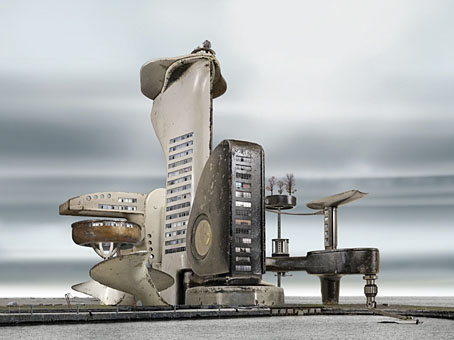
The Fishing Complex (2008).

Canadian artist David Trautimas re-purposes household and other objects into fantasy buildings by exaggerating their scale then montaging them into landscapes. This example is from his Habitat Machines series; there’s also an Industrial Parkland series. Many of the former group are pleasantly convincing, and their weathered appearance adds to the impression of having discovered the works of a lost Modernist architect. Some of these are like digital equivalents of paintings by Arnau Alemy.

Via Things Magazine.

Previously on { feuilleton }
The art of Arnau Alemany

The art of Julien Champagne, 1877–1932

champagne1.jpg

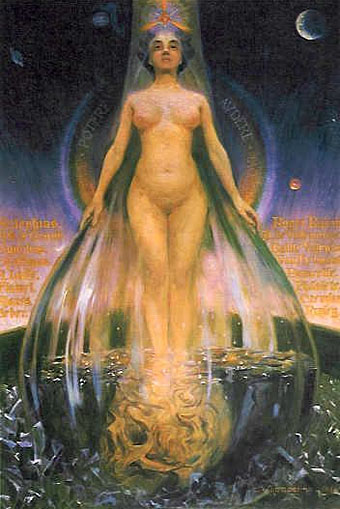
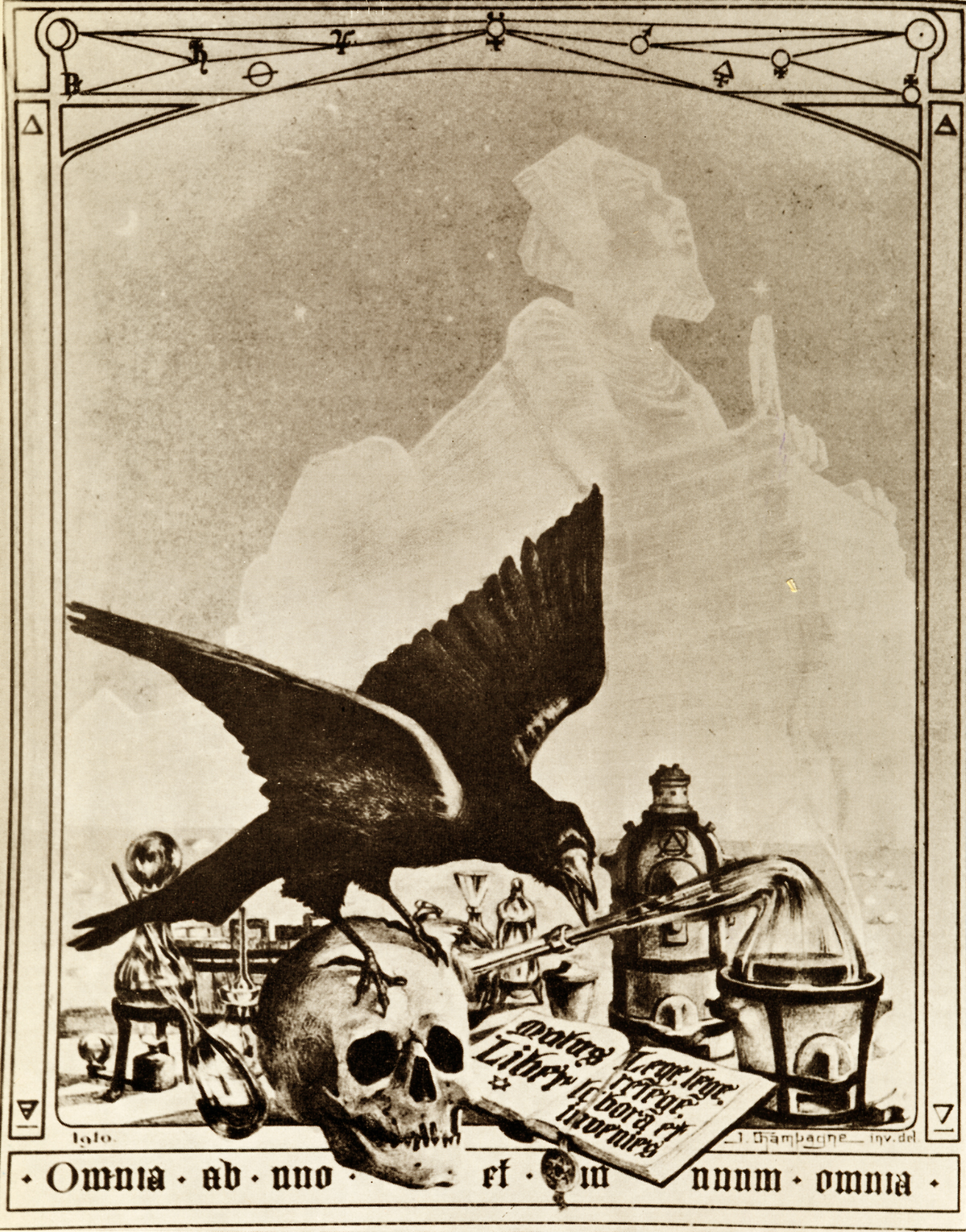
An obscure occult artist even among catalogues of obscure occult artists, Julien Champagne (also listed as Jean-Julian) is known principally for his associations with the persistently elusive 20th century alchemist Fulcanelli. Champagne provided a frontispiece (below) for Fulcanelli’s examination of architectural symbolism, Le Mystère des Cathédrales (1926), and is continually rumoured to have been Fulcanelli himself. Whatever the solution to that mystery, the alchemist’s book is rather more visible than the artist’s distinctly Symbolist paintings. There’s a French blog devoted to his life and works here but little else around. I wouldn’t mind seeing a decent online gallery of his pictures at some point.

champagne2.jpg

Previously on { feuilleton }
Digital alchemy
The art of Pamela Colman Smith, 1878–1951
The art of Andrey Avinoff, 1884–1949
The art of Cameron, 1922–1995
Austin Osman Spare

Layered Orders: Crowley’s Thoth Deck and the Tarot

magus.jpg

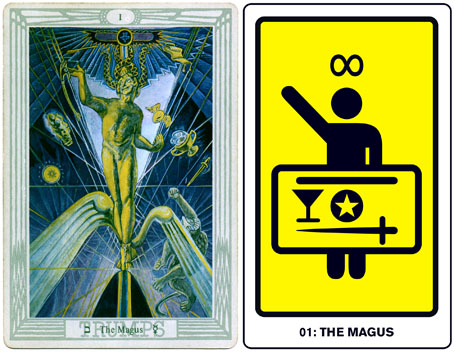
left: The Magus from the Thoth Tarot by Frieda Harris and Aleister Crowley (1938–1940?); right: The Magus from The Major Arcana by John Coulthart (2006).

Phantasmaphile presents another magickal art event in NYC next week. Layered Orders: Crowley’s Thoth Deck and the Tarot is described as “a personal narrative by Jesse Bransford”, an artist with a very distinctive approach to traditional occult symbolism. Bransford’s talk will focus on the peerless Thoth Tarot deck which Frieda Harris painted over several years under the careful direction of Aleister Crowley. The Thoth deck for me is still the ultimate Tarot deck. Crowley and Harris sought to create a Tarot for the 20th century, throwing out much of its tired and degraded iconography. This they replaced with dramatic interpretations which brought new layers of symbolism to the cards—including references to contemporary science—and also acknowledged the developments of Cubism and Futurism in the visual sphere. Tarot decks have proliferated since the 1960s but the Thoth deck has few (if any) rivals. I made use of Crowley’s controversial reordering and renaming of the cards in 2006 when I produced my set of Major Arcana designs based on international symbol signs.

The Tarot in general and Aleister Crowley’s Thoth Tarot in particular represent a miasmic confluence of image and thought into a single structure that is both liberating and overwhelming in its scope. In creating the deck, Crowley (in collaboration with painter Lady Frieda Harris) sought to integrate the mythological structures of the major mystical systems of both Western and Eastern occult traditions and to bring them into line with contemporary scientific thinking. The symbolism of the cards blends Kabbalah, Alchemy, Astrology, Egyptian mythology, quantum physics and even the I-Ching in ways that are at the same time clear and utterly confounding.

In an image-soaked personal narration Bransford, whose research-based artwork has delved into many of the territories Crowley sought to unify, will discuss some of the basic concepts of Tarot symbolism, returning to Crowley’s deck as among the most total example of the cards’ syncretism and as the most controversial.

Layered Orders: Crowley’s Thoth Deck and the Tarot takes place at Observatory, 543 Union Street, Brooklyn, NYC on Friday, July 17 at 7:30pm. Admission is free and there are further details at the Observatory website and Phantasmaphile.

Previously on { feuilleton }
Fata Morgana: The New Female Fantasists
Aleister Crowley on vinyl
The Man We Want to Hang by Kenneth Anger
The art of Cameron, 1922–1995