The Magic Art of Jan Švankmajer

svankmajer1.jpg

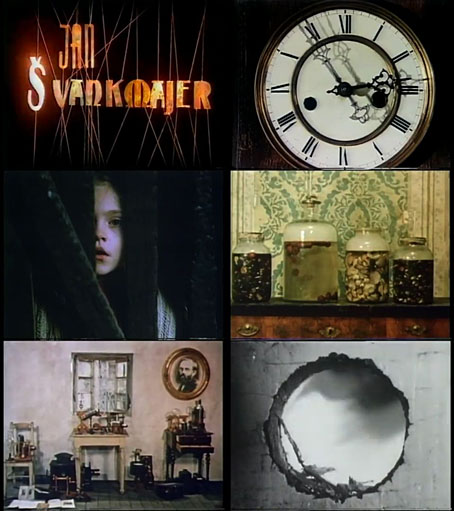
Three years ago I binged on all the Jan Švankmajer feature films after buying the box of blu-rays released by the director’s Athanor company. Once I’d worked my way through that lot, and rewatched the BFI collection of Švankmajer’s short films, I went through all the documentaries I’ve managed to accumulate, including this two-part BBC study which I taped when it was first broadcast in 1992. It’s likely that Švankmajer’s approach to film and to Surrealism no longer requires the kind of introduction that seemed necessary in the 1990s, but for those who do need such a thing this is a good place to start.
svankmajer2.jpg

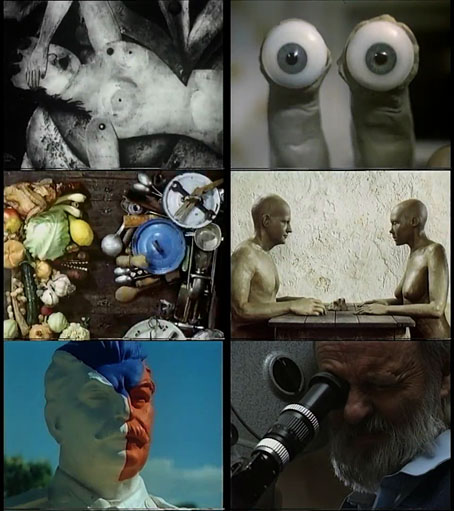
Ben Fox’s documentary was made to coincide with an exhibition of Švankmajer’s films and artworks being shown at an animation festival in Cardiff. The two installments examine a different aspect of Švankmajer’s cinematic works: “Memories of Mysterious Beings” concerns the films that deal with childhood dreams and fears, while “The Naming of Demons” concentrates on his use of Surrealism as a tool for satire or social critique. In between lengthy extracts from the films the camera prowls around some of the director’s artworks while an actor reads statements Švankmajer has made about his interests and intentions. This last feature isn’t something I enjoy very much, not when the actor’s nasal delivery is so different from Švankmajer’s own voice. It’s a common ploy in documentaries, having someone impersonate an interviewee to avoid using subtitles, but it’s one I find distracting when done like this.
eva.jpg

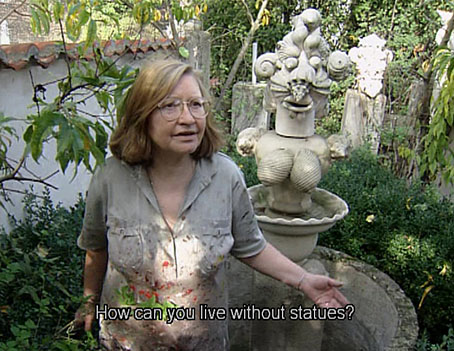
Eva liked statues.

At this point I would have directed your attention once again to Jan Švankmajer, Director, a documentary about Czech cinema which featured the man himself talking at length about his activities in the 1960s, but this has now been removed from YouTube. In its place, however, there’s a more recent upload, Les Chimères des Švankmajer, an 80-minute documentary for French TV by Bertrand Schmitt and Michel Leclerc which is included among the extras on the BFI’s collection of Švankmajer’s short films. The only trouble here is that the YT copy has no subtitles, you’ll need to be a French speaker to understand the voice-overs which run throughout. This is one of the best of all the Švankmajer documentaries since it shows the range of activities conducted by Švankmajer and his late wife, Eva Švankmajerová, as artists and foremost members of the Prague Surrealist Group; film-making, as Švankmajer has often stressed in interviews, was only one outlet for his creativity. (It was also one he was forbidden to practice for several years when the Communist authorities took exception to his work.) In addition to seeing the Švankmajers preparing an exhibition of their creations, Schmidt and Leclerc show us something of their home outside Prague, an artwork in itself that combines the sculpture park and Wunderkammer. Eva Švankmajerová was the creator of many of those sculptures, a celebrated artist in her own right whose contribution to her husband’s films has often been overlooked.

Elsewhere on { feuilleton }
The Surrealism archive

Previously on { feuilleton }
Švankmajer’s cats
Jan Švankmajer: The Animator of Prague
Jan Švankmajer, Director
Don Juan, a film by Jan Švankmajer
The Pendulum, the Pit and Hope
Two sides of Liška

Weekend links 657

foxx.jpg

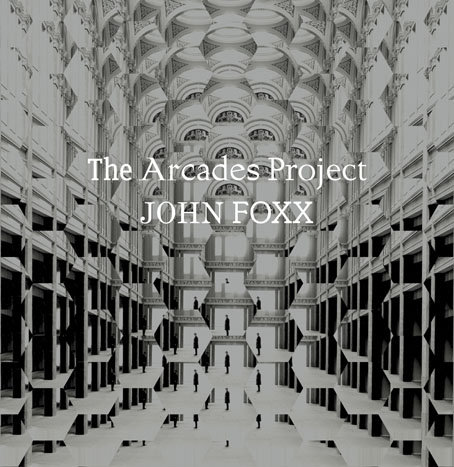
• Cover art for a new album by John Foxx which will be released on CD in March. This catches my attention for being based on Walter Benjamin’s compendious collection of esoterica, with the music being solo piano pieces. If the latter are anything like the albums Foxx recorded 20 years ago with Harold Budd then this is all very promising. Is the cover design by Jonathan Barnbrook? The typography and formal treatment of the photo suggest as much.

• “The new game was not providing access to everything but finding out how many expensively licensed properties you could cull from your service before people started to question how much they were paying a month.” Sam Thielman on the sudden unavailability of hundreds of classic Warner Brothers cartoons. Regarding his comment about the unplayability of Internet Archive videos: you download them and put them on a USB drive.

Frost Flowers on the Windows (1899) is a book that documents “the extraordinary power of windowpane frost to take ‘ice photographs’, images capable of expressing the ‘vital qualities’ of life forms close to the glass,” according to its author, Albert Alberg.

• New music: ev THe norTH, “a sound journey through the winter of the far north” by Lorenz Weber. (The encoding of the album title won’t display properly on this page.)

• RIP Yukihiro Takahashi, singer, songwriter and drummer with the fabulous Yellow Magic Orchestra. The space-disco video for YMO’s Rydeen never gets old.

• “I want an indescribable feeling”: composer Kali Malone on her search for the sublime.

• Old music: Roundtrip by Don Cherry & Jean Schwarz, a live performance in Paris, 1977.

• At Spoon & Tamago: Glass artist Genki Sudo crafts tentacle earbuds.

• At Unquiet Things: The Incandescent Otherworlds of Gervasio Gallardo.

• At Dennis Cooper’s: Acid Westerns Day.

Arcade (1987) by Chris & Cosey | The White Arcades (1988) by Harold Budd | Arcade (2018) by Philip Jeck

A Little Phantasy on a Nineteenth-Century Painting

mclaren1.jpg

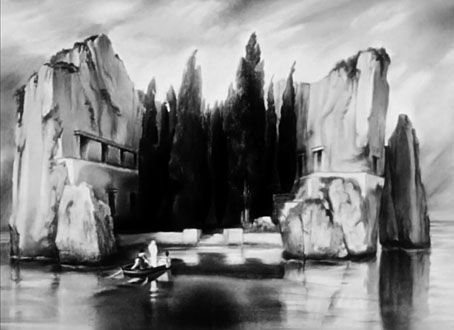
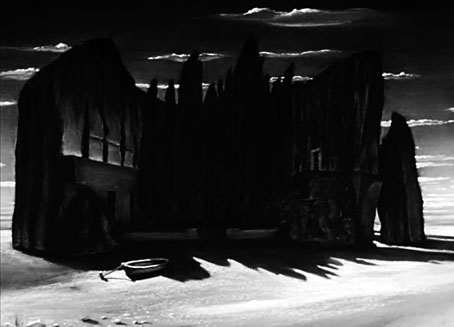
The painting in question is the same one used as the source for the pictures in the previous post, The Isle of the Dead by Arnold Böcklin, which is here transformed in a very short animated film by Norman McLaren. Watching this again I thought it might have been created with the pinscreen (previously) since the NFB posting doesn’t offer any information about the technique used. The close shots, however, reveal the kinds of texture and smudges common to pastel drawing. McLaren followed this a few years later with a pastel animation in colour which he titled A Phantasy.

mclaren2.jpg

This isn’t the only cinematic rendering of Böcklin’s painting—Toteninsel.net lists a few more—but it may be the only one that ends by withdrawing the sea that surrounds the island. This spoils the setting a little but it adds a finishing touch. That’s the trouble with animating paintings, you’re always compelled to account for the passage of time in a scene that exists in a timeless space.

Previously on { feuilleton }
L’île des Morts
More Isles of the Dead
Isles of the Dead
A Picture to Dream Over: The Isle of the Dead
The Isle of the Dead in detail
Arnold Böcklin and The Isle of the Dead

L’île des Morts

ile1.jpg

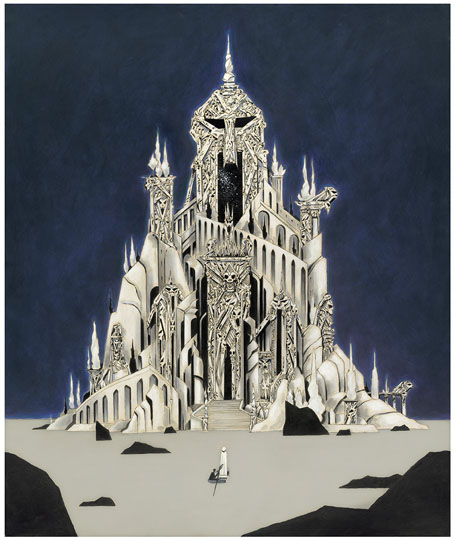
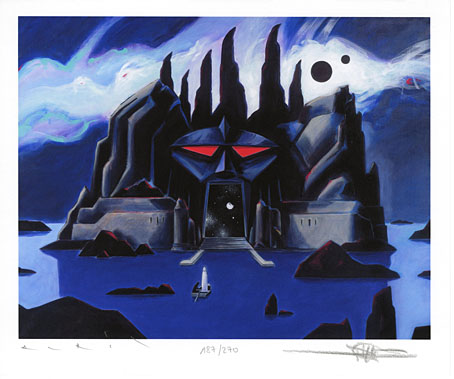
In Philippe’s studio there was always against a wall this large canvas sketched in the 80s on the theme of the Isle of the Dead. During a work session on the print, I asked him if he intended to finish it one day. He answered me: “NO”, then “we will finish it together.”

Thus François Avril writing about his collaboration with Philippe Druillet on yet another version of The Isle of the Dead, the endlessly malleable Symbolist emblem created in the 1880s by Arnold Böcklin. Druillet had already drawn an impressive version of the cemetery island for Gail, one of the later Lone Sloane stories, in 1976. These new versions are from an exhibition of prints staged last year at Galerie Barbier in Paris.

ile2.jpg

Copies of the prints are still for sale, as is a pricey (€ 100) signed and limited exhibition catalogue. More tempting, although even more expensive, is a forthcoming catalogue from another Druillet exhibition, Les 6 Voyages de Philippe Druillet which explored the artist’s “oeuvre colossale”.

All of this reminds me that when I was writing about René Laloux’s films for the previous post I was thinking once again that it was a shame Laloux never produced anything based on Druillet’s art. There is an animated series, Bleu, L’enfant de la Terre, which Druillet designed for French TV in the 1980s, but this was aimed at children so there’s none of the cosmic doom that dominates Druillet’s early books. My ideal today would be a Lone Sloane feature animated by one of those Japanese studios with a fanatic attention to detail. I can dream, can’t I?

Previously on { feuilleton }
More Isles of the Dead
Isles of the Dead
Du Tac au Tac: Druillet, Hogarth and Buscema
Sorcerer: Druillet and Friedkin
Ô Sidarta: a film about Philippe Druillet
Lovecraft: Démons et Merveilles
Philippe Druillet album covers
A Picture to Dream Over: The Isle of the Dead
The Isle of the Dead in detail
Druillet’s vampires
Druillet meets Hodgson
Arnold Böcklin and The Isle of the Dead

Weekend links 656

escher.jpg

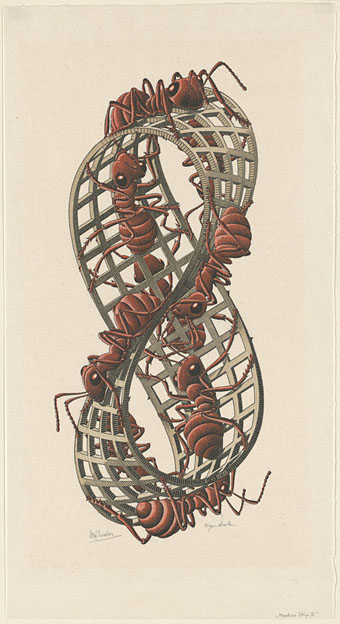
Mobius Strip II (1963) by MC Escher.

• Old music: Warp Records is reissuing two recent Jon Hassell discs later this year: The Living City (Hassell’s ensemble playing live in NYC, 1989) and Psychogeography (Zones Of Feeling) (remixes from City: Works Of Fiction), which will be available as standalone releases or bundled together as Further Fictions together with Hassell’s Atmospherics book.

• “His library is an immense and enviable wellspring, a demimonde of objects by murky creators who for decades have gnawed away at the inner organs of polite society.” Steven Heller talks to Glenn Bray about Library, an 800-page collection of scans from Bray’s trove of books, comics and print ephemera.

• New music: Tsathoggua, the latest in the Lovecraftian series of Cryo Chamber Collaborations which reminds me that I’m still missing the more recent entries. Also the non-Lovecraftian Coil by Ian Boddy.

• “Music is a way to express yourself beyond words,” says Hildur Guðnadóttir.

• See this year’s winners of the annual Close-up Photographer of the Year competition.

• At Dennis Cooper’s: Spotlight on…Ishmael Reed The Last Days of Louisiana Red (1974).

• A few new photos of Michael Heizer’s City in the Nevada desert.

City Of Night (1994) by David Toop & Max Eastley | City As Memory (1995) by John Foxx | City Appearing (2013) by Julia Holter