Engelbrecht lives to fight another day

engelbrecht1.jpg

The beat Engelbrecht had drawn for the early morning rise was a stretch of jet black water between the Jubilee Gasometer and the Municipal Slaughter House. A dank mist lay over the canal. The vampire bats were out in swarms. The bot-fly waltzed in virid clouds. You could hardly have had a better surrealist fishing day.

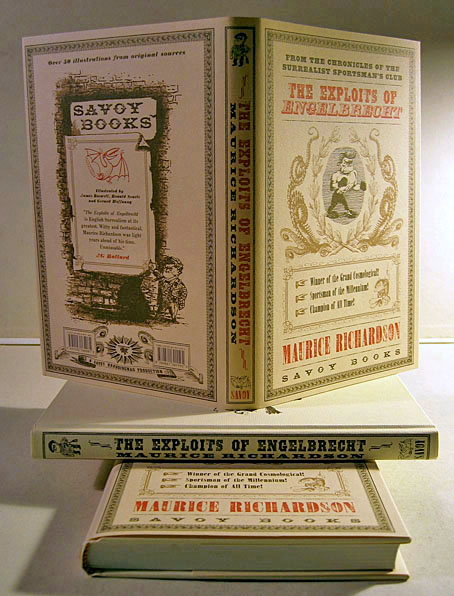
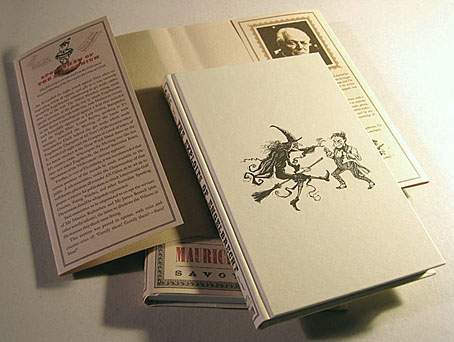
Thus Maurice Richardson in The Exploits of Engelbrecht, newly-printed copies of which I picked up this week from the Savoy Books’ office. This is the reprint of the Savoy edition which was published in 2000 and would have been out two years ago had various problems not intervened. As a result it’s inadvertently become an anniversary edition which is fitting since Engelbrecht was the first title in the line of books from Savoy’s publishing relaunch ten years ago. I’ve mentioned before that I was dissatisfied with my original design so it was a pleasure being able to rework the book slightly in a manner which better suits Richardson’s marvellous stories. The main change is a completely re-designed dust jacket done in three colours printed on textured paper; this has made the book a nice thing to handle as well as look at. A few new illustrations were added courtesy of Savoy artist Kris Guido. Kris is a far better cartoonist than I and his drawing of Engelbrecht facing one of his broomstick-riding foes adorns the front board.
engelbrecht2.jpg

Another cartoonist, Martin Rowson (currently at the Guardian), reviewed the earlier edition for The Independent on Sunday:

Far more obscure, but for my money the best book of the year, is The Exploits of Engelbrecht by Maurice Richardson. Richardson, who died in 1978, was one of the old school of hacks; he later became a stalwart infester of the Colony Rooms and the sordid pubs round Soho that teemed with pissed-up talent in the 1940s and 1950s. The Exploits of Engelbrecht, the dwarf surrealist boxer, and his adventures shooting witches, boxing grandfather clocks, playing football on Mars and games of surrealist golf which last for infinity, originally appeared in Lilliput when it was at its post-war zenith. The stories were illustrated by, among others, Searle and Hoffnung. Ah, God, those were the days.

This edition is lavishly illustrated and comes with endorsements from artist James Cawthorn (who provided some illustrations and an introduction), Michael Moorcock (who provided the afterword), and JG Ballard (who provided a blurb). Since its original publication in 1950 Engelbrecht had been one of Ballard’s favourite books; I wish he could have lived long enough to see this latest edition.

Engelbrecht isn’t on sale yet as I don’t think a price has been decided on but since this is a limited run it’ll be around £25 + p&p. Any queries should be directed to Savoy Books who have a PDF of the first chapter (plus illustrations) available to read. Next up is the enormous Moorcock tome; more about that soon.

Previously on { feuilleton }
Ronald Searle book covers
Engelbrecht again
Mervyn Peake in Lilliput

More decorated books from the Netherlands

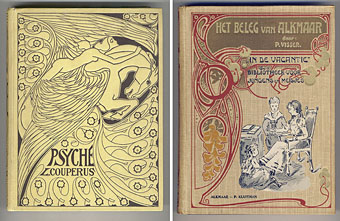
netherlands1.jpg

left: Jan Toorop (1898); right: no designer credited (1904).

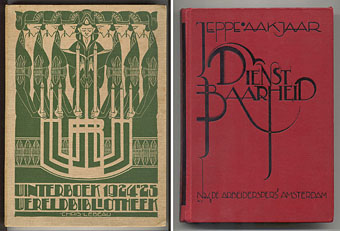
A search this week for work by Dutch designer Chris Lebeau (1878–1945) turned up another collection of fantastic decorated covers and prints from the Netherlands, running from the Art Nouveau period through Art Deco up to the 1940s. I found some Lebeau pieces but the big surprise was also discovering a number of cover designs by the Symbolist artist Jan Toorop (1858–1928). Toorop’s highly-stylised draughtsmanship easily lends itself to graphic design but I’ve never seen cover illustration mentioned in any discussion of his work. The site doesn’t have any text in English but the pictures are well worth a browse.

Update: Well…the pictures were worth a browse but the site is currently offline, all the links now go to a domain holding-page.

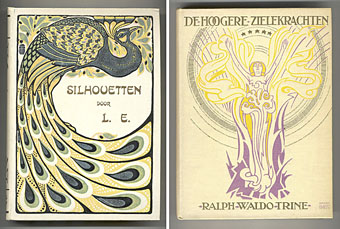
netherlands2.jpg

left: Albert Angus Turbayne (1913); right: CA Vlaanderen (1919).

The peacock cover is a variation on an earlier design by Albert Angus Turbayne.

netherlands3.jpg

left: Chris Lebeau (1924); right: AP Hahn Jr. (1931).

Elsewhere on { feuilleton }
The book covers archive

Previously on { feuilleton }
Netherlands decorated books

Mark Twain

twaintesla.jpg

Nikola Tesla and Mark Twain, 1894.

Mark Twain died 100 years ago today, April 21st, 1910, and the anniversary is being marked in America by a variety of events throughout the year, some of which are listed on this dedicated site. I’ve always been grateful to Twain for cheering a portion of my dismal school days with The Adventures of Huckleberry Finn, one of two books we were forced to read that I actually enjoyed. (The other was Lord of the Flies; both stories, perhaps significantly, concern Wild Boys.) I’ve wanted to re-read Huckleberry Finn for years, perhaps now would be a good time to actually do so.

Unlike many writers of his generation, Twain’s work still seems vital today, and not only his fiction. His broadsides and polemics return continually to basic issues of tolerance and humanity and are often as relevant now as they were a century ago. Twain had little patience for the hypocrisies of his fellows when it came to matters of religion, warfare or the treatment of other human beings; like his contemporary, Oscar Wilde, he’s always been endlessly quotable. Consider these two extracts:

Citizenship? We have none! In place of it we teach patriotism which Samuel Johnson said a hundred and forty or a hundred and fifty years ago was the last refuge of the scoundrel—and I believe that he was right. I remember when I was a boy and I heard repeated time and time again the phrase, ‘My country, right or wrong, my country!’ How absolutely absurd is such an idea. How absolutely absurd to teach this idea to the youth of the country. True Citizenship at the Children’s Theater, 1907

But the truth is, that when a Library expels a book of mine and leaves an unexpurgated Bible lying around where unprotected youth and age can get hold of it, the deep unconscious irony of it delights me and doesn’t anger me. Letter to Mrs FG Whitmore, February 7, 1907

(more)

…then wonder what Twain would have to say about America’s current crop of blustering yahoos with their flags and crosses and misspelled signs.

A copy of the first edition of The Adventures of Huckleberry Finn, illustrated throughout by EW Kemble, can be downloaded at the Internet Archive. For Twain’s dim view of the Bible and its adherents, see his Letters from the Earth. The Tesla Memorial Society has another photograph of Twain in the great inventor’s laboratory.

Repin and Ljuba

repin.jpg

Sadko in the Underwater Kingdom (1876).

This painting by Russian artist Ilya Yefimovich Repin (1844–1930) is included in one of my Symbolist art books despite its pre-dating the Symbolist period and there being little else in the artist’s career which might suit the label. It’s a curious picture, however, illustrating a medieval folk tale and depicting the moment when the Sadko of the title is forced by the Sea Tsar to choose a wife from a line of aquatic maidens. It was art historian Philippe Jullian who had me returning to Repin, and the reminder gives me an excuse to post something by Serbian Surrealist Ljuba (aka Ljuba Popovic) whose colours, fauna and metamorphic female figures are a match for Repin’s sirens. Last time I looked for Ljuba pictures there were few available, a situation which has now been remedied by blogs such as this one.

ljuba.jpg

Lot and Lotus (1972).

Previously on { feuilleton }
The art of Ivan Bilibin, 1876–1942
Magic carpet ride
Short films by Walerian Borowczyk
The art of Ljuba Popovic

Weekend links 11

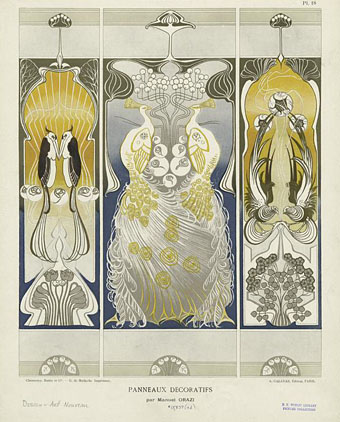
orazi4.jpg

Panneaux decoratifs (1900) by Manuel Orazi at NYPL.

Ghostsigns: “a collaborative national effort to photograph, research and archive the remaining examples of hand painted wall advertising in the UK and Ireland.”

• Golden Age Comic Book Stories posts some Alphonse Mucha.

Voyage Fantastique – An illustrated guide to the body and mind at A Journey Round My Skull.

The gallery of the International Exhibition of Calligraphy.

Trevor Wayne Pin-Up Show, a new photo collection of the tattooed Mr Wayne which includes photos and a foreword by Clive Barker.

Phallophonies, a gallery exploring the penis in religious art. Related: “Churchgoers are outraged over a crucifix in a Catholic church that they say shows an image of genitalia on Jesus.”

Hollingsville: “Expect live and unscripted wanderings around voodoo science parks, examinations of cities as battle suits and thoughts on pods, capsules and world expos.”

Phantom Circuit #33 is a Ghost Box special featuring an interview with Jim Jupp (Belbury Poly) and Julian House (The Focus Group). Related: Ghost Box films at YouTube.

Eldritchtronica and Wyrd Bliss, a mixtape by Simon Reynolds.

• Avant garde music and cinema meet at The Sound of Eye.

• Make your own newspaper with Newspaper Club.

Drawdio: A pencil that lets you draw music.

Yoko Ono collects rare books.

KittehRoulette.

• Song of the week: The Four Horsemen (1972) by Aphrodite’s Child.