
Steampunk overloaded!

infernal.jpg

Yes, it’s the “S” word again, and if there was any doubt that this has been the Year of Steampunk here at Coulthart Towers, look at these recent works. And this is by no means everything I’ve been doing in this area, there’ll be further announcements later on.

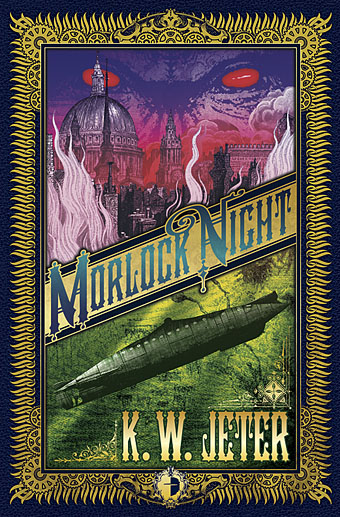
The covers for KW Jeter’s novels are a pair of reprintings from UK publisher Angry Robot whose books will shortly be available in the US and Canada. Jeter is now famous—infamous, perhaps—for having given the word “steampunk” to the world in the early 1980s. This was intended as a jest after he and a couple of other writers (including a favourite of mine, Tim Powers) had written a number of science fiction novels set in the 19th century; like many light-hearted neologisms, it gained a life of its own. Angry Robot are reissuing two of these early works as a result of the ongoing steampunk explosion.
morlock.jpg

Morlock Night (1979) is a pulpy affair which sees the Morlocks from HG Wells’ The Time Machine using the Time Traveller’s vehicle to return to Victorian London and wreak no end of havoc. Infernal Devices (1987) is a rather more substantial confection involving a great deal of clockwork mechanisms (for once the clock parts are justified!), automata, fish people, and a device capable of destroying the earth. I’ve been producing a lot of engraving collage à la Ernst and Sätty recently but the technique seemed especially appropriate here as a means of illustrating works which themselves are collages of Victorian motifs.
zeppelins.jpg

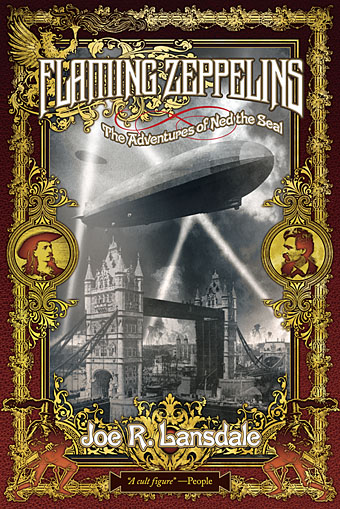
Meanwhile, over at Tachyon Publications, there’s this cover for another Victorian adventure, two in fact, from master beserker Joe R Lansdale. Flaming Zeppelins combines a pair of comic adventures, Zeppelins West (2001) and Flaming London (2006), which feature a host of notable figures including Mark Twain, Annie Oakley, Buffalo Bill Cody…and a talking seal. Publication date is November 1st.

steampunk.jpg

Then from Tachyon in mid-November there’ll be Steampunk II: Steampunk Reloaded, a 430-page anthology edited by Ann & Jeff VanderMeer which includes fiction and non-fiction from William Gibson, Caitlín R Kiernan, Jeffrey Ford, Cherie Priest, and many others. Also a comic strip, copious illustrations and a very full-on interior design from yours truly of which I’ll only show you the above page for the time being. Yes, that’s a mechanical ostrich but if you want to know what it’s doing there you’ll have to read the book. More about this later. And more later about The Steampunk Bible to which I’m also a contributor, a glossy, full-colour guide to the entire sub-culture which will be published next year by Abrams. By the time that appears I’ll probably be sick of the sight of clockwork parts, dirigibles, florid typefaces and Victorian decoration; I’ll be needing a good dose of Helvetica and Josef Müller-Brockmann minimalism to calm down.

Previously on { feuilleton }
Skeleton clocks
Vickers Airship Catalogue
The Air Ship
Dirigibles
More Steampunk and the Crawling Chaos
La route d’Armilia by Schuiten & Peeters
The art of François Schuiten
Steampunk Redux
Steampunk framed
Steampunk Horror Shortcuts
The Airship Destroyer
Zeppelin vs. Pterodactyls

Beardsley’s Rape of the Lock

pope1.jpg

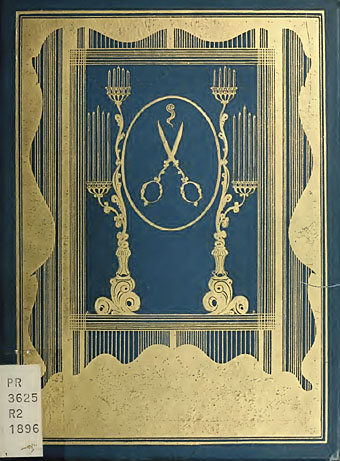
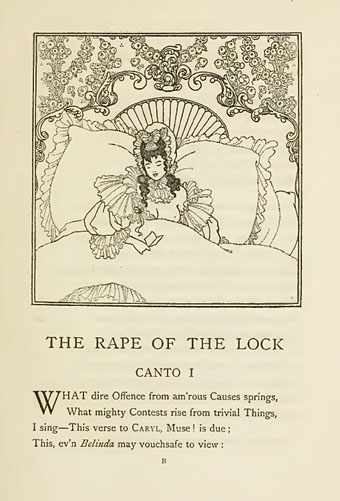
This week’s reading has been Virginia Woolf’s Orlando, a capricious novel which features in its 18th century scenes encounters with some of the great poets of the era, including Alexander Pope. A number of references are made to Pope’s satiric The Rape of the Lock (1717), one of his most notable works which received an equally notable set of illustrations in 1896 from Aubrey Beardsley. The pictures here are from a copy of the first edition published by Leonard Smithers which can be seen at the Internet Archive where the collection features a large number of books created by or written about the artist. Even though Beardsley’s illustrations are endlessly reprinted I do like to see how they were first presented to the world, how the pages were typeset and so on. One detail from this first edition is that we see the credit on the title page: “Embroidered with nine drawings by Aubrey Beardsley.” The cover design is often reproduced in its original black-and-white state which fails to convey the intended effect of those great slabs of gold, while the illustrations within are some of the finest and most detailed of the artist’s career. If the PDF doesn’t really do them justice there are better copies to be found, here and here, for example.

pope2.jpg

Leonard Smithers was notorious in Victorian London for his publishing of pornography but he tried to use the proceeds to occasionally produce works with a better reputation such as this. Beardsley had also been tarred as a pornographer, of course, but here he restrained himself in order to do justice to a book he admired. There is one possible exception in the cover design; I’m afraid I couldn’t find the reference but one of Beardsley’s critics asserts that the open scissors and fatal lock of hair shown in the mirror create a surreptitious image of the female pudenda. With many other artists this interpretation might be dismissed as fanciful but Aubrey filled his early drawings with phalluses and breast shapes, and his unfinished novel, the erotic fantasy Under the Hill, has a title referring to the mons pubis. No other artist of the time would be so daring even with a pornographer for a publisher; it was just this sort of impudence which infuriated his more staid contemporaries. Under the Hill is far more overt in its sexuality and its writing style owes something to Pope’s era which Aubrey adored. The posthumous edition of that book, containing other Beardsley ephemera, can be found here.

Elsewhere on { feuilleton }
The Aubrey Beardsley archive
The illustrators archive
The book covers archive

Weekend links 30

woody.jpg

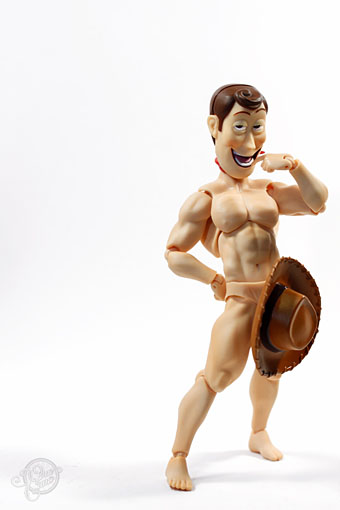
Did someone say “woody”? Plenty more toy antics at TheOneCam.

• And yet more Haeckelisms: Praying in Haeckel’s Garden, recent works by artist Mary O’Malley.

Seasons of the Peacock, the perennial showoff as depicted by a handful of Art Nouveau artists. A couple of examples there I hadn’t seen before.

• Dorian Cope presents On This Deity, “Commemorating culture heroes and excavating world events.”

• At long last, Fantagraphics will be publishing Ah Pook is Here, the comic strip collaboration between William Burroughs and artist Malcolm McNeill. Something to look forward to for next year. Related: Malcolm McNeill’s website.

David Lynch Dark Splendor: “Der große Filmemacher David Lynch als Fotograf, Maler, Zeichner und Grafiker.”

More on the forthcoming album from Brian Eno, Leo Abrahams and Jon Hopkins. With this degree of hype the end result is going to be a disappointment.

Book design by Richard Hollis, including John Berger’s essential Ways of Seeing.

A fistful of Vignellis: the work of Lella and Massimo Vignelli celebrated.

• Berni Wrightson’s Frankenstein at Golden Age Comic Book Stories.

Jimi Hendrix, Philip José Farmer reader.

Imagerie du Chemin de Fer.

El UFO Cayó (2005) by Ry Cooder.

The art of scent revisited

haapaniemi1.jpg

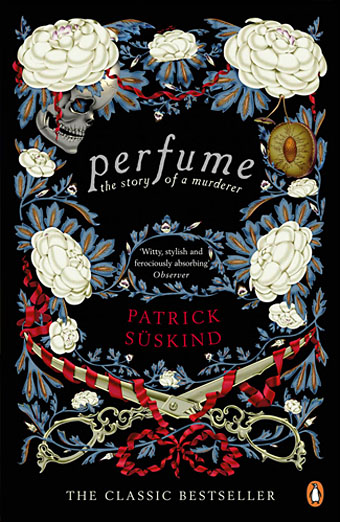
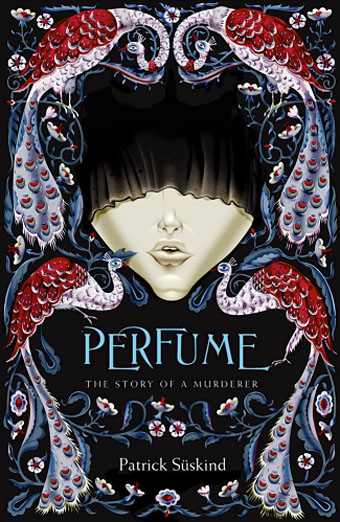
I made a post about the various cover designs for Patrick Süskind’s novel, Perfume, shortly after the film had been released in 2007 but haven’t paid much attention to the book since. These recent designs are by Klaus Haapaniemi, a Finnish illustrator based in London, and do a good job of presenting the story’s themes without resort to the recumbent (or dead) females common to earlier editions. The version below wasn’t given final approval but gets included here for its peacocks. Via Chateau Thombeau.

haapaniemi2.jpg

Elsewhere on { feuilleton }
The book covers archive
The illustrators archive

Previously on { feuilleton }
Perfume: the art of scent

Vintage eye candy

sargent.jpg

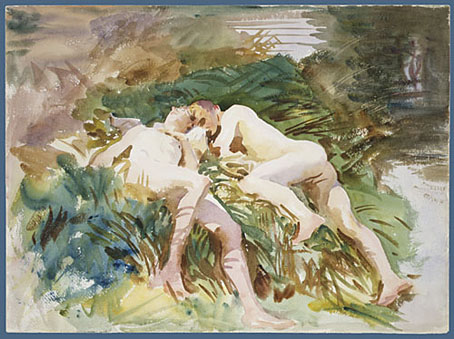
Tommies Bathing by John Singer Sargent (1918).

More discoveries from recent image trawls. There’s been plenty of speculation about the sexuality of John Singer Sargent—see here, for example—and this watercolour depiction of relaxing British soldiers would seem to be another of his works which confirms an enchantment with the male form. Lust aside, it’s a remarkable and typically assured sketch in a difficult medium.

hicok1.jpg

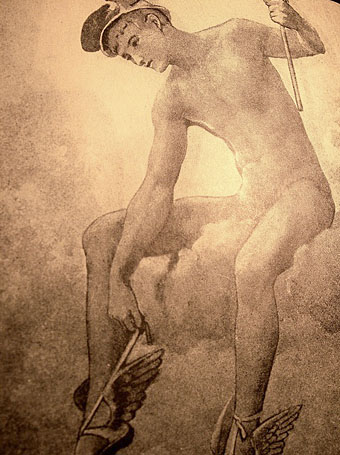
Hermes by Will H. Low (1885).

Will Low’s Greek god is from an illustrated edition of Keats’ Lamia, a PDF of which can be found at the Internet Archive although the compression setting is so severe that the drawings are pretty much ruined throughout. This is how Microsoft and Google are safeguarding the world’s artistic heritage… The copy above comes via another Flickr set.

hicok2.jpg

Also at Archive.org, and far better quality, is another book illustrated by Will Low, In Arcady by Hamilton Wright Mabie, a rather insipid parable in a faux-Classical manner which gave the artist an opportunity to fill the pages with piping fauns and naked youths. It wouldn’t be fair to paint Low as another closet Uranian like Sargent solely on account of this handful of drawings; for now he can remain a further victim of our salacious modern sensibilities.

Elsewhere on { feuilleton }
The illustrators archive