Byam Shaw’s Garden of Kama

shaw01.jpg

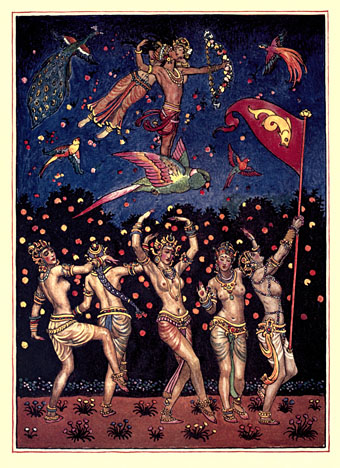
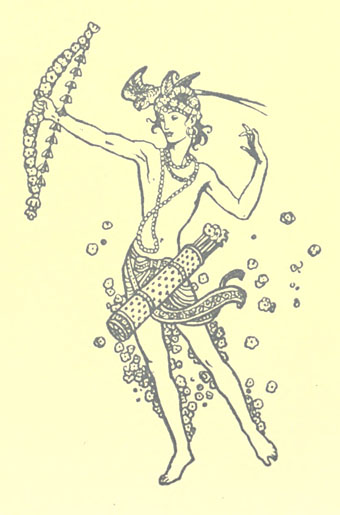
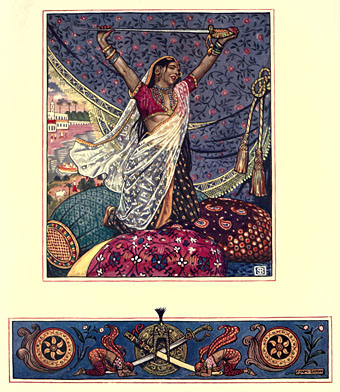
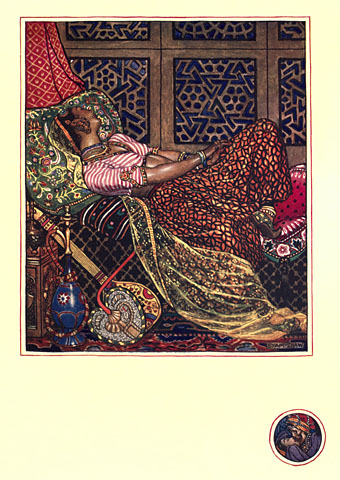
The post title sounds like a psychedelic album but the illustrations are from The Garden of Kama (1901), allegedly a collection of Indian love poems “translated by Laurence Hope”. The translator’s real name was Adela Florence Nicolson who no doubt wished to do for India what Edward Fitzgerald had done for Persia but rather than presenting new translations of unknown verse the poems were all her own work. The book survived this mild scandal to be republished several times, the illustrations here by Byam Shaw (1872–1919) being from a 1914 edition. I linked to a selection of these plates last year when they were posted at Golden Age Comic Book Stories but anyone wanting to see the complete book, poems and all, may do so at the Internet Archive.

The content may be Orientalist pastiche but Shaw paid great attention to the decorative details. This is also an adult work, with violence, death and some sexy females. So many illustrated books of this period are children’s stories it can be a surprise to find something where the characters don’t live happily ever after.

shaw02.jpg

shaw03.jpg

shaw04.jpg

Continue reading “Byam Shaw’s Garden of Kama”

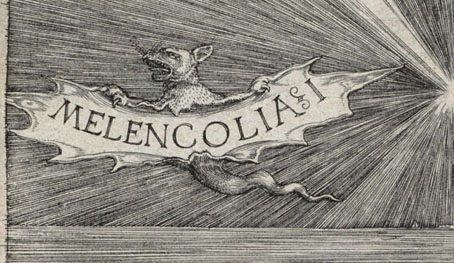
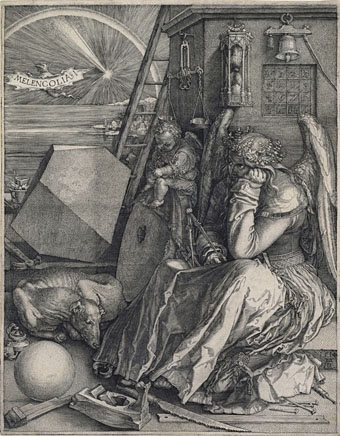
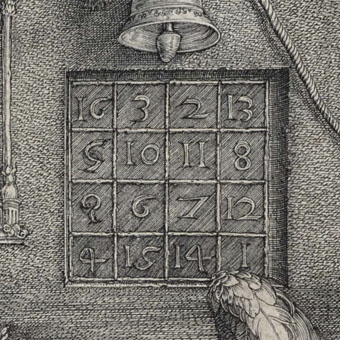
Melencolia details

durer1.jpg

The idle question “Where can you find the best reproduction of Albrecht Dürer’s Melencolia I?” was answered at the Google Art Project where there are four different prints to examine. As usual it seems churlish to complain but I would have preferred one decent copy and a few more Dürer engravings in place of the duplicates; his Knight, Death and the Devil, for example, is absent. There are several other engravings, however, all of whose minute details and shading benefit from close scrutiny. Dürer is well-represented compared to other artists, there are several paintings there as well. The only oddity is the inclusion of this drawing of three witches by Dürer’s pupil Hans Baldung Grien. The museum that owns the drawing credits Grien but a search isn’t really necessary when it’s signed with the artist’s “HBG” monogram in place of Dürer’s famous “AD”. Does Google have any art historians proofing these entries or is it solely the work of technicians copying and pasting information?

durer2.jpg

durer3.jpg

Continue reading “Melencolia details”

Leo Dillon, 1933–2012

dillons.jpg

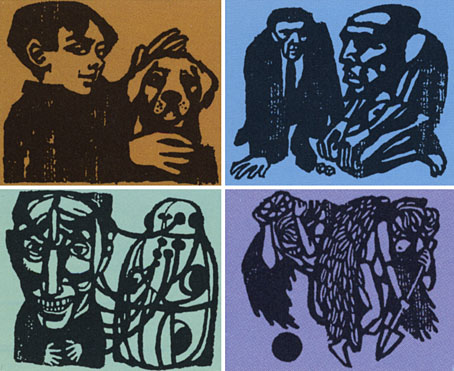
Illustrations for Dangerous Visions (1967) by Leo & Diane Dillon.
top left: Lord Randy, My Son by Joe L. Hensley; top right: Gonna Roll the Bones by Fritz Leiber
; bottom left: The Happy Breed by John Sladek; bottom right: Shall the Dust Praise Thee? by Damon Knight

Beyond my love for them and my understanding that they have influenced my ethical and moral life almost more than anyone else I’ve ever known, my respect for their artistic intelligence and their incomparable craft is enormous. Leo and Diane Dillon are the best. Simply put: the best.

Harlan Ellison, from The Illustrated Harlan Ellison (1978)

Pre-internet, illustrators and designers often suffered from being landlocked by whatever territories (to use that wretched marketing term) the work they embellished was sold in. I’ve said as much in the past but it’s worth repeating since it explains how reputations could loom large in one country while the artists in question might be unknown elsewhere. Leo and Diane Dillon are a good example of this, lauded in the US for work that spanned a variety styles and media yet barely visible in Europe unless you chanced across an imported paperback bearing one of their covers. Their long and fruitful relationship with Harlan Ellison saw them illustrate many of his major works, books which when they were reprinted here were often packaged with inappropriate spaceship art by Chris Foss or one of his imitators. Happily the Dillons’ superb woodcut illustrations for Ellison’s Dangerous Visions anthology survived the journey across the Atlantic. I still find those illustrations thrilling for the way they condensed the essence of thirty-two challenging stories with the greatest economy of means. And thanks to the internet we can see just how versatile they were at The Art of Leo and Diane Dillon. That site also includes links to interviews and further examples of their art.

Elsewhere on { feuilleton }
The illustrators archive

Previously on { feuilleton }
Science fiction and fantasy covers
Groovy book covers
Harlan Ellison: Dreams with Sharp Teeth

Ah Pook Is Here

pook1.jpg

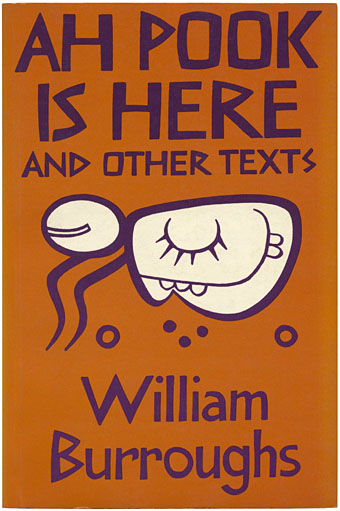
John Calder edition (1979). Design by Brian Paine incorporating a glyph of Ah Pook from the Dresden Codex.

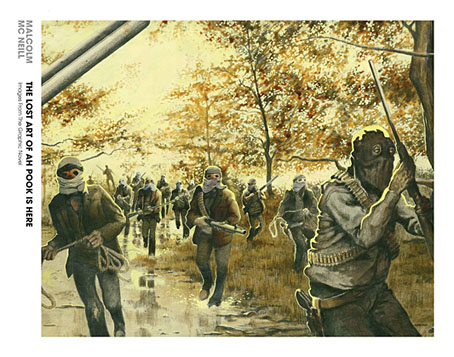
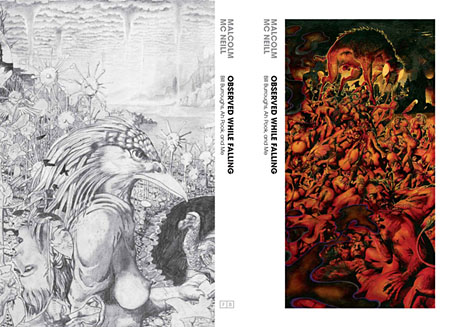
It would have been tempting to write “Ah Pook is finally here” but that’s not quite the case. Artist Malcolm McNeill sent Savoy Books the following preview images last week. What was originally going to be the long-awaited publication of McNeill’s collaboration with William Burroughs, Ah Pook Is Here, will now be two separate volumes published by Fantagraphics Books later this year: The Lost Art of Ah Pook Is Here which will comprise McNeill’s art without the accompanying text (apparently the Burroughs estate objected to its inclusion), and Observed While Falling—Burroughs, Ah Pook and Me, a memoir of the project’s creation. The loss of the text is an annoyance but not the end of the world, at least if you’re fortunate enough to own the scarce Calder book above which comprises a 40-page story that I imagine (and hope) may be read whilst viewing McNeill’s meticulous artwork. Amazon’s listing shows the two books scheduled for October 2012, and there’s now a website for the two books with further preview images.

pook2.jpg

pook3.jpg

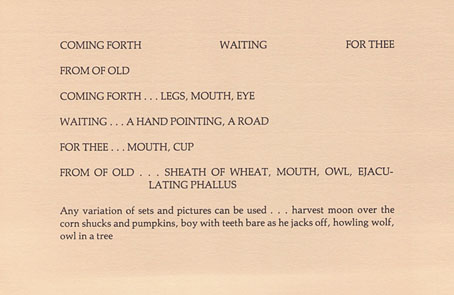
The 1979 Ah Pook Is Here is a fascinating collection, not least for the title piece which fits with the Wild Boys/Port of Saints narratives that Burroughs worked on during the 1970s. It’s also one of the better Burroughs anthologies so it’s always seemed odd that it’s remained resolutely out of print. Burroughs mentions McNeill’s artwork in a preface but doesn’t show any examples of his work. There is other artwork, however: in addition to some uncredited line drawings of figures like those in the Mayan codices there’s the whole of The Book of Breeething, a collaboration with artist Robert F. Gale from 1974. The latter concerns Burroughs’ interest in hieroglyphic communication, and attempts to show how one might convey short sentences through visual images alone, as in the pages below.

breeething1.jpg

The Book of Breeething (1974).

breeething2.jpg

The final piece in the book is The Electronic Revolution, an essay about using technology for guerilla purposes which was an inspiration for Cabaret Voltaire and others. All of this is choice and unusual material so it’s surprising that it’s been out of print for so long. In the case of Ah Pook Is Here it’s even more surprising to find it being prevented from republication despite Burroughs’ hope in his 1978 preface that the text would eventually be published along with the artwork. I’m sure the Burroughs estate have their own reasons for these manoeuvres but you can’t help but feel that this is another example of best intentions acting posthumously against the wishes of the artist they represent. A final irony can be found on the first page of Ah Pook Is Here where we see several mentions of a predatory agency that Burroughs warned against throughout his career, the thing he called CONTROL.

Elsewhere on { feuilleton }
The William Burroughs archive

Weekend links 110

janke.jpg

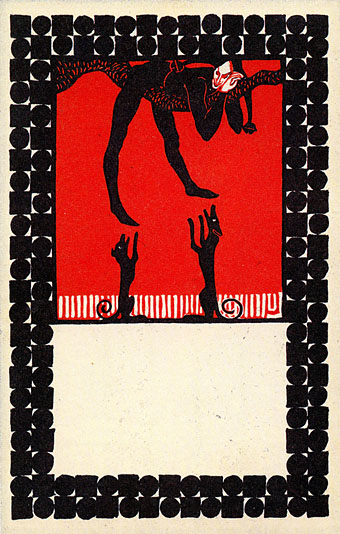
Til Eulenspiegel by Urban Janke. From Twenty Postcards of the Wiener Werkstätte at 50 Watts.

Rorschach Audio by Joe Banks is “essential reading for everyone interested in air-traffic control, anechoic chambers, artificial oxygen carriers, audio art, bell-ringing, cocktail parties, cognitive science, communications interference, compost, the death penalty, Electronic Voice Phenomena, evangelism, evolutionary biology, experimental music, ghosts, the historiography of art, illusions of sound and illusions of language, lip-reading jokes, nuclear blast craters, predictive texting, singing hair, sonic archives, sound design, steam trains, tinnitus, the Turing Test, Victorian blood painting, visual depth and space perception, ultrasonic visual music, ventriloquism, voices and warehouse fires and robberies.”

• “Freud did not understand female sexuality. Klimt did. Klimt’s women please themselves. The realization that women have an independent sexual life was an insight in art.” Eric Kandel discusses his new study The Age of Insight: The Quest to Understand the Unconscious in Art, Mind, and Brain, from Vienna 1900 to the Present.

• Three new books already mentioned here receive further attention: Stan Persky on Christopher Bram’s Eminent Outlaws : The Gay Writers Who Changed America. | Matthew Aquilone on Paul Russell’s The Unreal Life of Sergey Nabokov. | Karin L. Kross on the new translation of the Strugatsky’s Roadside Picnic.

The creative writing moment/movement baffles me and it intrigues me. What does it signify, all this creative longing? And why through language? Specifically fiction, poetry, memoir? […] The crazy part of it is that we are breeding professional, competent, homogenised writers who will go on to teach writing that is professional, competent and homogenised. The intriguing part of it is whether this movement towards creativity and self-expression is really the start of a kind of Occupy – that it could be dangerous and confrontational, not homogenised at all.

Dangerous? But then they won’t get published and win awards and get film deals and… Jeanette Winterson prepares to teach creative writing at Manchester University.

The Underground New York Public Library is a visual library featuring the Reading-Riders of the NYC subways.

Hob by No Man: “Constructed from soundtrack noises from both version of Quatermass and the Pit.”

Stephen Thrower talks about his soundtrack music for The Erotic Films of Peter De Rome.

John Waters surprises everyone by hitchhiking across the US.

• Sounds & the City: An interview with Julia Holter.

The Dead Dream of the Dirigible.

Meditation (1979) by Edward Artemyev.