Giger’s Necronomicon

giger1.jpg

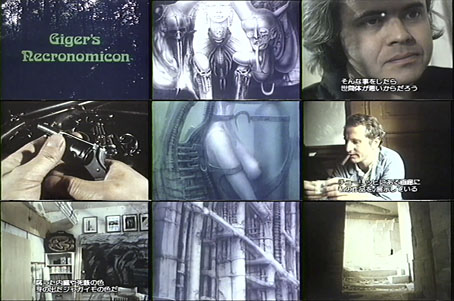
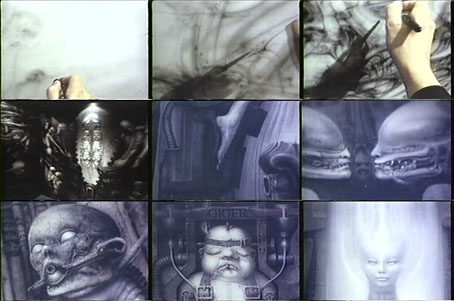
Another artist documentary only this time the artist concerned is a full participant and co-creator. Giger’s Necronomicon was filmed from 1972 to 1976 and functions as a taster for the first book collection of the artist’s work, also called Giger’s Necronomicon, which was published a year later. JJ Wittmer was the co-director. The paintings are very familiar now so it’s worth being reminded how shocking and outré Giger’s work seemed in the 1970s. In addition to interviews with the artist’s parents and some of the painting’s owners there are shots of a very modish gallery event, and we get to see inside Giger’s studio and witness one of the paintings being produced. The sound quality is somewhat erratic since the video appears to come from a Japanese tape but the voiceover is in English. The most notable thing about Giger’s Necronomicon is that all the mobile camera shots are from the artist’s point of view, we only see him when he looks in a mirror.

Giger’s Necronomicon: part 1 | part 2 | part 3 | part 4
giger2.jpg

There’s some additional interest here for Krautrock aficionados. Giger’s books mention his associations with a couple of peripheral figures from the Swiss end of Cosmic Courier/Cosmic Jokers scene: Sergius Golowin and Walter Wegmüller. Golowin is credited with one of the spacier albums on the Cosmic Courier label but he was better known in Switzerland as a writer, and he appears briefly in Giger’s Necronomicon offering some thoughts about the artist’s paintings. The music for the film sounds like the ambient jazz doodlings of Stomu Yamash’ta but is the work of Joël Vandroogenbroeck and Carole Muriel. Vandroogenbroeck recorded a lot of library music, including one release entitled Biomechanoid (1980) which has a Giger cover painting. Prior to this he was a member of German group Brainticket and plays on Cottonwoodhill (1970), an album with a (deserved) reputation as the most demented Krautrock release.
giger3.jpg

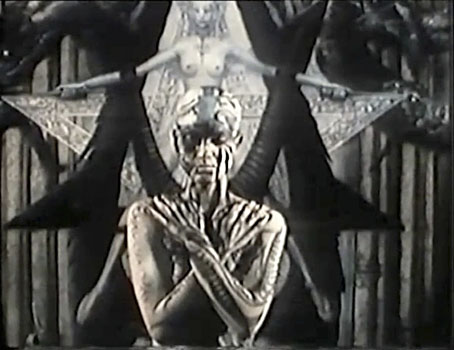
Also at YouTube is another Giger film from the same period, Giger’s Second Celebration of the Four (1977), a four-minute piece directed by JJ Wittmer showing a ritualistic club event. The combination of robes, torches and some of Giger’s more Satanic imagery resembles a black metal music video, albeit with a jazzy soundtrack.

Elsewhere on { feuilleton }
The fantastic art archive

Previously on { feuilleton }
Dan O’Bannon, 1946–2009
Alejandro Jodorowsky’s Dune
The monstrous tome

The art of George Stavrinos, 1948–1990

stavrinos1.jpg

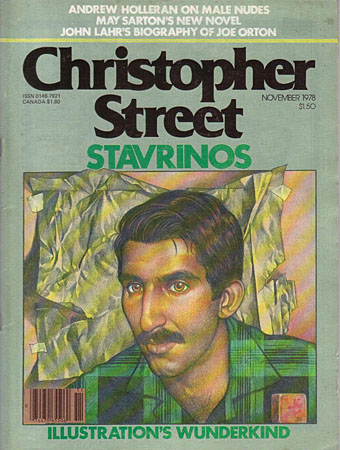
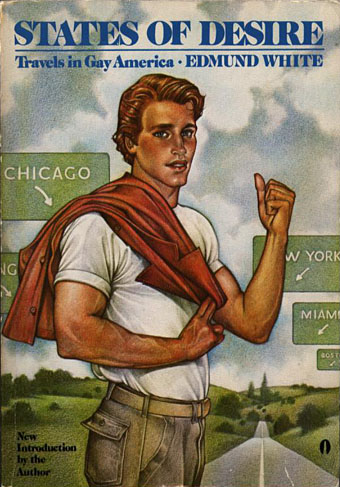
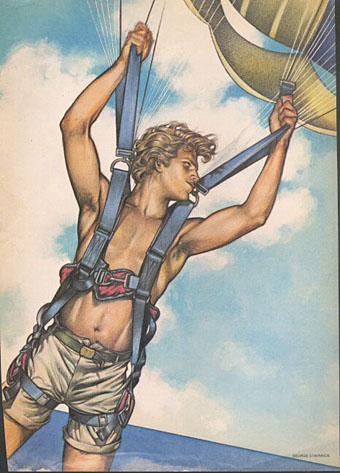
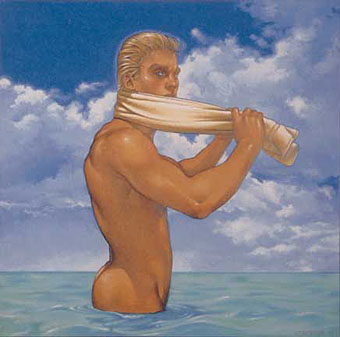
I’m still playing catch-up with the generation of gay artists who came to prominence in the 1970s or early 1980s. Many of them worked for American magazines which were seldom seen over here: both Mel Odom and George Stavrinos provided illustrations for Blueboy while Stavrinos was popular enough to be given the cover treatment from Christopher Street in 1978. Stavrinos is rightly remembered for his stunning Art Deco-styled fashion illustrations but there was enough work in the gay press for him to be regarded as an important artist in that sphere. There’s more at The Advocate and Decoy.

stavrinos2.jpg

stavrinos3.jpg

stavrinos4.jpg

Bather (1977).

stavrinos5.jpg

Elsewhere on { feuilleton }
The gay artists archive

Joseph Cornell: Worlds in a Box

cornell1.jpg

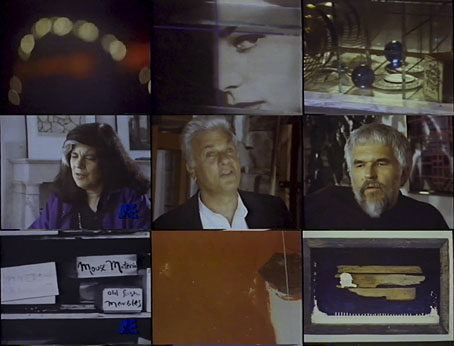
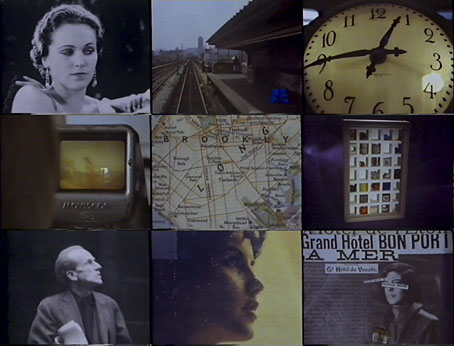
Susan Sontag, Tony Curtis and Stan Brakhage all shared an appreciation for the work of American artist Joseph Cornell (1903–1972), and all appear in a 51-minute documentary Joseph Cornell: Worlds in a Box directed by Mark Stokes for the BBC in 1991. Susan Sontag was also the subject of one of Cornell’s collages, something she discusses here. Tony Curtis collected many of Cornell’s boxes and used to visit the artist when he was in New York; in Stokes’s film he discusses their relationship and reads from Cornell’s writings.

cornell2.jpg

I’ve had a tape of this for years courtesy of Kerri Sharp who worked on the film (hi Kerri!) but it’s taken a while to turn up on YouTube. The value of films such as this isn’t so much the view they give of the works themselves—all of which are better judged in books or museums—but the way they function as mini-biographies which give a sense of the environment from which the art emerged. You can read in detail about Cornell’s life in Deborah Solomon’s Utopia Parkway: The Life and Work of Joseph Cornell (1997) but a text description of his home lacks the immediacy of the views Stokes gives us of the Cornell house, and the room where he created so much of his work. The film also follows Cornell’s train journeys into New York City, and visits the locations of his short films. Extracts of the latter appear throughout the documentary but you can see them in full at Ubuweb.

If you’re looking for an arty (and costly) Christmas present this year, Thames & Hudson have just published Joseph Cornell’s Manual of Marvels: How Joseph Cornell reinvented a French Agricultural Manual to create an American Masterpiece; two books in a box with a CD, edited by Analisa Leppanen-Guerra and Dickran Tashjian. The NYT reviews it here.

Previously on { feuilleton }
Joseph Cornell, 1967
Rose Hobart by Joseph Cornell
View: The Modern Magazine

Weekend links 137

jacobsen.jpg

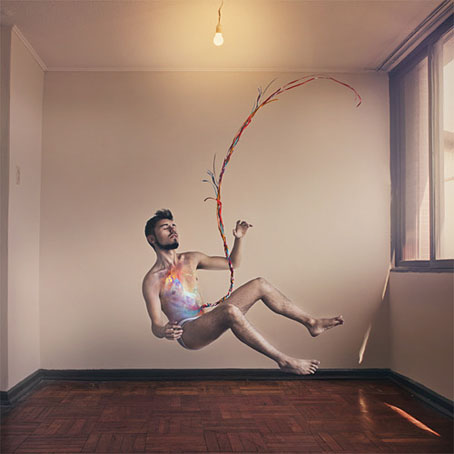
Self-portrait by Jon Jacobsen from his Home series.

Steven Arnold: Cabinet of Curiosities is “a retrospective exhibition of this groundbreaking yet under-recognized queer artist at the ONE Archives Gallery & Museum in West Hollywood. The exhibition celebrates Arnold’s radical imagination, presenting many of his tableaux vivant photographs alongside never before exhibited drawings, sketchbooks, paintings and original poster art. In conjunction with the exhibition, ONE will screen Arnold’s four films, including Luminous Procuress (1970), which featured The Cockettes and was lauded by Salvador Dalí.” The exhibition runs to  January 12, 2013.

• “The boundary-pushing techno/sound design duo Emptyset will transform London’s cavernous industrial space Ambika P3 into an immersive sound installation for one night only—and here’s how they’re going to do it”.

• “At one time he was a well-known figure in Montparnasse, where he had a reputation as a master of the occult sciences.” Aleister Crowley is interviewed about his expulsion from France in 1929.

Our normal waking consciousness, rational consciousness as we call it, is but one special type of consciousness, whilst all about it, parted from it by the filmiest of screens, there lie potential forms of consciousness entirely different. We may go through life without suspecting their existence; but apply the requisite stimulus, and at a touch they are there in all their completeness… No account of the universe in its totality can be final which leaves these other forms of consciousness quite disregarded… [T]hey forbid our premature closing of accounts with reality.

William James (1842–1910) quoted in What Should We Do With Our Visions of Heaven—and Hell? by John Horgan at Scientific American.

Screws is an album of piano music by Nils Frahm that’s currently available as a free download (inc. aiffs).

• At Pinterest: Art Visonnaire. Related: Ain’t We Got Fun: The magical surrealism of Jen Ray.

Rowan Somerville “challenges the purpose and legitimacy” of the Bad Sex Awards.

Jimmy’s End: the website for the film by Alan Moore & Mitch Jenkins.

Douglas Rushkoff in conversation with Genesis Breyer P-Orridge.

• Linda Rodriguez McRobbie explores The History of Boredom.

• Recreating the sounds of the BBC Radiophonic Workshop.

Alchemical Emblems, Occult Diagrams, and Memory Arts.

Rocaille: A Blog about Decadence, Kitsch and Godliness.

• A new video for Goddess Eyes II by Julia Holter.

• The complete audio recordings of Jean Cocteau.

The Rumpus interview with Russ Kick.

Forgotten Bookmarks

• RIP Spain Rodriguez

Astradyne (1980) by Ultravox (produced by Conny Plank) | Biomutanten (1981) by Les Vampyrettes (Conny Plank & Holger Czukay) | Never Gonna Cry Again (1981) by Eurythmics (feat. Holger Czukay, produced by Conny Plank).

How It Works

hiw1.jpg

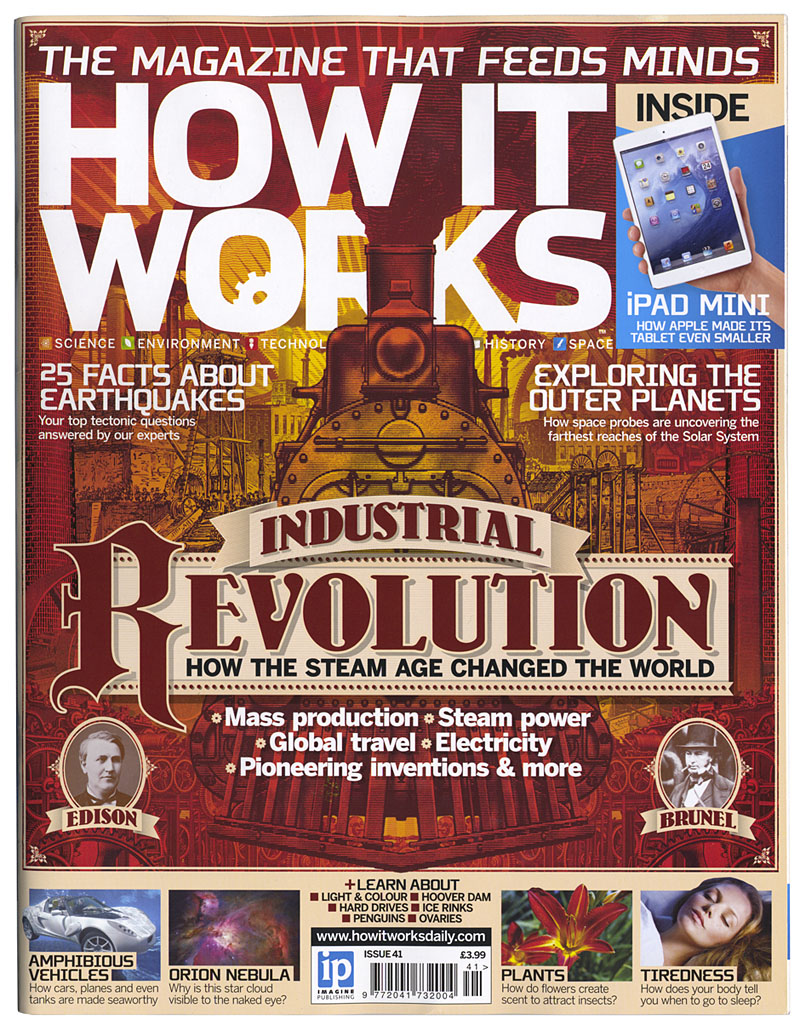
Yes, it’s all happening this month… Unlike other work that’s surfaced recently the cover art for issue 41 of How It Works magazine was completed less than a month ago. Headlines obscure much of the artwork but the picture is also run full-page inside, something I wasn’t expecting. How It Works has major newsstand distribution so people in the UK may see this on shelves in newsagents and supermarkets throughout December.

The theme is the Industrial Revolution but the brief was for something similar to a couple of my recent steampunk illustrations, with a request for a colour scheme like that used for the Bookman Histories cover. The main visual requirement was the train looming out of the picture. I thought this wouldn’t be a problem, I have the old Dover Publications’ Transportation book which features many copyright-free engravings of trains, in addition to other books and source material downloaded from the Internet Archive. One of these would be sure to have a decent front elevation of a steam locomotive, right? Wrong. When you start looking for pictures of locomotives you quickly find that 99% of them show the machines from the side or from an angle, as on the Bookman cover. I downloaded three entire books of over 500-pages each from the Internet Archive, fantastic volumes in themselves, especially Modern Locomotive Construction (1892) which contains meticulous descriptions of every last part of a steam locomotive, down to the smallest screw. But none of their drawings were usable.

Continue reading “How It Works”