John Austen’s Harlequin

austen01.jpg

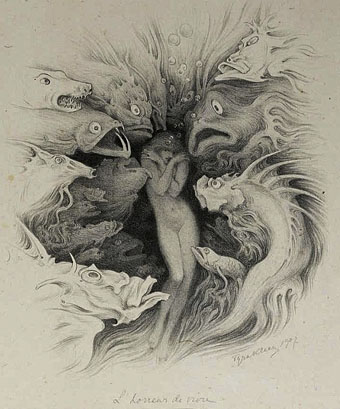
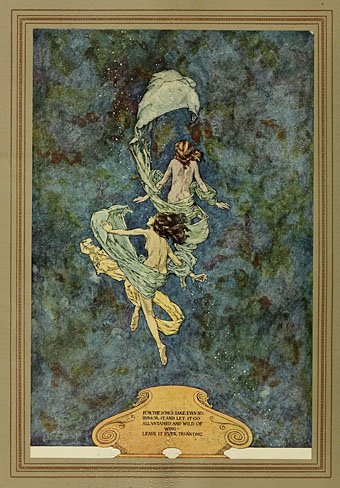
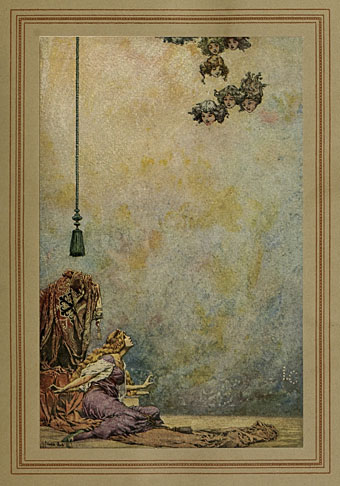
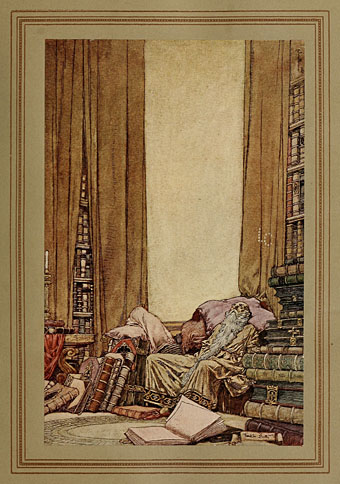
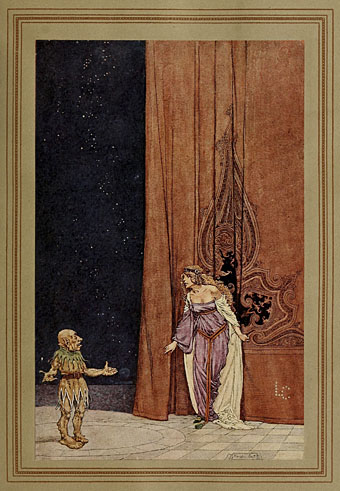
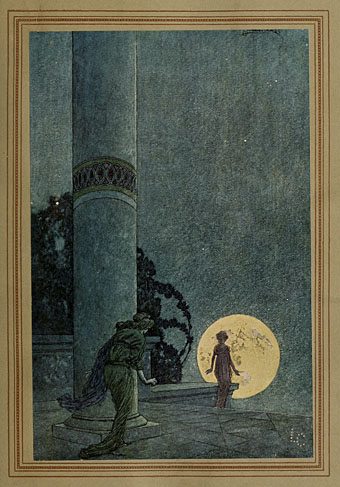
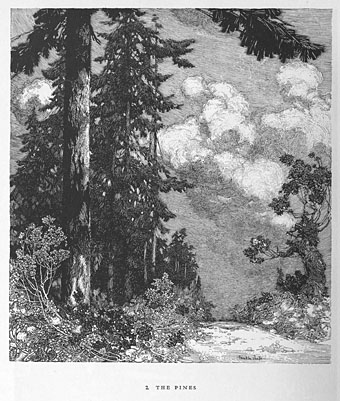
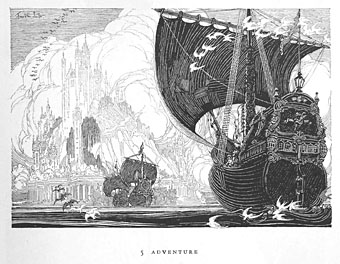
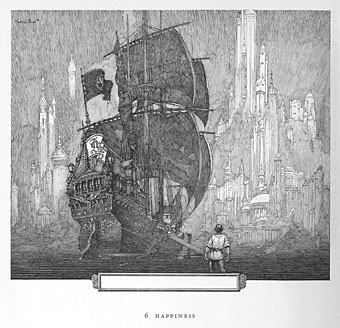
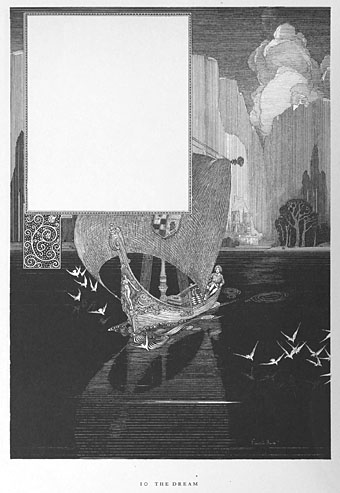
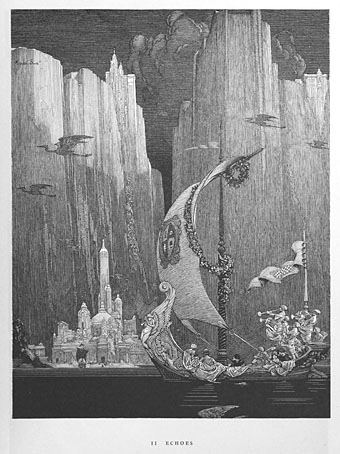
The familiar characters of the Commedia dell’arte—Harlequin, Columbine, Pierrot et al—are depicted here by British illustrator John Austen for The Adventures of Harlequin (1923), a prose recounting by Francis Bickley of events in the life of the trickster character. Or a life… Since Harlequin has only ever been a theatrical archetype Bickley has to employ considerable invention to flesh out the details. The enterprise may be a questionable one but I’m always happy to see another book illustrated by Austen, especially when so many of his illustrated editions remain difficult to find. A Pierrot figure appeared in the first of these, The Little Ape and Other Stories, at a time when Austen’s drawing style was closer to Harry Clarke in its use of decorative detail. His style continued to evolve throughout the 1920s. Here it’s closer to George Barbier, the French artist who drew his own Commedia dell’arte trio when illustrating Michel Fokine’s Carnaval for a ballet portfolio, Designs on the Dances of Vaslav Nijinsky.

austen02.jpg

austen03.jpg

austen04.jpg

austen05.jpg

Continue reading “John Austen’s Harlequin”

Emshwiller illustrates Bester

emshwiller01.jpg

Having finished reading The Count of Monte Cristo I thought I’d, er jaunt from the 1840s into the far future by revisiting Alfred Bester’s Dumas-derived The Stars My Destination. I prefer the alternate title to Bester’s novel, Tiger! Tiger!, but Stars… is the one that’s more commonly used, with the unfortunate side-effect of making the book sound like a typical space opera of the 1950s. The story may begin in space but most of it takes place on Earth in the 24th century. Bester borrows the revenge theme and a couple of other details from The Count of Monte Cristo but wisely resists any attempt to imitate the labyrinthine plotting of the Dumas novel.

emshwiller02.jpg

Before publication in book form, the story was serialised in four parts in Galaxy magazine, from October 1956 to January 1957; Ed “Emsh” Emshwiller illustrated each instalment as well as the cover of the debut issue. I’ve said before that one of the great benefits of being able to browse old magazines online is having the opportunity to turn up neglected illustrations like these. Bester’s novel has long been regarded as a genre classic—Michael Moorcock and William Gibson both refer to it as a favourite—but its print editions haven’t generated many memorable covers. Here we have Emshwiller illustrating the entire story, and doing an excellent job, yet his drawings have been buried for years.

emshwiller03.jpg

For the purposes of this post I’ve removed the text surrounding some of the illustrations in order to highlight the drawings. The original printings, plus the full text of the serialised story, may be found at the links below:

Galaxy, October 1956
Galaxy, November 1956
Galaxy, December 1956
Galaxy, January 1957

emshwiller04.jpg

emshwiller05.jpg

Continue reading “Emshwiller illustrates Bester”

Ralph Steadman, 1977

steadman1.jpg

This is the kind of thing I like to see: 35 minutes of an artist doing nothing but drawing or talking about drawing. Michael Dibb’s profile of Ralph Steadman is the earliest BBC portrait of the artist, made for the long-running Arena arts series. Arena was launched in 1975 but films from the series prior to 1980 are rare things on the internet. This one concentrates on Steadman’s creation of a drawing for a new book, The Cherrywood Cannon, an anti-war story by Dimitri Sidjanski. In between work on the drawing Steadman describes how he approached illustrating Alice Through the Looking-Glass, and his drawings of the Patty Hearst trial, before repairing to the local pub where he sketches the regulars. Hunter S. Thompson only receives a passing mention, which may surprise some viewers; if it’s Thompson you’re after then you’ll want to see Fear and Loathing on the Road to Hollywood, the 1978 Omnibus profile of the writer which features Steadman again, plus many more of his drawings.

steadman2.jpg

The Arena film is relatively short but valuable for the insight it gives into Steadman’s technique: no preliminary drawing, for example, he starts with ink on a blank sheet of paper. I was amused to see him using a spray diffuser to fill in the background. This is a kind of lung-powered airbrush, an angled tube which you place in your bottle of ink then blow through to create spray effects. I used one myself for a while as a rougher (and cheaper) alternative to an airbrush, before graduating to using old toothbrushes which are easier to control when spattering ink. I’d always assumed that Steadman used an airbrush himself but seeing his loose approach to sketching it makes sense that he’d like the grainier, less predictable textures created by a diffuser.

steadman3.jpg

Michael Dibb’s film is at the producer’s Vimeo channel together with many other excellent documentaries, including John Berger’s landmark Ways of Seeing series.  Vimeo changed its policies recently, insisting that you sign in if you want to see something that hasn’t been rated by the user (ie: most of the things there). This can be avoided by using the mobile Vimeo app, an option which also gives you better search facilities.

Elsewhere on { feuilleton }
The illustrators archive

Previously on { feuilleton }
Ralph Steadman record covers
Beardsley and His Work

Weekend links 639

alphaville.jpg

Japanese poster for Alphaville (1965).

Peter Bogdanovich: I think we’d better have your thoughts on Godard.

Orson Welles: Well, since you’re so very firm about it. He’s the definitive influence if not really the first film artist of this last decade, and his gifts as a director are enormous. I just can’t take him very seriously as a thinker—and that’s where we seem to differ, because he does. His message is what he cares about these days, and, like most movie messages, it could be written on the head of a pin. But what’s so admirable about him is his marvellous contempt for the machinery of movies and even movies themselves—a kind of anarchistic, nihilistic contempt for the medium—which, when he’s at his best and most vigorous, is very exciting.

• RIP JLG. I was watching Alphaville again just two weeks ago after a DVD turned up in the local charity shop. Still the only Godard film I like 100% but “liking” seems beside the point. His influence today is everywhere, so fully absorbed into the language of cinema that people barely notice it.

• “The things that cause my gaze to linger are usually the portraits or landscapes that spark a feeling of unease, disquiet and discomfort. A shadow amongst the summer trees, a lurking silhouette reflected in a perfect blue iris, a vibrant flower in the early stages of decay.” S. Elizabeth talking to Beautiful Bizarre about her new book, The Art of Darkness: A Treasury of the Morbid, Melancholic and Macabre.

• Allow John Waters (again) to dictate your film viewing with a Letterboxd list of his favourite films, based on comments in his writings and interviews. On the subject of Godard, Waters’ Crackpot book contains a whole chapter about Hail Mary.

• Astor’s Electrical Future: Iwan Rhys Morus explores a vision of the year 2000 recounted in A Journey in Other Worlds (1894), a “scientific romance” by John Jacob Astor IV, with illustrations by Daniel Carter Beard.

• Strange Attractor has announced a Kickstarter campaign to fund the publication of an Austin Osman Spare Tarot deck.

• At Wormwoodiana: The Parrot, the Unicorn and the Golden Dragon: Some 17th Century Booksellers’ Signs.

• At Bandcamp: Andy Thomas on Chris Watson‘s post-Cabaret Voltaire career in nature recordings.

• A new outlet for cinematic obscurities: Radiance Films.

Alphaville (1978) by Klaus Schulze | Alphaville (1979) by The Monochrome Set | Alphaville (1999) by Scanner

Weekend links 636

frey.jpg

Untitled painting by Oliver Frey based on The Wild Boys by William Burroughs.

• RIP Oliver Frey, a prolific illustrator and comic artist whose art for UK computer magazines in the 1980s made a lasting impression on a generation of games players, hence this obituary at Eurogamer. On this site, however, Frey is also remembered for his artistic alter-ego “Zack” (previously), an equally prolific creator of comic-strip erotica for Britain’s few gay-porn mags at a time when any such material being sold in the UK ran the risk of police seizure or even a court appearance. For a while, Zack’s Rogue and Tom of Finland’s Kake were rare examples of assertive, unashamedly lustful gay characters with strips of their own, which makes Oliver Frey something of a pioneer, and a daring one at that.

• “The title characters were a trio of boys named Jupiter Jones, Pete Crenshaw, and Bob Andrews, who live in the fictional California town of Rocky Beach, not far from Hollywood, on the coast…” Colin Fleming on the satisfyingly spooky adventures of Robert Arthur Jr’s Three Investigators. I was never as obsessive as Fleming was but I read all of the books about the trio that I could find in our local library.

• “Though its inimitable visual style has safeguarded it as a quintessential cult film most at home behind a shroud of pot smoke, the influence of Koyaanisqatsi has been sweeping.” Josef Steen on 40 years of Godfrey Reggio’s Koyaanisqatsi.

• “Putting it simply, coincidences and curiosities and chance encounters happen when people go looking for zodiacs.” Mark Valentine on Britain’s terrestrial zodiacs.

• At Literary Hub: Marguerite Duras on writing the screenplay for Alain Resnais’s Hiroshima Mon Amour.

• New/old music: a reissue of Solar Maximum by Majeure.

• New music: Kerber Remixes by Yann Tiersen.

• At Dennis Cooper’s: Ingrid Caven Day.

• Threnody To The Victims Of Hiroshima (1959-61) by Krzysztof Penderecki | Memory Of Hiroshima (1973) by Stomu Yamash’ta | Hiroshima Mon Amour (1977) by Ultravox!