Harry Clarke’s The Year’s at the Spring

clarke1.jpg

The Internet Archive seems to be improving as a resource for out-of-copyright books. Browsing there this week it’s become apparent that a number of recent additions include rare illustrated titles which can be downloaded as PDFs or scanned pages. Project Gutenberg has the quantity where free books are concerned but their quality leaves much to be desired when it comes to illustrations. The nice thing about these scans from libraries is that they copy the complete book, including covers and endpapers. In many cases the covers have been spoiled by bar code stickers and other library ephemera but they still give a good idea of the original volume.
clarke2.jpg

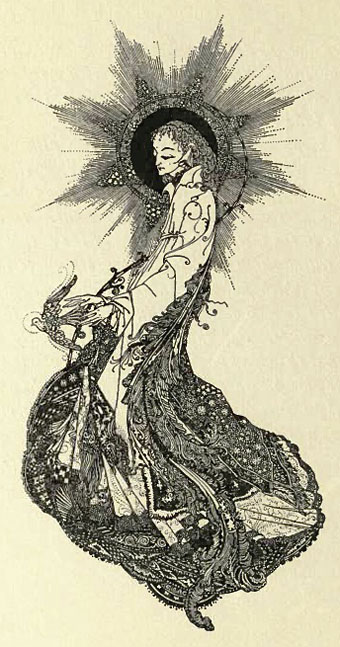
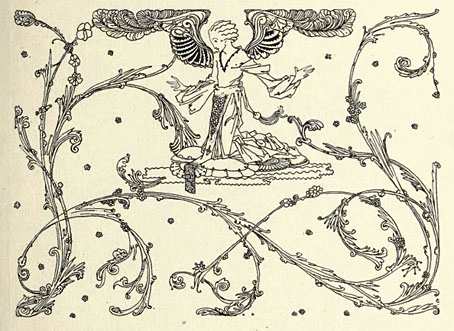
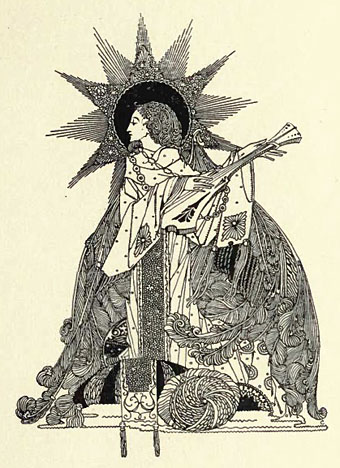
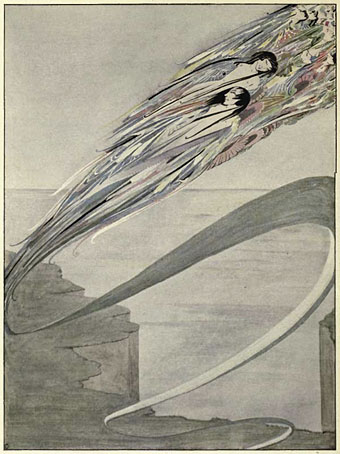
First of the discoveries is this poetry collection, The Year’s at the Spring (sic), from 1920 illustrated by the peerless Harry Clarke (1889–1931). Among the poets featured are WB Yeats, GK Chesterton, Rupert Brooke and Walter de la Mare. This really is a discovery for me since I don’t think I’ve seen any of the illustrations before. The drawings are certainly up to the standard of Clarke’s other work and the colour plates show a possible Japanese influence in some cases, as well as being reminiscent of the colour plates for his Poe volume. There are 21 full-page illustrations in all, with many vignettes.

A couple more illustration samples follow below the fold. I’ll be featuring other titles which have caught my eye over the next few days.
clarke31.jpg

clarke4.jpg

“I am born of a thousand storms, and grey with the rushing rains.”

Elsewhere on { feuilleton }
The illustrators archive

Previously on { feuilleton }
My pastiches

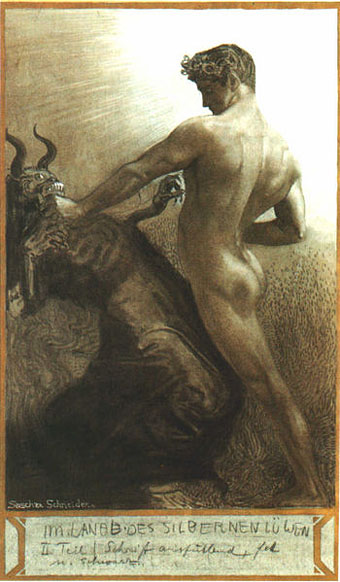
The art of Sascha Schneider, 1870–1927

schneider1.jpg

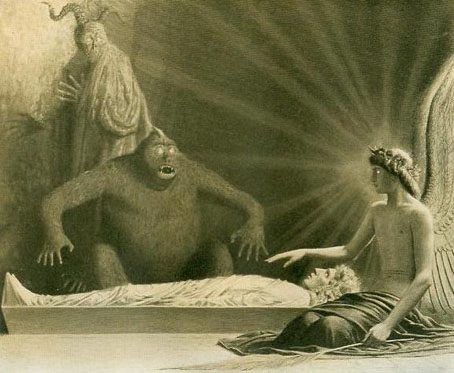
I first came across Sascha Schneider’s art some years ago when reading about German writer Karl May (1842–1912), and it was as May’s illustrator that Schneider initially gained recognition. May was one of Germany’s most popular novelists, his Western adventures about Old Shatterhand and Winnetou the Warrior sold millions of copies and numbered Albert Einstein and Adolf Hitler among their enthusiasts. Schneider’s work struck me as unusual compared to other illustrators of the period; there was a curious quality which seemed to owe more to Symbolist painting than book illustration and the few examples I saw were distinctly homoerotic at a time when homosexuality was regarded with suspicion or downright hostility. Sure enough it turns out that Schneider was openly gay and that May had no problem with this. It also transpires that the Symbolist tone which seemed so unsuited to a writer of Western pulp fiction complemented the content of some of May’s later works which weren’t Westerns at all but were Orientalist fantasies with a metaphysical inclination. The publisher wasn’t too happy with the ambivalent nature of these pictures, however, and they were replaced in later editions.

schneider14.jpg

For once I don’t have to complain about a lack of website examples, Schneider’s connections with May have at least ensured his work is still being written about even if it seems overlooked by gay art histories. This latter circumstance is unusual since he was a contributor to Der Eigene, the world’s first gay periodical, founded by Adolf Brand in 1896.

I’ve taken the liberty of posting more samples than usual here and you’ll have to forgive the lack of information about titles and dates. Many of the pictures are quite bizarre for the way they’re continually juxtaposing naked figures with angels, demons or monsters. Even the Winnetou illustrations, which should be depicting Native Americans, look more suited to the wall of a salon in fin de siècle Paris than stories of the Wild West. Links to various galleries follow.

Schneider’s Karl May frontispieces
An extensive Russian gallery
A smaller Schneider gallery

Continue reading “The art of Sascha Schneider, 1870–1927”

William Blake in Manchester

blake.jpg

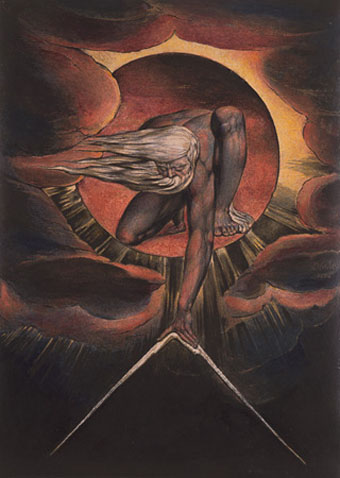
Europe: A Prophecy by William Blake (1794).

Two exhibitions based around the work of William Blake open today at Manchester’s Whitworth Art Gallery, Mind-Forg’d Manacles, “organised to coincide with the 250th anniversary of Blake’s birth as well as the 200th anniversary of the Parliamentary abolition of the transatlantic slave trade” and Blake’s Shadow: William Blake and his Artistic Legacy. The latter seems to be the more interesting of the two.

Blake’s Shadow: exhibition summary

This exhibition explores Blake’s continuing fascination for artists, filmmakers and musicians. It features around sixty watercolours, prints and paintings in addition to numerous illustrated books and a range of audio-visual material. Blake is a unique figure in British visual culture, attracting both academic and popular interest. In the years since his death in 1827, Blake has continued to influence the world of creativity and ideas. He has inspired people with such wide ranging interests as literature, painting, book design, politics, philosophy, mythology through to music and film making. Alongside works by Blake—prints, watercolours, engravings and book illustrations—the exhibition spans two centuries of his influence.

• His contemporaries in the late 18th and early 19th century are represented with works from John Flaxman, Edward Calvert, Samuel Palmer, J.H. Fuseli and Thomas Stothard
• Blake’s influence on artists in the Victorian period is explored through works by Ford Madox Brown, Walter Crane, Frederic Shields, John Everett Millais, Dante Gabriel Rossetti, Simeon Soloman and G.F. Watts.
• British artists working in the 20th and 21st century include Cecil Collins, Douglas Gordon, Paul Nash, Anish Kapoor, David Jones, Ceri Richards, Patrick Proctor, Austin Osman Spare and Keith Vaughan. This section of the exhibition features photographs and original works.
• From the 1960s onward, writers, musicians, film makers like Allen Ginsberg, Bob Dylan, Jim Morrison of The Doors and John Lennon have adopted Blake as a mystical seer and anti-establishment activitist. More latterly, as British musicians and activists like Billy Bragg and Julian Cope have grappled with notions of national identity, Blake has enjoyed something of a renaissance. Blake’s Shadow examines this more recent influence as evidenced in work by the filmmakers Jim Jarmusch and Gus Van Sant, and various musicians, notably Patti Smith and Jah Wobble.

spare.jpg

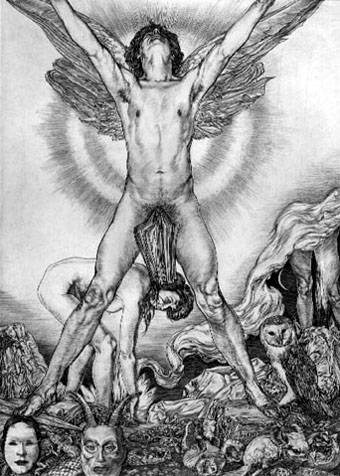
The Dawn by Austin Spare (no date).

It’s good to see Austin Spare being included in something like this. He always referred to Blake as an influence but, as I’ve mentioned before, he’s frequently been treated disrespectfully by an art establishment that doesn’t know what to make of the occult basis of his work.

Mind Forg’d Manacles runs to 6 April 2008, Blake’s Shadow to 20 April.

Elsewhere on { feuilleton }
The illustrators archive

Previously on { feuilleton }
Austin Spare in Glasgow
Tygers of Wrath
Austin Osman Spare

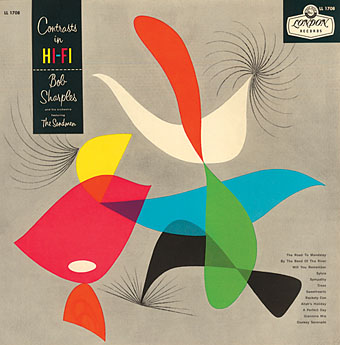
Alex Steinweiss: creator of the album cover

steinweiss2.jpg

Contrasts in Hi-Fi by Bob Sharples.

A Tribute to Alex Steinweiss
The Creator of the Album Cover

Robert Berman Gallery announces an exhibition of Alex Steinwiss. Original album covers, paintings, and collages by Steinweiss, and special tribute by selected artists. Co-curated by Kevin Reagan and Greg Escalante.

In 1939, a 23 year-old graphic designer revolutionized the music industry. No longer would records come in plain brown wrappers. As Art Director at Columbia Records, Steinweiss created the ‘album package.’ His idea was to create a visual to complement the musical. It was an instant success, and spawned an entire new field of illustration and design: Album Cover Art. Steinweiss was the king of the genre; his covers are still regarded as icons.In his four decade career, Steinweiss created album covers for musical luminaries such as Louis Armstrong, Duke Ellington, Igor Stravinsky and Benny Goodman.

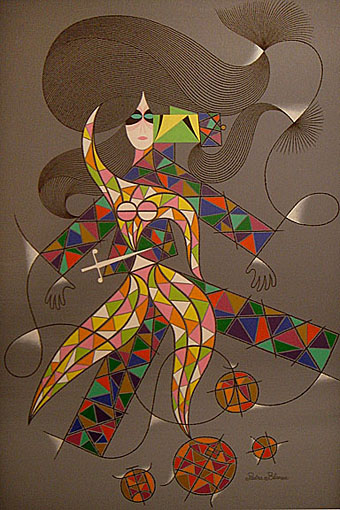
steinweiss1.jpg

The Miraculous Mandarin (circa 1977).

The Steinweiss exhibition will feature 50 of his original cover designs, plus 50 original ‘tribute’ works, created specifically for this show. Artists that are honoring Steinweiss in the show include: Clive Barker, Bill Barminski, Ron English, Mick Haggerty, Raymond Pettibon, Shag, and Glenn Wexler. The featured artists have created album covers for a wide range of musicians, including Black Flag, Dixie Chicks, Goo Goo Dolls, Supertramp, and Rob Zombie.

“Steinweiss is 90 years old this year; this tribute is long over-due. The art community is excited to have a chance to pay homage to Alex’s unprecedented contribution to album cover art,” says Kevin Reagan, three time GRAMMY winning Art Director.

“It’s amazing to discover this one man, this un-sung hero, who is responsible for inventing the album. Steinweiss should be a household name,” says Greg Escalante, curator of Juxtapoz, and co-founder of Copro-Nason Gallery.

“The opportunity to highlight ‘the art of music’ is exciting. You have the energy of two different genres, and their combination is explosive,” says gallery owner Robert Berman. “Just plain design didn’t mean a damn thing,” Steinweiss says. You had to know music. I had to find a way to bring out the beauty of the music and the story.” (dwell, 10/07)

Alex Steinweiss lives in Sarasota, Florida, where he continues to design and paint.

A Tribute to Alex Steinweiss
Gala Opening: January 19th
Show runs through February 12th, 2008

Robert Berman Gallery
Bergamot Station Arts Center
2525 Michigan Avenue, C2
Santa Monica, CA 90404

Alex Steinweiss at the Art Director’s Club Hall of Fame
For the Record: The Life and Work of Alex Steinweiss at Amazon
Alex Steinweiss at Soundfountain

Elsewhere on { feuilleton }
The album covers archive

Mervyn Peake in Lilliput

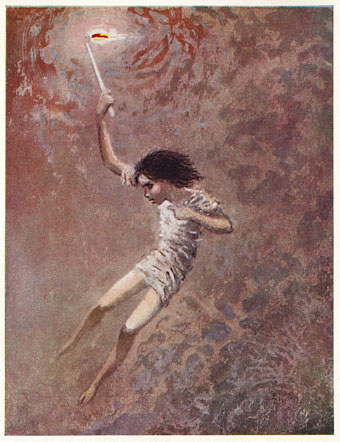
This month I’ve been redesigning the Savoy Books edition of The Exploits of Engelbrecht by Maurice Richardson, in preparation for a reprint. This has involved scanning the covers of the issues of Lilliput, the magazine where Richardson’s tales of the dwarf surrealist sportsman first appeared, and one number of these, from May 1950, also includes a feature about nursery rhymes illustrated by Mervyn Peake. The paintings were reprinted in Mervyn Peake: The Man and his Art in 2006 but shrunk onto a single page so this is a chance to see them at a larger size. Also reproduced below is the accompanying article by Leslie Daiken and the Arcimboldo-style cover by Ronald Ferris. Some of the earlier covers by Walter Trier—all of which featured a man, a woman and a dog in a variety of guises—can be seen at VTS.

Update: For more about Mervyn Peake, see also Peake Studies.

peake1.jpg

“How many miles to Babylon?”
“Three score miles and ten.”
“Can I get there by candle-light?”
“Yes, and back again.
If your heels are nimble and light
You may get there by candle-light.”

Continue reading “Mervyn Peake in Lilliput”