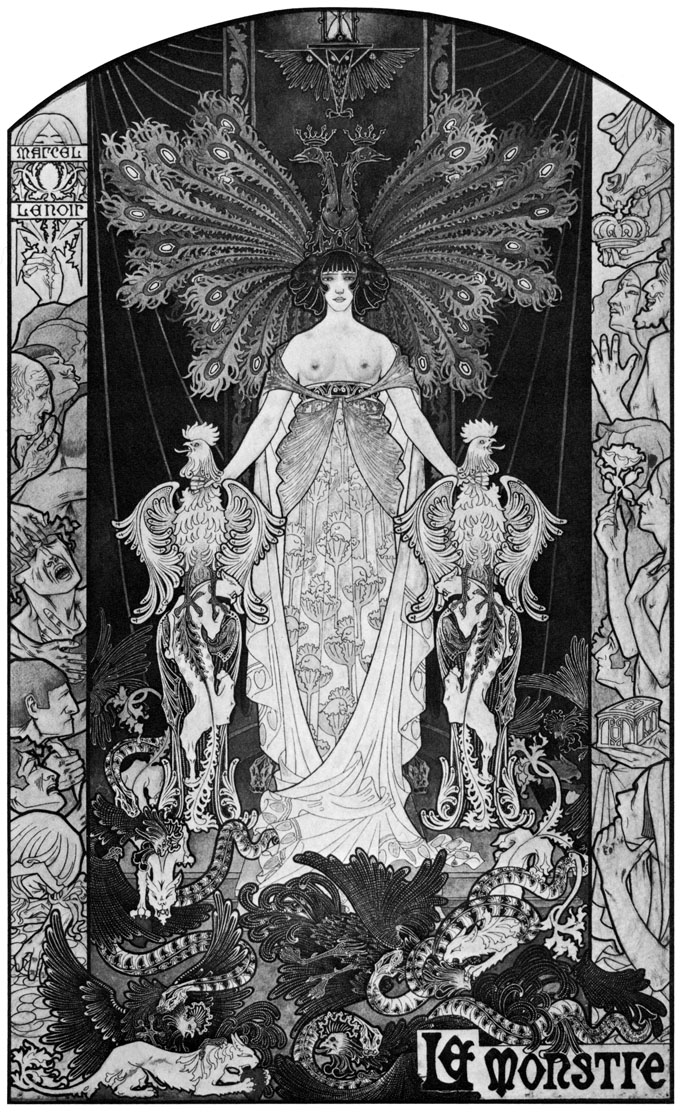
Le Monstre

lenoir11.jpg

Continuing the theme of the fin de siècle feminine, there’s this bizarre (undated) piece by Marcel Lenoir representing…what? A witch? Some demoness? Or woman in general? Considering the often overt misogyny of the period, the latter interpretation is quite possible; there were more than enough artists prepared to see women as the foundation of all evil as well as place them on pedestals. In our post-Freudian age it’s impossible not to do a double-take at a picture of a bare-breasted woman gripping a pair of cocks…
lenoir2.jpg

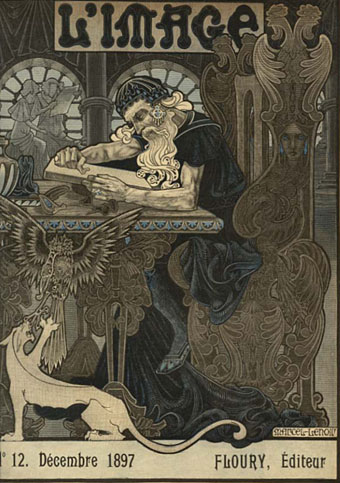
Marcel Lenoir is yet another artist who receives scant attention online but I did find this nice magazine cover from an 1897 number of L’Image. There’s more splendid cover scans here.

Previously on { feuilleton }
The Divine Sarah
Carlos Schwabe’s Fleurs du Mal
Empusa
The art of Philippe Wolfers, 1858–1929
The Masks of Medusa

Sidney Sime and Lord Dunsany

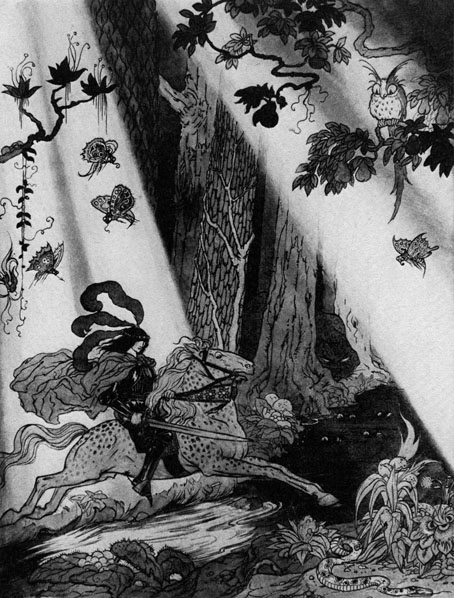
sime1.jpg

‘We would gallop through Africa’ from A Dreamer’s Tales.

More from the book scans at the Internet Archive. Lord Dunsany was Edward John Moreton Drax Plunkett, 18th Baron of Dunsany and a writer of a number of fantasy tales beginning with The Gods of Pegana in 1905. His work is notable these days for having been a huge influence on the early stories of HP Lovecraft who once divided his literary output into his Poe pieces and his Dunsany pieces. Dunsany found an ideal illustrator in Sidney Sime who started out as a Beardsley pasticheur but developed his own slightly comical variant on the kind of exotica favoured by Edmund Dulac and Kay Nielsen.

Of the Dunsany/Sime books, Archive.org has The Sword of Welleran (1908), A Dreamer’s Tales (1910), The Book of Wonder (1912) and Tales of Wonder (1916). These stories are frequently too whimsical for my tastes—I’ve never been very keen on Lovecraft’s Dunsany pieces either—but they’re still worth a look for anyone interested in the lighter side of 20th century fantasy.

sime2.jpg

‘The City of Never’ from The Book of Wonder.

Elsewhere on { feuilleton }
The illustrators archive

Previously on { feuilleton }
HP Lovecraft’s favourite artists

Ballantine Adult Fantasy covers

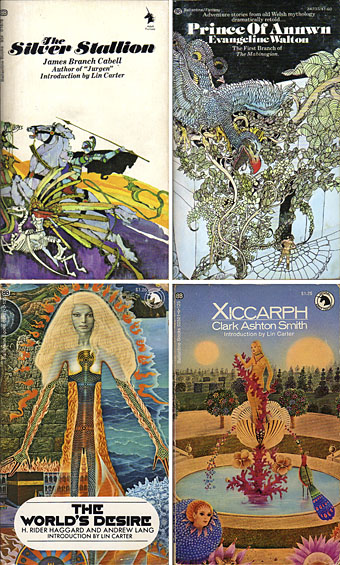
baf.jpg

top left: Bob Pepper (1969); right: David Johnston (1974).
bottom left: Mati Klarwein (1972); right: Gervasio Gallardo (1972).

I wrote about the classic line of fantasy paperbacks in the Ballantine Adult Fantasy series last year as part of the post about Bob Pepper’s illustration:

It was the success of the publication of The Lord of the Rings in America which inspired Betty Ballantine to publish a line of fantasy classics in the late Sixties. The series began its run in 1969 and continued until 1974. Lin Carter was commissioned as editor and given free reign to choose any title he thought might be suitable with the result that many of the books in the series—obscurities such as Lud-in-the-mist by Hope Mirrlees—received their first paperback publication. Carter also reprinted personal favourites which frequently shifted from fantasy to outright horror, such as the titles from HP Lovecraft and William Hope Hodgson. The range and scope of this line is what makes the series so notable today and the books have become highly-collectable as a result.

I’m fairly sure this page of cover scans of the BAF series wasn’t there when I was searching for Pepper covers. Whether it was or not, it contains a lot of Bob Pepper artwork I hadn’t seen before at large size, plus a substantial number of the other covers. I was never all that taken with Gervasio Gallardo’s work which took the lion’s share of the illustration duties but the passage of time has lent his paintings and their florid title designs the distinction of being emblematic of the era. And some of the rest are still pretty decent covers.

Elsewhere on { feuilleton }
The illustrators archive
The book covers archive

Previously on { feuilleton }
The art of Bob Pepper
Fantastic art from Pan Books

The art of Charles Robinson, 1870–1937

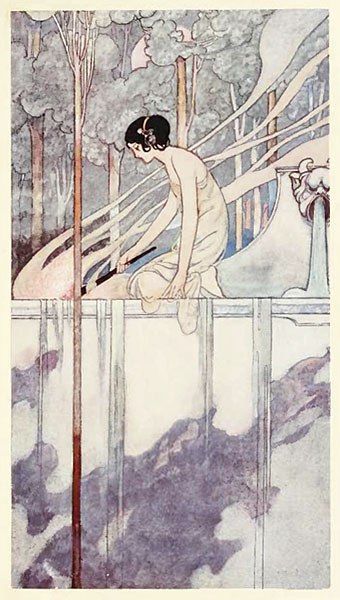
cr1.jpg

‘Fair and False’, Songs and Sonnets by William Shakespeare (1915).

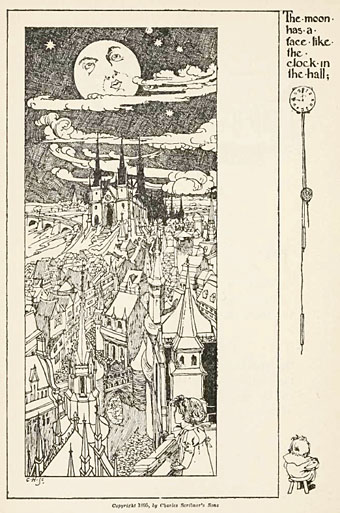
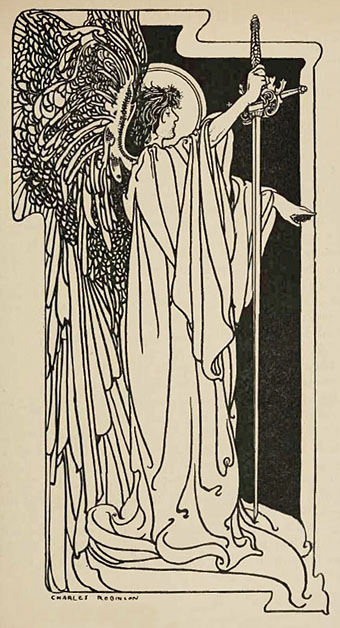
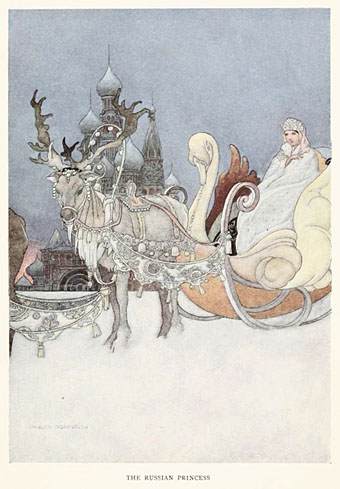
More illustrated gems from the collection of books at the Internet Archive. Charles Robinson, as mentioned earlier, was the older brother of illustrator William Heath (there was also a third illustrator brother in the family, Thomas). Charles was so prolific it’s difficult to choose one work over the many examples available in the Internet Archive, so here’s a brief selection from different books. If you only look at one of these, his oft-reprinted edition of A Child’s Garden of Verses by Robert Louis Stevenson is especially fine. There’s a distinct Art Nouveau flavour to much of Charles Robinson’s work and he also devoted more attention to page layout than his younger brother, many of his drawings being presented within sinuous frames and augmented by some very elegant lettering. If they haven’t been digitised already at Fontcraft’s Scriptorium, some of these type designs would make great fonts.

cr6.jpg

A Child’s Garden of Verses by Robert Louis Stevenson (1895).

cr4.jpg

Lullaby-land : Songs of Childhood by Eugene Field (1897).

cr2.jpg

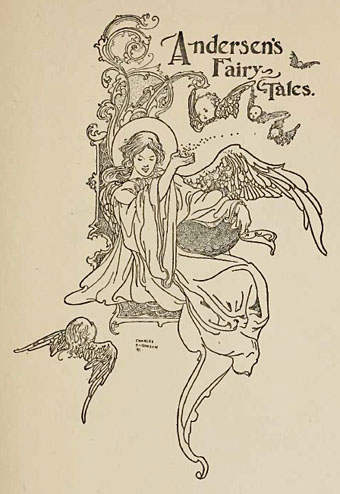
Fairy tales from Hans Christian Andersen (1899).

cr3.jpg

‘The Red Shoes’, Fairy tales from Hans Christian Andersen (1899).

cr5.jpg

The Story of the Weathercock by Evelyn Sharp (1907).

cr7.jpg

The Happy Prince and Other Tales by Oscar Wilde (1913).

Elsewhere on { feuilleton }
The illustrators archive

William Heath Robinson’s Midsummer Night’s Dream

mnd1.jpg

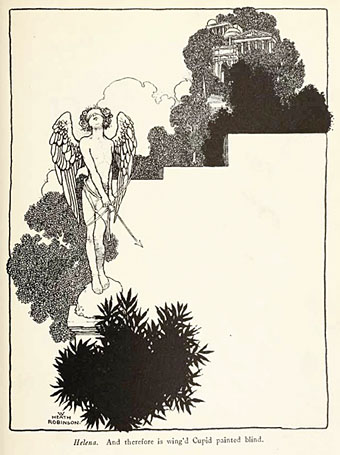
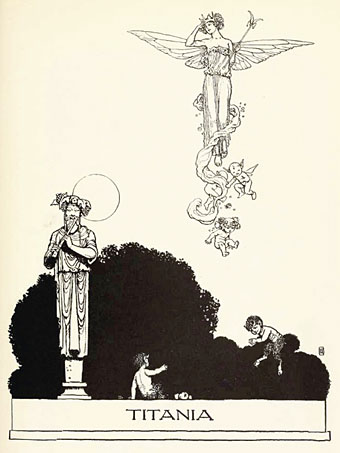
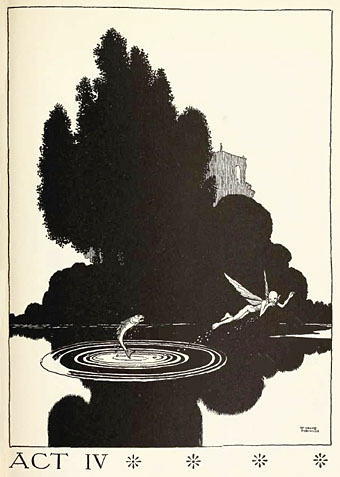
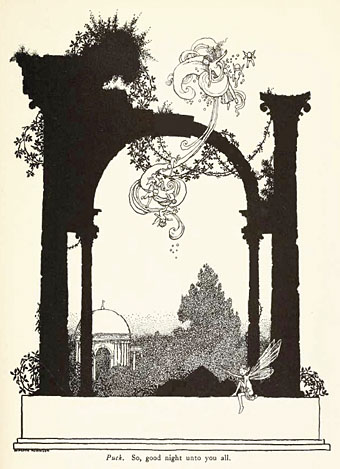
I wasn’t planning on featuring William Heath Robinson again so soon but I couldn’t resist posting some extracts from his 1914 edition of A Midsummer Night’s Dream, another great download from the scanned books at the Internet Archive. I have a few of these illustrations in a WHR monograph but I didn’t realise the book as a whole was so good. The Robinson brothers had a remarkable mastery of space in their work, no doubt derived from Beardsley but they found a way to make his expanses of black and white work for their own distinctive styles. This book, like many of those of the period, features colour plates but I much prefer Heath Robinson’s black-and-white work to his watercolours. His Poe book contains many fine drawings but his style is more suited to this Shakespeare play, especially in the depictions of clouds of fairy figures tumbling through the air.

mnd2.jpg

mnd3.jpg

mnd4.jpg

Elsewhere on { feuilleton }
The illustrators archive.

Previously on { feuilleton }
William Heath Robinson’s illustrated Poe