Deutsche Kunst und Dekoration #1

dkd01-01.jpg

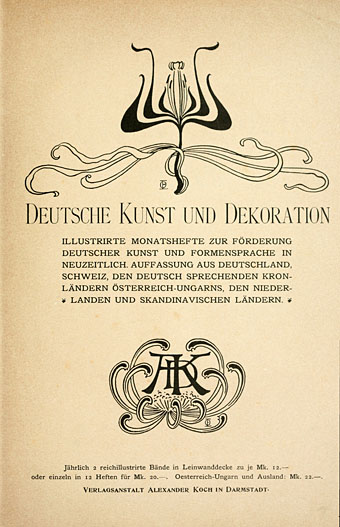
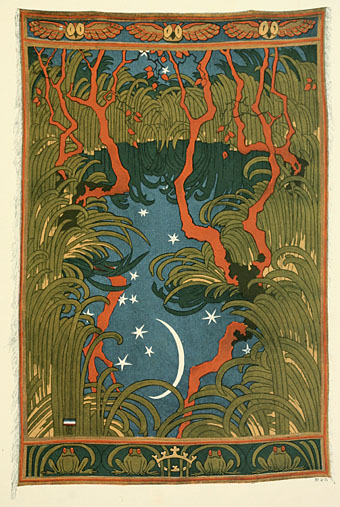
Last year saw an exploration here of the fecund pages of Jugend magazine so in the same spirit I’m embarking on a serial delve into Jugend‘s more serious contemporary Deutsche Kunst und Dekoration. I’ve made a couple of posts in this direction already but these were done before I’d had a chance to look properly through the editions at the Internet Archive, the first thirty of which form a collection which comprises some 7500 pages. Since few people would want to download and sort through that mountain these posts can serve as a select guide to the contents.
dkd01-02.jpg

Deutsche Kunst und Dekoration was published by Alexander Koch in Darmstadt and the first volume is dated October 1897–March 1898. Jugend was a humour magazine so the contents tend to be frivolous and lighthearted, Koch’s title by contrast was a guide to the best of German contemporary art and design and has the advantage of featuring furniture and architectural designs as well as graphic material. The content of this first edition is relatively sedate compared to some of the later numbers when the Art Nouveau style builds up a head of steam. There’s some astonishing design work in subsequent issues, as well as further illustration discoveries like Marcus Behmer. Watch this space.
Continue reading “Deutsche Kunst und Dekoration #1”

“Who is this who is coming?”

whistle4.jpg

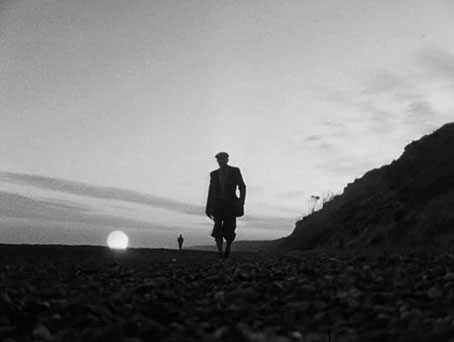
Whistle and I’ll Come to You (1968).

He blew tentatively and stopped suddenly, startled and yet pleased at the note he had elicited. It had a quality of infinite distance in it, and, soft as it was, he somehow felt it must be audible for miles round. It was a sound, too, that seemed to have the power (which many scents possess) of forming pictures in the brain. He saw quite clearly for a moment a vision of a wide, dark expanse at night, with a fresh wind blowing, and in the midst a lonely figure—how employed, he could not tell. Perhaps he would have seen more had not the picture been broken by the sudden surge of a gust of wind against his casement, so sudden that it made him look up, just in time to see the white glint of a sea-bird’s wing somewhere outside the dark panes.

MR James, Oh, Whistle, and I’ll Come to You, My Lad.

One of the alleged highlights of this year’s Christmas television from the BBC was a new adaptation of an MR James ghost story, Oh, Whistle, and I’ll Come to You, My Lad. The film starred John Hurt and came with the same truncated title, Whistle and I’ll Come to You, as was used for Jonathan Miller’s 1968 version, also a BBC production. The story title comes originally from a poem by Robert Burns. The new work was adapted by Neil Cross and directed by Andy de Emmony, and I describe it as an alleged highlight since I wasn’t impressed at all by the drama, the most recent attempt by the BBC to continue a generally creditable tradition of screening ghost stories at Christmas. Before I deal with my disgruntlement I’ll take the opportunity to point the way to some earlier derivations. (And if you don’t want the story spoiled, away and read it first.)

Continue reading ““Who is this who is coming?””

Wildeana 4

hichens.jpg

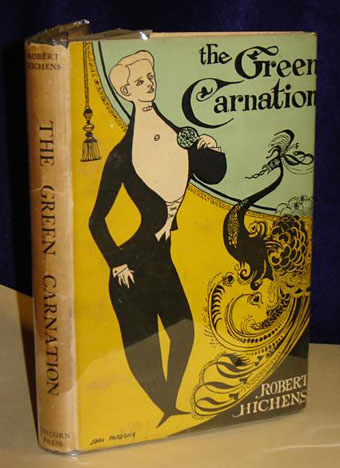
I could make these posts a lot more often since there’s seldom a week goes by when Oscar Wilde’s work or something from his life isn’t making the news somewhere. I forget now how I came across the Robert Hichens book but the Beardsley-derived cover design is the best I’ve seen for this title. The Green Carnation was first published in 1894 and is the notorious roman à clef whose lead characters, Esmé Amarinth and Lord Reginald Hastings, are based on Wilde and Lord Alfred Douglas. Hichens paints the pair as very obvious inverts with none of the “is he or isn’t he?” subtlety that Wilde managed to sustain in public. For a scandalised London the book seemed to confirm what was already suspected about Wilde and Bosie’s relationship.

The cover art is credited to one John Parsons, an illustrator whose other work, if there is any, eludes the world’s search engines. This edition was published in 1949 by Unicorn Press and it’s something I’m tempted to buy as a companion for my Unicorn Press edition of Dorian Gray.

The following links are to recent articles spotted whilst looking for other things:

Oscar Wilde, Classics Scholar. A review of The Women of Homer by Oscar Wilde, edited by Thomas Wright and Donald Mead.
• A new Broadway production of The Importance of Being Earnest has actor Brian Bedford playing Lady Bracknell.
Buyers go Wilde for Oscar as short note to his friend sells for €1,500.
Outsmarted: What Oscar Wilde could teach us about art criticism.

Elsewhere on { feuilleton }
The Oscar Wilde archive
The book covers archive

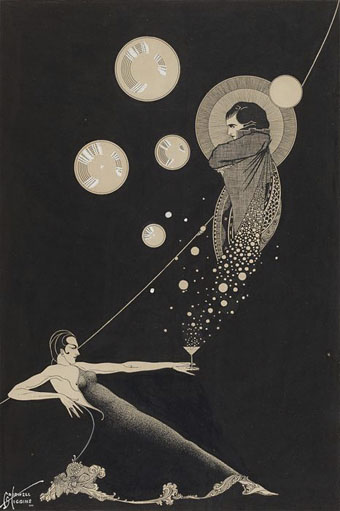
Cardwell Higgins versus Harry Clarke

higgins1.jpg

A Delightful Page in the Record of My Existence.

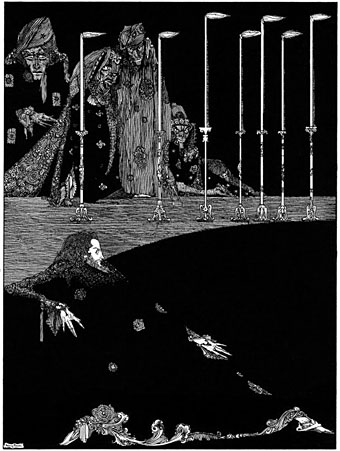
This picture popped up at Chateau Thombeau a few days ago and it’s also been circulating in Tumblr’s recursive labyrinth. The very obvious debt to Harry Clarke’s black-and-white style caught my attention, especially to the artist’s Poe illustrations with the reclining woman being a blatant swipe from one of the Pit and the Pendulum drawings.

clarke.jpg

The Pit and the Pendulum (1919) by Harry Clarke.

Searching around revealed that the artist responsible, Cardwell Higgins, produced a small series of similar pieces in the late 1920s. He then settled into a career as an illustrator for American magazines and advertising, working in a far more commercial style which isn’t really the kind of thing I get very excited over. Six drawings from the black-and-white series were published as a lthograph set in 1979. Some of the originals came up for sale recently which accounts for the surfacing of these copies.

Continue reading “Cardwell Higgins versus Harry Clarke”

Modern book illustrators, 1914

clarke1.jpg

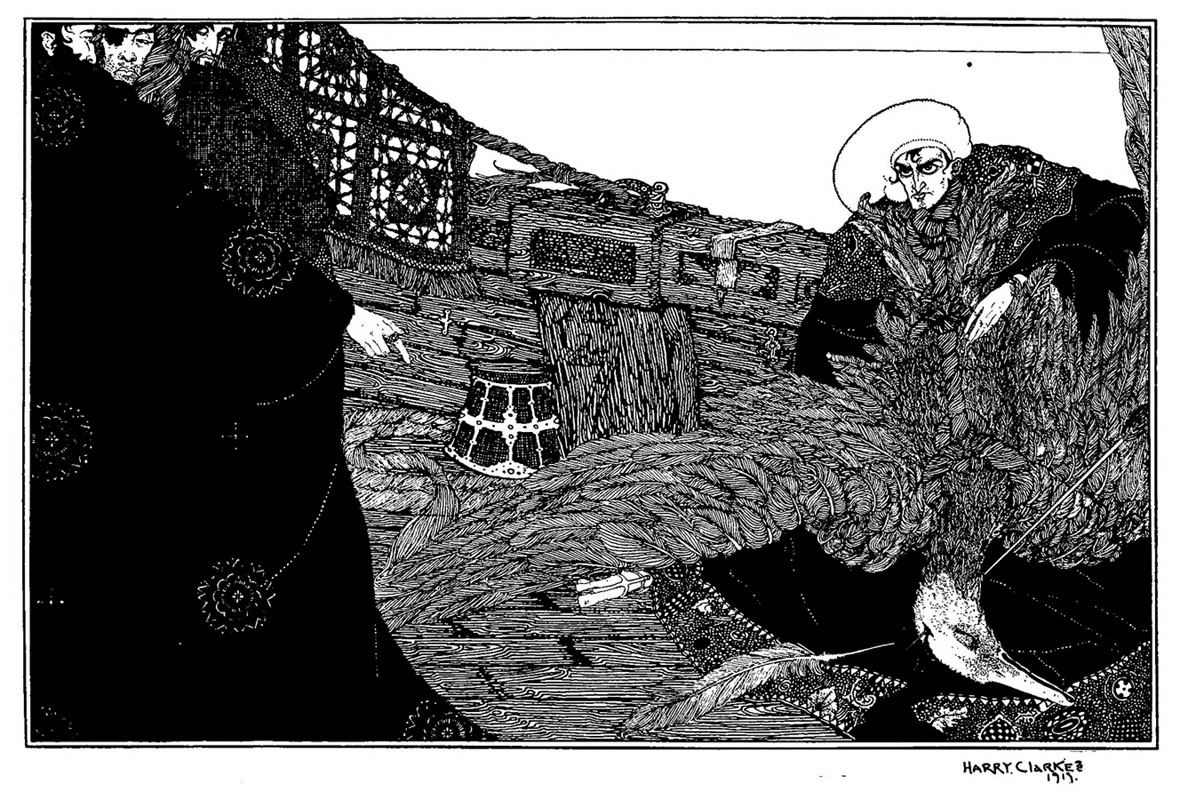
The Rime of the Ancient Mariner by Harry Clarke.

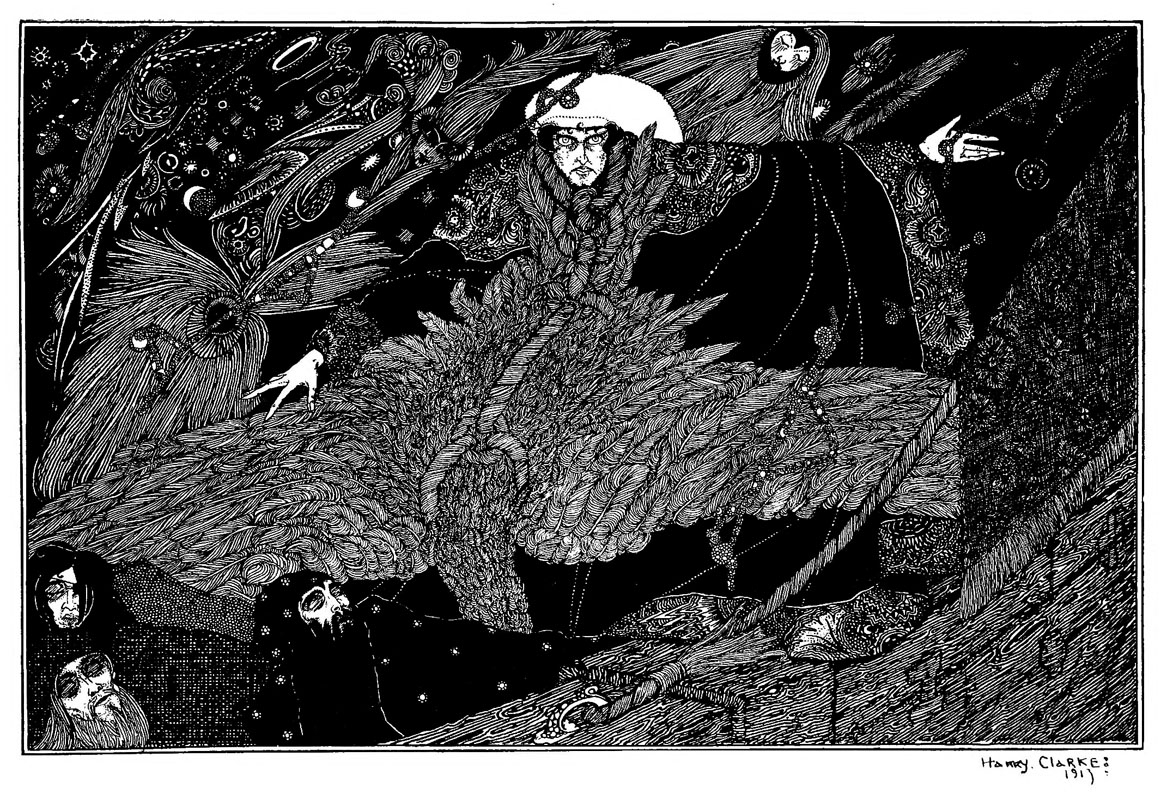
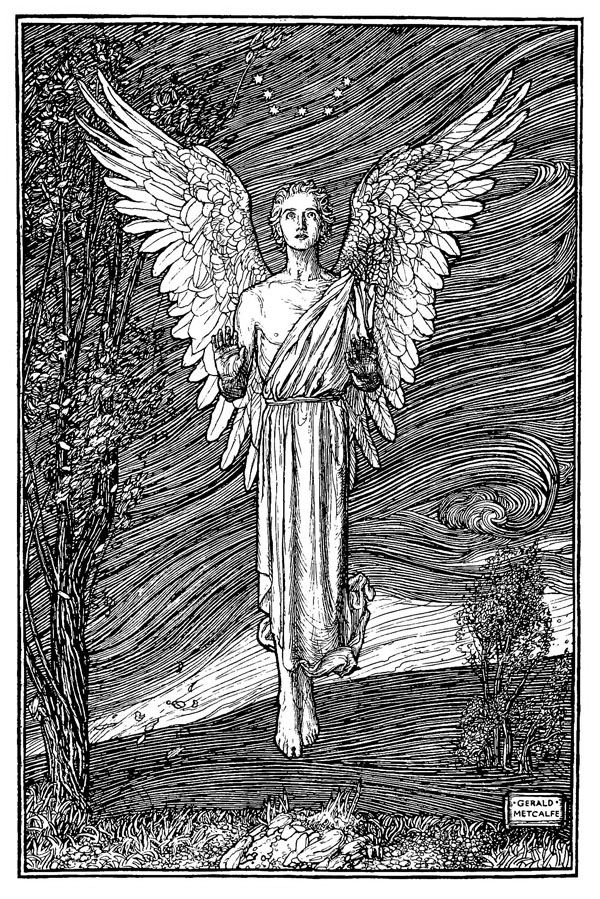
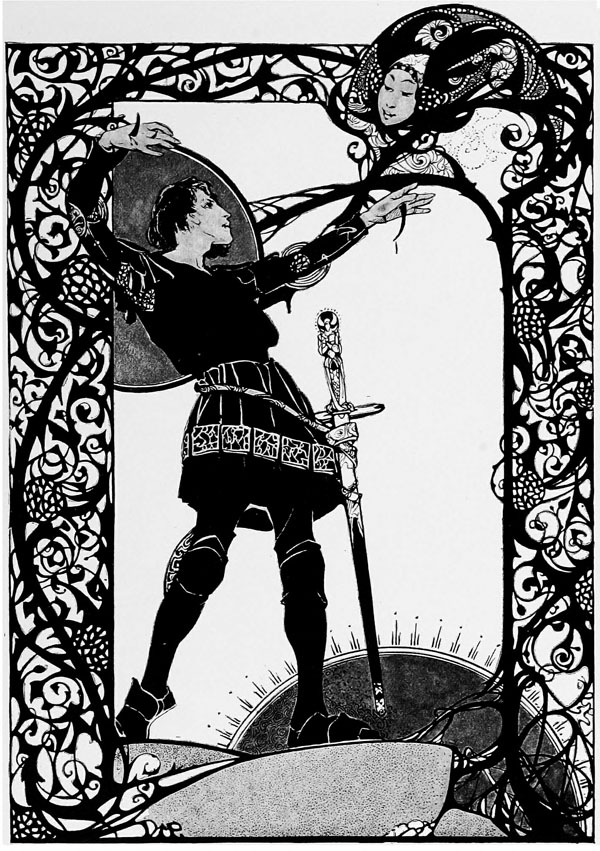
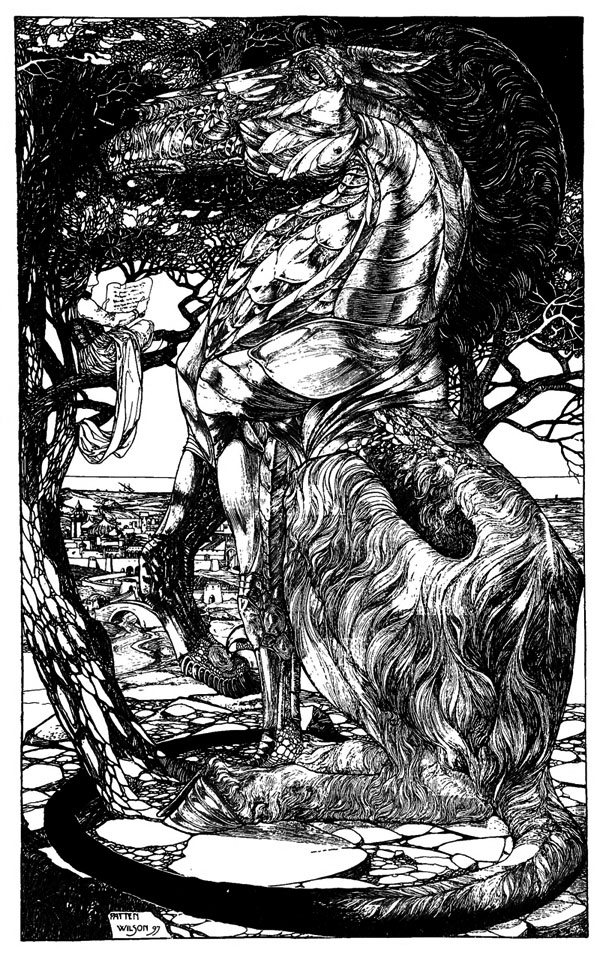
Some samples from a collection of mostly black-and-white drawing at the Internet Archive, Modern Book Illustrators and Their Work (1914), edited by C. Geoffrey Holme & Ernest G. Halton. This was an illustration review produced by The Studio magazine and in this edition happens to feature two pieces of work from Harry Clarke’s The Rime of the Ancient Mariner (1913). Also at the Internet Archive is an earlier Studio publication, Modern Pen Drawings: European and American from 1901 from which I’ve selected Patten Wilson’s hyper-detailed rendering of Rustum and the Simoorg, a fantastic piece of work in every sense.

clarke2.jpg

The Rime of the Ancient Mariner by Harry Clarke.

metcalfe.jpg

From The Poems of Coleridge by Gerald Metcalfe.

payne.jpg

La Belle Dame sans Merci by Dorothy M. Payne.

wilson.jpg

Rustum and the Simoorg by Patten Wilson.

Elsewhere on { feuilleton }
The illustrators archive

Previously on { feuilleton }
Illustrating Poe #3: Harry Clarke
Strangest Genius: The Stained Glass of Harry Clarke
Harry Clarke’s stained glass
Harry Clarke’s The Year’s at the Spring
The art of Patten Wilson, 1868–1928
The art of Harry Clarke, 1889–1931