Die Farbe and The Colour Out of Space

farbe2.jpg

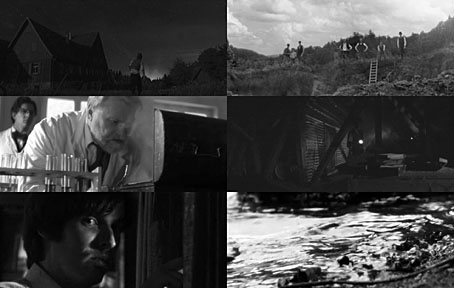
Die Farbe (2010).

The colour, which resembled some of the bands in the meteor’s strange spectrum, was almost impossible to describe; and it was only by analogy that they called it colour at all. Its texture was glossy, and upon tapping it appeared to promise both brittleness and hollowness.

The Colour Out of Space (1927).

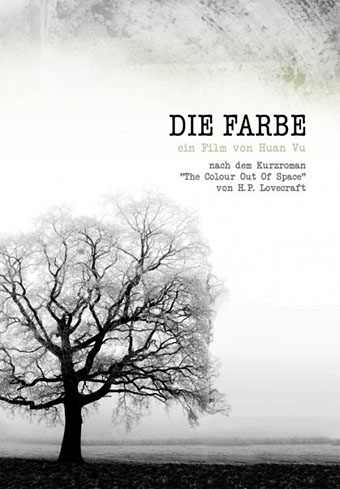
Die Farbe (The Colour) is a German feature film by Huan Vu based on HP Lovecraft’s tremendous short story The Colour Out of Space. Vu’s film was completed last year, and has been well-received at film festivals and by Lovecraft aficionados but I’ve been rather tardy in hearing about it. Better late than never.

Having adapted two-and-a-half stories, I tend to take a more than cursory interest in works based on Lovecraft’s fiction. One of the reasons I tackled his works in the first place was out of frustration at the apparent inability of film producers and comic artists to treat the stories as they’d been written. The Colour Out of Space is one of the masterpieces of Lovecraft’s mature period, and was the favourite of his own stories, a skilful blending of horror and science fiction in the tale of a fallen meteorite infecting a farm with an inexplicable process of decay and physical mutation. The mysterious colour is the product of some unearthly substance inside the meteorite which corresponds to no known part of the visible spectrum. This wasn’t the first story of Lovecraft’s that I read—I’d earlier found The Moon-Bog in a ghost story anthology—but it was the first that made a serious impression when I came across it in another anthology at age 12 or 13. Since then, whenever people ask me which Lovecraft stories to read first The Colour Out of Space is always one I recommend.
farbe1.jpg

Continue reading “Die Farbe and The Colour Out of Space”

Will Bradley posters

bradley01.jpg

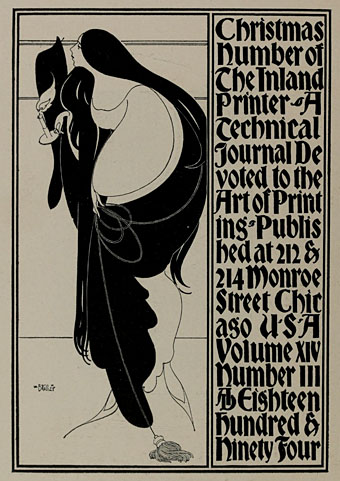
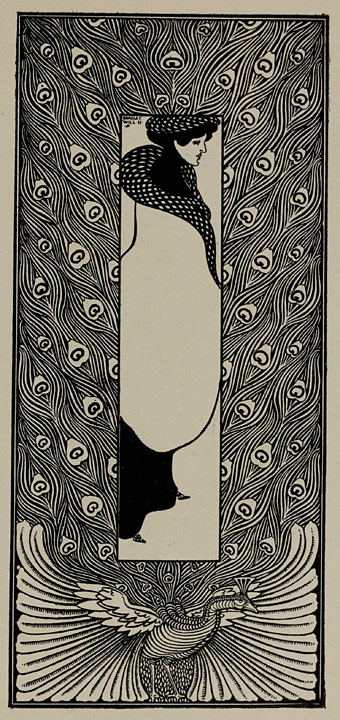
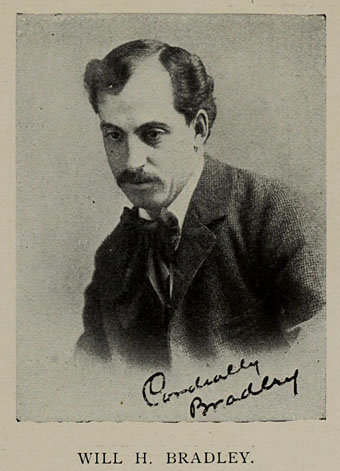
More from American illustrator and designer Will Bradley (1868–1962) from the height of his Beardsley period circa 1894–95. These are from a collection by Edward Penfield entitled Posters in Miniature (1897) in which Bradley’s work receives more attention than some of his better-known contemporaries. Half of these designs are familiar, the rest I hadn’t seen before, including the peacock piece below. Even though Bradley was trying out various Beardsley moves at this stage, his work was always a lot more versatile than the lesser imitators. More of Bradley’s designs, and work by other artists, can be found in the scanned edition of Penfield’s book at the Internet Archive.

bradley02.jpg

bradley03.jpg

Continue reading “Will Bradley posters”

Weekend links 73

sun2.jpg

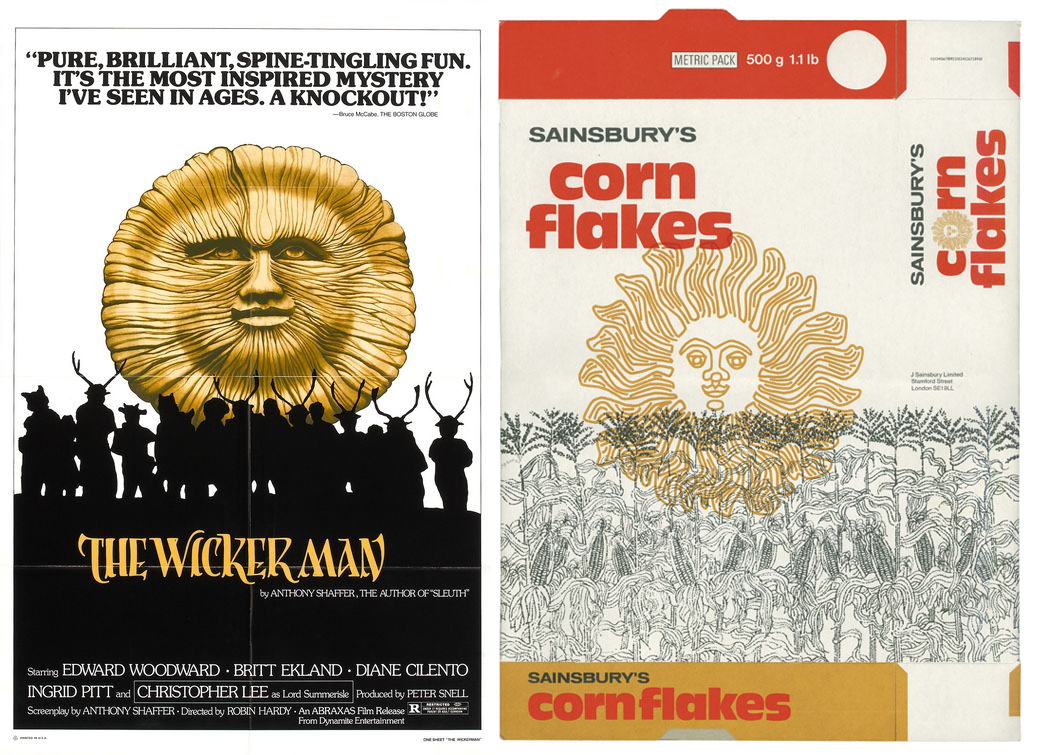
Johnny Trunk of Trunk Records reissued the soundtrack to The Wicker Man in 1997. Mr Trunk’s latest delve into the cultural past is Own Label: Sainsbury’s Design Studio, a book from Fuel examining the supermarket chain’s packaging design of the 1960s and 1970s. Creative Review shows some examples while I have to note the uncanny similarity between one of the posters for The Wicker Man and an old Sainsbury’s corn flakes box. Now we see that the Old Weird Britain wasn’t only hiding in the fields and the folk songs but was also lurking on the supermarket shelves.

Related: a new DVD set from the BFI, Here’s a Health to the Barley Mow: A Century of Folk Customs and Ancient Rural Games. And let’s not forget the ley lines of Milton Keynes, and a new edition of Ritual by David Pinner, said to be the novel which inspired The Wicker Man.

• “He wrote me…” Sans Soleil (1983), Chris Marker’s beguiling accumulation of memories, dreams and reflections, is recalled in a Quietus piece entitled Things that Quicken the Heart. Not the first time on DVD as it says there (Nouveaux Pictures released it with La Jetée in 2003) but it’s good to know it’s being reissued.

• Marker’s film references Tarkovsky’s Stalker a couple of times, most notably in the comment, “On that day there will be emus in the Zone.” Geoff Dyer has what he describes as “a very detailed study” of Stalker out next year.

I don’t like those commentators who keep on saying that London will never be the same again. London is always the same again. I remember those comments were made very loudly after the [July 2005] terrorist attacks – “London will never be the same again, London has lost its innocence” – it was all nonsense. London was exactly the same again the following day. Rioting has always been a London tradition. It has been since the early Middle Ages. There’s hardly a spate of years that goes by without violent rioting of one kind or another. They happen so frequently that they are almost part of London’s texture. The difference is that in the past the violence was more ferocious, and the penalties were more ferocious – in most cases, death.

Peter Ackroyd, reminding us that the Four Horsemen of the Apocalypse don’t wear hoodies and ride bikes.

Wolf Fifth: “rare vinyl records from the golden era of avant garde and experimental music”. And in FLAC as well, not crappy mp3; I want to hear all those scratches uncompressed, dammit!

Another great mix at FACT, this time compiled by snd who throw together Morton Feldman, Siberian shamen, Einstürzende Neubauten, Dome, Oval and many others.

• Colin Marshall asks “how weird is Australia?” in an appraisal of Nicolas Roeg’s Walkabout.

A Comprehensive Solution to the Tokyo Umbrella Problem.

• More poster art from Hapshash and the Coloured Coat.

Morbid Excess, a series of drawings by May Lim.

Conrad Schnitzler (1937–2011) by Geeta Dayal.

Neopolitan cephalopods.

Willow’s Song (1973) by Paul Giovanni & Magnet | The Willow Song (1989) by The Mock Turtles | Wicker Man Song (1994) by Nature and Organisation.

Weekend links 70

swinburne1.jpg

Faustine (1928) by Harry Clarke.

• This week’s Harry Clarke fix: 50 Watts reposts the Faust illustrations while Golden Age Comic Book Stories has the illustrated Swinburne.

What Goes Steam in the Night is an evening with contributors to The Steampunk Bible hosted in London by The Last Tuesday Society on September 6th:

Co-author S. J. Chambers invites you to the official U.K. celebration of her book The Steampunk Bible (Abrams Image). Part lecture, part signing, and part entertainment, S. J. will be accompanied by contributors Jema Hewitt (author of Steampunk Emporium ) and Sydney Padua (Lovelace & Babbage) for a discussion of the movement, a special performance by Victorian monster hunter, Major Jack Union, and inevitable hi-jinks and shenanigans to later be announced.

• RIP Conrad Schnitzler, an incredibly prolific electronic musician, and founder member of Tangerine Dream and Kluster/Cluster.

Golden Pavilion Records reissues fully-licensed late 60’s and 70’s psychedelic, progressive, acid-folk & art-rock music.

Dressing the Air is “an exclusive consulting and online resource for the creative industries”.

Luke Haines explains how to cook rabbit stew whilst listening to Hawkwind.

Wood pyrography by Ernst Haeckel from his home, the Villa Medusa.

swinburne2.jpg

Satia Te Sanguine (1928) by Harry Clarke.

The truth is, the best novels will always defy category. Is Great Expectations a mystery or The Brothers Karamazov a whodunnit or The Scarlet Letter science fiction? Does Kafka’s Metamorphosis belong to the genre of fantasy? In reality men don’t turn into giant insects. And it’s funny. Does that mean it’s a comic novel? […] At a time when reading is in trouble, those readers left should define themselves less rigidly.

Howard Jacobson: The best fiction doesn’t need a label.

Pace the redoubtable Jacobson, Alan Jacobs believes We Can’t Teach Students to Love Reading.

How Ken Kesey’s LSD-fuelled bus trip created the psychedelic 60s.

Salvador Dalí creates something for Playboy magazine in 1973.

JG Ballard: Relics of a red-hot mind.

Electric Garden (1978) by Conrad Schnitzler | Auf Dem Schwarzen Kanal (1980) by Conrad Schnitzler.

The angels in their anguish

chj4.jpg

Equus (2009).

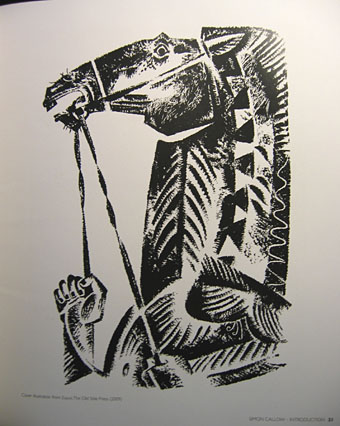
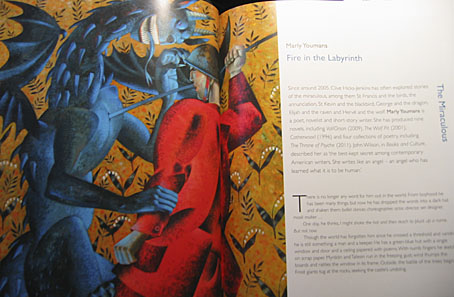
As an addendum to the earlier post about the Clive Hicks-Jenkins retrospective currently running at the National Library of Wales, Aberystwyth, here’s a brief look at the artist’s monograph which turned up in the post this week. Having seen much of this work only in Clive’s blog posts (many of which were day-to-day recordings of work in progress) it’s a real pleasure to see them at larger size in high-quality print. In addition to familiar works there are many sketches and smaller pieces interleaved with the text, and unlike many monographs this isn’t the work of a single author but features appreciations from Simon Callow, Damian Walford Davies, Andrew Green, Rex Harley, Kathe Koja, Anita Mills, Montserrat Prat, Jacqueline Thalmann and Marly Youmans, as well as notes and comments by the artist.

chj5.jpg

Battle Ground (2007).

Andrew Wakelin has done a great job with the book’s design, the use of Gill Sans throughout feels just right. As mentioned before, the publisher is Lund Humphries, and they have a discount for orders made through their website. A few more page samples follow.

Continue reading “The angels in their anguish”