Hidden Hands: A Different History of Modernism

hh1.jpg

I thought I’d finished with the arts documentaries until I remembered this four-part series from 1995. Hidden Hands was based on researches by Frances Stonor Saunders who also co-produced. As the subtitle suggests, the programmes examined aspects of Modernist art and architecture that weren’t exactly unknown but were often downplayed (sometimes deliberately ignored) by the art establishment. The episodes were as follows:

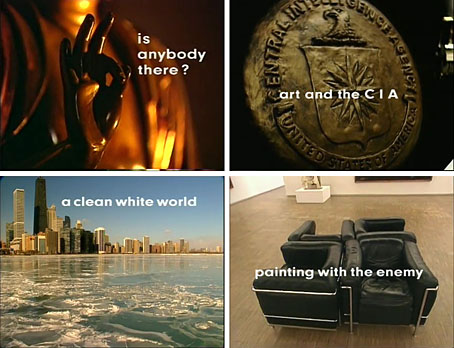
1: Is Anybody There? The occult roots of abstract painting, especially the influence of Theosophy on Vasily Kandinsky and Piet Mondrian. Kazimir Malevich and František Kupka are also mentioned at the beginning of the programme but we don’t hear anything more about them.

2: Art and the CIA. A history of the Congress for Cultural Freedom, a CIA front for channelling money to avant-garde exhibitions and literary magazines during the Cold War.

3: A Clean White World. Modernist architecture as a reaction to, and proposed solution for, the squalor of 19th-century city life. Also the similarity between the impulses that drove the Modernist architectural ideal, and the later health and purity obsessions of European fascist states.

4: Painting with the Enemy. The inadvertent way in which the animus towards “degenerate art” shared by the Nazis and the Vichy regime in occupied France helped sustain Modernism during the war years.
hh2.jpg

This is a very good series on the whole, informative and with a roster of authoritative interviewees. The narration overstates the contrarian angle in places but that’s television for you. Much of the history under investigation wasn’t necessarily hidden, more sidestepped by general discussions of 20th-century art. Even so, fifteen years earlier in the architecture episode of The Shock of the New, Robert Hughes covered similar territory and with similar criticisms, following the development of what would become known as the International Style while noting Mussolini’s adoption of a Modernist idiom for the architecture of Fascist Italy.

Elsewhere, when Hughes reviewed a major Kandinsky retrospective he paid sufficient attention to Kandinsky’s Theosophical beliefs; this was in 1982 for TIME magazine, not exactly an obscure publication. Theosophy’s ectoplasmic tentacles are all over the art of the late 19th century so you’d expect some crossover into the art of the new century, as there was in the careers of the artists themselves. (Matisse was a pupil of Gustave Moreau, for example, an inconvenient detail that often irritated critics.) Given the amount of artists swayed by Madame Blavatsky’s writings, a more interesting argument might have been to propose Theosophy as the prime cause of early abstraction rather than another inconvenient factor in its development. Hilma af Klint’s pioneering abstract paintings were as much products of her Theosophical studies as were those of Kandinsky but in the 1990s nobody was paying her very much attention.
hh3.jpg

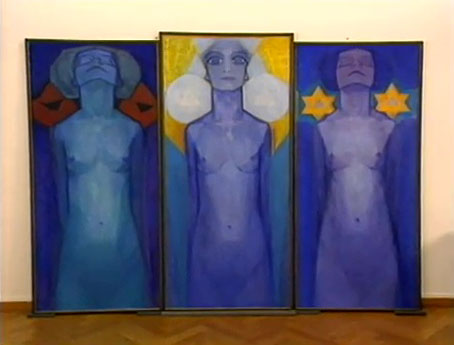
Mondrian’s mysticism: Evolution (1910–1911).

As for the CIA, the agency’s clandestine cultural adventures were exposed by a leak in the late 1960s—Stephen Spender famously resigned in shame from his editorship of Encounter magazine—so this could almost be classed as old news. What you wouldn’t have had in the past, however, is the agents involved in the scheme openly discussing their activities.

Continue reading “Hidden Hands: A Different History of Modernism”

Weekend links 620

varo

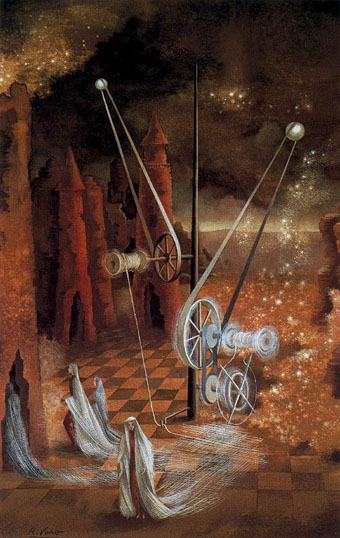
Premonition (1953) by Remedios Varo.

• “Classical mythology, Arcadian idylls, occult speculation, and an interest in cultural curiosities coexisted in the grotto, allowing for the playful exploration of a new tension emerging between Nature and Artifice.” Laura Tradii explores the artificial grottoes of the Renaissance and beyond.

• “Some of the symbols and signs seem like bridges to nowhere, and perhaps Nabokov was lovingly teasing our endless quest to find patterns and generate meaning.” David M. Rubin on writing a response to a Nabokov short story.

• New music: “KMRU & Aho Ssan erupt in post-apocalyptic extremity with Resurgence“. I did the layout for this latest release on the Subtext label but I still haven’t got round to updating my web pages so you’ll have to take my word for it.

• Powell & Pressburger’s Black Narcissus “unleashes a level of eroticism that’s surprising for 1940s British cinema,” says Adam Scovell.

• “Premonitions are impossible, and they come true all the time.” Fiona Sturges reviews The Premonitions Bureau by Sam Knight.

• Between Hell and Paradise: paintings by Hieronymus Bosch and his followers at the Museum of Fine Arts, Budapest.

• At The Collector: Olivia Barrett on the Voodoo Queens of New Orleans.

• Steven Heller’s font of the month is Astronef Super.

• Mix of the week: Isolatedmix 118 by Pan American.

TMP-01 Vintage Synth TV Series from Benge.

• Vale, A Year In The Country.

Premonition (1979) by Simple Minds | Premonition (1980) by Cabaret Voltaire | Premonition (Giant Empty Iron Vessel) (1987) by David Sylvian & Holger Czukay

Weekend links 618

anderson.jpg

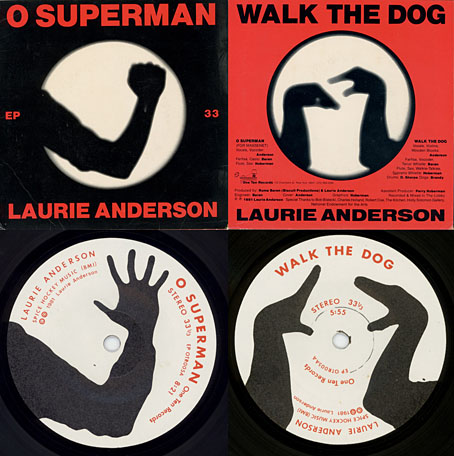
O Superman (1981), a seven-inch single on One Ten Records. Design by Laurie Anderson and Perry Hoberman.

• “…I was painting a picture of a garden at night. It had a lot of black and this green kind of coming out of the black, and I sat back, probably to take a smoke, looking at this painting, and I suddenly heard a wind coming from the painting, and the green started to move. And I thought, ‘Oh, a moving painting.’ And that experience led to cinema.” David Lynch talking to Josh Hitchens about living in Philadelphia.

• “This is the time and this is the record of the time.” Big Science, the album that propelled Laurie Anderson from performance artist to pop star, is 40 years old this month. Mat Colegate recalls his confused impression that the album was the work of a West Country folk singer, while Studs Terkel talked to Laurie Anderson about the album shortly after its release.

• At Public Domain Review: Kensy Cooperrider explores a millennium of “hand mnemonics”, “the variety of techniques practised by Buddhist monks, Latin linguists, and Renaissance musicians for remembering what might otherwise elude the mind.”

Ghosts in the Machine is an exhibition being hosted by Bower Ashton Library, Bristol, for World Book Night, 2022. 93 participants contributed ghost-related images for an accompanying artist’s book [PDF].

• “Sixty years after Seattle’s Century 21 Exposition, world’s fairs have largely fallen out of fashion in the US.” Grant Wong charts the rise and fall of world’s fairs.

• A trailer for Ennio: The Maestro, a feature-length documentary about Ennio Morricone by Giuseppe Tornatore.

• “The film Putin doesn’t want the world to see: Firebird, a gay love story about fighter pilots.”

• At Dennis Cooper’s: Andrei Tarkovsky Day.

• New music: Intersections by Specimens.

Schöne Hände (1977) by Cluster & Eno | Hands 2 Take (1981) by The Flying Lizards | Red Hand (1996) by Paul Schütze

Weekend links 615

tesla.jpg

Tesla does the Astro. Hunter Dukes at Public Domain Review examines the promotion of Nikola Tesla’s ideas via this famous photograph.

• Coming soon from Side Real Press: Kokain—The Modern Revue, a magazine produced in Vienna that ran for five issues during 1925. “Original copies are so rare that it scarcely appears in any of the literature relating to the Weimar period and its contents have remained almost entirely ignored and certainly untranslated. Until now.”

• “Magritte had gotten this far in life by refusing to obey anyone, and in a way his disobedience proved that he understood Surrealism better than the leader of the Surrealists.” Jackson Arn reviewing Magritte: A Life by Alex Danchev.

• “Go as far into your dream as possible and find your own unique voice.” Meredith Monk (again) talking to Elizabeth Aubrey.

• Coming soon from Strange Attractor: City of the Beast: The London of Aleister Crowley by Phil Baker.

• At Spoon & Tamago: The natural world springs to life in kirie paintings by Tamami Kubota.

Antonia Mufarech on why sunflowers are Ukraine’s national flower.

• At Dennis Cooper’s: Etienne-Louis Boullée’s unbuildable tombs.

• Mix of the week: I Can’t Go For That by The Ephemeral Man.

• New music: Triumph Of The Oak by The Lord.

• RIP Philip Jeck.

Tesla (1997) by Jimi Tenor | Tesla (2011) by They Might Be Giants | Tesla Coil (2016) by Xhei

Hipgnosis interview

hipgnosis1.jpg

This is a frustratingly short piece of film—a mere 16 minutes—but it’s fascinating all the same for the brief views it gives inside the London studio of the Hipgnosis design partnership at the tail end of their golden decade, the 1970s. Being an occasional album cover designer as well as a minor Hipgnosis obsessive I like to see where so many of the team’s album covers originated. The two Hipgnosis founders, Aubrey Powell and Storm Thorgerson are both interviewed; the third member of the partnership, Peter Christopherson, is absent. The film is also undated but the discussion of the cover photo for Look Hear? by 10cc puts the year at around 1980. The views of the studio aren’t much different from the rather murky shots of the place in the first Hipgnosis book, An ABC of the Work of Hipgnosis: Walk Away René (1978), but the film gives a better sense of the dishevelled actuality: those stairs that Thorgerson runs up at the opening are the same ones that form the background to the melting Peter Gabriel photo used on the cover of Gabriel’s third album. Powell and Thorgerson are such engaging interviewees they really ought to have been profiled at greater length by the BBC or ITV, not given a few minutes to discuss some of their more notable creations by a small French film crew.

hipgnosis2.jpg

Aubrey Powell shows off the mystery object from the Presence album by Led Zeppelin.

The Hipgnosis studio occupied two floors of a building in Denmark Street, a minor thoroughfare off the Charing Cross Road that used to be a home to music publishers, rehearsal rooms and many of London’s musical instrument vendors. For a few years it was also home to the original and equally dishevelled Forbidden Planet book and comic shop, a place I first visited shortly after it opened in 1978. I always used to visit Forbidden Planet when I was in the capital but the Hipgnosis team had gone their separate ways by the time I found out they’d been based in the same street. Had I known about this earlier I probably would have wandered around for a while wondering which door led to their rooms. With its clutter and blithe disregard for client-flattering furnishings (the reception room, said Thorgerson, had nowhere to sit down) the studio was a long way from anybody’s idea of a well-appointed design business. The place reminds me of the offices occupied for many years by Savoy Books in Deansgate, Manchester: ancient, first-floor rooms whose better days were long past, with tools of the trade littering every surface, recent works-in-progress on the walls and old stickers peeling off the door. In Walk Away René, Thorgerson also admits that the studio lacked a toilet so they had to resort to pissing in a sink, a disgraceful expediency also shared by the Savoy office. In such places was art once made.

Previously on { feuilleton }
Design as virus 16: Prisms
Storm Thorgerson, 1944–2013
Hipgnosis turkeys
Peter Christopherson, 1955–2010
Storm Thorgerson: Right But Wrong