Esquisses Décoratives by René Binet

exposition1.jpg

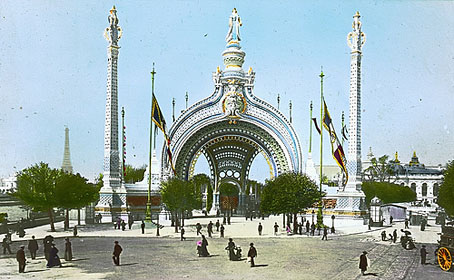
The work of French architect and designer René Binet (1866–1911) has been featured here before with one of his most famous creations, the monumental gate he designed for the Paris Exposition Universelle of 1900. Philippe Jullian in his 1974 book about the exposition, The Triumph of Art Nouveau, calls the gate the “Porte Binet” and also notes that it was referred to as “the Salamander” for its resemblance to the salamander stoves of the period.

binet1.jpg

The reference to nature is apt, albeit for a different reason, since it was Ernst Haeckel’s Kunst-Formen der Natur which Binet used as inspiration for his designs, the encrustation on the gate being based on Haeckel’s studies of shell forms. This influence was developed four years later in Binet’s Esquisses Décoratives, a series of speculative designs which applied Haeckel’s work to architecture and interior design as a whole; the Porte Binet can be seen on the title plate above and the print there seems to have been either signed by or dedicated to Haeckel.

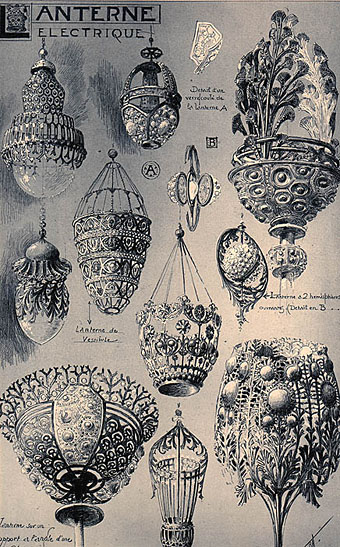
Art Nouveau design is usually thought of in terms of the curvaceous style derived from Alphonse Mucha and others, but there were several designers of the period looking to nature for inspiration in a way which went beyond William Morris’s application of plant forms to flat surfaces. Binet’s lamp designs below show how Haeckel’s sea-life could be transmuted into enclosures for electric lights. These designs hint at a direction which went unexplored in the 20th century; the Art Nouveau style was steadily vulgarised after the Exposition Universelle until it was replaced altogether by the development of Art Deco following the First World War. Binet went on to design the extension of the Paris department store, Printemps, but his huge Art Nouveau atrium was later destroyed by fire.

binet2.jpg

There aren’t many examples of Binet’s designs on web pages, the ones here are from this Flickr set and a vintage print seller. There is a recent study of Binet’s work available, however, René Binet: from Nature to Form by Olaf Breidbach. For an idea of how an entire city based on Haeckel might look, we have Schuiten and Peeters’ imaginary metropolis of Blossfeldtstad whose “Vegetalistic” architecture was featured in an earlier post.

Previously on { feuilleton }
Le Palais de l’Optique, 1900
Exposition Universelle films
Exposition jewellery
Exposition Universelle catalogue
Exposition Universelle publications
Exposition cornucopia
Return to the Exposition Universelle
The Palais Lumineux
Louis Bonnier’s exposition dreams
Exposition Universelle, 1900

Weekend links 29

dancer.jpg

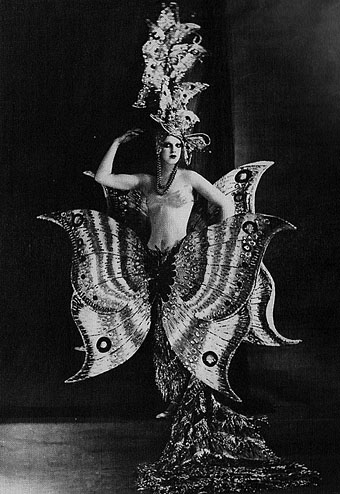
A Folies Bergère dancer, c. 1909.

Six Novels in Woodcuts: The Library of America publishes a boxed set of Lynd Ward’s works: Gods’ Man, Madman’s Drum, Wild Pilgrimage, Prelude to a Million Years, Song Without Words and Vertigo.

• RIP ace graphic designer Raymond Hawkey. Related: Raymond Hawkey: An eye for detail, and Hawkey’s James Bond cover designs from the mid-60s.

The Record: Contemporary Art and Vinyl, an exhibition at Duke University, North Carolina, features work by 41 artists from around the world, from the 1960s to the present, using vinyl records as subject or medium.

decaris.jpg

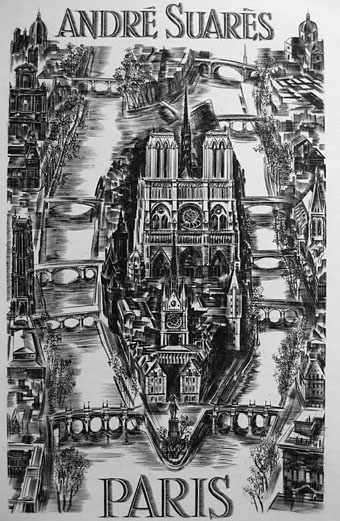
The Île de la Cité, a steel engraving by Albert Decaris (1950).

Fred Tomaselli will have a new exhibition of his work at the Brooklyn Museum next month.

Socialist Monuments in Bulgaria photographed by Linda Ferrari.

• What would Howard think of the Mythos Art Dildo?

Space is Process, a film about Olafur Eliasson.

Thurston Moore’s Indie Books.

Chris Colfer in a leather bar.

Ephemeral New York.

• Chrome! Helios Creed’s YouTube channel.

Salon Futura #1

salon-futura.jpg

It’s been a pleasure this week seeing my 1999 portrait of Cthulhu’s rotting domicile, R’lyeh, used as the cover image for Salon Futura, a new online magazine edited by Cheryl Morgan. Cheryl describes SF as “a new and hopefully somewhat different magazine devoted to the discussion of science fiction, fantasy and other forms of speculative literature.” Among the contents there’s a podcast interview with Gary K Wolfe, Nnedi Okorafor and Fábio Fernandes (the latter is a contributor to the steampunk book I’m currently designing for Tachyon); there are video interviews with writers Lauren Beukes and China Miéville, and the Guardian‘s Sam Jordison writes an appraisal of EL Doctorow’s 1994 novel The Waterworks (about New York City’s minatory Croton Reservoir) which stimulated my interest enough to make me want to search out the book. And speaking of minatory architecture, {feuilleton} approves of the presence of Taschen’s fat volume of Piranesi works spied on China Miéville’s bookshelf. China always has interesting things to say; go and see for yourself.

Previously on { feuilleton }
Le horreur cosmique

The House of Orchids by George Sterling

sterling1.jpg

Do all roads lead to the Internet Archive? Not really but I keep ending up there when I happen to discover an interesting old book and wonder whether they have a PDF of the volume in question. The volume for consideration today, The House of Orchids, is a 1911 collection of verse by George Sterling (1869–1926), an American but another of those writers whose poetry looked to Decadent London and Paris for its flavour, hence the Wildean title, and, it should be said, the cover design. I haven’t been able to find an artist credit for this; if anyone knows who was responsible, please leave a comment.

sterling2.jpg

Many of the books at Archive.org are unremarkable library editions but this is a rare exception, being a gift to the University of California of writer Ambrose Bierce, Sterling’s idol and the person to whom he writes the above thanks and a dedication. Bierce praised Sterling’s work but must have passed the book on fairly soon after receiving it since he famously disappeared in Mexico two years later. Or maybe his library was passed to the university after his disappearance? Whatever the answer, this edition contains another curious feature in the form of a pasted-in newspaper clipping from 1926 concerning the death in mysterious circumstances of Sterling himself at San Francisco’s Bohemian Club. The general supposition is that he killed himself with a vial of cyanide he was in the habit of carrying around. One of Sterling’s young poetic protégés at the time The House of Orchids appeared was Clark Ashton Smith whose first volume of verse, The Star-Treader, and Other Poems, was published a year later. That book and another of Smith’s titles is also available at Archive.org, as I noted in June. Also there, and of particular {feuilleton} interest, is Sterling’s The Evanescent City, a paean to San Francisco’s 1915 Panama-Pacific International Exposition. (This site has scans of the text and photos.)

George-Sterling.org is a site devoted to the writer which includes many of his poems and other texts. Looking at his lengthy piece from 1907, A Wine of Wizardry, you can see what it was about his work that so appealed to Clark Ashton Smith and others.

Elsewhere on { feuilleton }
The book covers archive

Previously on { feuilleton }
Odes and Sonnets by Clark Ashton Smith
Clark Ashton Smith book covers
The Evanescent City

Mind the doors!

andreev1.jpg

Russian artist Alexey Andreev populates the Moscow Metro with eldritch weirdness in a photo-collage series he calls Metronomicon. A couple of these pieces remind me of Clive Barker’s throat-grabbing story, The Midnight Meat Train, which was filmed a couple of years ago. For an earlier cinematic example of the horror inherent in underground transport systems there’s Gary Sherman’s Death Line, or Raw Meat as it was fatuously rebranded for the US, a very effective low-budget film from 1972. Fantastic Voyages reviews it here.

Andreev tip via MetaFilter.

andreev2.jpg

Previously on { feuilleton }
Subterrania
Tunnel 228