Suchard at the Exposition Universelle

suchard1.jpg

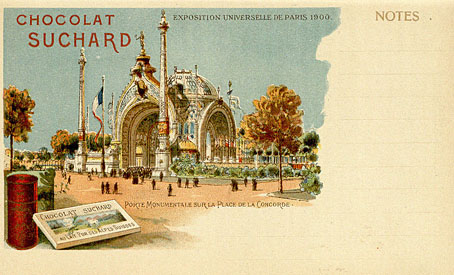
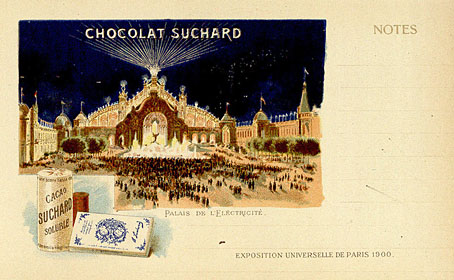
A pair of adverts from the Guide Lemercier for the Paris Exposition Universelle of 1900, available as either a PDF or individual page scans at the University of Heidelberg’s archive. This looks like it would have been a very usable guide, with coloured maps and a good selection of photographs. The Suchard adverts provide splashes of colour throughout and this is the only guide I’ve seen to date which favours a single company this way. The space for notes on each ad page is rather generous as well as being something you can’t imagine anyone trying now.

suchard2.jpg

Previously on { feuilleton }
Esquisses Décoratives by René Binet
Le Palais de l’Optique, 1900
Exposition Universelle films
Exposition jewellery
Exposition Universelle catalogue
Exposition Universelle publications
Exposition cornucopia
Return to the Exposition Universelle
The Palais Lumineux
Louis Bonnier’s exposition dreams
Exposition Universelle, 1900

Charles Méryon revisited

meryon1.jpg

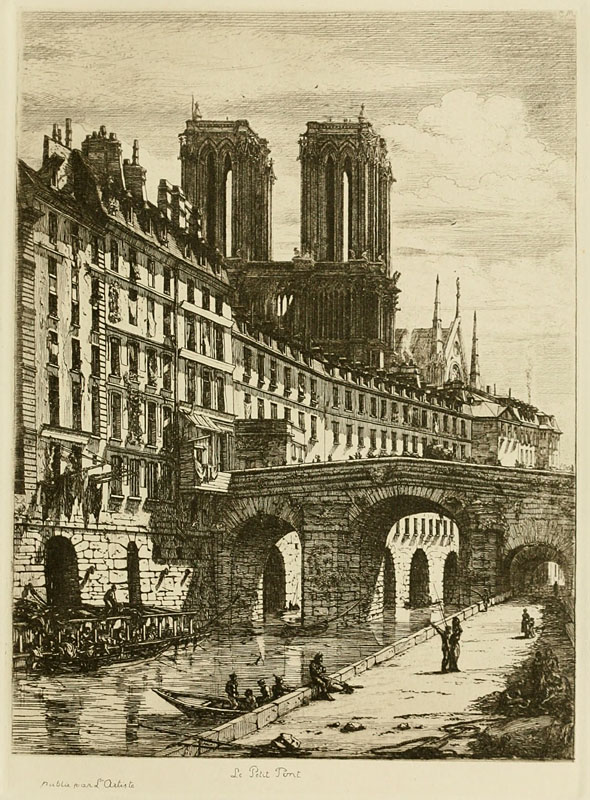
Le Petit Pont (fifth state) (1850).

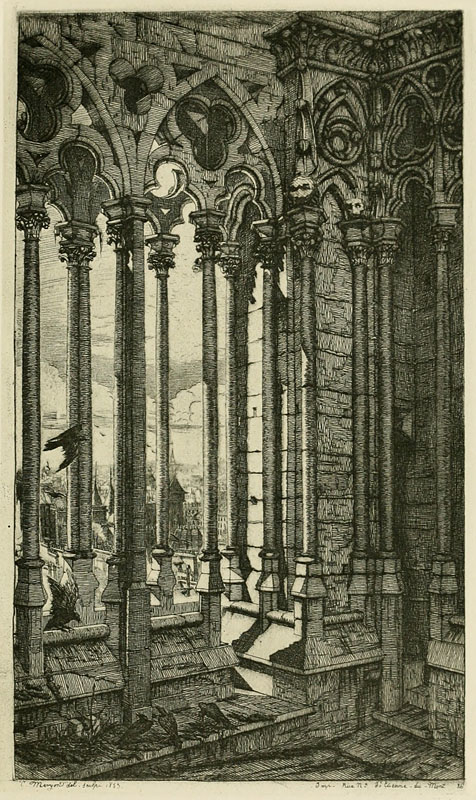
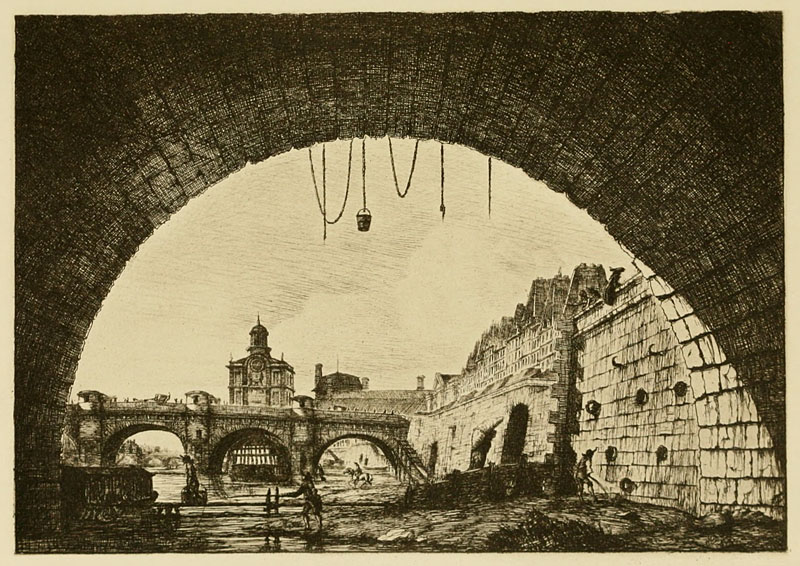
A short piece about the Paris etchings of Charles Méryon (1821–1868) was one of the first posts I made here. I’ve little to add to what I said four years ago other than to point out that the Internet Archive has The Etchings of Charles Méryon available for download, a rather fine collection of the artist’s Piranesi-like renderings of the city. The view below of Pont-Neuf through one of the Seine bridges is very Piranesian indeed and makes me wish Méryon had been as productive as his predecessor was with his Vedute di Roma.

meryon2.jpg

La Galerie Notre-Dame (third state) (1853).

meryon3.jpg

Le Pont-Neuf et La Samaritaine (third state) (1855).

Elsewhere on { feuilleton }
The etching and engraving archive

Previously on { feuilleton }
Vedute di Roma
Charles Méryon’s Paris

Weekend links 37

peeping.jpg

Michael Powell’s Peeping Tom is fifty-years old this year, an occasion celebrated with a limited UK cinema run and a reissue on Blu-ray and regular DVD. This was the film which famously ended Powell’s career as a director in Britain for reasons which have never been quite clear. Was the film’s critical vilification the culmination of an impatience with the director’s alleged excesses over the years? Was it an unarticulated discomfort at the way Powell and screenwriter Leo Marks implicated themselves and the audience in the sordid murders they (we) were watching in the dark? Or was the film withdrawn simply because producer Nat Cohen wanted a knighthood and was worried over his reputation as a peddler of “filth”? The bitterest blow for Powell would have been seeing his long-time rival Alfred Hitchcock have another success a few months later with Psycho, a film which allows its audience similar female-slaughtering thrills without questioning the role of the viewer in sustaining the drama. Hitchcock spent much of his career “punishing” women in a manner that verges on outright misogyny yet was indulged all along by audience and critics; Powell made a single film about a murderer and was himself punished for it. His other films often featured strong female characters, and I’ve long regarded him as the superior artist.

The Guardian this week celebrated Powell’s film with a number of articles: Peeping Tom may have been nasty but it didn’t deserve critics’ cold shoulder, Peeping Tom, pornography and the press, The Peeping Tom timebomb.

A Wizard of Earthsea: an unfilmed screenplay from 1983 by Michael Powell and Ursula K Le Guin based on Le Guin’s first two Earthsea novels.

1860.jpg

A boy in a dress with mother and sister, 1860. Yesterday was the 12th Annual Transgender Day of Remembrance.

Quaintance by Reed Massengill and Dian Hanson, in which the pioneer of 20th century beefcake art gets the heavyweight Taschen treatment. Expensive but they’re making these volumes for obsessives. Related: Hide/Seek: Difference and Desire in American Portraiture, an exhibition of gay and lesbian art at the Smithsonian’s National Portrait Gallery. The gallery has a preview of the exhibition here. On a more humble level, BUTT magazine has a recreation of Quentin Crisp’s inevitably messy New York City apartment.

• From gay art to gay song and dance: Queer To The Core!: Queer Rock From The Vaults! Super-rare novelty singles with titles like Queer Police by Billy Devroe and The Devilaires. Meanwhile Cleveland Street: The Musical is a forthcoming stage celebration of Victorian London’s notorious male brothel. By Glenn Chandler, creator of the popular TV detective series Taggart (!) whose earlier musicals have titles like Boys of the Empire and Scouts in Bondage.

pejic.jpg

Strikingly androgynous male model Andrej Pejic photographed by Armin Morbach. There’s a lot more Andrej Pejic at Homotography.

Thrilling Wonder Stories II, “eight hours of architectural futurism featuring an unbelievable line-up of novelists, game designers, animators, scientists, comic book artists, architects, and more”. At the Architectural Association, London, November 26.

• “The iPad is one of the oldest things in the world…a pad or a slate.” Artist Tom Phillips reworks A Humument for a new medium. Related: Creating new books from old, in which Jonathan Safran Foer follows Phillips’ lead by cutting words from Bruno Schulz’s Street of Crocodiles to create a new work, Tree of Codes.

• “Technology is turning us into switchboard operators in the communication networks of our own lives.” I know the feeling. Rick Poynor on the seductive tyranny of design technology.

• Comic artist Moebius gets the Tumblr treatment. And speaking of Tumblr, my thanks to everyone who’s been reblogging the Cephalopod Bride.

Skull Comics, 1970–72, at Golden Age Comic Book Stories. Underground artists excavate Lovecraftian horrors, among other things.

The lost town of Dunwich.

The Bells of Dunwich (1975) by Stone Angel | Dunwich Beach, Autumn, 1960 (1982) by Brian Eno.

Weekend links: the Halloween edition

goddem.jpg

Goddem with Attendants (1924) by Harry Clarke.

• Some of Harry Clarke’s extraordinary illustrations from Goethe’s Faust can be seen at A Journey Round My Skull. And a reminder for anyone who missed them, Clarke’s Poe illustrations at Golden Age Comic Book Stories.

HP Lovecraft – Audio Books, Radio Plays, & Audio Documentaries. Out-of-print recordings and (no doubt) pirate copies of more recent things. I found this page by accident so it was a surprise to see my 1999 Lovecraft portrait used there. I used to own the David McCallum Dunwich Horror, an album with a singularly appalling sleeve illustration.

• Better album sleeves can be found here: Prospective 21e Siècle, a collection of foil designs from 1967. Some of the very challenging music within can be downloaded at the Avant Garde Project archive. Related: Have an electroacoustic Halloween with İlhan Mimaroğlu’s Le Tombeau d’Edgar Poe (1964) and Wings of the Delirious Demon (1969).

startrails.jpg

Star Trails and the Captain’s Ghost, a photo by Chris Kotsiopoulos at Astronomy Picture of the Day.

• “The horror industry is totally male dominated from its directors to its slashers, and even its bloggers…and I think that needs to change.” Day of the Woman, a blog for the feminine side of fear.

6 of the Scariest Queer Horror Books Ever. I think I’d agree with the commenter in picking The Haunting of Hill House by Shirley Jackson.

• Designer Jonathan Barnbrook (pictured in a graveyard by the looks of things) is interviewed at MyFonts.

A Weird and Scratching Beauty: The Art of John Coulthart and Call of Cthulhu.

Is the Royal Masonic School for Boys the scariest building in Britain?

50-million-year-old insect trove found in Indian amber.

The Café Kaput Samhain 2010 mixtape.

The Groovy Age of Horror.

Monster Mash (1962) by Bobby “Boris” Pickett & The Crypt-Kickers.

Weekend links 34

austin.jpg

Halloween in Austin, Texas this year will look and sound like this.

• “Blade Runner will prove invincible“: Philip K Dick’s letter of praise to the film’s producers. Related: one of the Blade Runner designers, Syd Mead, has recently styled New York’s Bar Basque and Foodparc.

• “I decided to go into fields where mathematicians would never go because the problems were badly stated…I have played a strange role that none of my students dare to take.” RIP Benoît Mandelbrot.

Science and poetry: “a richly vexed topic badly in need of rethinking”. Related: Why the Singularity isn’t going to happen.

• In case you missed this week’s earlier announcement, a reminder that I was interviewed at Coilhouse. My vanity: it knows no bounds.

• Franklin Booth’s illustrations for The Flying Islands of the Night (1913) by James Whitcomb Riley.

On the Verge (1950) by Maurice Sandoz, illustrated by Salvador Dalí. Also this and this.

bowie.jpg

Bowie Sphinx, 1969. Photo by Brian Ward.

The Laughing Gnostic: David Bowie and the Occult.

• “Moonlighting as a Conjurer of Chemicals“: Isaac Newton’s alchemical interests.

• “A sense of otherness that goes right back“: Alan Garner at Alderley Edge.

Jimmy’s End—Alan Moore’s new feature film and spin-off TV series.

A Guide to the New Ruins of Great Britain by Owen Hatherley.

• The It Gets Better Project now has a dedicated website.

Quicksand (1971) by David Bowie.