Weekend links 90

varo.jpg

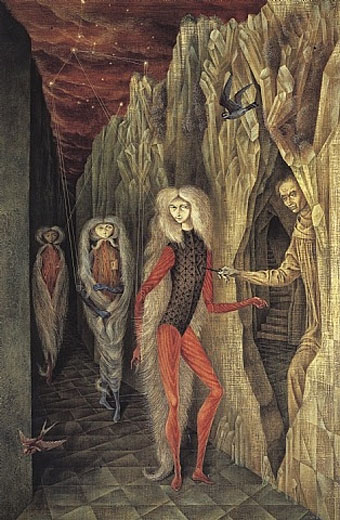
Portrait of Dr. Ignacio Chavez (1957) by Remedios Varo (1908–1963) some of whose Surrealist paintings can be seen at Frey Norris, San Francisco, from 19th January. There’s also In Wonderland: The Surrealist Adventures of Women Artists in Mexico and the United States at the Los Angeles County Museum of Art from 29th January.

The current crop of Republicans jostling for the Presidential nomination have reminded me of the Downunder people in Harlan Ellison’s post-apocalypse novella A Boy and His Dog (1969): a retrograde, fear-ridden community who send troublesome individuals to be exterminated at “the farm”. Rick Santorum (unforgettably pictured here with family in 2006 after losing an election) almost received the majority of Iowa’s votes for his nomination last week, prompting renewed scrutiny of his negative views about gay people, sexually active people, foreign people (especially Arabs and Mexicans), and anyone generally who isn’t a white, Catholic, Downunder person. Santorum is against gay marriage, of course—it’s hard to find a Republican who isn’t—but he also wants to ban abortion even in cases of rape and incest, and given the opportunity would allow US states to prevent any use of contraception. Add to this his pro-torture stance (which offends current Catholic church policy), and his willingness to wage war with Iran, and it’s easy to see why his name prompts reactions such as this:

I have a history with Rick Santorum. In 2003, when Santorum, in an interview with the Associated Press, first compared gay relationships to child rape and dog fucking (have I mentioned that Santorum has compared gay relationships to child rape and dog fucking?), I held a contest to redefine Santorum‘s last name. The winning definition: “the frothy mix of lube and fecal matter that is sometimes the byproduct of anal sex.” (“Sometimes” is the most important word in the new definition of santorum; if you’re doing anal sex correctly, there won’t be any santorum – lower- or upper-case.) And since 2003, the new definition has been the No. 1 Google return when you search “santorum“.

Rick Santorum’s homophobic frothing by Dan Savage

Related: Santorum was named one of the three “most corrupt” Senators in 2006 | “Homohater fosser fram” which is how Dagbladet, Norway’s second largest tabloid newspaper, introduces Santorum to its readers | “Rick Santorum channels Saint Augustine” an article at Slate exploring the Handmaid’s Tale extent of Santorum‘s attitudes towards sex and morality | Rick Santorum quotes as New Yorker cartoons.

marlin.jpg

The Rod (1973) by Brigid Marlin.

• Ballardian posts a long-overdue interview with Brigid Marlin, famous now for having brought two lost Paul Delvaux paintings back to life for JG Ballard, but also a woman with an extensive career as a fantastic artist using Ernst Fuchs‘s laborious mische painting technique.

Quentin Blake on Ronald Searle, in which Blake notes that his hero was given a full-scale exhibition of his work at the Bibliothèque Nationale, France, in 1973 whilst being ignored throughout his life by the major institutions in Britain.

Alfred Jarry: A Pataphysical Life by Alastair Brotchie is reviewed by Michael Moorcock who tells me the Guardian cut out his references to Boris Vian, Maurice Richardson and David Britton.

Ian McKellen stirs things up by suggesting (not for the first time) that Shakespeare was bisexual.

• Ten posters by Only More Never Less inspired by Pink Floyd’s Dark Side of the Moon.

An end to bad heir days: The posthumous power of the literary estate.

Peace Eye! Fug! A Long Talk With Ed Sanders.

• Sand sculptures by Carl Jara.

Letterheady

• Skylab: These Are The Blues (1995) | Beyond The Breeze (1995) | Red Light, Blue Light (1995) | Indigo (Sabres of Paradise remix, 1995) | Seashell (Nobukazu Takemura mix, 1995).
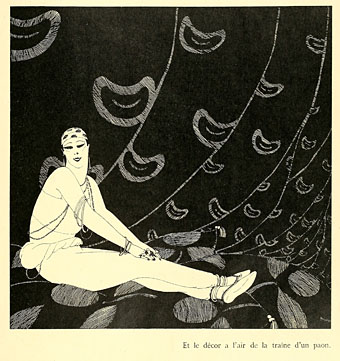
Vaslav Nijinsky by Paul Iribe

iribe1.jpg

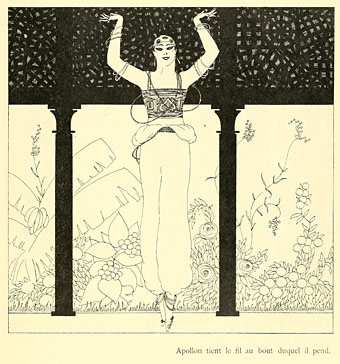
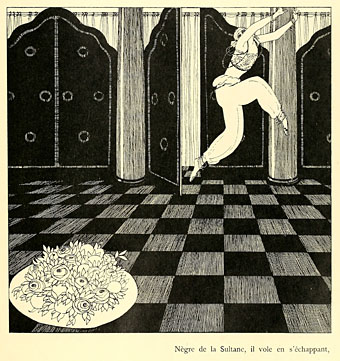
Another small and obscure volume hiding in the Internet Archive, Vaslav Nijinsky is a portfolio of six ink drawings by Paul Iribe (1883–1935) with a few lines of appended verse by Jean Cocteau. Iribe was a French designer and fashion illustrator who for a while was a member of the Ballets Russes circle, hence these depictions of the troupe’s most celebrated dancer. As post-Beardsley black-and-whites go these are pretty good although Iribe’s figures lack the requisite grace for their subject. If they were the only drawings of their kind that wouldn’t be so bad but one of Iribe’s contemporaries, George Barbier, produced his own superb series of Nijinsky drawings most of which can be seen here.

Note: the date given for this book at the Internet Archive is 1900 which seems quite wrong given that Nijinsky was still a young dancer in Russia at that time. Iribe’s drawings must date at least from 1910, maybe later.

iribe2.jpg

iribe3.jpg

Continue reading “Vaslav Nijinsky by Paul Iribe”

Albert Bierstadt in Yosemite

bierstadt1.jpg

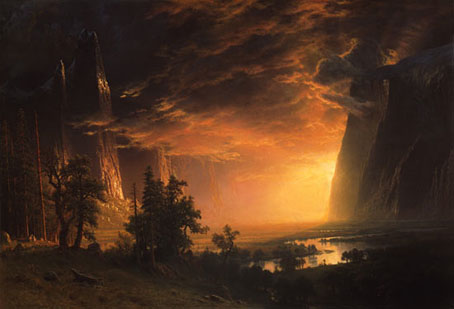
Sunset in the Yosemite Valley (c. 1868).

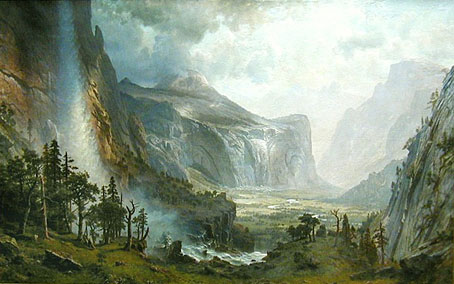
After yesterday’s photos of the Yosemite Valley I have to follow up with paintings of the region by Albert Bierstadt (1830–1902), a German immigrant whose landscape art is connected to the Hudson River School although much of his work concerned views of California and the Rocky Mountains. Some of the paintings apparently received criticism for their deliberately Romantic approach to landscape, especially the John Martin-like blazing sunsets. All the pictures here date from the same period that Carelton Watkins was taking his celebrated photos of the area (which makes me wonder whether artist and photographer ever met) so complaints about lack of realism would seem somewhat redundant.

Wikimedia Commons has a substantial collection of Bierstadt’s paintings.

bierstadt2.jpg

Looking Down Yosemite Valley, California (1865).

bierstadt3.jpg

The Domes of the Yosemite (1867).

bierstadt4.jpg

Cathedral Rocks, A Yosemite View (1872).

Previously on { feuilleton }
Carleton Watkins in Yosemite
Two American paintings

Carleton Watkins in Yosemite

watkins1.jpg

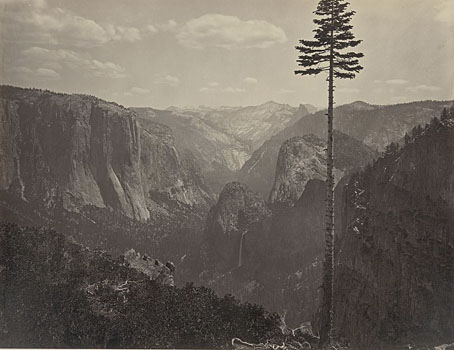
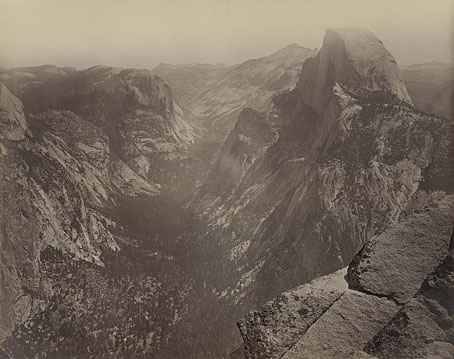
Yosemite Valley (c. 1865).

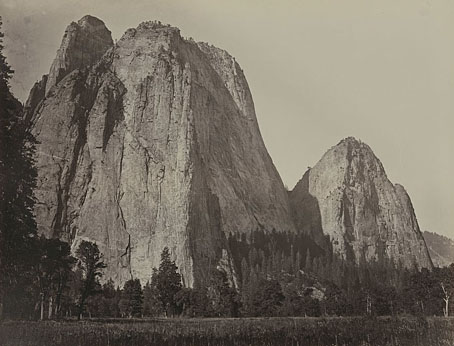
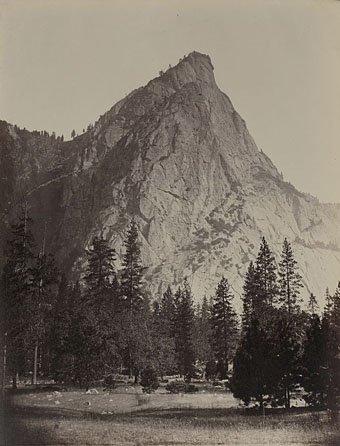
The Getty Museum recently published a large and expensive ($195) volume collecting all the surviving photographs by one of the pioneers of landscape photography, Carleton Watkins (1829–1916). The most important of Watkins’ many photos of California in the mid-19th century are those taken in the Yosemite Valley, a series of views which helped persuade Abraham Lincoln to preserve the area as a national park. The pictures here are from the Watkins collection at the Library of Congress where many of the images can be downloaded as huge (200mb) tiffs. The LoC also has a number of stereograph views. The quality of these pictures is quite stunning when you consider that the photographic medium was only about thirty years old. To capture many of these views Watkins had to cart a bulky glass-plate camera up and down mountain trails.

Carleton Watkins, The Complete Mammoth Photographs edited by Weston Naef & Christine Hult-Lewis can be ordered direct from the Getty Museum. There’s also an earlier study by Weston Naef, Carleton Watkins in Yosemite.

watkins4.jpg

Half Dome, Yosemite Valley (c. 1865).

watkins2.jpg

Cathedral Rock, Yosemite Valley (c. 1865).

watkins3.jpg

Front view, Three Brothers, Yosemite (c. 1865).

Previously on { feuilleton }
Dead Roads

The art of Ronald Searle, 1920–2012

searle01.jpg

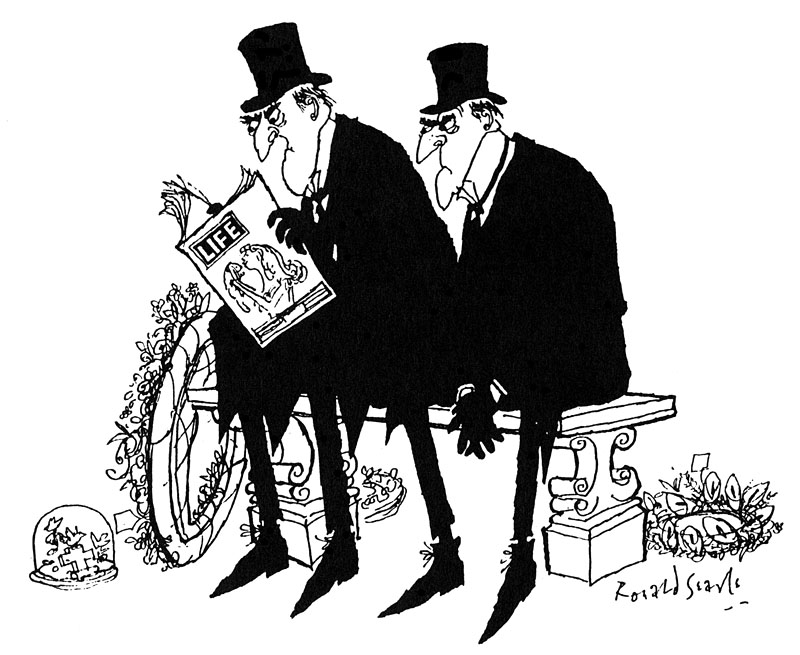
Undertakers. From Punch magazine (undated).

I started trying to draw like Ronald Searle when I was about eight. So there was Jabberwocky and Ronald Searle I was turning into by the time I was thirteen. You know, I was determined to be Lewis Carroll (giggles) with a hint of Ronald Searle.

John Lennon, 1968

Does the late Ronald Searle need any introduction? Everyone knows he created the anarchic schoolgirls of St Trinian’s in the 1940s, although their exploits had the greatest audience in the films based on Searle’s cartoons rather than the original drawings. Searle’s work first came to my attention through reprints of the Molesworth books he produced with Geoffrey Willans in the 1950s—Down with Skool! (1953), How to be Topp (1954), Whizz for Atomms (1956) and Back in the Jug Agane (1959)—a masculine riposte to St Trinian’s which allowed for a broader range of humour than the slapstick and short-skirted salaciousness the films drifted into. The Molesworth books are perhaps best appreciated at age 11 as this LRB review notes; looked at with older eyes all I see is a portrait of a rigidly class-bound nation whose boarding schools, gowned masters, “maters” and “paters” could only inspire affection in the Etonians currently attempting to govern Britain. But the drawings remain a treat: wiry and mordant with flashes of a viciousness that make Searle the godfather of Gerald Scarfe and Ralph Steadman.

searle.jpg

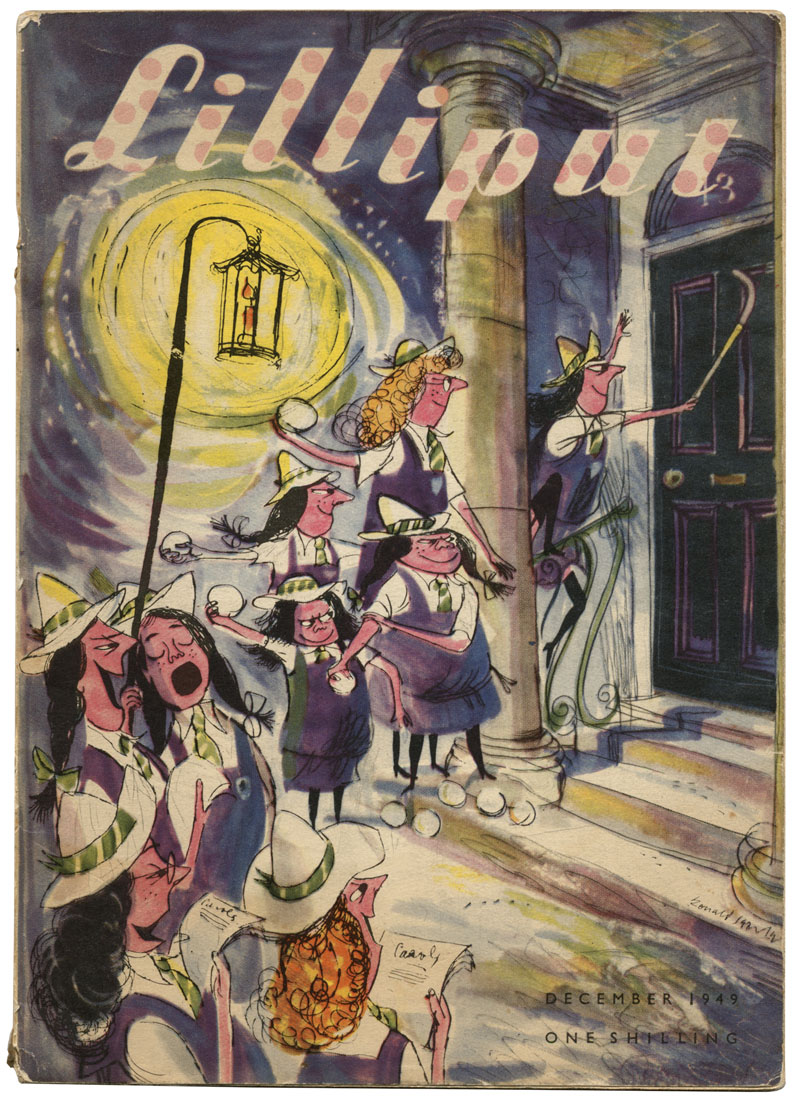
The girls of St Trinian’s, Lilliput magazine, December 1949.

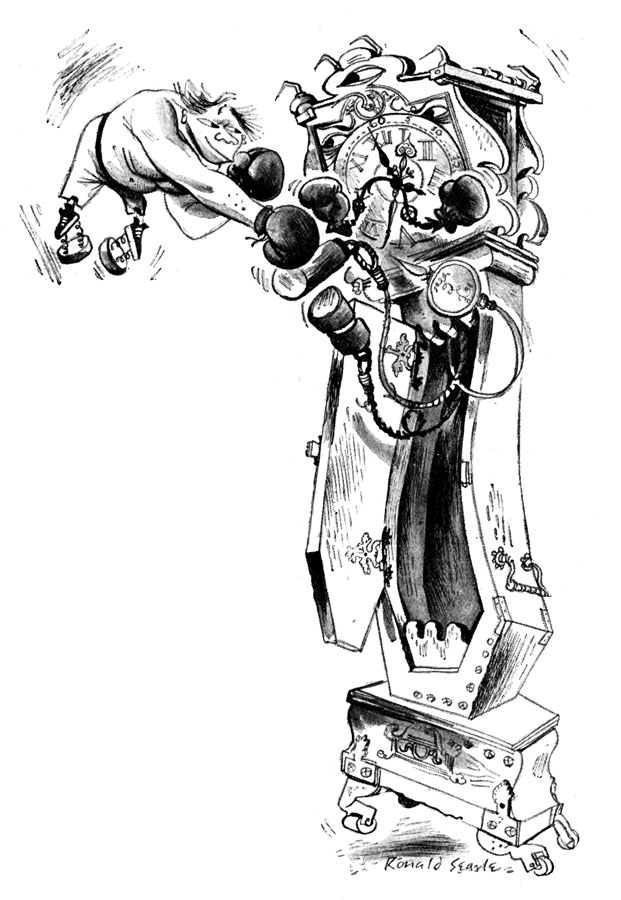
Given Searle’s influence on generations of newspaper cartoonists it’s no surprise that the British papers are being free with the plaudits. Links to various stories follow. The images here are taken from earlier posts or pulled from my bookshelves. The illustration of Engelbrecht below is from the Savoy Books edition of Maurice Richardson’s The Exploits of Engelbrecht which I designed in 2010.

Guardian obituary | Telegraph obituary | NYT obituary
• Ronald Searle in pictures: Telegraph | Guardian
Ronald Searle: a life in pictures by Steve Bell.
Mike Leigh: ‘Ronald Searle was my inspiration’.
Ronald Searle: Now let’s have some fizz: Gerald Scarfe remembers his friend and childhood hero.
Ronald Searle was our greatest cartoonist – and he sent me his pens, says Martin Rowson.

Other links:
Perpetua, the Ronald Searle tribute
Searle at VTS
Winespeak at BibliOdyssey

searle03.jpg

Engelbrecht versus Grandfather Clock. From The Exploits of Engelbrecht (1950) by Maurice Richardson.

molesworth.jpg

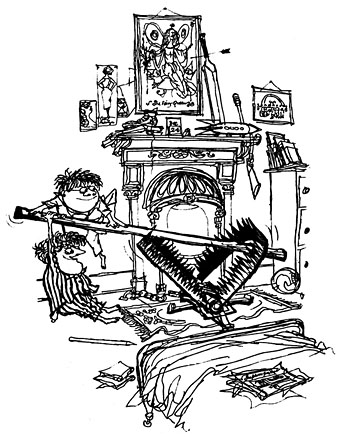
“A trap for dere Santa”. From How to be Topp (1954) by Geoffrey Willans and Ronald Searle.

searle02.jpg

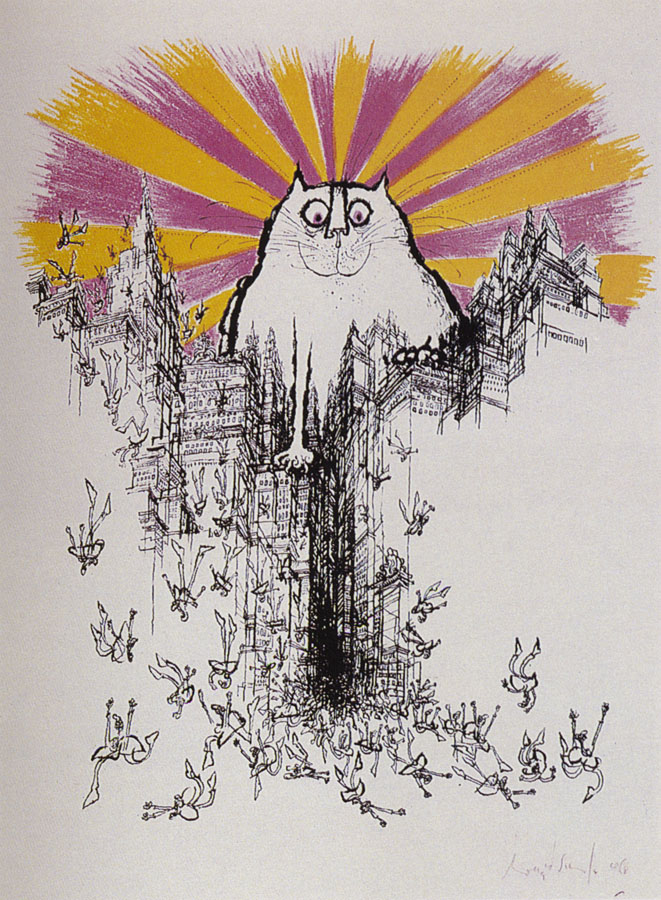
The Coming of the Great Cat God (1968).

Elsewhere on { feuilleton }
The illustrators archive

Previously on { feuilleton }
Engelbrecht lives to fight another day
Ronald Searle book covers
Engelbrecht again