Vathek illustrated

vathek1.jpg

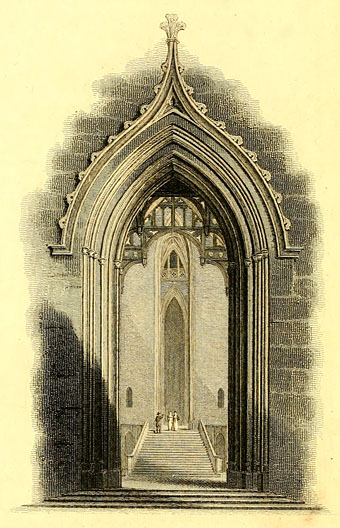
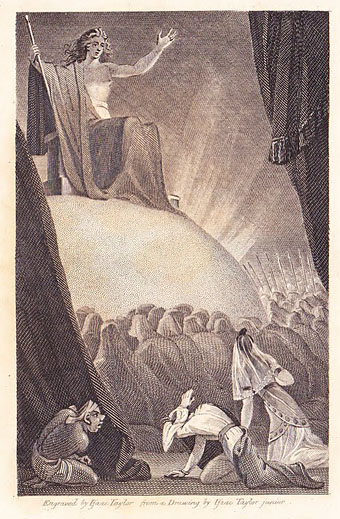
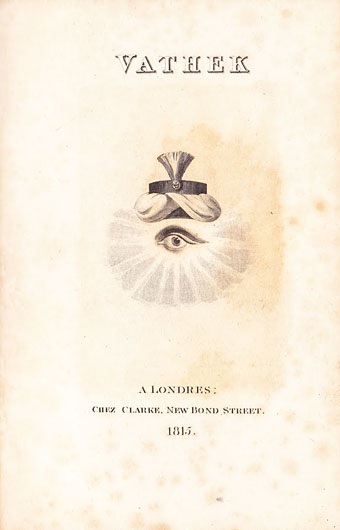
Frontispiece, 1815. Engraved by Isaac Taylor after a drawing by Isaac Taylor Jr.

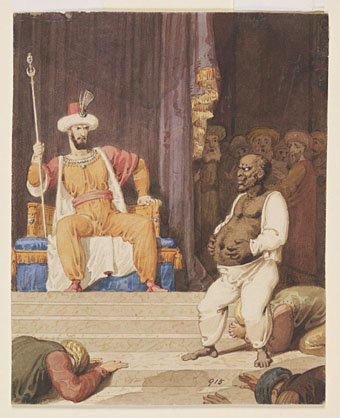
After some time Vathek and Nouronihar perceived a gleam brightening through the drapery, and entered a vast tabernacle carpeted with the skins of leopards; an infinity of elders with streaming beards, and Afrits in complete armour, had prostrated themselves before the ascent of a lofty eminence, on the top of which, upon a globe of fire, sat the formidable Eblis. His person was that of a young man, whose noble and regular features seemed to have been tarnished by malignant vapours; in his large eyes appeared both pride and despair; his flowing hair retained some resemblance to that of an angel of light; in his hand, which thunder had blasted, he swayed the iron sceptre that causes the monster Ouranabad, the Afrits, and all the powers of the abyss to tremble; at his presence the heart of the Caliph sank within him, and for the first time he fell prostrate on his face.

Vathek by William Beckford

The inevitable follow-up to yesterday’s post. Vathek was, we’re told, written in three days and two nights in the winter of 1782 when William Beckford was only 21. The novel is an Orientalist fantasy that’s grotesque and arabesque in the original sense of those terms, very much influenced by The Arabian Nights and similar tales. Here’s HP Lovecraft with a description:

Vathek is a tale of the grandson of the Caliph Haroun, who, tormented by that ambition for super-terrestrial power, pleasure, and learning which animates the average Gothic villain or Byronic hero (essentially cognate types), is lured by an evil genius to seek the subterranean throne of the mighty and fabulous pre-Adamite sultans in the fiery halls of Eblis, the Mahometan Devil. The descriptions of Vathek’s palaces and diversions, of his scheming sorceress-mother Carathis and her witch-tower with the fifty one-eyed negresses, of his pilgrimage to the haunted ruins of Istakhar (Persepolis) and of the impish bride Nouronihar whom he treacherously acquired on the way, of Istakhar’s primordial towers and terraces in the burning moonlight of the waste, and of the terrible Cyclopean halls of Eblis, where, lured by glittering promises, each victim is compelled to wander in anguish forever, his right hand upon his blazingly ignited and eternally burning heart, are triumphs of weird colouring which raise the book to a permanent place in English letters. No less notable are the three Episodes of Vathek, intended for insertion in the tale as narratives of Vathek’s fellow-victims in Eblis’ infernal halls, which remained unpublished throughout the author’s lifetime and were discovered as recently as 1909 by the scholar Lewis Melville whilst collecting material for his Life and Letters of William Beckford. Beckford, however, lacks the essential mysticism which marks the acutest form of the weird; so that his tales have a certain knowing latin hardness and clearness preclusive of sheer panic fright.

Jorge Luis Borges noted some of the influences in his 1943 essay On William Beckford’s Vathek:

…I believe that Vathek foretells, in however rudimentary a way, the satanic splendors of Thomas De Quincey and Poe, of Charles Baudelaire and Huysmans. There is an untranslatable English epithet, “uncanny,” to denote supernatural horror; that epithet (unheimlich in German) is applicable to certain pages of Vathek, but not, as far as I recall, to any other book before it.

[Guy] Chapman notes some of the books that influenced Beckford: the Bibliothéque orientale of Barthélemy d’Herbelot; Hamilton’s Quatre Facardins; Voltaire’s La Princesse de Babylone; the always reviled and admirable Mille et une nuits of Galland. To that list I would add Piranesi’s Carceri d’invenzione: etchings, praised by Beckford, that depict mighty palaces which are also impenetrable labyrinths. Beckford, in the first chapter of Vathek, enumerates five palaces dedicated to the five senses; Marino, in the Adone, had already described five similar gardens.

Byron admired the novel enough to take the name “Giaour” for one of his poems, and it’s no surprise to read that Clark Ashton Smith penned additions to The Third Episode of Vathek. Beckford’s fantasy is very much a precursor of Smith’s equally lurid and sinister stories.
vathek2.jpg

Given all this, it’s a surprise that more illustrators haven’t been attracted to the book. This may in part be a hangover of Victorian prudery: some of the novels of the Gothic period remained shocking to later sensibilities while Beckford’s scandalous reputation (Byron called him “the great Apostle of Paederasty”; to Hilaire Belloc he was “one of the vilest men of his time”) wouldn’t have made his name popular among the collectors of costly illustrated editions. Of the pictures here, the 1815 volume has a frontispiece showing Eblis perched on a hemispherical throne like the one John Martin later gave to Milton’s Satan. More of the uncredited edition from 1923 can be found at the Internet Archive while VTS has plates from the Marion Dorn edition. Mahlon Blaine not only put more effort into his illustrations but the content is also far more suited to his temperament; a shame there aren’t more of the drawings online. And it’s a shame too that Harry Clarke never tackled Beckford’s novel. Many of his contemporaries produced illustrated fairy tale books, as Clarke himself did with Charles Perrault’s stories. But none would have been able to match Clarke if he’d adapted Vathek with the same vigour he brought to Faust.
vathek6.jpg

The Caliph and the Giaour (c. 1800) by Richard Westall.

Continue reading “Vathek illustrated”

Fonthill Abbey

fonthill1.jpg

Views such as these are all we’ve ever have of Fonthill Abbey, a monstrous pile that would have been Britain’s most grandiose folly had it not collapsed in 1825. William Beckford (1760–1844) was the man responsible, among other things a very wealthy and bisexual writer whose Vathek (1786) is one of the better Gothic novels. The Gothic fad fuelled many such constructions, Horace Walpole having inaugurated the trend decades earlier at Strawberry Hill House. Fonthill always fascinates for that outrageously excessive octagonal tower which must have been visible for miles across Wiltshire. Plans and other views show that excess was also a factor elsewhere, especially in the vast hall. The pictures here are from Wikimedia Commons. There’s a book at the Internet Archive A Description of Fonthill Abbey, Wiltshire (1812) by James Storer, a contemporary account describing the building in detail, and also Delineations of Fonthill Abbey (1823) by John Rutter.

fonthill2.jpg

fonthill3.jpg

fonthill4.jpg

fonthill5.jpg

Elsewhere on { feuilleton }
The etching and engraving archive

Previously on { feuilleton }
Gothic details
Schloss Falkenstein
Pite’s West End folly
Viollet-le-Duc

Jacques Brissot’s Hay Wain

brissot1.jpg

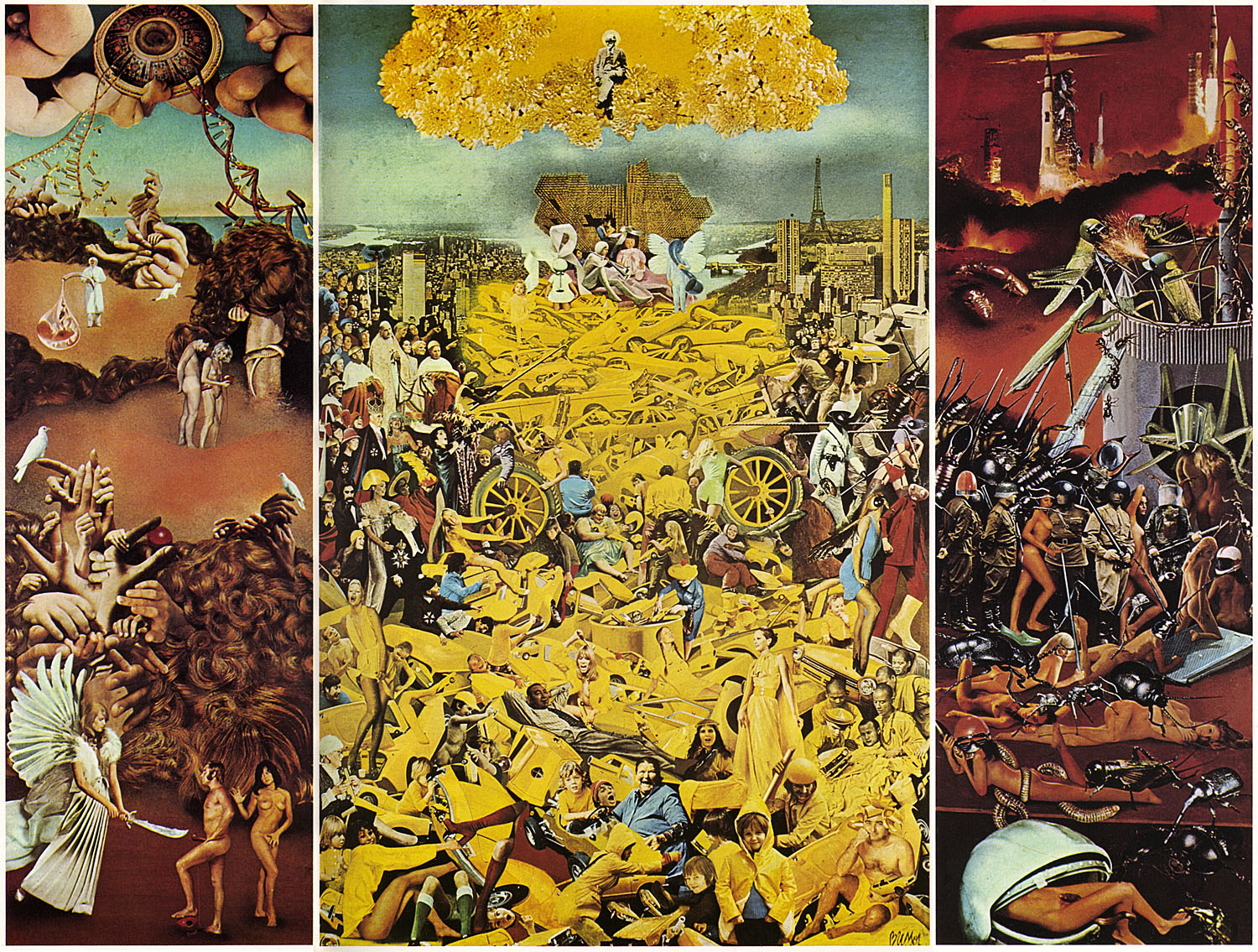
The Hay Wain (1973) by Jacques Brissot.

Another post intended to encourage further investigation. Searching for Jacques Brissot’s art is a problem since the French artist (born 1929) gets confused with the French writer Jacques Pierre Brissot (1754–1793). Details about Brissot the artist are also scant:

Jacques Brissot lives and works in Paris. He began his career as a film maker (his movie Egypt O Egypt was selected as the official French entry for the Cannes Film Festival). Later, his unique form of artistic expression, a reinvention of the most dramatic masterpieces of the past through collage, relief, over-painting etc., led to his immense success as a visual artist. (more)

brissot2.jpg

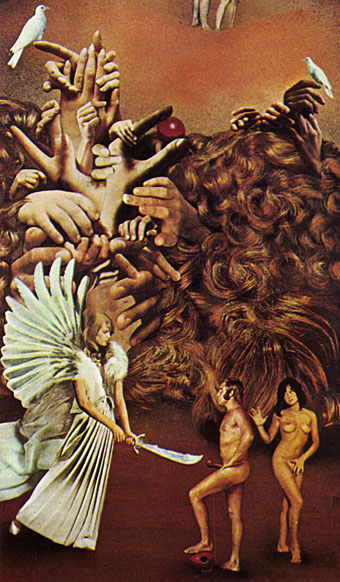
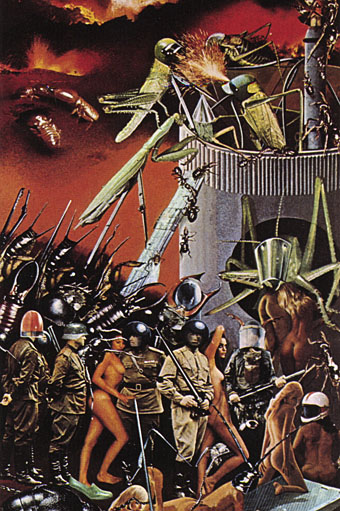
Anyone familiar with art history will recognise Brissot’s Hay Wain triptych as being a Surrealist updating of the Hieronymus Bosch triptych of the same name: a side-by-side comparison shows that many of the details are carefully matched. (In Brissot’s version Christ in the clouds appear to have been replaced by Sigmund Freud.) The copies here come from Temptation (1975) edited by David Larkin. In the same book there’s also a panel from Brissot’s Garden of Earthly Delights (1973). Judging by the works visible on auction sites Brissot has continued his meticulous collage work to the present day but there’s a surprising lack of attention outside the marketplace. Works such as this deserve to be seen in greater detail.

brissot3.jpg

Elsewhere on { feuilleton }
The fantastic art archive

Previously on { feuilleton }
The art of Jindřich Štyrský, 1899–1942
Initiations in the Abyss: A Surrealist Apocalypse
Vultures Await
Wilfried Sätty: Artist of the occult
Illustrating Poe #4: Wilfried Sätty
Metamorphosis Victorianus
Max (The Birdman) Ernst
Gandharva by Beaver & Krause
Fantastic art from Pan Books
The art of Stephen Aldrich

Le Grand Macabre

topor1.jpg

Yesterday I mentioned Leslie Megahey’s Ligeti film, All Clouds Are Clocks, an hour-long documentary based around an interview with György Ligeti filmed in 1976. A unique feature of that film was that Megahey returned to film Ligeti in the same room in 1991 where they discussed the composer’s work during the intervening period. Of these, Le Grand Macabre, written in the late 1970s, was the most ambitious piece.

topor2.jpg

Bartók and Ligeti share some attributes: both were Hungarian, and both were forced to flee their native country. Both composers also wrote only one opera apiece. Le Grand Macabre is Ligeti’s opus, an absurdist drama based on Michel de Ghelderode‘s 1934 play, La Balade du grand macabre. In the film Ligeti explains that he didn’t want to repeat the mid-century concept of the anti-opera but was also dissatisfied with the traditional variety, hence Le Grand Macabre‘s description as an “anti-anti-opera”, a work that combines the tradition and its reaction.

topor3.jpg

Continue reading “Le Grand Macabre”

Leslie Megahey’s Bluebeard

bluebeard01.jpg

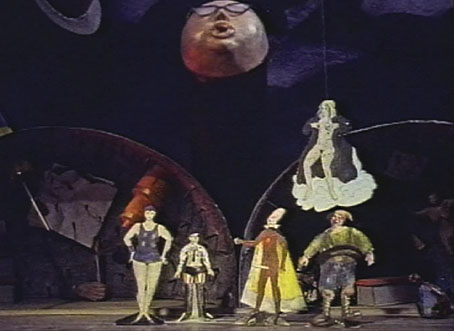
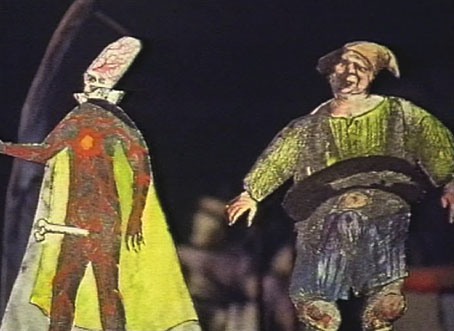
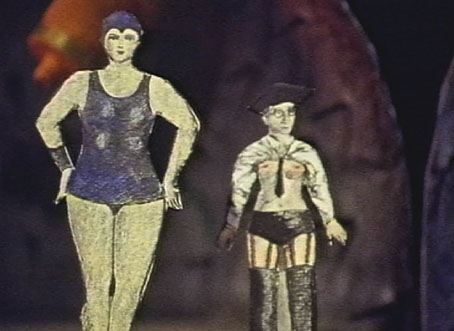
Back in the days when the BBC’s television output challenged its audience rather than pandered to it, Leslie Megahey was a name I always looked out for. During the 1970s and 80s, Megahey was one of the corporation’s outstanding producers and directors, and since his tastes often ran very close to mine seeing his name in a magazine listing was an alert for some essential viewing. Favourite Megahey documentaries would include his Omnibus film about (and interview with) György Ligeti in 1976, and the two-part Arena special about Orson Welles in 1982 that persuaded the director to talk at length for the first time about his career. Megahey’s arts films included drama documentaries about the French painters David and Gericault, and two dramas with painting themes, Cariani and the Courtesans (1987), and Schalcken the Painter (1979), the latter being an exceptional adaptation of the Sheridan Le Fanu ghost story. Duke Bluebeard’s Castle was one of the last of his BBC films, an adaptation of the Bartók opera that had this Bartók obsessive hopping with delight when it was screened in 1988.

bluebeard02.jpg

Bluebeard and Judith.

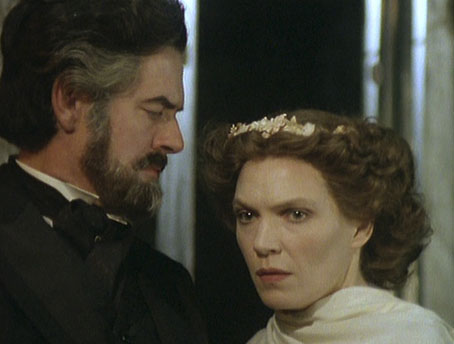
Bartók’s only opera was written in 1911, and is easier to adapt than most, being a single act of an hour or so in length with only two performers, Bluebeard (bass) and Judith (soprano). Given this it’s surprising there haven’t been more filmed versions. I wrote something a while back about the seldom-seen Michael Powell version; then there’s a version from 1981 by Miklos Szinetár scored by the London Philharmonic Orchestra with Georg Solti conducting. Megahey’s film also features the London Philharmonic with Adam Fischer conducting. Robert Lloyd and Elizabeth Laurence are the performers.

bluebeard03.jpg

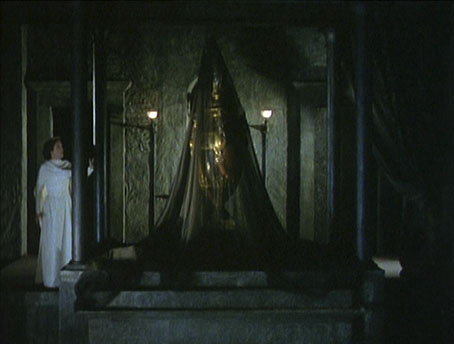
The libretto by Béla Balázs turns the old fairy tale into a psychodrama that’s also one of the first post-Freud operas, with the audience being asked in the prologue “Where is the stage? Is it outside, or inside?” Judith is ushered into the castle by Bluebeard to find seven locked doors: her curiosity and her demands to discover what lies behind the doors (or inside the mind of her husband-to-be) seals her fate. In some of the fairy tale versions the brothers of the bride arrive at the last moment to rescue their sister; not so here.

Continue reading “Leslie Megahey’s Bluebeard”