Weekend links 83

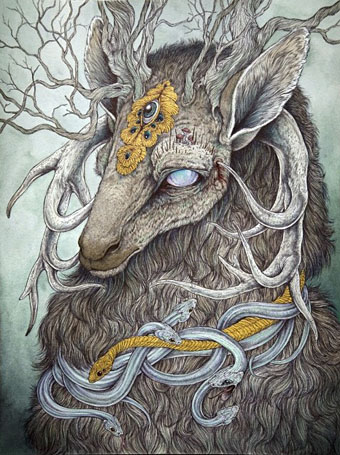
hackett.jpg

In Memory by Caitlin Hackett who describes her astonishing drawings as “contemporary mythology”.

• David Lynch’s solo album, Crazy Clown Time has just been released so The Guardian last Friday let the artist/director/musician edit their G2 supplement. Xan Brooks tried to get Lynch to open up about his inspirations while elsewhere Lynch had a chat with ZZ Top’s Billy Gibbons. Of more interest to me was news that some of the deleted sequences from Blue Velvet have been discovered. I’ve known about these for years from a feature in Video Watchdog magazine but never thought we might get to see them. Related: a mixtape by David Lynch & musical collaborator/engineer ‘Big’ Dean Hurley.

• “Book jackets these days, for reasons I won’t unpack, seem to revel, overtly, in wit, conceptual deviousness, unusual clever or droll juxtapositions – we, as a professional community, seem to have elevated the visual bon mot above all other virtues.” Peter Mendelsund in a great post about certain problems in book design, starting with the very problematic question of what to do with Nabokov’s Lolita. Related: Covering Lolita, a gallery of covers through the ages which run the gamut of bad decisions.

• “For his sins Pinocchio is not only hanged but robbed, kidnapped, stabbed, whipped, starved, jailed, punched in the head, and has his legs burned off.” Nathaniel Rich goes back to Carlo Collodi’s original Pinocchio. Disney it ain’t.

wolpe.jpg

Some of Berthold Wolpe’s Faber cover designs are now available as prints from wire-frame whose Pelham/Ballard prints were mentioned here recently. Related (and worth another visit): Faber 20th century classics at Flickr.

Technical Vocabularies – Games for May, a small collection of poems by Alan Moore & Steve Moore, is now online with authorial permission. Alan’s Beardsley pastiche on the cover is a bonus.

• Cabaret Voltaire’s Richard H. Kirk says the group’s Virgin albums will be reissued next year by Mute. A new edition of The Crackdown? Yes, please.

• “Homo Riot can only think of six or seven street artists in the world who regularly feature gay themes in their work, and he knows all of them.”

Rub Out The Words: Letters from William Burroughs and Philip K. Dick on the language virus theory of William Burroughs.

L’exilé de Capri: the connections between Jacques d’Adelswärd-Fersen and Roger Peyrefitte explored at Strange Flowers.

• Flying cars and monorails: Soviet Russia in the 1960s also had a Gerry Anderson view of the future.

Are You An Anarchist? The Answer May Surprise You.

Baby’s On Fire (1973) by Brian Eno | Baby’s On Fire (live, 1974) by Eno & The Winkies | Baby’s On Fire (live, 1976) by 801 | Baby’s On Fire (1998) by The Venus In Furs.
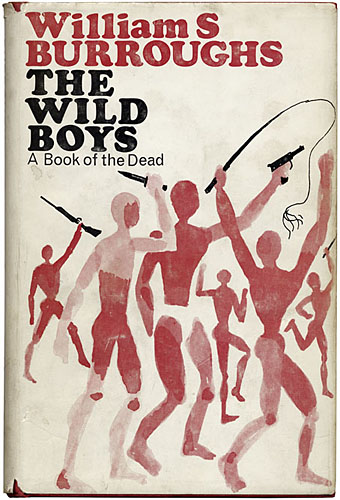
Looking for the Wild Boys

wildboys-calder.jpg

Calder & Boyars, 1972. Design by John Sewell.

This must be the first space novel, the first serious piece of science fiction—the others are entertainment.

Mary McCarthy defending The Naked Lunch in the New York Review of Books, June, 1963.

Mary McCarthy’s view—echoed a year later by Michael Moorcock and JG Ballard in the pages of New Worlds magazine—has never been popular or even particularly acceptable. William Burroughs gets touted as an sf writer by other writers, and John Clute gives him an entry in the Encyclopedia of Science Fiction, but Burroughs’ sf scenarios are guaranteed to offend those readers who prefer their narratives presented in a neat, linear form with detailed explanations of How The Future Would Actually Work, or the physics behind some piece of imaginary technology. The books which immediately follow The Naked LunchThe Soft Machine, The Ticket that Exploded, and Nova Express—all feature sf scenes or ideas. The latter was deemed sufficiently generic to prompt Panther Books in the UK to publish it three times as “Panther Science Fiction” although given the severe criticism that Moorcock sustained for trying to broaden the horizons of readers in the late 60s I don’t expect sales were encouraging.

The Wild Boys, published in 1971 (1972 in the UK), was Burroughs’ first novel after Nova Express, and his first book of fresh material after mining the stack of writing that birthed The Naked Lunch and the titles which followed. The novel is subtitled A Book of the Dead (as in the Egyptian or Tibetan Books of the Dead), and is certainly science fiction although I’ve never seen it marketed as such or noticed any sf reader include it in a list of notable genre novels of the period. My Calder & Boyers hardback offers a précis of the fractured narrative:

The year is 1988. The Wild Boys, adolescent guerilla armies of specialized humanoids, are destroying the armies of the civilized nations and ravaging the earth. The wild boys, who began in the pre-present past as petrol gangs, dousing their victims with petrol and setting them on fire for kicks, have grown to an army, dedicated to violence. One of them is used in a cigarette commercial. He becomes a new cult figure, a demi-god responsible for great destruction, and it is left to strong man Arachnid Ben Driss to exterminate the wild boys. He slaughters them, but the battle continues underground until all civilization collapses, revealing a future of horrifying dimensions. The originality of the theme and the very special Burroughs style together make this one of the most unusual science fiction novels ever, a prophetic exploration of the future, that should quickly establish itself as one of the classics of the present time.

That’s accurate, up to a point, although like many book blurbs it misrepresents the content somewhat. It also neglects to say how funny the book is. For anyone with a black sense of humour Burroughs has always been a great comic writer, and The Wild Boys has some prime examples, not least the opening chapter, Tío Mate Smiles, which is best appreciated in the author’s own reading.

Having gone through the novel in the past week, and going through its follow-up/appendix/remix Port of Saints at the moment, a couple of things occurred to me. The first was the way The Wild Boys strongly prefigures later works like Cities of the Red Night and The Place of Dead Roads. This is a fairly obvious point but it’s one that hadn’t fully clicked until now. The Wild Boys takes the problems of repressive control systems posed in the first few novels and offers a possible solution: a homoerotic utopia/dystopia where gangs of teenage boys hide out in depopulated regions, waging war against the rest of humanity with sex, magic and a mastery of weapons, including biological and viral varieties. While doing this they are steadily mutating so they can leave behind all human concerns with nation, family, laws and written language. Cities of the Red Night was Burroughs first novel after The Wild Boys and presents a less radical proposal, ranging through time with its anarchist pirate colonies and the six cities of the title. In The Place of Dead Roads Kim Carsons has his band of outlaw cowboys, The Wild Fruits, and the book gives us the conflict between the Johnsons—those who “mind their own business”—and the Shits: lawmen, politicians, tycoons, all the usual agents of Control.

Continue reading “Looking for the Wild Boys”

Wroblewski covers Burroughs

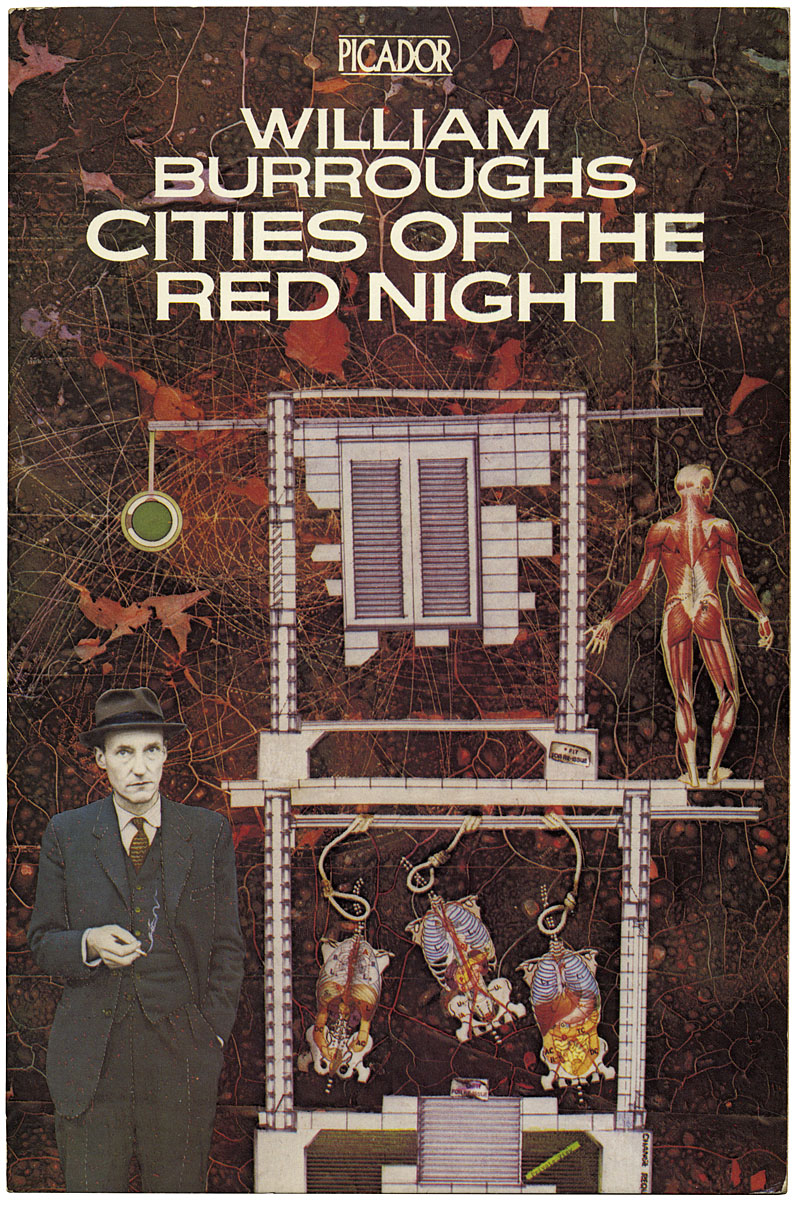
cities-1982.jpg

Picador, 1982.

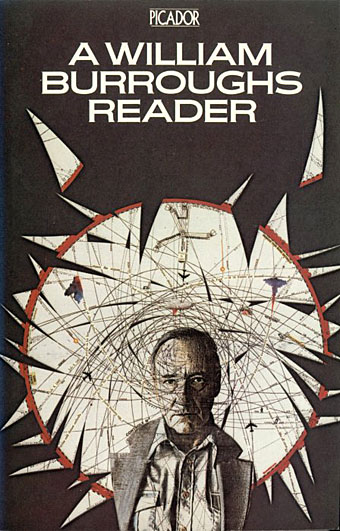
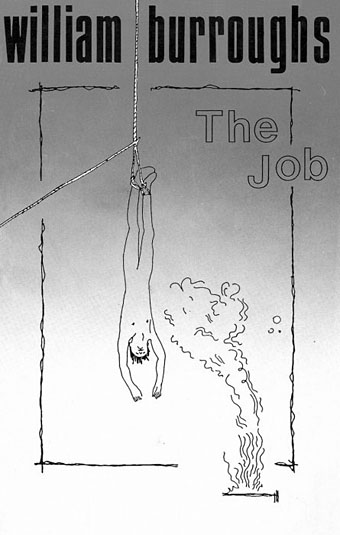
Being an occasional cover designer I naturally have a more than passing interest in how the books of favourite writers are packaged. I’ve mentioned a couple of times how much I liked the covers that Thomi Wroblewski produced in the 1980s for UK editions published by Picador and John Calder. Wroblewski is a designer who also creates his own artwork using a variety of media, with some form of collage being a common technique. Burroughs has had a number of decent designs over the years but Wroblewski is one of the few people loosed on his books who seemed to fully appreciate the tenor of the writing, and was able to convey something essential without ever being too abstract or too illustrative. I’d have been happy to see him design a complete range of the titles.

reader-1982.jpg

Picador, 1982.

Most of the covers here have been swiped from the excellent Burroughs page at Beat Book Covers where you can judge Wroblewski’s work against other editions. An exception below is the art for an unknown edition of The Wild Boys, a picture described as being from 1988 so it may have been on a Picador cover I’ve never seen. The only cover at Beat Book Covers using that art is a later Russian edition. If anyone can say when and where Wroblewski’s picture was first used, please leave a comment.

job-1984.jpg

Calder, 1984.

Also below is an album cover from Wroblewski’s parallel career as a music designer. Minutes was an audio magazine released in 1987 on the LTM label, and is included here since two of the tracks were Burroughs readings. The album has never been reissued but a copy from the vinyl can be downloaded here. Worthwhile mainly for WSB and Winston Tong of Tuxedomoon.

For more about the elusive Thomi Wroblewski, Momus wrote something about him a couple of years ago. There’ll be more about The Wild Boys, and Winston Tong, tomorrow.

Continue reading “Wroblewski covers Burroughs”

Mugwump jism

mugwump1.jpg

Naked Lunch (1991).

So what happens when you take a regular scenario like this:

There is a type person occasionally seen in these neighbourhoods who has connections with junk, though he is neither a user nor a seller. But when you see him the dowser wand twitches. Junk is close. His place of origin is the Near East, probably Egypt. He has a large straight nose. His lips are thin and purple-blue. The skin is tight and smooth over his face. He is basically obscene beyond any possible vile act or practice. He has the mark of a certain trade or occupation that no longer exists. If junk were gone from the earth, there might still be junkies standing around in junk neighbourhoods feeling the lack, vague and persistent, a pale ghost of junk sickness.

So this man walks around in the places where he once exercised his obsolete and unthinkable trade. But he is unperturbed. His eyes are black with an insect’s unseeing calm. He looks as if he nourished himself on honey and Levantine syrups that he sucks up through a proboscis.

What is his lost trade? Definitely of a servant class and something to do with the dead, though he is not an embalmer. Perhaps he stores something in his body—a substance to prolong life of which he is periodically milked by his masters. He is as specialized as an insect, for the performance of some inconceivably vile function.

Junkie (1953) by William Burroughs.

…and subject it to a dose of The Weird? This happens:

The Meet Café occupies one side of the Plaza, a maze of kitchens, restaurants, sleeping cubicles, perilous iron balconies and basements opening into the underground baths.

On stools covered in white satin sit naked Mugwumps sucking translucent, coloured syrups through alabaster straws. Mugwumps have no liver and nourish themselves exclusively on sweets. Thin, purple-blue lips cover a razor-sharp beak of black bone with which they frequently tear each other to shreds in fights over clients. These creatures secrete an addicting fluid from their erect penises which prolongs life by slowing metabolism. (In fact all longevity agents have proved addicting in exact ratio to their effectiveness in prolonging life.) Addicts of Mugwump fluid are known as Reptiles. A number of these flow over chairs with their flexible bones and black-pink flesh. A fan of green cartilage covered with hollow, erectile hairs through which the Reptiles absorb the fluid sprouts from behind each ear. The fans, which move from time to time touched by invisible currents, serve also some form of communication known only to Reptiles.

The Naked Lunch (1959) by William Burroughs.

Mugwump jism…The Weird…whatever you call it, I’m an addict. And while we’re on the subject, this turned up at Wikimedia Commons in their Patent medicine section:

mugwump2.jpg

Mug-wump Manufacturing Co. for all Venereal Diseases… And you thought Burroughs was writing fiction?

Lastly, Justin Warfield and Tim Simenon have a message for ya. Play loud.

Elsewhere on { feuilleton }
The William Burroughs archive

Weekend links 78

carr.jpg

Struggle (2009) by Lindsey Carr.

• “Twilight Science is an imprint for sound, music and DVD editions initiated by artist Paul Schütze. We will progressively publish all back catalogue, new projects and collaborations. These will include works by Phantom City, NAPE, Schütze-Hopkins and others.” Related (because Paul Schütze remixed Main): Main Feed The Collapse, Neil Kulkarni talks to Robert Hampson.

• “You can’t really narrate or display this situation, you can only, endlessly, contemplate it. When the writer or director gets tired of the iterations, he tells us who the mole is.” Michael Wood on the novel, (superb) television series and recent film of Tinker, Tailor, Soldier, Spy.

• “Havin’ a dick is pretty fuckin’ awesome” says Horst, a new gay magazine limited to 1000 copies. Related (well, there’s a guy in and out of his underwear): Naked Lunch, a fashion shoot very tenuously based on David Cronenberg’s film.

“At first, I tried fighting bullies one-on-one, but they don’t fight fair; they fight two and three on one,” Bennett said. So the youths got together and “started carrying mace, knives, brass knuckles and stun guns, and if somebody messed with one of us then all of us would gang up on them.”

 “Gay black youths go from attacked to attackers” says the headline. A group of genuine Wild Boys; William Burroughs would have approved.

• Tor.com reminded me of Sally Cruikshank‘s amazing animated film Face Like a Frog (1987) which features a score and Cab Calloway-style song by Danny Elfman.

• It’s 1969, OK? Pádraig Ó Méalóid talks with Kevin O’Neill about the Swinging League of Extraordinary Gentlemen.

• In the Tumblr labyrinth this week: Fuck Yeah St Sebastian and Gender is Irrelevant.

• For when you need some motherfucking placeholder text: Samuel L Ipsum.

• “Study finds ‘magic mushrooms’ may improve personality long-term.”

Solar Megalomania: paintings by Leonora Carrington.

• It’s all fun and games until Charles Manson turns up.

Firmament II (1993) by Main | Firmament IV (1993) by Main | Reformation (1994) by Main.