Home of the Brave

hotb1.jpg

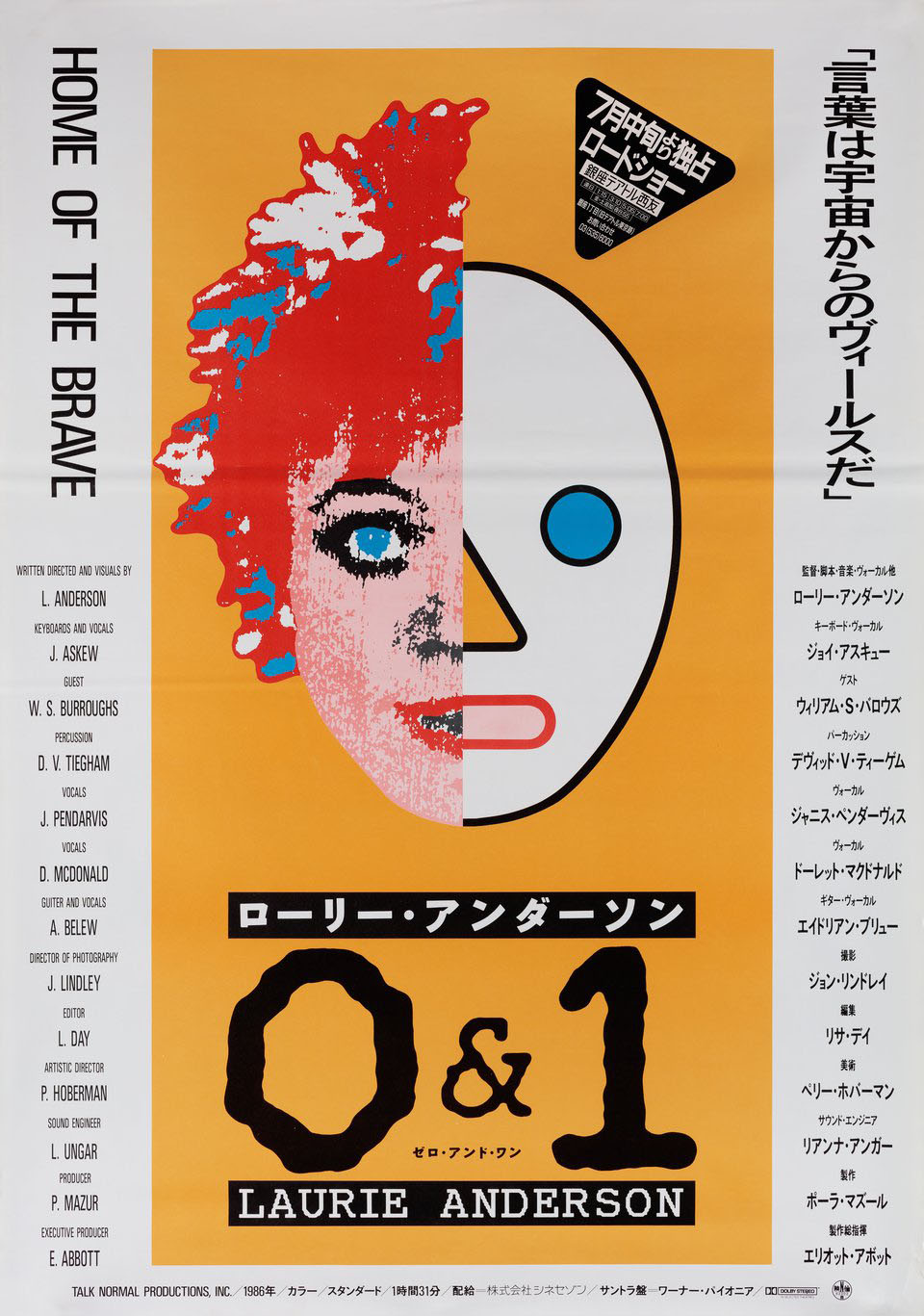
A Japanese poster.

Home of the Brave is a Laurie Anderson concert film from 1986 that more people might know about if it hadn’t been out of circulation for the past thirty years. The reason for the unavailability remains a mystery; Anderson announced a DVD release in 2007 but so far nothing has materialised. Whatever the explanation may be, this copy (which appears to be a Laserdisc rip) is better than the VHS transfers that circulate elsewhere.

hotb2.jpg

The concert itself is a 90-minute multimedia stage show built around the songs from Anderson’s second album, Mister Heartbreak. Between the album songs there are quirky, sketch-like interludes together with a reworked version of Language Is A Virus from her United States show, which was later reworked again for a single release. The album transcription extends to the projected visuals which incorporates graphics from Anderson’s design for the album cover, elements which show her to have been an early user of Macintosh computers. The Chicago font which was the default for the original Mac OS is a recurrent presence here, even being used for the title of the film on the posters and the cover of the soundtrack album. Another recurrent presence is William Burroughs, a friend of Anderson’s whose inimitable voice turns up on the last song on Mister Heartbreak, Sharkey’s Night. Burroughs’ first appearance in the film occurs when he and Laurie Anderson waltz across the stage, probably the first and last time that Burroughs was ever persuaded to dance in public.

hotb3.jpg

As for the music, if you’re as familiar as I am with Mister Heartbreak it’s good to see the songs from the album presented in live versions by some of the album’s musicians: Adrian Belew (playing guitar between stints in King Crimson), David Van Tieghem (percussion), and Dolette McDonald (backing vocals). This was Laurie Anderson’s first overtly pop-oriented outing (if you can call something “pop” that features William Burroughs and a song dedicated to Thomas Pynchon), but the stage show is filled with moments that aren’t so different to her earlier performances: solo keyboard spots, textual projections (one of which has her handwritten musings about the title of the show), unusual instruments (the tape-loop violin, body percussion, a keyboard tie), processed voices, and so on. The overall effect is simultaneously weird and playful, with the songs and general activity preventing the show from coming across like a low-key comedy act, the way United States often does. A proper reissue would be preferable but for now this is about the best you can get.

Previously on { feuilleton }
Going beyond the zero
Ear to the Ground

Weekend links 756

crane.jpg

A Diver (no date) by Walter Crane.

• At Worldbuilding Agency: The first part of a long interview with Bruce Sterling concerning “the pursuit of deliberate oxymorons as a creative strategy, worldbuilding in the context of history and futurity, Berlusconi on the moon and more”. With questions from Paul Graham Raven, and my cover art for Bruce’s Robot Artists and Black Swans.

• “With its focus on the 1970s career of Leonard Rossiter and its mordant metaphysics of the moist, Sophie-Sleigh Johnson’s Code: Damp might just be the most original book yet to emerge from Repeater publishing,” says Tim Burrows.

• “A definitive guide to the work of William S Burroughs’ on screen.” It’s a guide but it’s hardly definitive when there’s no mention of the four films Burroughs made with Anthony Balch.

• A catalogue of lots at the forthcoming After Dark: Gay Art and Culture online auction. Homoerotic art, photos, etc, also historic porn and a few garments worn by Divine.

• New music: Jay recommends the high-grade motorik en espanol dance-rock of Sgt Papers; Topology Of A Quantum City by Paul Schütze; Overtones by Everyday Dust.

• This week’s obligatory Bumper Book of Magic entry: Ben Wickey at Alan Moore World talks about his work on the book’s Great Enchanters comic strips.

• At Dennis Cooper’s it’s Malcolm Le Grice’s Day. Le Grice’s death was announced earlier this month.

• At The Wire: The magazine’s contributors’ charts showing their favourite music of the past year.

• A new website for the Sanborn Fire Maps and their decorated title pages.

• Mix of the week: DreamScenes – December 2024 at Ambientblog.

• At Public Domain Review: Albert Kahn’s autochromes.

Burroughs Called The Law (1960s) by William S. Burroughs | Language Is A Virus From Outer Space (Live) (1984) by Laurie Anderson | Burroughs Don’t Play Guitar (1996) by Islamic Diggers

The Japanese Sandman, a film by Ed Buhr

js1.jpg

I upgraded my DVD of David Cronenberg’s Naked Lunch to blu-ray recently. The film is one of my favourites in the Cronenberg oeuvre even though its connection to the novel is minimal at best. After watching it again I was thinking (not for the first time) that one way to adapt either Naked Lunch or any of the books in the “Nova Trilogy”—The Soft Machine, The Ticket That Exploded, Nova Express—would be to commission ten or twenty very different film-makers to adapt portions of the novel in whatever manner they chose. The resulting short films could either be run in sequence or cut together to make a meta-film which, if nothing else, would be closer to the disjointed structure of William Burroughs’ early novels than the semi-biographical narrative that Cronenberg delivered .

js2.jpg

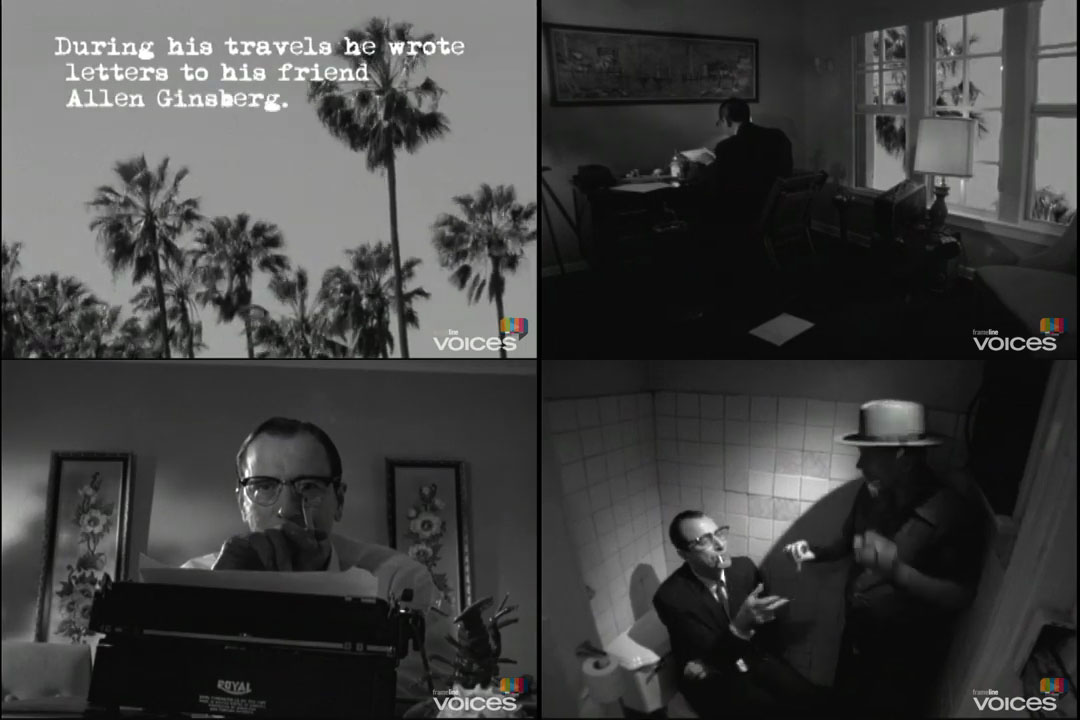
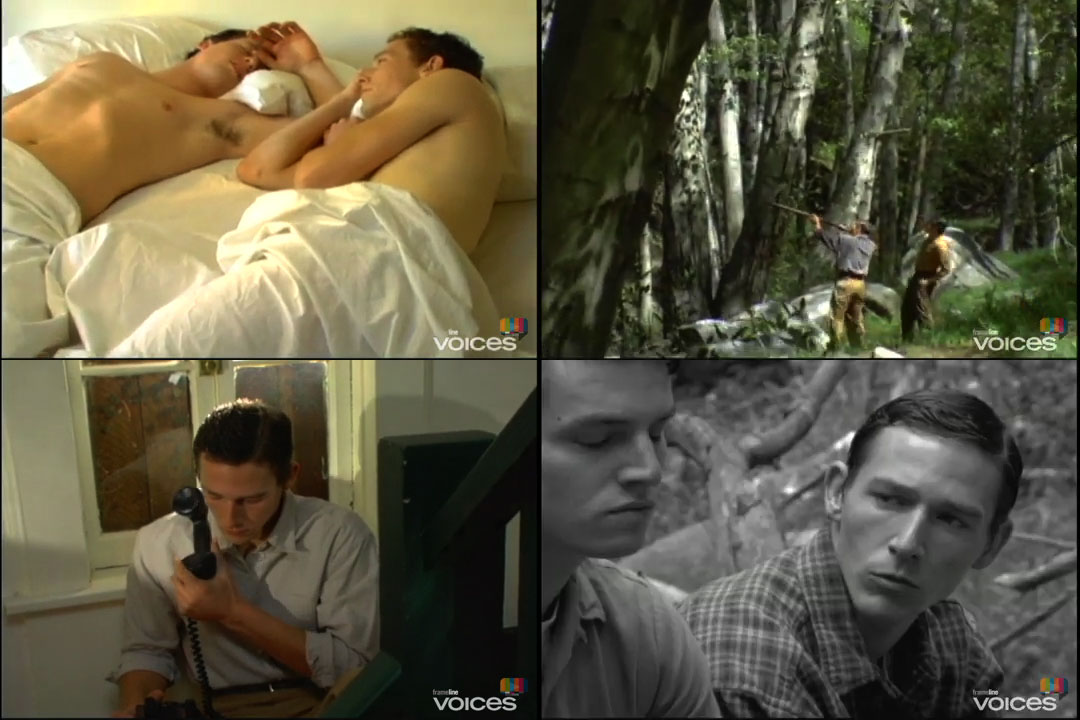
Which brings us to The Japanese Sandman, a 12-minute film made by Ed Buhr in 2008 which turned up recently on YouTube. Buhr’s short is a dramatisation of passages from the letters that Burroughs wrote to Allen Ginsberg in 1953, in which Burroughs recounts his experiences in Panama while searching for the yage vine, a plant which yields the hallucinogen known as ayahuasca. Narrator John Fleck is a decent Burroughs mimic (although the real Burroughs pronounced “Panama” with a distinct drawl at the end, more like “Panamawww”), and since Burroughs’ own words provide the text of the piece the film is closer to Burroughs’ books than many other short films. Black-and-white scenes in Panama rooms alternate with a colour sequence where Burroughs recalls a doomed love affair with a boy in the St Louis of the 1930s. It’s gratifying to see someone draw attention to an aspect of Burroughs’ writing that’s often ignored, the persistent thread of melancholy and regret for lost time/lost people which runs through so many of his novels. It’s a side of the fiction that would also have to be accounted for in any longer adaptation of Burroughs’ work.

Elsewhere on { feuilleton }
The William Burroughs archive

The art of Denton Welch, 1915–1948

welch04.jpg

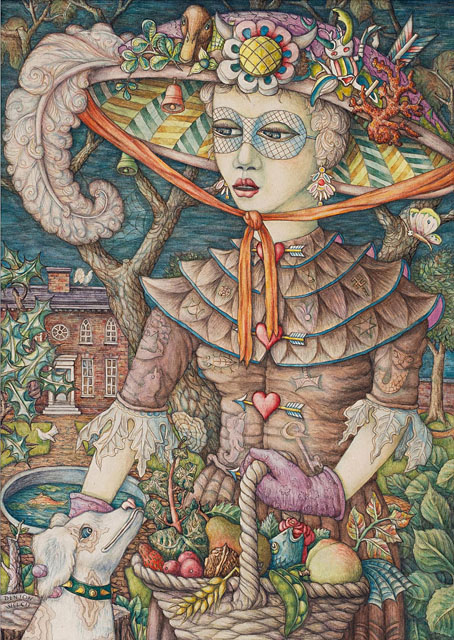
Symbolist Figure (1946).

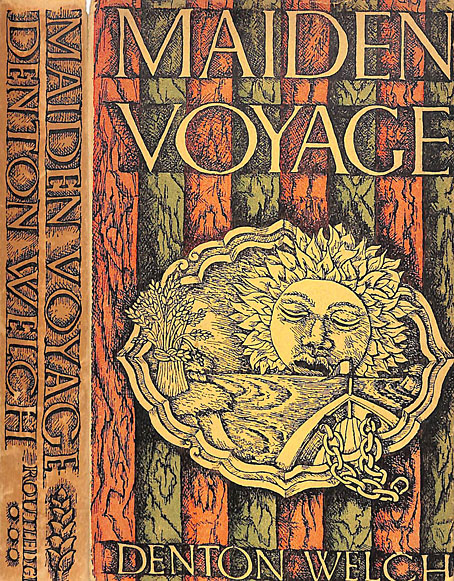
The visual art, that is, not the novels and short stories. Last month I finally got round to reading Denton Welch’s first two novels, Maiden Voyage (1943) and In Youth is Pleasure (1945). Finally, because I’ve known Welch’s name for a long time, mostly via William Burroughs—who dedicated The Place of Dead Roads to him—and John Waters—who often lists In Youth is Pleasure as one of his favourite novels. This was also the book that Burroughs favoured, and he wrote an introduction for a US reprint in 1983. At first glance, Welch would seem a surprising choice for the pair: the protagonist in each book is a thinly fictionalised avatar of the author—he’s even named Denton Welch in the first—an effete upper-middle-class English teenager who hates his school and most of the people he meets, and who spends as much time as possible wandering alone, looking for affordable antiques and any old buildings that may be of interest. The homosexual undercurrents in each book generate persistent tensions which are an obvious attraction for many readers, even though nothing is ever stated overtly and there’s no hand-wringing over unrequited passions. Welch’s boys are most passionate about the things they collect, and their determination to be left alone to pursue their interests when all the adults around them are trying to push them in different directions. Having been a similar school-hating, art-obsessed, introverted teenager, if I’d read In Youth is Pleasure when I was the same age as the beleaguered Orvil Pym it would have made a huge impression.

welch07.jpg

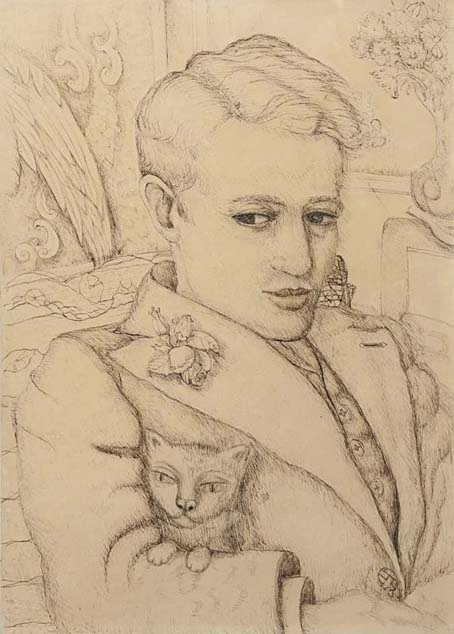
Self-portrait With Cat.

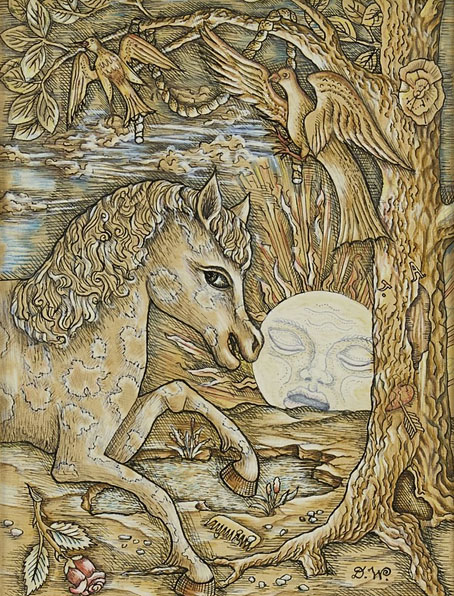
Art was the interest that Welch most wanted to pursue but it’s the writing for which he’s remembered. Few people have good things to say about his drawings and paintings but there’s a strange quality to many of them that I like, an atmosphere of menace that lurks beneath the often naive renderings. I was surprised how gloomy and claustrophobic many of them are. The refined sensibilities in the novels lead you to expect something lighter, frivolous even, like the paintings and illustrations of his contemporary, Rex Whistler, or other artists of the Neo-Romantic school of the 1930s. In fact looking at Whistler’s work again, it’s the Whistler style I most expected even though it’s unfair to compare the two. Welch and Whistler shared a taste for pictorial decoration, and a blithe indifference to the avant-garde trends of the day, but Whistler was a formidable talent, the kind of successful illustrator that Welch could only dream of being. (That said, both artists were commissioned by Shell for the company’s poster series showing views of Britain.) Yet lack of ability sometimes takes an artist into places that a professional wouldn’t reach. Whistler would have given us a perfect cat, not the strange creatures with almost human faces that Welch liked to draw. I’m curious to know which, if any, contemporary artists Welch preferred. His diaries are now earmarked for a future reading.

A Voice Through A Cloud: Discovering Denton Welch

welch05.jpg

Hadlow Castle, Kent (1937).

welch06.jpg

Horse and Moon (1943).

welch03.jpg

Continue reading “The art of Denton Welch, 1915–1948”

Talking time: Cabaret Voltaire interviews

cabs1.jpg

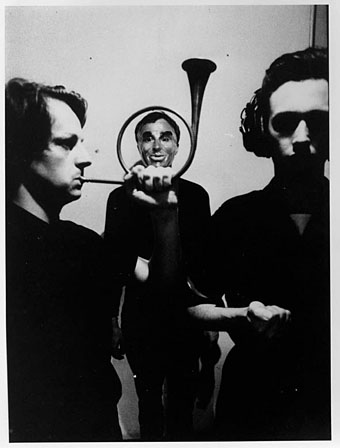
Cabaret Voltaire, circa 1981. Left to right: Richard H. Kirk, Chris Watson, Stephen Mallinder.

…A few brief facts. CV came about from a mutual interest in producing “sound” rather than “music”, a few years ago, making very rare live appearances from time to time. Now an interest has developed in the band, we are playing live more frequently instead of just recording. CV dislike the sick commercialism which pervades most “contemporary music”.

At the moment we are working on a basis which involves two types of performance. A “set” which consists of songs, and a set which is completely improvised, lasting from 20 minutes to “x” number of hours. CV also use films + slides as lighting in live performance. A CV concert is like a bad acid trip; CV want to create total sensory derangement. MIT UND OHNE POLITIK, UNVERNUNFTIGKEIT.

INFLUENCES — “anything which is unacceptable”.

The band’s line up is —
RICHARD – Guitar, Clarinet, Tapes, Vocals.
MAL – Bass, Electronic Percussion, Lead Vocals.
CHRIS – Electronics, Tape, Vocals.

Early band correspondence with a German fanzine

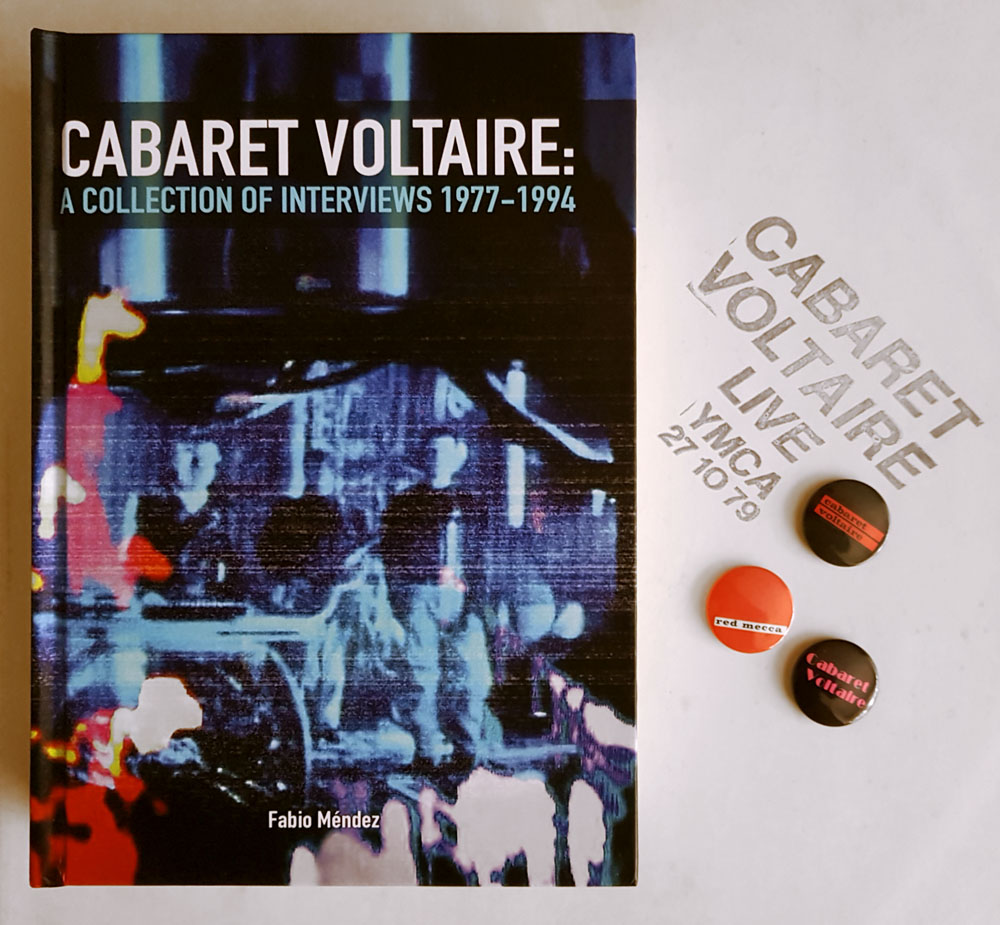
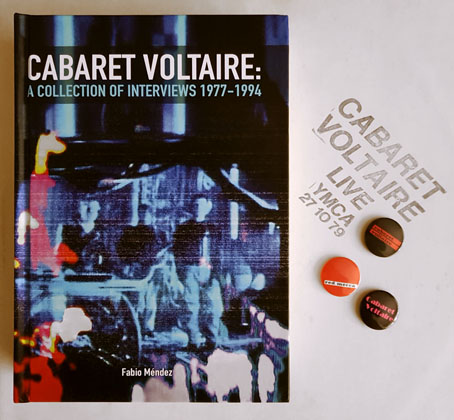
Another week, another book of music talk. Cabaret Voltaire: A Collection of Interviews 1977–1994 was published two years ago but I only just discovered it as a result of my recent cycling through the Cabs’ discography. I’ve never been a great reader of music books yet here I am with three of them devoted to this particular group. Fabio Méndez’s collection joins Cabaret Voltaire: The Art of the Sixth Sense, the first Cabs book from 1984, in which Mick Fish and D. Hallberry interrogate Kirk and Mallinder about their progress to date; and Industrial Evolution, a reprint of the Sixth Sense interviews plus newer ones appended to Fish’s memoir about life in the Cabs’ home town of Sheffield during the 1980s. The Méndez collection is the most substantial of the three, gathering articles from fanzines, magazines and newspapers, and translating into English many pieces from European publications.
cabs2.jpg

Badges not included.

As with Coil, I’ve always liked hearing what Kirk, Mallinder and Watson had to say. There was a fair amount of historical intersection between the two groups, Cabaret Voltaire having been a part of the first wave of Industrial music along with Throbbing Gristle, 23 Skidoo (whose records were produced by TG & CV), Clock DVA and the rest; later on the Cabs were part of the Some Bizzare stable along with Soft Cell, Coil, Einstürzende Neubauten and others. One of the interviews in Méndez’s book is from Stabmental, a short-lived fanzine edited in the early 1980s by a pre-Coil Geoff Rushton/John Balance. The zine ended its run with a cassette compilation, The Men With The Deadly Dreams, which included two exclusive recordings by Chris Watson and Richard Kirk. Watson’s piece, which applies cut-up theory to a radio news broadcast, is a good example of Cabaret Voltaire’s engagements with William Burroughs’ speculations about electronic media. Further examples of cut-up theory may be found in the group’s lyrics and in the video material they created, initially for use as projections while playing live, then later for their music videos which were in the vanguard of the form in the early 1980s.

A lot of the things we do tend to get glossed over. We’ll talk to anyone. We do loads of interviews with fanzines.

Unidentified group member, 1980

582 pages of interviews with a group that never had any kind of popular success is more information than most people would ever want or need. But as with Nick Soulsby’s Coil book, Méndez is doing future historians a service by resurrecting material from scarce and ephemeral sources. The post-punk period from 1978 to 1982 was a uniquely fertile musical moment, especially in Britain. For a few years absolutely anything seemed possible, with much of the wilder activity being logged and discussed in fanzines like Stabmental which usually had a limited circulation (often distributed by mail order) and a print run of a few hundred copies at most. The British music press also covered this scene, of course, but only up to a point, especially when the music was pushing the boundaries of the possible or the commercially acceptable. Méndez’s book emphasises the differences between the music-press approach—where the article is often as much about the writer as the group itself—and the fanzine interview which tends to be a list of questions with a small amount of contextual commentary. Fanzines were a circumscribed medium but they had advantages over the music papers; sincerity, for a start, allied with genuine enthusiasm and fewer of the tics that made reading the music press each week such a chore. The small publications weren’t always free of the bad habits of the weeklies but there was less of the journalistic posturing, the ignorant dismissal of whole areas of music, and the relentless snark and sarcasm which you’ll find thriving today on social media. The drawbacks of the fanzines were mostly about quality; fact-checking was often non-existent. Méndez’s book is littered with footnotes that log the errors present in the transcripts.

Which bands are influential on your music?
Chris: “Can, Neu!, Kraftwerk, Captain Beefheart…especially Can have influenced us.”

Spex magazine interview, 1980

Questions about influence are a common feature of any interview with creative people. Chris Watson’s reply is the first example I’ve seen of the Cabs mentioning so many German groups, as well as Captain Beefheart. A recurrent theme of these interviews concerns the group’s unusual trajectory, a career which evolved through a series of changes in direction that weren’t always predictable. The trio had started out in 1974 as resolute non-musicians and sound-collage provocateurs with Dadaist intentions; the music-making took time to develop. By the late 1970s the group that now called itself Cabaret Voltaire had become a more disturbed and disturbing counterpart to Sheffield’s other electronic music ensemble, The Human League. When Chris Watson departed in 1981 Kirk and Mallinder joined the Some Bizzare roster and followed the League to Virgin Records where a substantial advance helped the pair upgrade their equipment, launch their own independent music and video label, Doublevision, and record some of their best work.

Continue reading “Talking time: Cabaret Voltaire interviews”