Nathanial Krill at the Time Node

krill.jpg

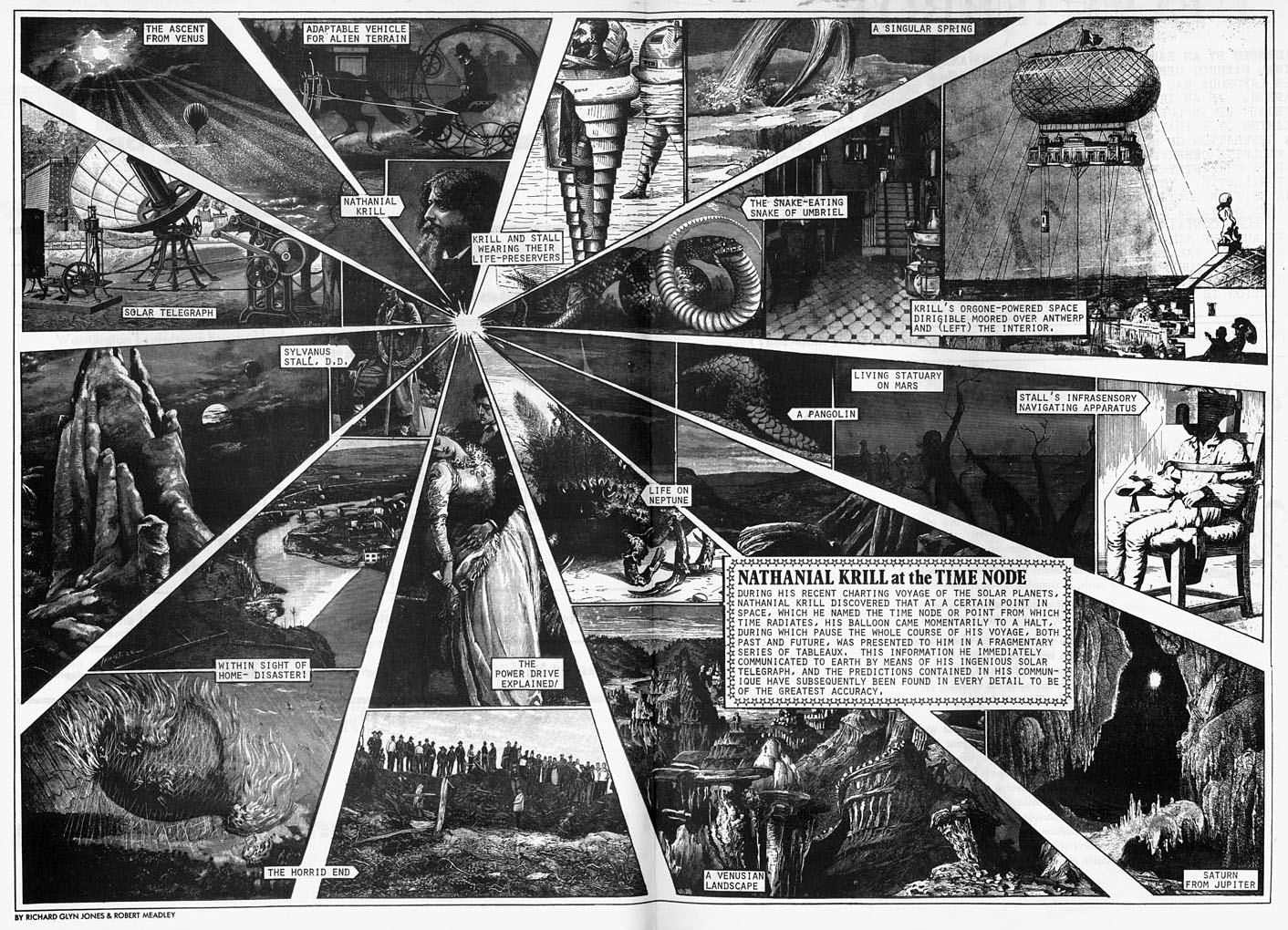
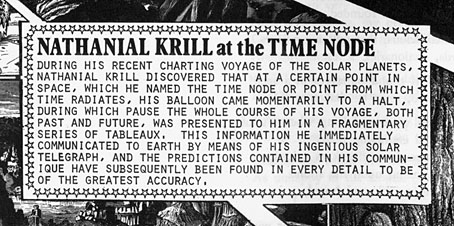
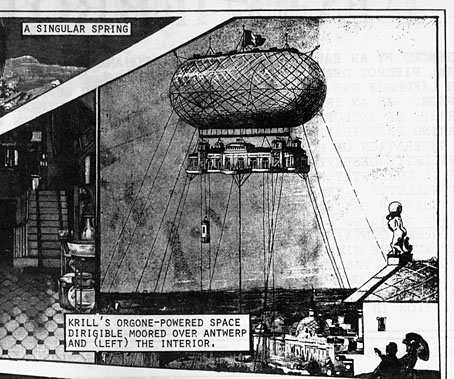
Nathanial Krill at the Time Node (1978) by Richard Glyn Jones and Robert Meadley.

Michael Moorcock’s New Worlds magazine resumed publication in 1978 after a hiatus of two years following the end of its New Worlds Quarterly paperback format. The issues for the years 1978 and 79 are the oddest in the entire run of the magazine. Issue 214 had the magazine title in Russian, a cover illustration of Union Jack anti-hero Zenith the Albino, and promised to deliver “Politics—Sport—Science”; issue 213 had an Empire-era cover, and contents which mostly dispensed with written fiction in favour of visual features such as newspaper pages from parallel time streams, or satirical collage.
krill2.jpg

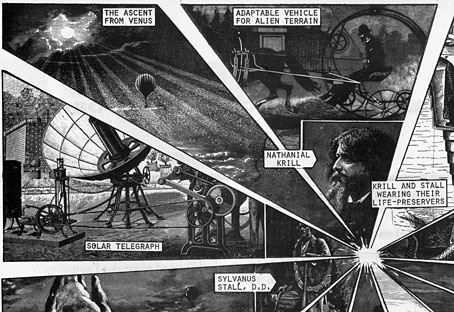
Among the satire there was this two-page piece by Richard Glyn Jones and Robert Meadley which is probably the closest the magazine came to what people now call steampunk. I say probably because many of Moorcock’s alternate histories were doing in the late 60s and early 70s what steampunk does today, although not all of these appeared in NW. Nathanial Krill at the Time Node has the additional interest for me in being another example of the use of period engravings for fantastic or satirical ends, and one that few people will have seen. Richard Glyn Jones was a regular illustration contributor to New Worlds; Robert Meadley had four short stories in New Worlds Quarterly. Ten years ago I designed Meadley’s essay collection, A Tea Dance At Savoy. He’s a great writer, I keep hoping we’ll see more of his work one day.
krill3.jpg

krill4.jpg

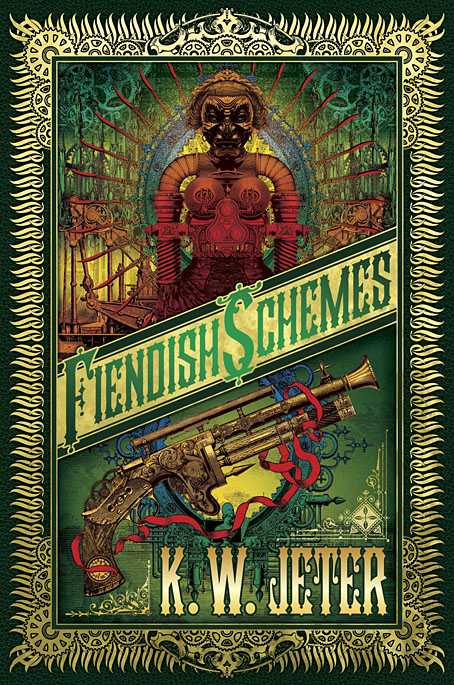
Fiendish Schemes

fiendish.jpg

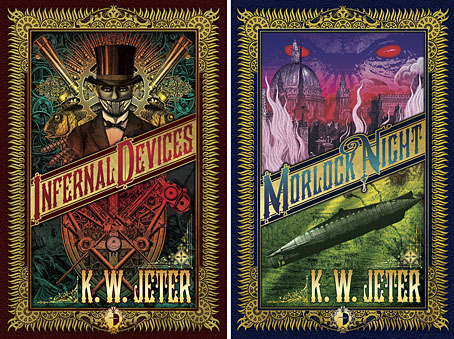
Now that this cover has appeared on Amazon I can mention it here. As usual, the machinery of publishing grinds slowly: this cover was commissioned in November last year, and worked on from the end of that month up to Christmas. Fiendish Schemes is a sequel by KW Jeter to his Infernal Devices, one of the original steampunk novels which was first published in 1987. In 2011 I created covers for reprints by Angry Robot of that title and the author’s earlier Morlock Night. Both those covers were very well received so Tor Books asked me to match their designs with a cover for the new book. This is quite unusual in publishing. Unless they make a real impact, cover designs seldom last beyond a couple of editions before being updated, and they rarely travel to other publishers.

jeter.jpg

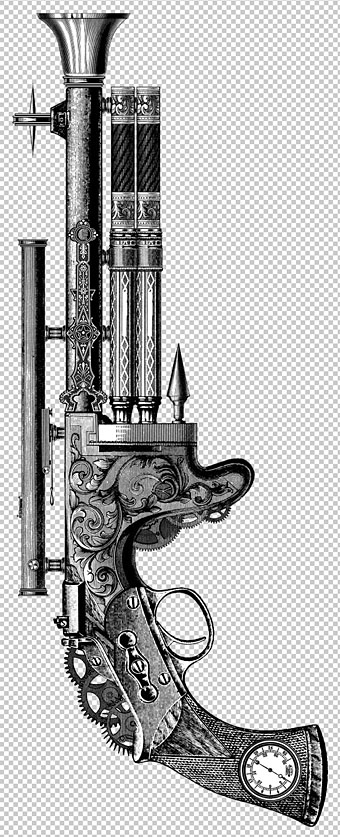
As with the earlier designs, the artwork is pieced together from very small pieces of period engravings, mostly from product catalogues or design books. In the novel, the steampunk weapon below is more alluded to than described but I was pleased with the way the illustration of it came together. Even though it’s composed of pieces of guns, fountain pens and clock parts it looks like something that could physically exist. One of the challenges I enjoy with this kind of collage illustration is trying to make something which doesn’t appear collaged at all.

Fiendish Schemes will be published on October 15th, 2013.

fiendish2.jpg

Previously on { feuilleton }
Ghosts in Gaslight, Monsters in Steam
Steampunk Revolution
The Bookman Histories
Aether Cola
Crafting steampunk illustrations
SteamPunk Magazine
Morlocks, airships and curious cabinets
The Steampunk Bible
Steampunk Reloaded
Steampunk overloaded!
More Steampunk and the Crawling Chaos
Steampunk Redux
Steampunk framed
Steampunk Horror Shortcuts

Ghosts in Gaslight, Monsters in Steam

ghosts.jpg

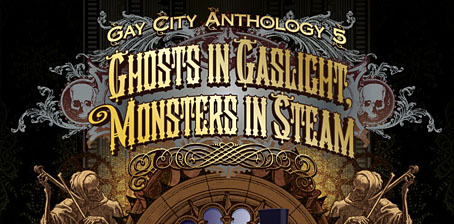
Ghosts in Gaslight, Monsters in Steam is a forthcoming anthology in the Gay City Anthology series from Seattle’s Gay City Health Project and Minor Arcana Press. The publishers describe it as “a multidisciplinary anthology of amazing queer monster and ghost fiction, poetry and art.” I’ve created a cover design for the book, and also have a work-in-progress extract from the never-ending novel I’ve been immersed in since August 2006, a self-contained piece which I call Study in Blue, Green, and Gold. As the anthology title implies, the general (although not exclusive) tenor is spooky steampunk business with a queer inclination; my piece features copious quantities of sex, hallucinogenic drugs, steam locomotives and a fractal cat. Anyone wishing to know more is encouraged to give a push to the Kickstarter donation fund which has been launched to help with promotional costs. I’m very pleased to be involved with this, not least because some of the fiction I’ve been working on for over a decade will receive an airing. I’ve resolved recently to start pushing the writing side of things a bit more so this is a start. When the final anthology contents are announced next month I’ll post an update here.

How It Works

hiw1.jpg

Yes, it’s all happening this month… Unlike other work that’s surfaced recently the cover art for issue 41 of How It Works magazine was completed less than a month ago. Headlines obscure much of the artwork but the picture is also run full-page inside, something I wasn’t expecting. How It Works has major newsstand distribution so people in the UK may see this on shelves in newsagents and supermarkets throughout December.

The theme is the Industrial Revolution but the brief was for something similar to a couple of my recent steampunk illustrations, with a request for a colour scheme like that used for the Bookman Histories cover. The main visual requirement was the train looming out of the picture. I thought this wouldn’t be a problem, I have the old Dover Publications’ Transportation book which features many copyright-free engravings of trains, in addition to other books and source material downloaded from the Internet Archive. One of these would be sure to have a decent front elevation of a steam locomotive, right? Wrong. When you start looking for pictures of locomotives you quickly find that 99% of them show the machines from the side or from an angle, as on the Bookman cover. I downloaded three entire books of over 500-pages each from the Internet Archive, fantastic volumes in themselves, especially Modern Locomotive Construction (1892) which contains meticulous descriptions of every last part of a steam locomotive, down to the smallest screw. But none of their drawings were usable.

Continue reading “How It Works”

Weekend links 134

ulian.jpg

Technological mandala 02 (The beginning) (2012) by Leonardo Ulian.

• The Yellow Magic Orchestra really were the Japanese equivalent of Kraftwerk in 1978. I’d not seen this video for Firecracker before. Same goes for the Technopolis and Rydeen videos. Related: YMO’s synth programmer, Hideki Matsutake, showing off his modular Moog on a Japanese TV show.

Sra is the final book in the Aedena Cycle by Moebius. It’s never been translated into English but Quenched Consciousness has just finished posting the entire book in an unofficial translation.

• “It’s better to have a small amount of good comics, than a big amount of mediocre comics.” Dutch comic artist Joost Swarte interviewed.

• From 2007: The Strange Lovecraftian Statuary of Puerto Vallarta (Thanks, Ian.) Related: More art by Alejandro Colunga.

steam.jpg

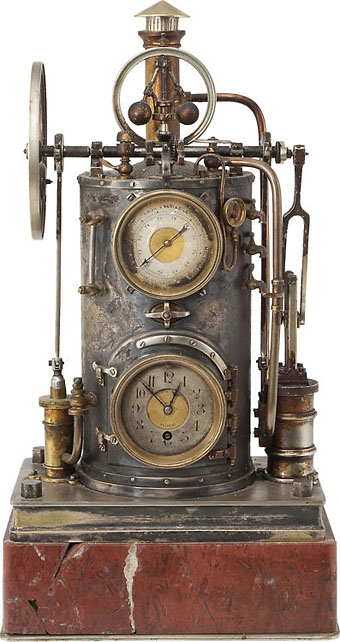
A novelty mechanical clock barometer in the form of a steam engine (c. 1885).

The MR-808: a room-size TR-808 drum machine by Moritz Simon Geist with real instruments played by robot hands.

• “Shoot us and dig the grave; otherwise we’re staying.” The women living in Chernobyl’s toxic wasteland.

Hotel Room Portraits 1999–2012 by Richard Renaldi, a new photo exhibition at Wessel + O’Connor.

Lane’s Telescopic View of the Opening of the Great Exhibition, 1851.

• “I’m the target market, and I don’t like it!” A Creative Catharsis.

Brian Eno’s new ambient album, Lux, is released on Monday.

Collages by Sergei Parajanov.

Techno City (1984) by Cybotron | Techno Primitiv (1985) by Chris & Cosey | Techno Dread (2008) by 2562.