Weekend links 807

kouninos.jpg

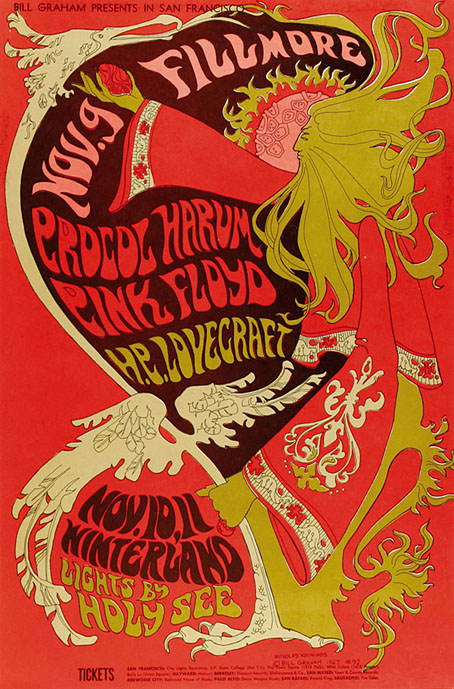
Poster art by Nicholas Kouninos for Procol Harum / Pink Floyd / HP Lovecraft at the Fillmore, San Francisco, 1967.

• Take a break from so-called reality with Gruesome Shrewd, more queasy psychedelia by Moon Wiring Club. MWC’s Ian Hodgson described his intentions to Simon Reynolds in a Reynolds roundup which notes the 20th anniversary of the Ghost Box project. The label is apparently on hold for the moment but I have to admit that my interest waned some time after the 10th anniversary, when it became increasingly apparent that the ghost had fled the box. Reynolds ends his piece with a list of favourite GB recordings which I mostly agree with, although I’d shuffle the order and swap some entries with Pye Corner Audio.

• “‘You know that feeling you get when you’ve just gotten back from the dry cleaners a pair of slacks, Dacron slacks, and you reach your hand in a pocket and you feel those fuzzy sandwiches with your fingers? Well, that’s the feeling I’m looking for.’ I just nodded and replied, ‘OK, Dave, I know exactly what you mean.’” Barry Gifford remembers David Lynch.

Aschenbach’s Last Journey: Lesley Chamberlain, the most recent translator of Thomas Mann’s Death in Venice, approaches the text by following the progress of its doomed protagonist from Brioni to the Venetian Lido. Related: Polly Barton describes to Katy Whimhurst some of the difficulties involved in translating Japanese fiction to English.

• From The Shout to Bait: Darran Anderson on the uses of sound in cinema. Rupert Hines’ soundtrack to The Shout has just been released by Buried Treasure.

• Video footage of modular synthesists Arc (Ian Boddy & Mark Shreeve) performing Arcturus live in 2004: part one | part two.

• At Aeon: “Black holes may be hiding something that changes everything,” says Gideon Koekoek.

• At the BFI: Michael Brooke selects 10 great Hungarian films.

• Steven Heller’s font of the year is Fillmore.

Shout The Storm (1984) by :Zoviet:France: | Shout At The Devil (2002) by Jah Wobble & Temple Of Sound | Shout (2005) by Tod Dockstader

Weekend links 779

finlay.jpg

The Crystal World by JG Ballard. An illustration by Virgil Finlay for the Summer–August 1966 issue of Things To Come, the Science Fiction Book Club mailer.

• At Blissblog, Simon Reynolds looks back on 20 years of limited-edition electronic music reissues by the Creel Pone label. (Previously.) A bootleg enterprise but a very worthwhile one since most of the reissues would otherwise remain deleted and largely forgotten. I thought the releases had finished years ago but it seems not, Discogs now lists over 300 of them.

• “Everyone recognized the brilliance of Robinson’s eventual script: they just didn’t want to make it.” David Cairns on the miserable magnificence of Bruce Robinson’s Withnail and I.

• Coming soon from Top Shelf: More Weight: A Salem Story, Ben Wickey’s illustrated account of the Salem Witch Trials.

• The tenth installment of Smoky Man’s exploration of The Bumper Book of Magic has been posted (in Italian) at (quasi).

• At Colossal: “A unique portfolio of Hilma af Klint’s botanical drawings communes with nature’s spiritual side”.

• At Nautilus: The Visual Language of Crystals—Chemistry becomes art in Thomas Blanchard’s timelapse video.

• At Unquiet Things: Supernatural field notes and incomprehensible eldritch frequencies: The art of Ed Binkley.

• See some of the entries from the 2025 Milky Way Photographer of the Year.

• New music: Instruments by Water Damage, and Reverie by Deaf Center.

• The Strange World of…Editions Mego.

Strobe Crystal Green (1971) by Gil Mellé | Crystal Leaves (1983) by Ippu-Do | Crystalline Green (2002) by Goldfrapp

Weekend links 729

demorgan.jpg

Phosphorus and Hesperus (1881) by Evelyn De Morgan.

• Mix of the week, or possibly the entire year: The Deep Ark, 167 tracks (over 8 hours of music), most of which are from the electronic deluge of the early 1990s. The download link may not work for all browsers—it didn’t for one of mine—but it is active. Via Simon Reynolds who has more about the Deep Ark project.

• At Nautilus: Betsy Mason on the use of stage magic to investigate animal behaviour. “By performing tricks for birds, monkeys, and other creatures, researchers hope to learn how they perceive and think about their world.”

• At The Daily Heller: Mad and the Usual Gang of Idiots. Meanwhile, Mr Heller’s font of the month may prove useful for this election season, a Jonathan Barnbrook design named Moron.

Looking back, you can see a pattern in those eras in which interest in telepathy boomed. Coined by Myers and his fellow psychical researchers in the 1880s, telepathy gained traction because it was formulated inside a moment of scientific and technological revolution, where uncanny transmissions proliferated across the visible and invisible spectrum, seeming to collapse the natural and the supernatural together. In the 1970s, telepathy returned, if under different names, as part of another moment of crisis. The Cold War arms race was an essential part of this, feeding a strange supplemental world of fantasy technologies, from mind control to brainwashing, and playing on an all-too-widespread psychological paranoia around being seen, infiltrated and manipulated by invisible agents.

Roger Luckhurst looks back at a century of psychic research

• New music: Portable Reality Generator by Field Lines Cartographer, and Sublime Eternal Love by Chrystabell and David Lynch.

• Coffee and Chocolates for Two Guitars: Robert Fripp interviewing John McLaughlin in July, 1982.

• Paintings by Ithell Colquhoun currently showing at the Ben Hunter gallery, London.

• At Public Domain Review: Eye Miniatures (ca. 1790–1810).

ESP (1965) by Miles Davis | ESP (1990) by Deee-lite | ESP (2002) by Comets On Fire

Weekend links 719

rimmington.jpg

The Decoy (1948) by Edith Rimmington.

• “Among other things, [Dalí’s] storyboards involved [Ingrid] Bergman turning into a statue that would then break up into ants.” Tim Jonze talks to film scholar John Russell Taylor about the storyboards for Alfred Hitchcock’s films, including the ones for Spellbound which Taylor found in a bric-a-brac sale.

• “Of all the pop acts that proliferated in the early 80s, it was Soft Cell who retained punk’s sharp, provocative edges.” Matthew Lindsay on 40 years of Soft Cell’s This Last Night In Sodom.

• Coming soon from White Rabbit books: Futuromania: Electronic Dreams, Desiring Machines and Tomorrow’s Music Today by Simon Reynolds.

Anathema to many philosophical systems, or perhaps philosophy itself, Lovecraft’s philosophical project fundamentally holds that contemplations of higher reality or the nature of things can never be fully realised. Ultimately, the search for knowledge does not constitute some telos, some purpose, for humankind, but rather leads to the violent dissolution of the self. Higher reality is that which the limited human psyche can never fully comprehend.

Sam Woodward on the cosmic philosophy of HP Lovecraft

• At Public Domain Review: Grotesqueries at Gethsemane: Marcus Gheeraerts’ Passio Verbigenae (c.1580).

• “Here is a remarkable form of popular heraldry.” Mark Valentine on the mystique of old inn signs.

• At Bandcamp: Brad Sanders on where to begin with Lustmord’s cosmic ambient.

• New music: Eleven Fugues For Sodium Pentothal by Adam Wiltzie.

• At Aquarium Drunkard: Jason P. Woodbury talks to Roger Eno.

Gomorrha (1973) by Can | Sodom (1978) by Can | Spellbound (1981) by Siouxsie And The Banshees

Weekend links 706

jardine.jpg

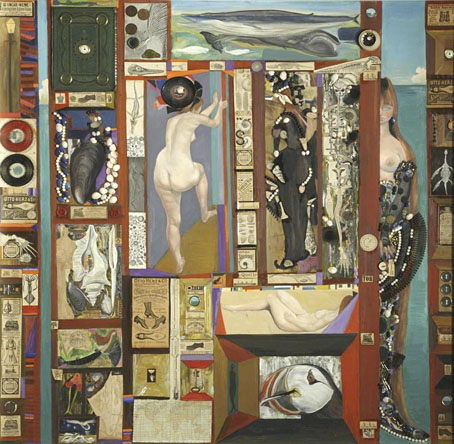
Sea Change (c.1966) by George Wallace Jardine.

A paucity of links this week thanks to the Xmas blight which reduced my RSS feed to a wasteland of no activity at all or too many of those lazy listicles devoted to “our top ten things of the year”. There was, however, this from Simon Reynolds:

I miss the inter-blog chatter of the 2000s, but in truth, connectivity was only ever part of the appeal. I’d do this even if no one read it. Blogging, for me, is the perfect format. No restrictions when it comes to length or brevity: a post can be a considered and meticulously composed 3,000-word essay, or a spurted splat of speculation or whimsy. No rules about structure or consistency of tone. A blogpost can be half-baked and barely proved: I feel zero responsibility to “do my research” before pontificating. Purely for my own pleasure, I do often go deep. But it’s nearer the truth to say that some posts are outcomes of rambles across the archives of the internet, byproducts of the odd information trawled up and the lateral connections created.

Setting aside the inter-blog conversation, which I was never very interested in, Reynolds articulates precisely why I still enjoy posting things here. I also agree with his comments about the psychological constraints that doing the same for Substack or similar would impose: a paying readership creates responsibilities that would make the whole thing feel like another form of work rather than play. To Reynolds’ comments I’d add that I also enjoy having a tiny area of the internet over which I exercise complete control. If I fall out with my webhost, as I did in the summer, I can move the entire site to a new location.

Reynolds expanded on his article at his regular forum, blissblog, where he examines the current state of the thing that people used to call the blogosphere. My thanks to Simon for including this place in his list of diehard operatives. I can’t say I’ve noticed the younger generations picking up the habit (then again, I haven’t really been looking…) but the small percentage of any generation who want to do more than simply follow the herd will always find outlets for their interests. And the tools for doing this have never gone away. This particular medium may not suit most people, but for those who can accommodate themselves to the format it’s a better way to spend your time than marinating your soul in the corrosive sump of social media.

• Elsewhere: Among other things, 2024 will be the year that the earliest manifestation of Walt Disney’s ubiquitous rodent enters the public domain in the USA. Jennifer Jenkins lists some of the more prominent books, films, songs, etc that will be following suit.

• At Open Culture: The Beautiful Anarchy of the Earliest Animated Cartoons.

• At Dennis Cooper’s: Another day for Shirley Clarke.

Suspended Animation (1980) by Bernard Szajner | Animation (1983) by Cabaret Voltaire | Reanimation (1996) by Bill Laswell feat. DJ Rob Swift