Maruyama Okyo’s peacocks

okyo1.jpg

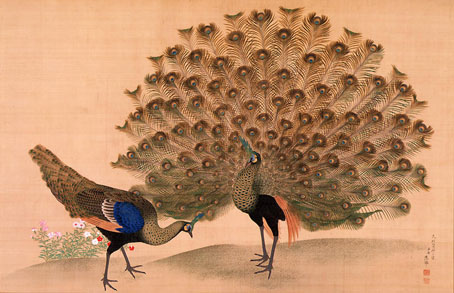
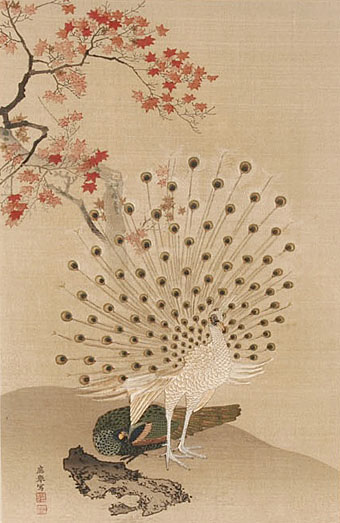
Peacock and Peahen (18th c.).

I’ve had an untitled Japanese painting of a peacock as a desktop image for a while now, its origin forgotten, and I’ve wondered a few times who the artist was. A recent posting about Maruyama Okyo (1733–1795) at Bajo el Signo de Libra made me think that Okyo might be the artist responsible. As it turns out, he wasn’t, my bird is by one of his pupils, Nagasawa Rosetsu (1754–1799), and looks like a copy of the picture below. Mystery solved anyway, and the search gives me a good excuse to link to some of Okyo paintings. These differed from the prevailing style of the period, Okyo having studied Western artists and their methods in order to produce work which was more realistic than that of his contemporaries.
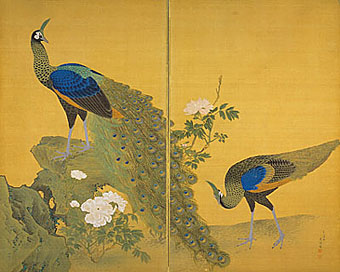
okyo2.jpg

Peony and Peacocks (1781).

A realist and an eccentric | Okyo and Rosetsu profiled.
okyo3.jpg

Peacock (no date).

Previously on { feuilleton }
Louis Rhead’s peacocks
The White Peacock
Peacocks
Whistler’s Peacock Room
Beardsley’s Salomé

Merely fanciful or grotesque

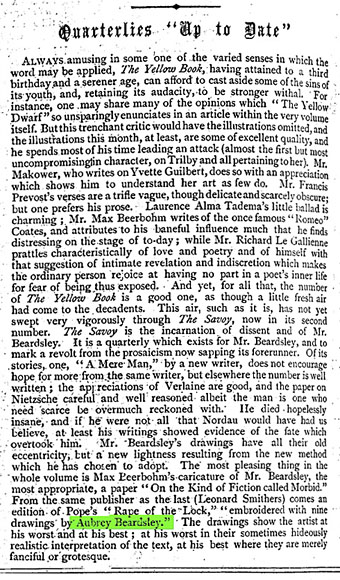
graphic.jpg

Thus the judgement of a reviewer examining Aubrey Beardsley’s work in The Graphic for May 23, 1896. The work in question was Beardsley’s Rape of the Lock illustrations being unveiled for the first time in the second number of The Savoy, the magazine which Beardsley co-founded with Arthur Symons and Leonard Smithers as a rival to the staid Yellow Book, also reviewed in the same column. Beardsley’s illustrations for Pope are now considered some of his very finest works and it’s difficult from our perspective to find any grotesquery there at all. It may be a reference to The Cave of Spleen, a drawing which saw the brief return of Beardsley’s earlier foetus creatures and a work to which some of Harry Clarke’s style would seem to owe a debt. In which case the reviewer should have been grateful to be spared the giant phalluses of The Lysistrata which Aubrey was also drawing for Smithers at this time.

The column above is one of many mentions of Beardsley and company to be found at the British Library’s new online archive of 19th century British newspapers. What might be a treasure trove is compromised slightly for me by being a collection of newspapers only, rather than magazines. A magazine database would give us all of The Savoy and The Yellow Book, as well as other titles which featured the work of fin de siècle illustrators. Patience is the key here, with every passing year more of the past becomes easily accessible.

So now, given the quantity of references there’s likely to be, dare I search for Oscar Wilde?

Elsewhere on { feuilleton }
The Aubrey Beardsley archive

The Great God Pan

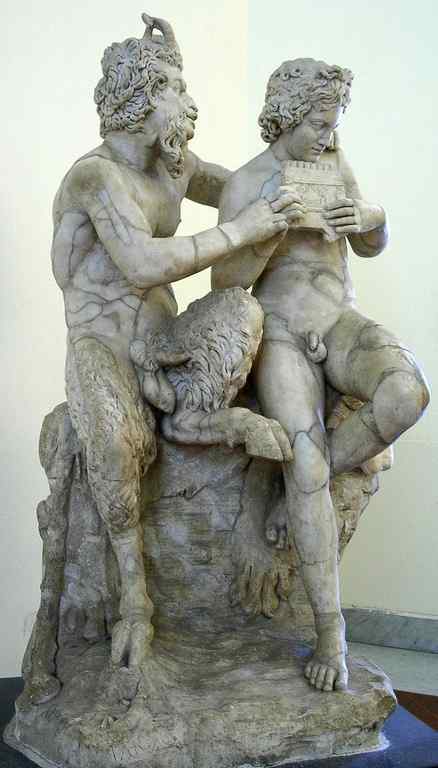
pan_daphnis.jpg

Pan teaching Daphnis to play the panpipes; Roman copy of a Greek original from the 3rd-2nd centuries BCE by Heliodoros.

“The worship of Pan never has died out,” said Mortimer. “Other newer gods have drawn aside his votaries from time to time, but he is the Nature-God to whom all must come back at last. He has been called the Father of all the Gods, but most of his children have been stillborn.”

So says a character in The Music on the Hill, one of the slightly more serious stories from Saki’s The Chronicles of Clovis (1911). Saki’s Pan is a youthful spirit closer to a faun than the goatish creature of legend. But being a gay writer whose tales regularly feature naked young men (surprisingly so, given the time they were written) I’m sure Saki would have appreciated the Roman statue above. There’s nothing chaste about this Pan with his “token erect of thorny thigh” as Aleister Crowley put it in his lascivious 1929 Hymn to Pan, a poem which caused a scandal when read aloud at his funeral some years later. The Roman statue was for a long while an exhibit in the restricted collection of the Naples National Archaeological Museum where all the more scurrilous and priapic artefacts unearthed at Pompeii were kept safely away from women, children and the great unwashed. These are now on public display and include the notorious statue of a goat being penetrated by a satyr.

Continue reading “The Great God Pan”

Louis Rhead’s peacocks

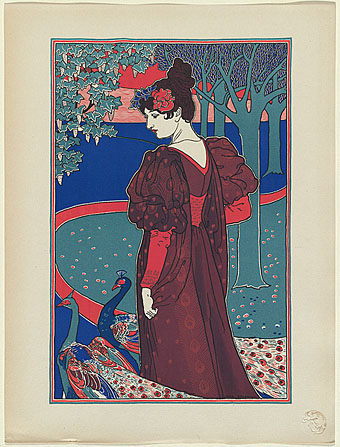
rhead1.jpg

La femme au paon (Woman with peacocks): from L’Estampe Moderne (1897).

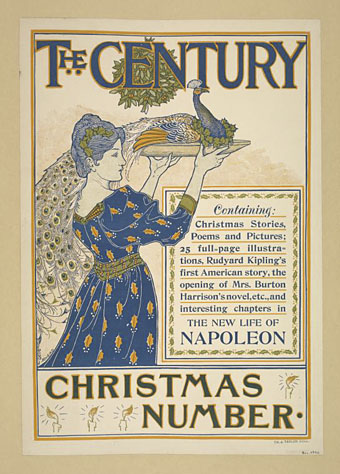
Two works by British Art Nouveau poster artist and illustrator, Louis Rhead (1858–1926). The first of these is very typical and resembles many of his magazine covers of the period. The cover illustration for The Century, meanwhile, must count as the only time I’ve seen a peacock presented as a possible Christmas dish.

rhead2.jpg

The Century Christmas Number (December 1894).

Previously on { feuilleton }
Peacocks
Rene Beauclair
Whistler’s Peacock Room
Beardsley’s Salomé

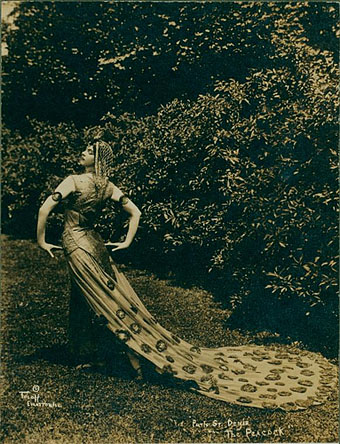
Ruth St Denis

denis1.jpg

The Peacock (no date).

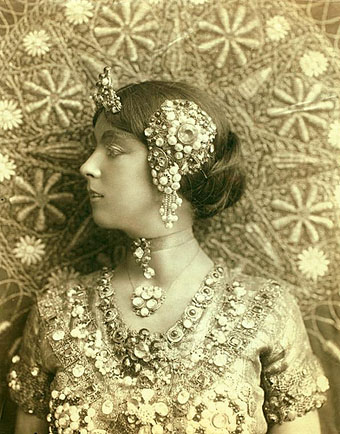
Dancer Ruth St Denis (1879–1968) strikes Art Nouveau poses in the New York Public Library’s Denishawn Collection, now at Flickr.

denis2.jpg

Radha (1904).

Previously on { feuilleton }
Peacocks
Rene Beauclair
Elizabetes Iela 10b, Riga
The Maison Lavirotte
Whistler’s Peacock Room
Beardsley’s Salomé
The art of Hernan Gimenez
Images of Nijinsky