Crystal worlds

finlay.jpg

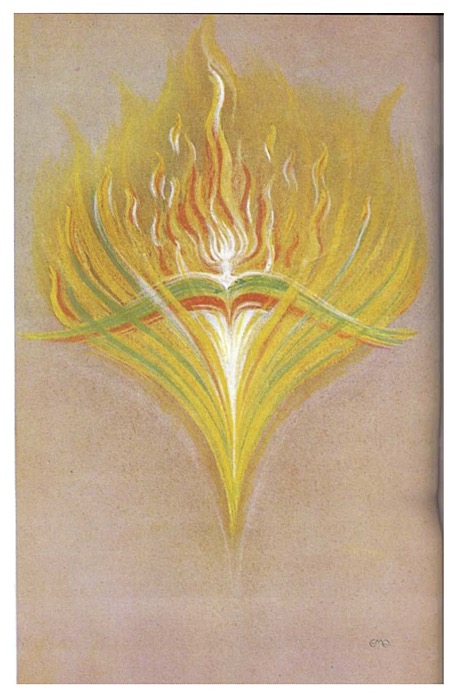
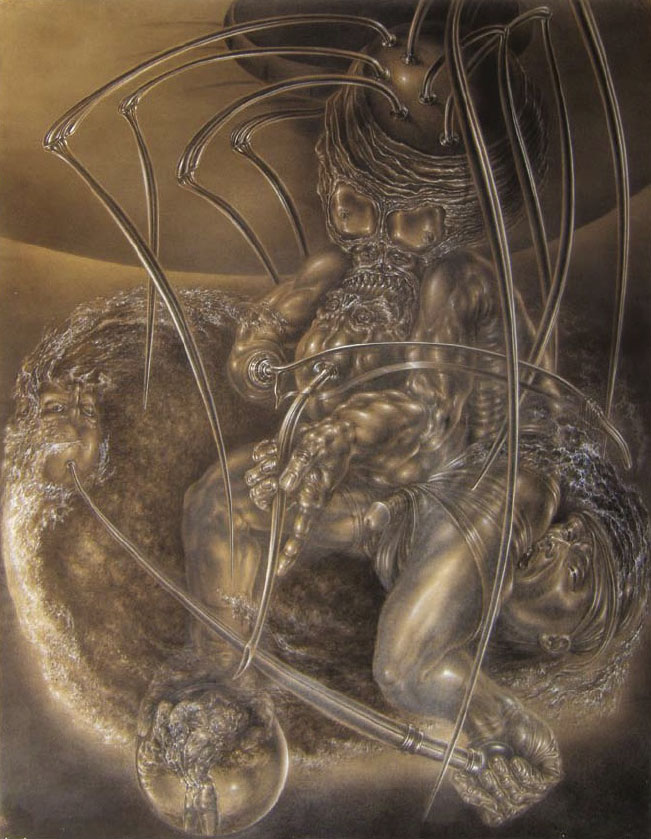
The Crystal World by JG Ballard. An illustration by Virgil Finlay for the Summer–August 1966 issue of Things To Come, the Science Fiction Book Club mailer.

1: Crystal words

JG Ballard didn’t have a pleasant experience with LSD when Michael Moorcock procured a dose of the drug for him in 1967, describing his acid trip in later years as a “psychotic nightmare”. I’ve often wondered how Ballard’s fiction might have developed in the 1970s if his experience had been a more positive one, something I was thinking about again when re-reading The Illuminated Man, a story collected in The Terminal Beach which was later reworked as The Crystal World, the fourth book in Ballard’s disaster quartet. There’s a psychedelic strain to Ballard’s writing which has long been overwhelmed by the popular enthusiasm for the condensed fictions of The Atrocity Exhibition and the three “concrete” novels of the 1970s: Crash, Concrete Island and High-Rise. The Crystal World was published in 1966 when LSD was still legally available in Britain, and even though the genesis of the book pre-dates the decade’s psychedelic fervour, the bejewelled prose chimes so well with the mood of the time it’s easy to assume it was inspired by psychedelic experience. Many readers thought as much, and in interviews Ballard had to emphasise that the novel was a product of his imagination and nothing more.

illuminated.jpg

The Magazine of Fantasy and Science Fiction, May 1964. Cover art by Ed Emshwiller.

After devastating the planet with plausible disasters in his first three novels, Ballard in The Crystal World offers a distinctly fantastic scenario, in which an interstellar phenomenon (“the Hubble Effect”) is manifesting on Earth as the spontaneous crystallisation of all objects, animate or inanimate. The process begins in isolated areas before spreading worldwide; in keeping with many other Ballard stories from this period, time is responsible for the changes taking place:

Just as a supersaturated solution will discharge itself into a crystalline mass, so the supersaturation of matter in a continuum of depleted time leads to its appearance in a parallel spatial matrix. As more and more time “leaks” away, the process of supersaturation continues, the original atoms and molecules producing spatial replicas of themselves, substance without mass, in an attempt to increase their foothold upon existence.

The Illuminated Man

As with other Ballard stories, the scientific hand-waving is merely a pretext. In The Illuminated Man and The Crystal World “leaking time” provides an excuse to transform areas of Florida swamp and African jungle into glittering arcades of prismatic foliage, where birds are crystallised in mid-flight, reptiles transmute into heraldic emblems, and everything fluoresces with an iridescent radiance. The Illuminated Man is a sketch of the novel, with a different location but similar events, in which a hazardous mutating landscape becomes the stage for a small group characters pursuing each other and their own obsessions. Landscape is the important factor in The Drowned World, The Drought and The Crystal World; all three novels are essentially Surrealist landscapes whose reflections of interior states are the primary interest of the novelist, the narrative and the characters being very much secondary elements. In this respect it’s disappointing that The Crystal World has yet to be brought to life by an inspired illustrator, as we’ll see below. And while the novel may seem to be the least realistic of Ballard’s disasters it has a connection to future events. The Illuminated Man offers one of the first examples in science fiction (maybe the first) of an isolated zone which is being transformed by an extraterrestrial phenomenon, a concept usually credited to the Strugatsky Brothers in their novel Roadside Picnic (1972), and popularised by Andrei Tarkovsky in Stalker (1979). (Algis Budrys had done something similar in an earlier novel, Rogue Moon, but Budrys’s infected zone isn’t located on the Earth.) Tarkovsky’s film would subsequently provide the containment zone around the irradiated region of Pripyat in Ukraine with a template for unauthorised behaviour, where the illicit guides to the region took to describing themselves as “stalkers”. Until my re-read of The Illuminated Man I hadn’t registered Ballard’s reference to an additional outbreak of crystallisation occurring in the Pripet Marshes in what was then the Soviet Union, a vast region that includes the irradiated zone of Pripyat. The Soviet scientists attempt to deal with outbreak in their usual inefficient manner but for the world at large efficiency proves to be of little consequence either way; Ballard’s disasters aren’t problems to be solved, as they would have been for an earlier generation of writers. Global calamity is dealt with by gradual accommodation, and a reconfiguring of the human psyche which eventually comes to accept the altered landscape.


2: Crystal visions

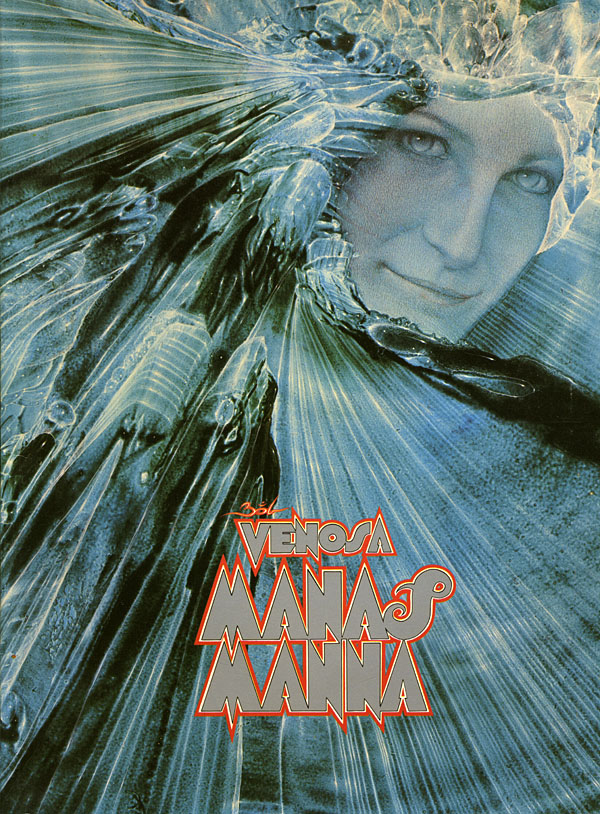
venosa.jpg

Celestial Tree (1976) by Robert Venosa.

The most obvious psychedelic elements of The Crystal World are the novel’s emphasis on rainbow spectra and brilliant lights, the endless descriptions of prismatic diffractions and iridescence. But jewels and crystals are an important feature of psychedelic and visionary experience, a quality that Aldous Huxley explored at length in Heaven and Hell (1956):

Men have spent enormous amounts of time, energy and money on the finding, mining and cutting of coloured pebbles. Why? The utilitarian can offer no explanation for such fantastic behaviour. But as soon as we take into account the facts of visionary experience, everything becomes clear. In vision, men perceive a profusion of what Ezekiel calls “stones of fire,” of what Weir Mitchell describes as “transparent fruit.” These things are self-luminous, exhibit a preternatural brilliance of colour and possess a preternatural significance. The material objects which most nearly resemble these sources of visionary illumination are gem stones. To acquire such a stone is to acquire something whose preciousness is guaranteed by the fact that it exists in the Other World.

Hence man’s otherwise inexplicable passion for gems and hence his attribution to precious stones of therapeutic and magical virtue. The causal chain, I am convinced, begins in the psychological Other World of visionary experience, descends to earth and mounts again to the theological Other World of heaven. In this context the words of Socrates, in the Phaedo, take on a new significance. There exists, he tells us, an ideal world above and beyond the world of matter. “In this other earth the colours are much purer and much more brilliant than they are down here…. The very mountains, the very stones have a richer gloss, a lovelier transparency and intensity of hue. The precious stones of this lower world, our highly prized cornelians, jaspers, emeralds and all the rest, are but the tiny fragments of these stones above. In the other earth there is no stone but is precious and exceeds in beauty every gem of ours.”

In The Illuminated Man Ballard extends his own thoughts about precious stones to touch on the numinous:

Perhaps it is this gift of time which accounts for the eternal appeal of precious gems, as well as of all baroque painting and architecture? Their intricate crests and cartouches, occupying more than their own volume of space, so contain a greater ambient time, providing that unmistakable premonition of immortality sensed within St Peter’s or the palace at Nymphenburg. By contrast the architecture of the 20th century, characteristically one of rectangular unornamented facades, of simple Euclidean space and time, is that of the New World, confident of its firm footing in the future and indifferent to those pangs of mortality which haunt the mind of old Europe.

moreau.jpg

A moment of frozen time: Salome Dancing Before Herod (1876) by Gustave Moreau.

There’s an overt spirituality to The Illuminated Man and The Crystal World (both stories feature priests among their small cast of characters), which again seems psychedelic when placed in the context of crystalline transmutation, and which is diametrically opposed to the hard-edged materialism of the late novels. The second part of The Crystal World takes its title from the short story, with “illuminated” here referring to a process of psychological (or even spiritual) illumination in addition to the more obvious generation of light.

myths.jpg

A late manifestation of the Symbolist Ballard, 1982. Cover art by Bill Botten.

I think of this side of Ballard’s work as less religious than Symbolist, an expression of his enthusiasm for Symbolist art and artists; the opening chapter of The Crystal World has the priest with an artist’s surname, Father Balthus, comparing the gloomy light around Port Matarre to the impending storm in Arnold Böcklin’s Isle of the Dead. The painting chosen to wrap the covers of the first edition of The Crystal World was The Eye of Silence by Max Ernst, a choice almost certainly suggested by Ballard himself who included the same picture in a list of favourite Surrealist paintings for New Worlds. The painting is the closest that Ernst gets to the jewelled settings of Gustave Moreau, an artist whose Byzantine architectures are studded with precious stones.

The Symbolist Ballard surfaced in occasional short stories throughout the late 60s and the concrete 70s but didn’t return in full until 1979 with the publication of The Unlimited Dream Company. The novel is such a dramatic break with the concrete novels it suggests a sudden release of pressure, as the Symbolist Ballard erupts into life with another story about the wholesale transformation of a circumscribed zone. The locus this time is Ballard’s home territory of Shepperton which is turned into a tropical paradise by the arrival of a wounded pilot (significantly named Blake) whose small plane has crashed into the River Thames. Blake may be suffering from brain damage, he may be imagining all the novel’s events in the moments before his death, or he may even be a new messiah; as with The Crystal World, the explanation is a side issue, the author is more interested in the transformed environment and its effect on the inhabitants of the town.

Continue reading “Crystal worlds”

Michel Henricot, 1936–2022

henricot1.jpg

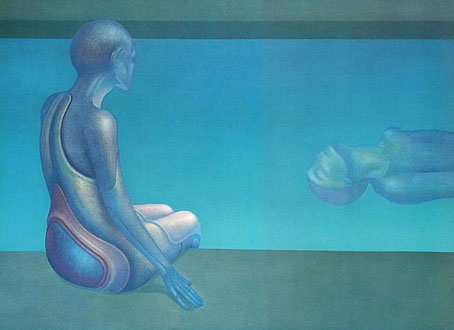
Deux Personnages (1974).

Jan of JKK Fine Arts was in touch this week to inform me that the French artist Michel Henricot died in February, a month before the opening of an exhibition of his work organised by JKK Fine Arts for the International Cultural Centre in Cracow, Poland.

henricot2.jpg

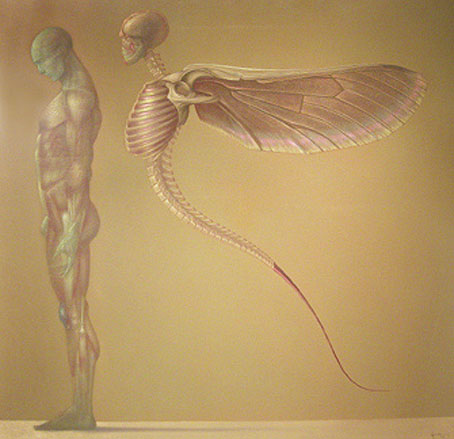
Le Voyageur IV (1996).

I first encountered Henricot’s work in the pages of OMNI magazine where he was one of several featured artists who can be grouped together as “fantastic realists”—Ernst Fuchs, Mati Klarwein, HR Giger, Robert Venosa, Rudolf Hausner, De Es Schwertberger—although the label wouldn’t have necessarily been agreed to by any of them apart from Fuchs and Hausner, both of whom were members of the Vienna School of Fantastic Realism in the 1960s. Henricot’s sombre and obsessive figure studies were a good fit for the magazine, with the science fiction context lending his paintings suggestions of the futuristic or alien that might otherwise be absent in the empty space of an art gallery.

henricot3.jpg

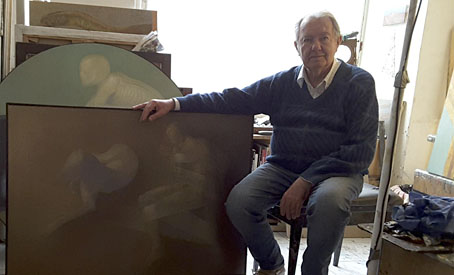
The artist photographed by Jan K. Kapera.

Despite such a high-profile showcase Henricot’s work has never been as visible as his more famous contemporaries so I’m grateful to Jan for supplying additional information, including the artist’s actual birth date, 8th July, 1936, rather than the erroneous dates found all over the internet. Henricot was friends with Leonor Fini, an artist whose work was also preoccupied with the human figure, often just as stylised and set against featureless monochrome backgrounds. Like Henricot, Fini’s art gets tagged as Surrealist even though her own obsessive paintings evolved away from any particular school. Henricot’s Les Promeneuses (1954) was definitely reaching for a Dalínean/Delvaux-like quality, but if his mature work belongs anywhere it’s with that small collection of French artists who don’t comprise any defined movement but who share a taste for the fantastic, the strange and the inexplicable: Sibylle Ruppert, Jean-Marie Poumeyrol, Jean-Pierre Ugarte, Gérard Trignac, Erik Desmazières, Jean-Paul Faccon, Pierre Clayette, Raymond Bertrand, Roland Cat, Gilles Rimbault, Jean-Michel Mathieux-Marie, and others. If I was given the opportunity to put together an art show for a French gallery (or even the Pompidou Centre…), these are some of the artists I’d choose.

henricot4.jpg

Le Silence (1979).

Henricot will be running at the International Cultural Centre, Cracow, until the end of April.

Elsewhere on { feuilleton }
The fantastic art archive

Previously on { feuilleton }
Saint Sebastian in NYC
The art of Michel Henricot

The art of Robert Venosa, 1936–2011

venosa.jpg

A few years back, while experimenting with the hallucinogens, I experienced visions of a dynamic energy in constant high-velocity motion, crystallizing and manifesting in a form which could only be described as angelic. Potential energy, crystallizing energy and structured energy were all visible in the same instant…time and space transcended. These visions, and a new-found awareness of spirit brought about through worship and meditation, were too powerful not to be expressed: a translation had to be attempted.

Robert Venosa, Manas Manna, 1978.

I only discovered a few days ago that American artist Robert Venosa had died last month. As with the late Sibylle Ruppert there’s the inevitable wish for some wider acknowledgement of the passing of these unique talents.

santana.jpg

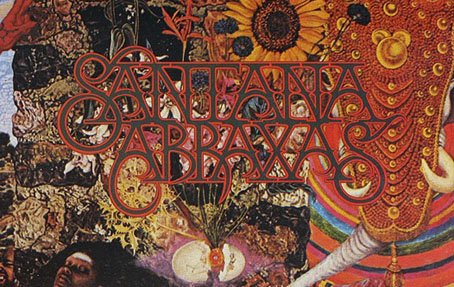
Millions of people have seen one of Venosa’s creations without being aware of it: in 1970 he designed the logo/title for Santana’s Abraxas album (the one with the amazing Mati Klarwein cover), a design which is still in use today. But it’s as a painter that he ought to be remembered. Manas Manna was the first collection of Venosa’s art published by Peter Ledeboer’s Big O imprint in 1978, and could be found on bookshelves that year with a pair of equally remarkable auto-monographs: Mati Klarwein‘s God Jokes and the first English edition of HR Giger‘s Necronomicon. All three artists were aware of each other (Venosa was friends with the other two), and all had managed the difficult feat of having their work sold in art galleries whilst also being visible to a much larger audience on album covers. All three books were eagerly plundered that year by the art team of OMNI magazine whose early issues made heavy use of paintings by Klarwein, Giger, Venosa, De Es Schwertberger and others. Of this Venosa has said:

OMNI was the first to give the artist equal credit with the author…something that to this day is still not seen in any other newsstand magazine. OMNI also put Fantastic Realism, Surrealism, Visionary, and every other type of ‘Fantasy’ art, square into the public’s eye. I and my colleagues owe OMNI a large measure of gratitude for its uncompromising stance and visionary concepts.

Venosa had been an art director at Columbia Records in the 1960s, a job he abandoned after he met Mati Klarwein and decided he’d rather devote his time to painting. Despite describing Klarwein in his book as his painting master, only a couple of his pictures are reminiscent of Klarwein’s distinctive style. Many of Venosa’s works are more loose and abstract than Klarwein’s tableaux, extending the processes of decalcomania which Max Ernst refined in works such as Europe After the Rain (1942) and The Eye of Silence (1944) to create stunning views of cosmic eruptions and vistas of crystalline beings rendered in a meticulous, hyper-realist manner. Many of his pictures could serve as illustrations for the later chapters of JG Ballard’s The Crystal World.

If the lazy definition of psychedelic art refers merely to shapeless forms and bright, clashing colours, Venosa’s art is psychedelic in the truest sense, an attempt to fix with paint and brush something revealed by a profound interior experience. This was deeply unfashionable by 1978, of course, but he carried on working anyway, and there are further book collections for those interested in his paintings. The Venosa website has a small selection of his extraordinary pictures although they really need to be seen at a larger size.

Elsewhere on { feuilleton }
The album covers archive
The fantastic art archive

Sibylle Ruppert revisited

ruppert1-1.jpg

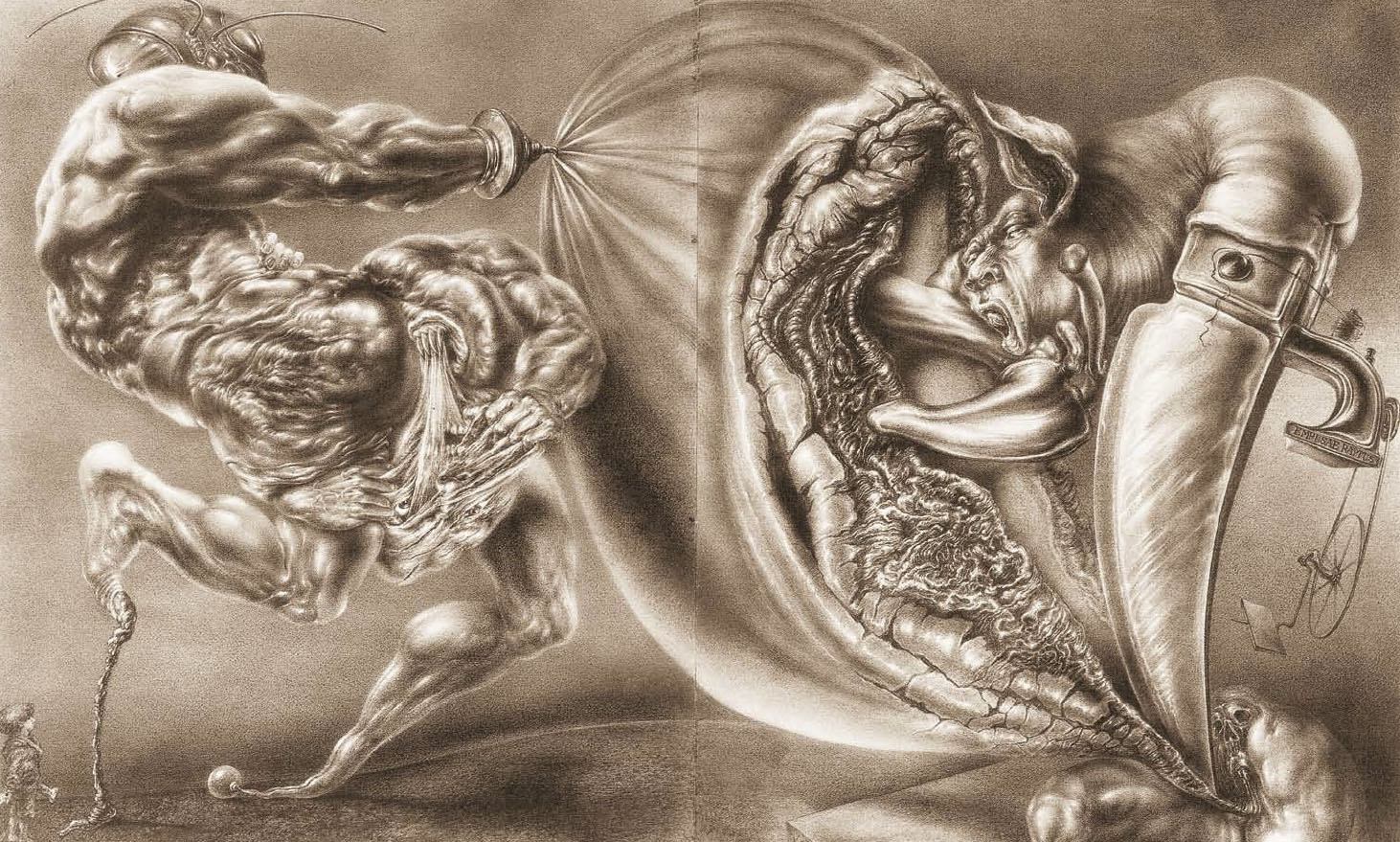
Empusae Raptus (1977).

Another post about this astonishing artist (I’ll keep talking about her if no one else does…). The pictures here are taken from the catalogue for the 2010 Sibylle Ruppert exhibition at the HR Giger Museum, Gruyères, Switzerland. Leslie Barany was good enough to send me a copy of this, and the pictures are posted courtesy of the museum. To purchase a copy of the catalogue contact marcowitzig@gigerworkcatalog.com

ruppert2-1.jpg

Le Chant de Maldoror (1978).

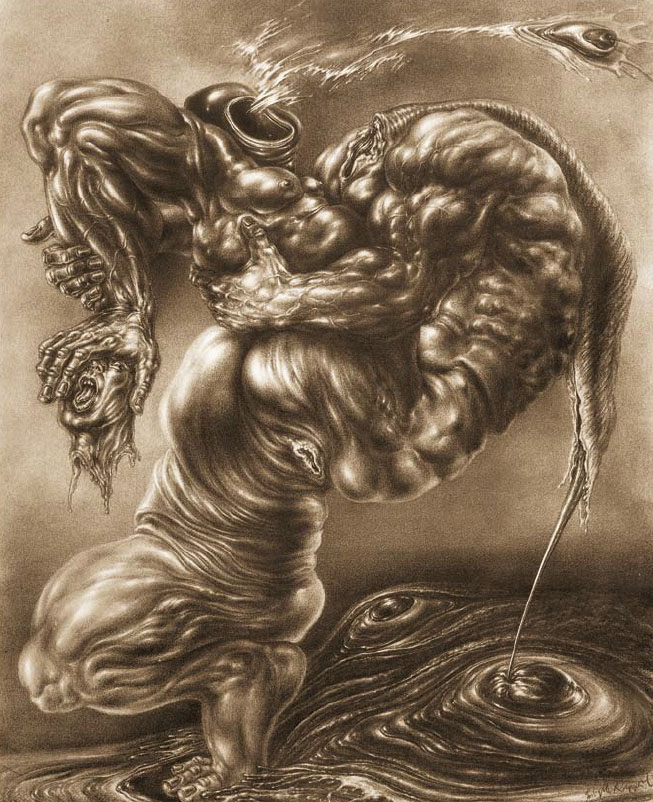
Looking over Sibylle Ruppert’s work this week I’ve been pondering why she wasn’t better known. She was working throughout the 1970s and could easily have been swept up in the vogue for fantastic art when it was being popularised by Omni magazine. Giger, Mati Klarwein, Robert Venosa, De Es Schwertberger and others all benefited from Bob Guccione’s publication, and to a lesser degree from appearances in Heavy Metal magazine. Ruppert’s lack of visibility may have been a result of the usual situation whereby women artists were overlooked or marginalised. But I think it’s far more likely that her work was simply too intense and visceral for the newsstands. Giger could get by with paintings like the semi-abstract NY City series which were attached to science fiction stories without causing a stir. It’s difficult to imagine Ruppert’s work gaining such a popular acceptance, especially in the United States where, lest we forget, Giger’s Penis Landscape did cause a stir in 1985. One of the great benefits of the web is the way so much previously buried culture is surfacing and finding new and enthusiastic audiences. Sibylle Ruppert’s greatest audience has yet to find her but they’re surely out there, you can’t keep work of this quality buried forever.

For a few more Ruppert works see that haven of all things grotesque, Monster Brains.

ruppert3-1.jpg

Le Spectacle de l’Univers (1977).

Continue reading “Sibylle Ruppert revisited”

The art of Mati Klarwein, 1932–2002

godjokes.jpg

If book collecting is frequently a waiting game, some waiting periods can be longer than others. In the case of Mati Klarwein’s God Jokes, my patience and hope have sustained themselves for 28 years until I finally acquired a copy this Thursday afternoon. God Jokes was the second book of Mati Klarwein’s work, published by Harmony Books, New York, in 1976, a slim catalogue-style collection of his paintings, some of which were featured in the early issues of Omni magazine. In 1979 and 1980 God Jokes turned up in a chain of UK remainder shops and for a while it seemed like everyone I knew owned a copy which possibly explains my unaccountable decision to avoid buying one myself. As the years passed and I became increasingly enamoured with Mati Klarwein’s work I came to regret that decision, not least because the book seemed to disappear completely. Copies have turned up since on Abe.com but at bizarrely inflated prices (£50 for a 56-page art book?!). I paid £4.99; patience sometimes pays off.

abraxas.jpg

Abraxas by Santana.

Mati Klarwein’s work has been most visible via the album sleeves of the Sixties and Seventies which borrowed his pictures for their covers. Chief among these is one of the best Santana albums, Abraxas (1970), which used his stunning 1961 painting The Annunciation (and a lettering design by Robert Venosa), and one of all-time favourite albums, the Miles Davis masterpiece Bitches Brew (1970). Miles Davis was a great Klarwein enthusiast for a while and commissioned new work for his Live-Evil album in 1971.

davis.jpg

Live-Evil by Miles Davis.

It’s not necessary to go into detail describing Mati Klarwein’s work when you can go to the web gallery maintained by his family and feast your eyes there. Klarwein is one of the few 20th century artists to have taken Salvador Dalí’s photo-realist painting style and make of it something unique to himself; his work is always immediately recognisable. That this work is still known mainly for its illustrative connections tells you more about the iniquities of the art world than it does about the value of the paintings as works of art.

maarifa.jpg

The most curious thing about having to wait so long to find a copy of God Jokes was that I ended up working with a picture of Mati Klarwein’s three years before I found the book; I would have expected to find the book one day but the latter eventuality was far less predictable. In 2005 Jon Hassell asked me to design his new CD, Maarifa Street, and Jon was keen to use a tiny video detail he made of a huge and incredible Klarwein painting, Crucifixion (1963–65). The detail is the rectangle in the centre of the cover, juxtaposed against some Hubble galaxies: the very small against the very large. We used the painting itself and further details inside the digipak. Jon was another of those who used Klarwein’s art for his album sleeves (for Earthquake Island, Dream Theory in Malaya and Aka-Darbari-Java/Magic Realism) and the two men became great friends as a result.

crucifixion.jpg

Crucifixion by Mati Klarwein.

Jon Hassell writes about Bitches Brew—and Mati Klarwein’s sleeve art—here. His site also includes a 1998 Mati Klarwein interview from The Wire in which the painter discusses his life and work. If you want a copy of God Jokes for yourself, be prepared to wait…or pay over the odds.

Elsewhere on { feuilleton }
The fantastic art archive

Elsewhere on { feuilleton }
The album covers archive

Previously on { feuilleton }
Ballantine Adult Fantasy covers
Visions and the art of Nick Hyde
The poster art of Marian Zazeela