Weekend links 807

kouninos.jpg

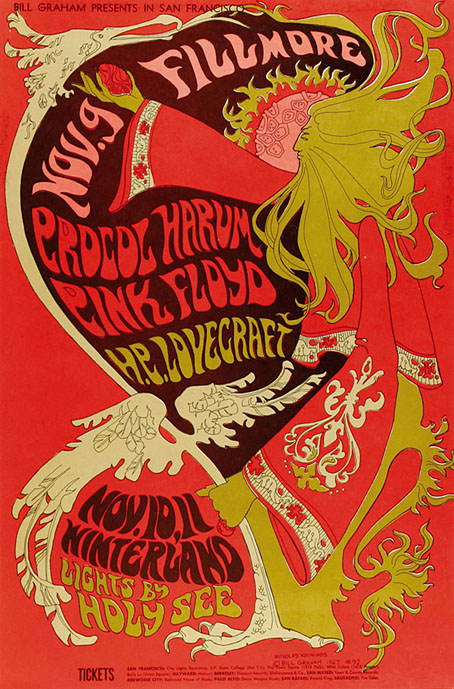
Poster art by Nicholas Kouninos for Procol Harum / Pink Floyd / HP Lovecraft at the Fillmore, San Francisco, 1967.

• Take a break from so-called reality with Gruesome Shrewd, more queasy psychedelia by Moon Wiring Club. MWC’s Ian Hodgson described his intentions to Simon Reynolds in a Reynolds roundup which notes the 20th anniversary of the Ghost Box project. The label is apparently on hold for the moment but I have to admit that my interest waned some time after the 10th anniversary, when it became increasingly apparent that the ghost had fled the box. Reynolds ends his piece with a list of favourite GB recordings which I mostly agree with, although I’d shuffle the order and swap some entries with Pye Corner Audio.

• “‘You know that feeling you get when you’ve just gotten back from the dry cleaners a pair of slacks, Dacron slacks, and you reach your hand in a pocket and you feel those fuzzy sandwiches with your fingers? Well, that’s the feeling I’m looking for.’ I just nodded and replied, ‘OK, Dave, I know exactly what you mean.’” Barry Gifford remembers David Lynch.

Aschenbach’s Last Journey: Lesley Chamberlain, the most recent translator of Thomas Mann’s Death in Venice, approaches the text by following the progress of its doomed protagonist from Brioni to the Venetian Lido. Related: Polly Barton describes to Katy Whimhurst some of the difficulties involved in translating Japanese fiction to English.

• From The Shout to Bait: Darran Anderson on the uses of sound in cinema. Rupert Hines’ soundtrack to The Shout has just been released by Buried Treasure.

• Video footage of modular synthesists Arc (Ian Boddy & Mark Shreeve) performing Arcturus live in 2004: part one | part two.

• At Aeon: “Black holes may be hiding something that changes everything,” says Gideon Koekoek.

• At the BFI: Michael Brooke selects 10 great Hungarian films.

• Steven Heller’s font of the year is Fillmore.

Shout The Storm (1984) by :Zoviet:France: | Shout At The Devil (2002) by Jah Wobble & Temple Of Sound | Shout (2005) by Tod Dockstader
Weekend links 737

pinkfloyd.jpg

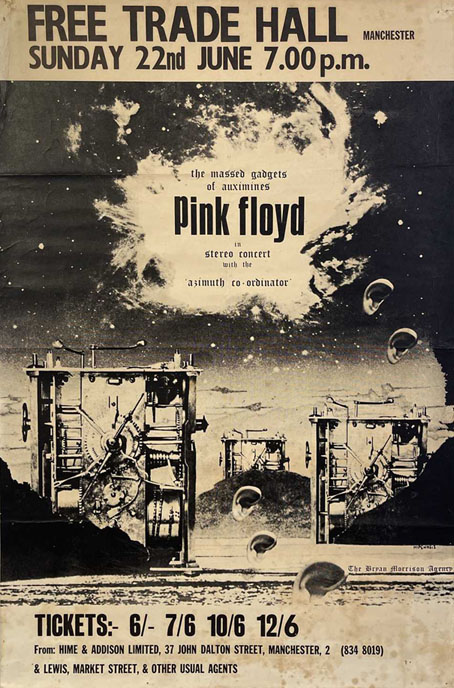
The Massed Gadgets of Auximines – Pink Floyd – in stereo concert with the “Azimuth Co-ordinator”. Design by Hipgnosis, 1969.

• At Rond1900: Sander Bink explores the life of another obscure Dutch Symbolist, Léonard Sarluis (1874–1949): artist, friend of Oscar Wilde and lover of Alfred Jarry.

• At Spoon & Tamago: Manga artist Hirohiko Araki pays tribute to Osaka station’s history and culture with new public art sculpture.

• At Public Domain Review: Scenes of reading on the early portrait postcard by Melina Moe and Victoria Nebolsin.

• At Dennis Cooper’s: 33 films that either faked ingesting LSD or did.

• At Bandcamp: Blissful Noise, Bad Vibes: A Doomgaze Primer.

• Mix of the week: Azimuth Coordinator by Tarotplane.

• New music: Global Transport by Monolake.

• The Strange World of…Gay Disco.

Speak & Glitch

Postcard From Jamaica (1967) by Sopwith Camel | Postcards Of Scarborough (1970) by Michael Chapman | An Unsigned Postcard (1991) by Tuxedomoon

Weekend links 648

klee.jpg

The Twittering Machine (1922) by Paul Klee.

• “Thinking of ‘writer Twitter’ as more important than writers themselves is an insult to the profession. People have been trading words for money for thousands of years. They will continue to do so after the death of a platform built on manufactured outrage, social hierarchy, unfunny jokes, stale memes, pornography, and spam. I mention this Atlantic essay only because it echoes what so many people are saying in the ether right now, not to pick on its author. The piece reads like a parody of how writers overestimate the importance of Twitter to their work and careers. It’s frankly a little embarrassing. Your work is the product you sell! Not the shitty jokes you tell with people you want to impress.” Freddie deBoer on the kerfuffle du jour. For “writer” see also “artist” or anyone else working at the intersection between commerce and creativity. From what I’ve read this week about potential technical problems at the pestilential birdcage I’d be less sanguine about its immediate survival. Since I retreated from the place as an active user two-and-a-half years ago all I get from it is the inflated subscriber number you see on the right-hand side of this page, a combination of Twitter followers plus email subscribers. The latter currently stand at some 270 individuals so if you’re among that number you can consider yourself part of a more exclusive group. And thanks for subscribing!

• “…the books of the past, besides adding to our understanding, offer something we also need: repose, refreshment and renewal. They help us keep going through dark times, they lift our spirits, they comfort us. Which means that I also strongly agree with the poet John Ashbery, who once wrote, ‘I am aware of the pejorative associations of the word “escapist,” but I insist that we need all the escapism we can get and even that isn’t going to be enough.'” Michael Dirda makes a case for reading classic, unusual and neglected books. Kudos for the mention of Anthony Skene‘s Monsieur Zenith, a character few of Dirda’s readers will have heard of.

• “While Haeckel’s paintings turn the floating phantoms into baroque spectacles of colour and flowing form, Mayer’s medusae are more sober, their tentacles subdued, their umbellate bells transparent.” Kevin Dann on the jellyfish and other “floating phantoms” described in AG Mayer’s Medusae of the World (1910).

• “The passing of time has added potency to the images, giving this interpretation of the Dracula story the feel of a distant fairy tale, a myth emerging from the mists of time, erupting across the world of cinema, its shadow reaching everywhere.” Martyn Bamber on 100 years of Murnau’s Nosferatu.

• At AnOther: Camille Vivier talks about shooting nude models in the treasure-filled home of HR Giger.

• New music: In Concert & In Residence by Sarah Davachi, and Anglo-Saxon Androids by Moon Wiring Club.

• At Spoon & Tamago: Kimono portraits were popular souvenirs for sailors visiting Japan in the 1800s.

• Mix of the week: Saturnalia: Deep Jazz for Long Nights, 1969–1980 at Aquarium Drunkard.

• At Dennis Cooper’s: Clouds.

Dark Clouds With Silver Linings (1961) by Sun Ra | Obscured By Clouds (1972) by Pink Floyd | Firmament (Cloudscape) (1995) by Main

Weekend links 585

bertha_lum.jpg

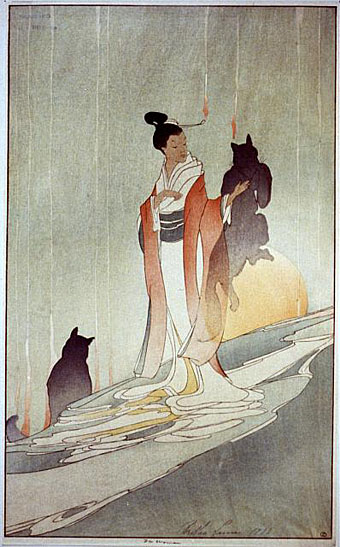
Fox Woman (c. 1916) by Bertha Lum.

• “Apparently he had been walking though customs/arrivals with a large cube of weed stuck on the end of his silver Dr Martens and a foot long silver flashlight full of seed, but when they realised who he was, and that today was his 60th birthday, he was released with just a warning.” Radio Lancashire DJ Steve Barker remembers the late Lee “Scratch” Perry, and links to one of his shows with Perry (and Roger Eagle) here.

• “…it’s the chase itself that shapes the film’s distinctive aesthetic—the under-lit interiors and the sunless and frigid exteriors of the many locations across the city, sites that take the cops well beyond their usual beat, to places both above and below ground.” Chris McGinley explains how William Friedkin’s The French Connection reinvented (and exploded) the police procedural.

• “Toibin, who is himself gay, has always extended historical sympathy to sexual outsiders. As he’s written elsewhere, ‘There are no 19th-century ballads about being gay.'” Dwight Garner reviews Colm Toibin’s The Magician, a novel about Thomas Mann.

Here is the key point: to experience such marvels you have to risk an unsophisticated, even credulous love for corn, and part of that love involves a willingness to submit to what [Phil] Ford calls a “magical hermeneutics” capable of transforming marginal chunks of pop culture. As he writes in the wonderful 2008 essay that inspired the episode, exotica is “less a genre of music than a class of cultural objects that share a characteristic projection of the self across boundaries of space and time.” This makes it essentially psychedelic—“film music for daydreams”—and Ford draws out that historical connection in his essay, which argues that while the hippie movement that Nature Boys like Ahbez prophesied looks like a radical rejection of the space-age bachelor pad of ’50s consumerism, tendrils of transcendent yearning link the exotica imaginary to the earnest if stoned mysterioso to come.

Erik Davis on Eden Ahbez and Californian exotica

Edgar Froese interviewed on WSHU radio in 1974 where he talks about Tangerine Dream, live performance and the future of electronic music.

• At Dangerous Minds: A momentary lapse of reason…when Dario Argento interviewed Pink Floyd in 1987.

• It’s that man again: John Doran interviews Kevin Martin, aka The Bug.

David McKenna on The Strange World of France, La Nòvia & friends.

• At Dennis Cooper’s: Tape deck.

Exotica (1958) by Martin Denny | Exotica Lullaby (1976) by Harry “The Crown” Hosono | Exotica (1979) by Throbbing Gristle

Weekend links 561

ghostbox.jpg

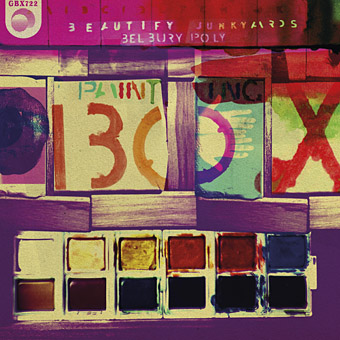
The next release on the Ghost Box label, Painting Box is a collaborative seven-inch single by Beautify Junkyards and Belbury Poly, the A-side of which is a cover of a song by The Incredible String Band. Available on 30th April. Design, as always, is by Julian House.

• “What is good for you as a person is often bad for you as a writer. People will tell you that this not true, and some of the people who will tell you that are also writers, but they are bad writers, at least when they try to convince you, and themselves, that the most important thing for a fiction writer to have is compassion.” Brock Clarke on the case for meanness in fiction.

• The week in non-human intelligence: “Life beyond human has to play by the rules of natural selection,” says David P. Barash, and Thomas Moynihan on dolphin intelligence and humanity’s cosmic future.

Ilia Rogatchevski speaks with historian Juliane Fürst about her new history of Soviet hippies and the counterculture of the former USSR.

• Mushroom with a view: Karen Schechner at Bookforum talks with Bett Williams about her mycological journey.

• Retro instinct versus future fetish: Fergal Kinney on Stereolab’s Emperor Tomato Ketchup 25 years on.

• At Dennis Cooper’s: Spotlight on…JG Ballard: The Atrocity Exhibition (1970).

This is Hexagon Sun: A feature-length video on Boards of Canada.

• Mix of the week: The Ides by The Ephemeral Man.

• New music: Gyropedie by Anne Guthrie.

Paintbox (1967) by Pink Floyd | Orgone Box (1989) by Haruomi Hosono | God Box (1996) by Paul Schütze & Andrew Hulme