Richard Bruce Nugent’s Salomé

nugent1.jpg

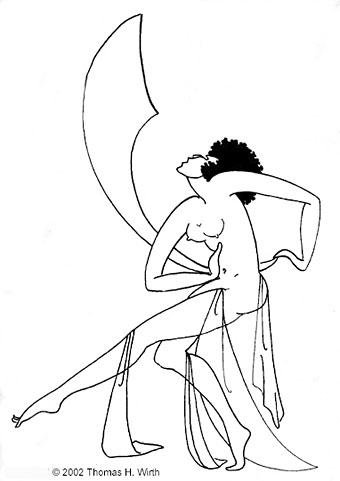
Untitled (Salomé, no date).

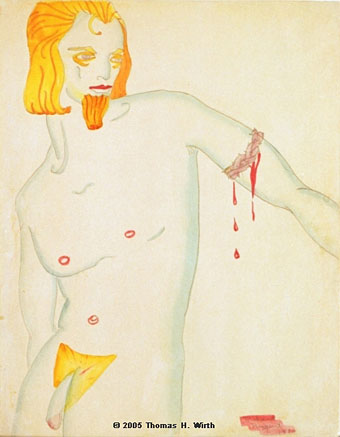
I was looking for work by the artist, Richard Bruce Nugent (1906–1987), not more Salomé illustrations so this was a surprise discovery. Nugent was an American writer, illustrator and painter who was friends in the 1920s with key figures in the Harlem Renaissance such as Langston Hughes and Zora Neale Hurston. Unlike Hughes, whose sexuality has been disputed for years, Nugent was openly gay at a time when such a stance carried considerable risks. According to the Nugent website he “stood for thirty years as the only African-American writer willing clearly to indicate his homosexuality in print.” That site hosts these pictures in a number of gallery pages which include some rather fine (and very gymnastic) erotic drawings. Among the writings there’s a piece entitled Slender Length of Beauty that dates from the same period as the picture below, a very Wildean retelling of the Salomé story which includes a character named after that favourite figure of Uranian myth, Narcissus.

nugent2.jpg

Untitled (John the Baptist? 1930).

Elsewhere on { feuilleton }
The gay artists archive
The Salomé archive

The Piper at the Gates of Dawn

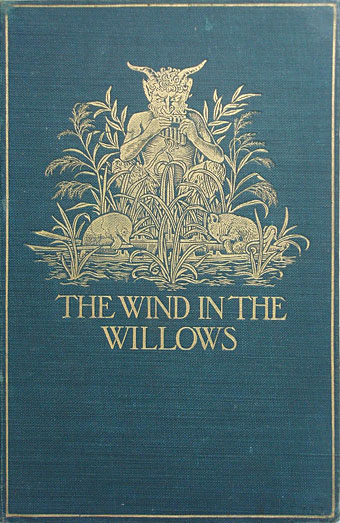
witw1.jpg

Illustration by W. Graham Robertson (19o8).

(No, this doesn’t concern Pink Floyd.)

The chapter – The Piper at the Gates of Dawn – is normally dropped because it jars, seems so strange compared to all the others and, to some, is vaguely homoerotic. [Kenneth] Grahame thought it essential.

Thus Mark Brown discussing the curious seventh chapter of The Wind in the Willows (1908) wherein Mole and Rat have a mystical encounter with the Greek god of nature in the British countryside:

Perhaps he would never have dared to raise his eyes, but that, though the piping was now hushed, the call and the summons seemed still dominant and imperious. He might not refuse, were Death himself waiting to strike him instantly, once he had looked with mortal eye on things rightly kept hidden. Trembling he obeyed, and raised his humble head; and then, in that utter clearness of the imminent dawn, while Nature, flushed with fullness of incredible colour, seemed to hold her breath for the event, he looked in the very eyes of the Friend and Helper; saw the backward sweep of the curved horns, gleaming in the growing daylight; saw the stern, hooked nose between the kindly eyes that were looking down on them humorously, while the bearded mouth broke into a half-smile at the corners; saw the rippling muscles on the arm that lay across the broad chest, the long supple hand still holding the pan-pipes only just fallen away from the parted lips; saw the splendid curves of the shaggy limbs disposed in majestic ease on the sward; saw, last of all, nestling between his very hooves, sleeping soundly in entire peace and contentment, the little, round, podgy, childish form of the baby otter. All this he saw, for one moment breathless and intense, vivid on the morning sky; and still, as he looked, he lived; and still, as he lived, he wondered.

Brown’s article concerns a forthcoming exhibition, Writing Britain: Wastelands to Wonderlands, at the British Library, part of the summer’s Olympic celebrations. Kenneth Grahame’s hand-written text of chapter seven will be on display together with a later Arthur Rackham illustration of the goat god. The Library makes a point of noting that the Pan chapter is sometimes excised from the book although I’m not sure how often this occurs, it’s been present in all the editions I’ve seen including the cheap paperback edition I have somewhere. W. Graham Robertson’s rather fine drawing above (showing Mole and Rat bowing to their presiding deity) embellishes the first UK edition. Paul Bransom’s illustration below is the frontispiece to a 1913 US edition.
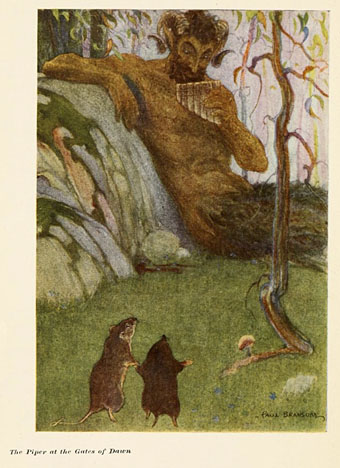
witw2.jpg

Illustration by Paul Bransom (1913).

One benefit of this bit of news has been finding Robertson’s illustration which gives Brown’s use of “homoerotic” a slight twist. Robertson was a children’s illustrator and playwright who Neil McKenna in The Secret Life of Oscar Wilde (2003) describes as being a member of the surreptitiously gay art world in London during the 1890s. (If there’s to be any dissent about this let’s note that one of his plays was entitled Pinkie and the Fairies…) Robertson knew Oscar Wilde but fell in with the contra-Wilde fraternity, notably Robert de Montesquiou, so gets left out of many accounts of Wilde’s circle. He was however immortalised by John Singer Sargent in this well-known portrait. I’ll be writing a little more about Robertson and Sargent’s painting at a later date. For more about the surprising recurrence of Pan in Victorian and Edwardian literature, see this earlier post.

Writing Britain: Wastelands to Wonderlands at the British Library opens on May 11th and runs throughout the summer.

Elsewhere on { feuilleton }
The illustrator’s archive

Previously on { feuilleton }
The Great God Pan
Peake’s Pan

Weekend links 82

morris.jpg

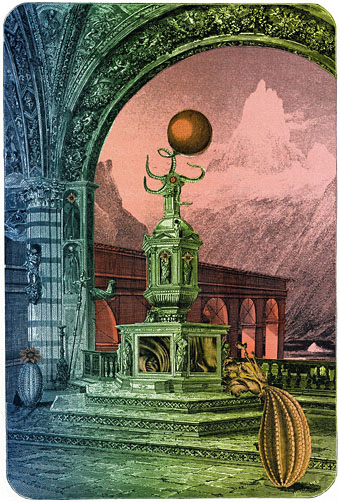
At the Mountains of Madness (1979) from Halloween in Arkham by Harry O. Morris.

• Golden Age Comic Book Stories always pulls out the stops in the run up to Halloween. In addition to a wonderful collection of Harry O. Morris collages, Mr Door Tree has also been posting Virgil Finlay’s illustrations for Edgar Allan Poe, Lynd Ward’s tremendous illustrations for a collection of weird tales entitled The Haunted Omnibus, Barry Moser’s woodcuts for an edition of Frankenstein, and Virgil Finlay’s illustrations for stories and poems by HP Lovecraft.

• “Eugene Thacker suggests that we look to the genre of horror as offering a way of thinking about the unthinkable world. To confront this idea is to confront the limit of our ability to understand the world in which we live – a central motif of the horror genre. In the Dust of This Planet explores these relationships between philosophy and horror.”

• “…the reader […] becomes a conscious participant in the process of imposing a linear sequence, while at the same time remaining aware that all narrative is an act of memory, and that memory is necessarily random.” Jonathan Coe reviews Marc Saporta’s book-in-a-box, Composition No.1, recently republished by Visual Editions.

• Nearly fifty years after its first performance, Peter Weiss’s Marat/Sade is still disturbing playgoers. And nearly ninety years after its release, Alla Nazimova’s silent film production of Oscar Wilde’s Salomé is touring the UK with live musical accompaniment.

Tom of Sinland at Homotography, in which illustrator Bendix Bauer portrays some of the fashion world’s notable male designers as Tom of Finland-style characters for Horst magazine.

Neil Gaiman Presents is a new audiobook imprint which launches with works by Jonathan Carroll, Alina Simone, Keith Roberts, M. John Harrison and Steven Sherrill.

• The Weird Wild West: Paul Kirchner has put all his Dope Rider comic strips online.

Leonora Carrington prints at Viktor Wynd Fine Art, London, from November 5th.

The Fall to Earth: David Bowie, Cocaine and the Occult.

Photos of New York City, 1978–1985.

Kathy Acker recordings at Ubuweb.

The Occupied Times of London.

The Golden Age of Dirty Talk.

Pushkin silhouettes.

• This week I’ve been lost in the Velvet Goldmine (again): John, I’m Only Dancing (1972) by David Bowie | The Jean Genie (1972) by David Bowie | Drive-In Saturday (1973) by David Bowie.

The Classical alibi in physique photography

stowitts.jpg

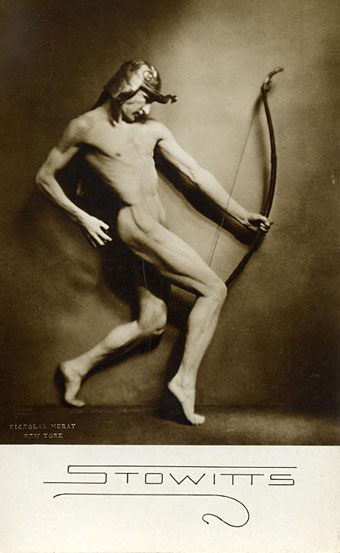
Stowitts photographed by Nickolas Muray.

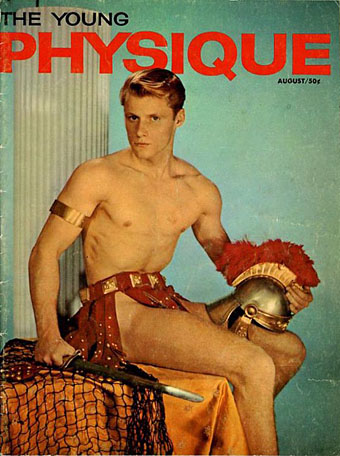
The title is from two gallery pages at the Queer Arts Resource which runs through a history of the old subterfuge whereby homoerotic pictures were decorated to look suitably Greek or Roman. This seldom fooled anyone, even in Oscar Wilde’s day, but it no doubt helped to keep the studios out of the law courts. Amid the plaster columns and antique props there’s a card I hadn’t seen before promoting dancer and artist Hubert Stowitts whose role as a satyr is one of the most memorable moments in Rex Ingram’s 1926 film of The Magician.

physique.jpg

Jim Galahad.

Also at Queer Arts is a copy of The Dying Gaul with a model who’s in the peak of health and a lot more well-hung than most Greek sculptures.

pose.jpg

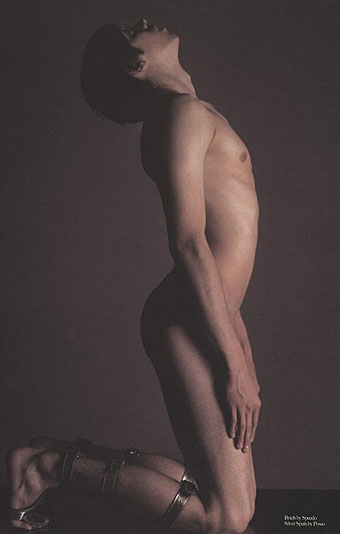
This picture is something I found ages ago on a lost web page and now have a tenuous reason to post here. What looks like erotica is actually a fashion shoot (and he’s wearing swimming trunks) but it shows how the Classical mode persists. He looks like he wants to see more of Jim’s sword…

Elsewhere on { feuilleton }
The gay artists archive
The men with swords archive

A Wilde Night

bragdon.jpg

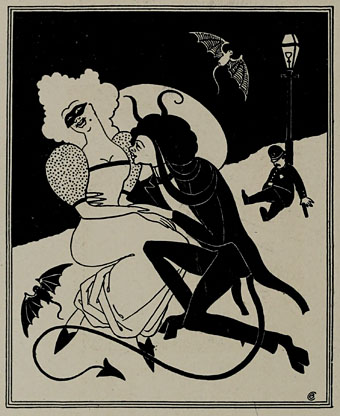
A couple more pieces from yesterday’s Posters in Miniature. The drawing above is entitled A Wilde Night and credited to Claude Fayette Bragdon (1866–1946) whose design work has appeared here before. Bragdon was an acquaintance of Will Bradley’s, and like Bradley was a man of many talents being variously employed as an architect, writer and stage designer. Bragdon and Bradley both worked together on The Chap-Book, Herbert Stone’s Chicago periodical which commenced publication in 1894, the same year as The Yellow Book, a magazine whose style and light-hearted content Stone and co. seemed keen to emulate. Bragdon’s small drawings for The Chap-Book are less Beardsley-like than Bradley’s designs which is why this very overt homage appears as a surprise.

yellowbook.jpg

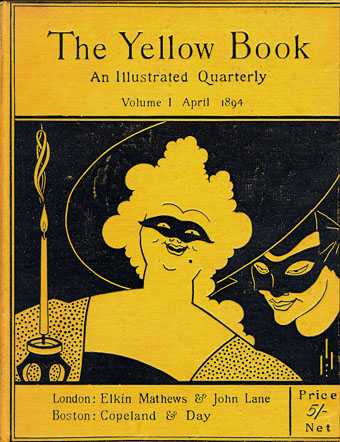
Bragdon’s picture is undated but the female figure is taken from Beardsley’s cover for the first issue of The Yellow Book which would place it in around 1894; the satyr-like male is an odd blend of bits of Beardsley’s male and female figures. Aubrey, however, would never have drawn bats like Bragdon’s, or a sleeping policeman…too gauche, my dear. As for the Wildeness, 1894 was only a year away from Oscar’s trial, a time when London was buzzing with scandalous rumours, none of which appear to have reached Chicago.

giannini.jpg

Also in Posters in Miniature is this piece by another American, Orlando Giannini (1860–1928), a glass designer and another Chicagoan who worked for a while with Frank Lloyd Wright. This design is dated 1895 and struck me with its radical appearance, so very different from the evolving Art Nouveau styles of the time. Giannini’s work as a glass designer evidently brought a different sensibility to graphic design, one which would have still looked bold and original ten years later.

Elsewhere on { feuilleton }
The Aubrey Beardsley archive
The illustrators archive
The Oscar Wilde archive