René Magritte album covers

beck.jpg

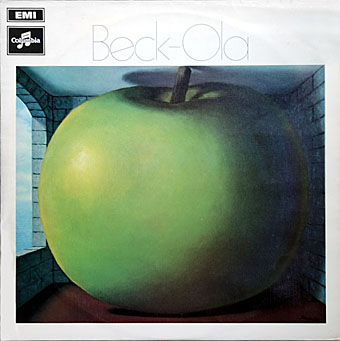
Beck-Ola (1969) by The Jeff Beck Group. Painting: The Listening Room (second version, 1958).

An inevitable post considering the shape of the week, and also a continuation of an occasional series about paintings used as album cover art. Given Magritte’s continuing popularity I’m sure these can’t be the only examples, especially when his work had such an effect on the cover designs of the 1970s. In addition to the Magritte-like covers created by Hipgnosis for Pink Floyd and others you can find the artist’s influence in the cover by Alton Kelley and Stanley Mouse for The Grand Illusion (1977) by Styx, a hugely successful album whose painting is derived from Magritte’s The Blank Cheque (1965). There are many more examples.

Magritte died in 1967 so he missed out on this explosion of interest which also spread into the advertising world. When it comes to influence, Magritte has probably had more of an effect on the general culture than any of the other Surrealists, Dalí included.

rascals.jpg

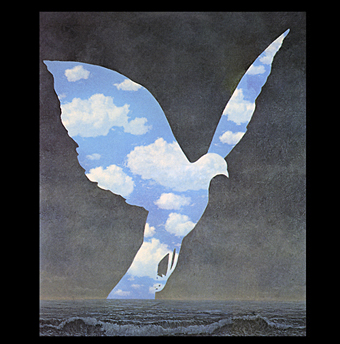
See (1969) by The Rascals. Painting: The Big Family (1963).

hull.jpg

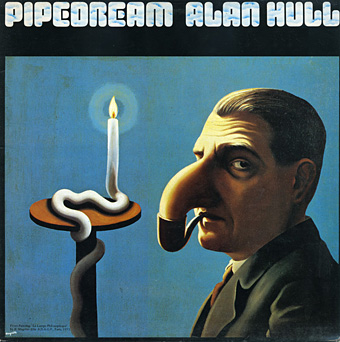
Pipedream (1973) by Alan Hull. Painting: Philosopher’s Lamp (1936).

balavoine.jpg

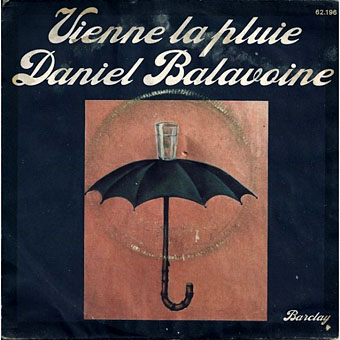
Vienne La Pluie (1975) by Daniel Balavoine. Painting: Hegel’s Holiday (1958).

Continue reading “René Magritte album covers”

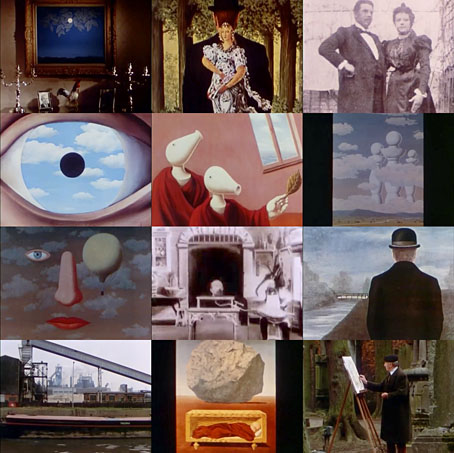
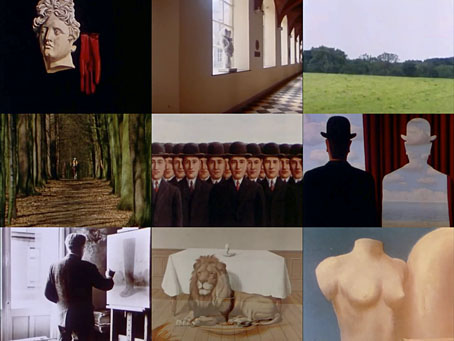
Monsieur René Magritte, a film by Adrian Maben

magritte1.jpg

Until the end of his life, [Magritte] preferred to take the tram.

Now there’s an attitude I approve of. George Melly in his BBC film about Surrealism mentions visiting Magritte at his home in Brussels, and we see Magritte’s house at the beginning of Adrian Maben’s 50-minute film about the artist’s life and work. Maben’s film was made in 1978 as an Franco-German TV production but the narration, by Maben himself, is in English. Surrealism seemed to be back in vogue in 1978: as mentioned yesterday, the Hayward Gallery in London staged an exhibition of Surrealist art that year, the BBC commissioned George Melly’s film as a result of this, while over on rival network ITV there was the marvellous documentary about Surrealist patron Edward James who modelled for one of Magritte’s most famous paintings, La reproduction interdite (1937).

magritte2.jpg

Adrian Maben’s name will be familiar to Pink Floyd obsessives as the director of Pink Floyd: Live at Pompeii (1972), and if you’re familiar with that film you can recognise the same shooting style in his Magritte film which deploys similar slow zooms, tracking shots and images sliding in and out of the frame. The music is credited to a surprising combination of Béla Bartók (mostly piano) and Roger Waters, although some of the pieces from the latter are actually by Pink Floyd, there’s even some of the opening of Obscured By Clouds. In style and content the film is as good as anything the BBC were producing at the time, with extracts from a TV interview with the artist, and also some of Magritte’s high-spirited home movies made with his wife and friends.

Magritte and Pink Floyd are a fitting match, some of the Floyd’s album covers could be Magritte paintings rendered photographically: two men shaking hands, one of whom is on fire; a giant pig adrift over a power station. Storm Thorgerson always acknowledged the debt that Hipgnosis owed Magritte’s example, it’s there in the title of the first Hipgnosis book, Walk Away René, and in this short Tate interview from 2011 where he mentions the Wish You Were Here album as being a very conscious Magritte homage.

Previously on { feuilleton }
George Melly’s Memoirs of a Self-Confessed Surrealist
The Secret Life of Edward James
René Magritte by David Wheatley

George Melly’s Memoirs of a Self-Confessed Surrealist

melly1.jpg

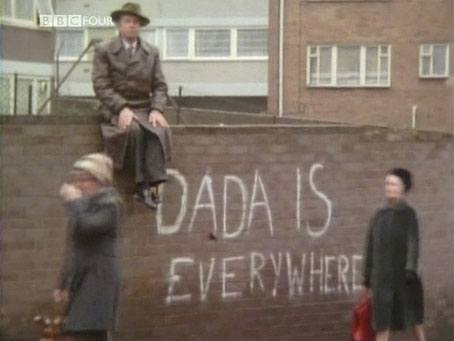
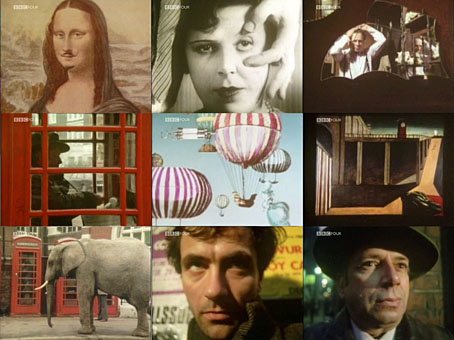
It’s a short step from Dada to Surrealism, and George Melly provides a brief skate through the philosophies of both in this 25-minute BBC film from 1978. Melly, like JG Ballard, was struck by Surrealism at an impressionable age, and the love affair was a lasting one. Both Melly and Ballard championed Surrealism during periods when it was deeply unfashionable, an oppositional stance that Ballard seemed to relish.

melly2.jpg

Melly’s enthusiasm was so well-known that he was often called upon as a token advocate of Surrealism whenever one was required by the TV channels, hence this film whose title implies an admission of something disreputable. A major exhibition of Surrealist art was taking place in 1978 at the Hayward Gallery in London, and it’s to this exhibition that Melly journeys, explaining (and demonstrating) what it means to be a Surrealist along the way. I saw this when it was first broadcast, and the absurd phone calls to strangers inspired myself and a few school-friends to similar activities; teenage pranks seemed less frivolous with an artistic justification. There’s a slight connection to yesterday’s post in Melly’s recounting of an anecdote from the 1950s when he was spared a night-time beating by his reciting of Kurt Schwitters’ Ursonate to a group of belligerent youths. Elsewhere you get to see punk band The Stranglers scowling at the camera—Melly suggests that the punks might be inheritors of the Dadaist attitude—and director Alan Yentob standing at a urinal.

Previously on { feuilleton }
The Secret Life of Edward James
René Magritte by David Wheatley

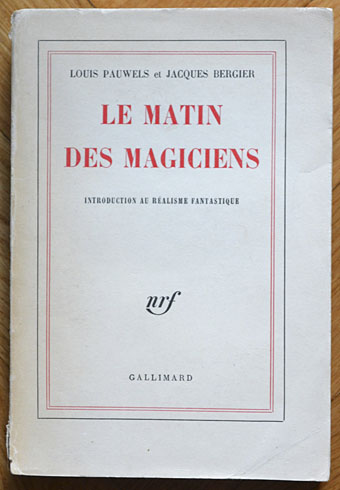
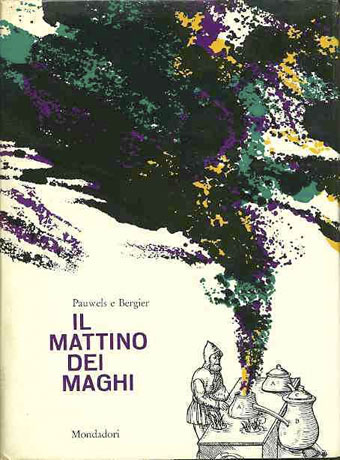
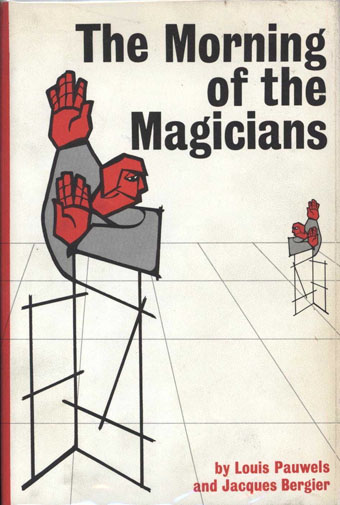
Morning of the Magicians book covers

motm01.jpg

Éditions Gallimard, France, 1960.

Yesterday’s post proved popular so it seemed worthwhile taking another look at the book that birthed Planète magazine. The main problem The Morning of the Magicians presents for an art director is how to encapsulate such wildly diverse contents in a cover design. To judge from the examples here, most people seem to have either given up or gone for vaguely symbolic designs which at the most correspond to the contents in a minor way. The biggest surprise for me was seeing the cover of the first edition above, one of those typically sober French titles which gives away nothing of the intellectual fireworks within. Few of these designs have any credits, and this is nothing like a complete list (more editions may be seen at Goodreads). More recent editions have been avoided altogether since they’re pretty terrible.

motm10.jpg

Arnoldo Mondadori Editore, Italy, 1963. This edition, which runs to 476 pages, includes three translated stories inserted into the text: The Nine Billions Name of God by Arthur C. Clarke, A Canticle for Leibowitz by Walter M. Miller Jr, and The White People by Arthur Machen.

A hardback edition showing an alchemist at work.

motm03.jpg

Stein and Day, USA, 1964.

You know a cover is failing when it could easily be applied to any number of other titles.

Continue reading “Morning of the Magicians book covers”

Weekend links 185

rondelli.jpg

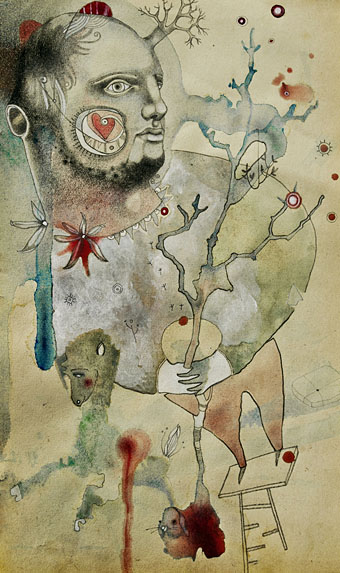
L’uomo che piantava gli alberi (2013) by Sofia Rondelli. Via Form Is Void.

• I’m looking forward to hearing the new album by Chrome Hoof, a band whose ambition and attitude makes many of their contemporaries seem lukewarm at best. Mick Middles gets to grips with Chrome Black Gold here. John Doran interviewed the group in 2010, a piece which includes a Chrome Hoof mix of tracks by other artists.

Jay Roberts: “I was a young Marine scout sniper, definitely his type. And for a single, unforgettable afternoon, Orange County’s most notorious serial killer coaxed me into a place from which many didn’t escape.”

Jonathan Meades: “Why I went postal … and turned my snaps into postcards.” “Meades isn’t your average architectural fanboy,” says Rachel Cooke who went to talk to him at his home in Marseille.

“Faced with a Nabokov novel,” Zadie Smith writes, “it’s impossible to rid yourself of the feeling that you’ve been set a problem, as a chess master sets a problem in a newspaper.” Certainly, while Humbert asks the reader “not to mock me and my mental daze”, the suspicion is that the power dynamic in his tale is a little different.

Tim Groenland on the difficulties of writing, publishing and reading Lolita.

Cosmic Machine is a double-disc collection of French electronic music from the 1970s & 1980s. Justice enthuse about the music here where you can also preview the tracks.

The Midnight Channel, Evan J. Peterson’s horror-poetry homage to the VHS era, is available now from Babel/Salvage. There’s a trailer here.

• “Our age reveres the specialist but humans are natural polymaths, at our best when we turn our minds to many things,” says Robert Twigger.

• Another musical Chrome: Richard Metzger on newly resurrected recordings by one of my long-time cult bands.

• Hermes Trismegistus and Hermeticism: An interview with Gary Lachman.

• A stunning set of photos of London in the sweltering summer of 1976.

Pye Corner Audio live at The Outer Church, Madrid, November 2013.

Judee Sill, the shockingly talented occult folk singer time forgot.

• Designer Jonathan Barnbrook answers twenty questions.

• Don’t trust the painting: Morgan Meis on René Magritte.

Laurie Anderson’s farewell to Lou Reed.

Philippe Druillet at Pinterest.

• The Chrome Plated Megaphone Of Destiny (1968) by The Mothers of Invention | March Of The Chrome Police (1979) by Chrome | Chrome (1981) by Debbie Harry