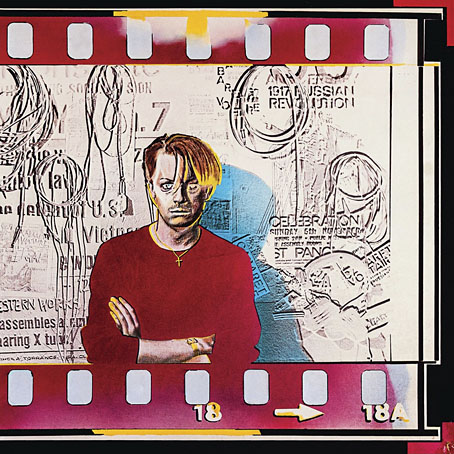
Richard H. Kirk, 1956–2021

kirk.jpg

Q: Was the initial idea to be a music group?

Richard H. Kirk: I suppose that depends on how you define “music”. No, the initial idea was to be more of a sound group, just putting sounds together like jigsaw pieces. If the result did sound like music then it was purely coincidental.

From Cabaret Voltaire: The Art of the Sixth Sense (1984) by M Fish & D Hallberry

This was a shock, in part because I tend to think of certain artists as perpetually young even when I’ve been following them for decades. In the case of the not-so-young Cabaret Voltaire it was an easy frame of mind to slip into when Kirk and Mallinder were only photographically visible up to about 1990. After this the group resumed their former obscurity, cloaked by abstract images and Designers Republic graphics.

Oddly enough I’d been running through the early Cabs albums only a couple of weeks ago, and wondering how long Kirk was going to keep the revived group going on his own. I suppose this means that Cabaret Voltaire is now definitely finished, in which case it’s a double RIP. And just a few days ago I was reading a Mark Fisher essay on Joy Division, feeling as frustrated as I always do when Curtis and co. are praised for “channelling” (or whatever) the spirit of William Burroughs when nobody would think to connect Burroughs and Joy Division if you changed the title of the song Interzone to something else. Throbbing Gristle were closer to Burroughs personally than were Cabaret Voltaire but the influence on TG only became really overt when Industrial Records released Nothing Here Now But The Recordings, an album of Burroughs’ tape experiments. The Cabs were more important to me as a youthful reader of Burroughs’ novels for seeming to be broadcasting from inside his texts. Their early albums were disturbed and disturbing (a friend once asked me to switch off their music for this very reason), an unwholesome amalgam of dialogue taped from TV and radio, crude electronics, threatening voices, and songs that were warped into strange new shapes. This is entertainment…this is fun… I’m still amazed that their first album included a cover of No Escape, a song by psychedelic group The Seeds, which didn’t sound out of place despite the weirdness surrounding it.
giorno-burroughs-cabs.jpg

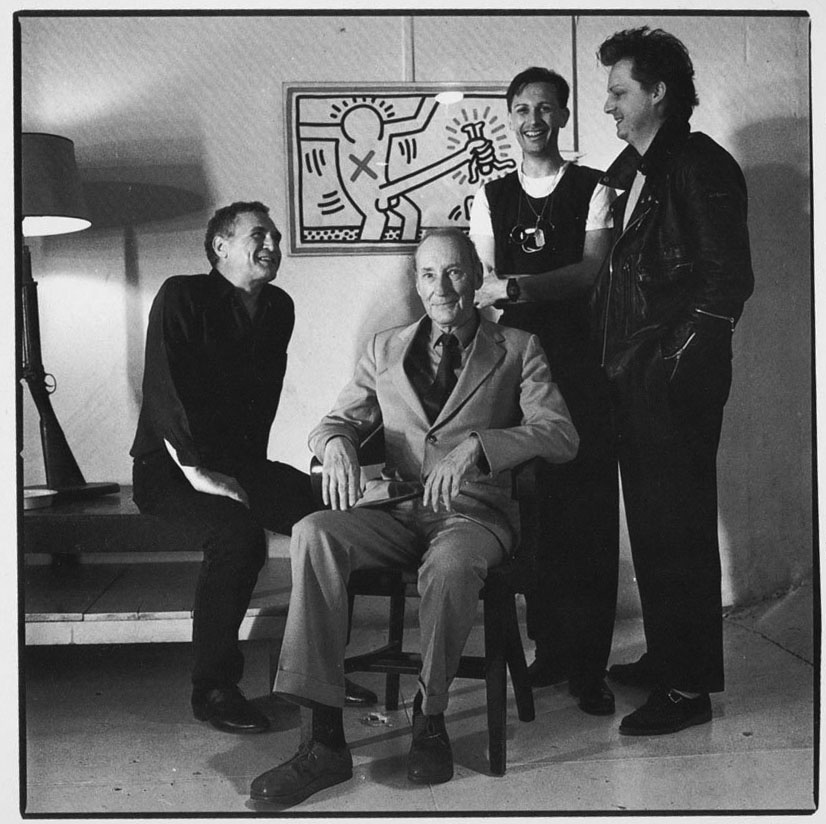
William smiles. Left to right: John Giorno, William Burroughs, Stephen Mallinder, Richard H. Kirk. Photo by Sylvia Plachy from the gatefold interior of A Diamond In The Mouth Of A Corpse (1985), a compilation album released by Giorno Poetry Systems.

Cut-up theory was a constant in the Cabaret Voltaire discography, and in many of Richard Kirk’s solo recordings, with the group starting out as Dada-inspired tape collagists* before they found a way to present their experiments in a musical form. The concept is to the fore in the title of Cabaret Voltaire’s debut album, Mix-Up, and exemplified in the track that opens side two, Photophobia, a reworked version of a Surrealist monologue that dates from the group’s days making recordings in Chris Watson’s attic. Photophobia pulls you into the same queasy dreamspace in which you find yourself when reading Burroughs’ early cut-ups, a catalogue of oneiric splicings—”they’re injecting the rivers with stainless-steel fish…a coelacanth/a body with a shrunken head…”—the phrases being increasingly overwhelmed by rising synthesizer drones and Kirk’s squeaking clarinet. Kirk’s solo debut, Disposable Half-Truths, was a cassette-only release on Industrial Records infused with the Burroughs spirit in both technique and content, offering track titles such as Information Therapy and Insect Friends Of Allah. Cabaret Voltaire continually referred to Burroughs’ speculative essay collection The Electronic Revolution in interviews but it was Kirk who extended the group’s cut-up experiments to film and video. By 1982 they’d accumulated enough of their own video material to release a VHS collection on their own music and video label, Doublevision.

If I’ve concentrated on the early recordings it’s because the post-punk period continues to seem like a miraculous moment, a space of four years when anything was possible musically, a time when Bruce Gilbert and Graham Lewis could record an album as uncompromisingly strange as 3R4 then have it released on 4AD and sold in racks next to albums by label-mates Bauhaus and The Birthday Party. Cabaret Voltaire took advantage of this unique period to warp expectations in their own way, and to extend the boundaries of the possible. Richard H. Kirk’s subsequent career was prolific, releasing a blizzard of albums and singles under a variety of pseudonyms (Discogs lists 42 different Kirk aliases). One of my favourite pieces from his solo recordings is White Darkness from 1993, the last track on a 12-inch single, Digital Lifeforms, credited to Sandoz. There’s a mysterious quality here that I wish he’d explored more often on his later albums instead of letting the rhythms run their course for another seven or eight minutes. The sampled voice maintains a thread of continuity with Kirk’s music before and after, as does the reference to LSD in the Sandoz name, taking us back to Mix-Up and the mescaline experiments described on Heaven And Hell. Psychedelia by other means.

* For a taste of unadorned Cabs-related tape manipulation, see The Men With The Deadly Dreams, a cassette release compiled by Geoff Rushton/John Balance which features contributions from Chris Watson and Richard H. Kirk. Note that the blog post doesn’t give an accurate description of the tape contents.

• At Vinyl Factory: An introduction to Richard H. Kirk in 10 records.
• At The Wire: two interviews with Kirk from the magazine’s archives.

Previously on { feuilleton }
Recoil and Cabaret Voltaire
Pow-Wow by Stephen Mallinder
TV Wipeout revisited
Doublevision Presents Cabaret Voltaire
Just the ticket: Cabaret Voltaire
European Rendezvous by CTI
TV Wipeout
Seven Songs by 23 Skidoo
Elemental 7 by CTI
The Crackdown by Cabaret Voltaire
Neville Brody and Fetish Records
Pynchonian cinema

tpa.jpg

(Pynchonian? Pynchonesque? Pynchon-heads can no doubt supply the most common descriptor but for now Pynchonian will do.)

Is it possible to identify a Pynchonian strand in cinema? This question came to mind while I was reading the end of Gravity’s Rainbow, and probably a little before then during a scene that takes place in the Neubabelsberg studio in Berlin. The Pynchon reading binge is still ongoing here—after finishing the Rocket book I went straight on to Vineland, and I’m currently immersed in Mason and Dixon—so I’ve been watching films that complement some of the preoccupations in the Pynchon oeuvre, at least up to and including Vineland. This is a small and no doubt contentious list but I’m open to further suggestions. Inherent Vice is excluded, I’ve been thinking more of films that are reminiscent of Pynchon without being derived from his work.

Elements that increase the Pynchon factor would include: a serio-comic quality (essential, this, otherwise you’d have to include a huge number of thrillers); detective work; paranoia; songs; and a conspiracy of some sort, or the suspicion of the same: a mysterious cabal–the “They” of Gravity’s Rainbow—who may or may not be manipulating the course of events.


tpa2.jpg

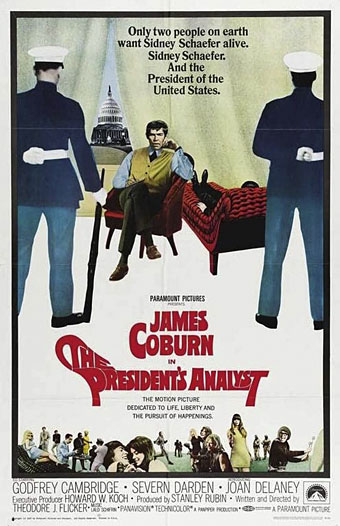
The President’s Analyst (1967)
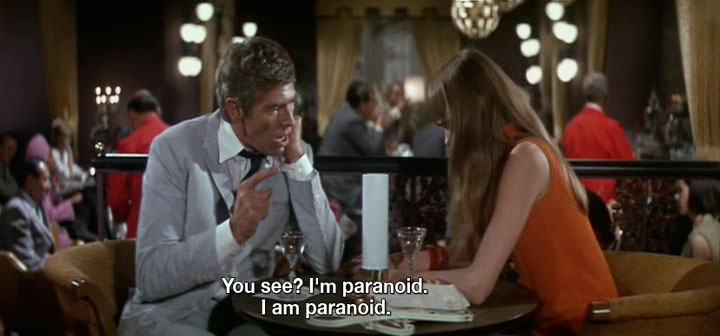
I’d be very surprised if Pynchon didn’t like this one. James Coburn as the titular analyst, Dr Sidney Schaefer, has little time to enjoy his new job in Washington DC before half the security services in the world are trying to kidnap him to discover what he’s learned about the President’s neuroses. This in turn leads the FBI FBR to attempt to kill Schaefer in order to protect national security. Pynchonian moments include a bout of total paranoia in a restaurant, Canadian spies disguised as a British pop group (“The ‘Pudlians”), and a visit to the home of a “typical American family” where the father has a house full of guns, the mother is a karate expert, and the son uses his “Junior Spy Kit” to monitor phone conversations. Later on, an entire nightclub gets spiked with LSD. This is also the only film in which someone evades abduction to a foreign country by the cunning use of psychoanalysis.
Is it serio-comic? Yes.
Is there detection? In the background: the CIA CEA and KGB agents have to work together in order to outwit the FBI FBR and discover who the ultimate villains might be.
Is there paranoia? You only get more paranoia in one of the serious conspiracy dramas of the 1970s like The Conversation or The Parallax View. (The latter includes the same actor who plays the All American Dad, William Daniels.)
Any songs? Yes. Coburn hides out for a while with the real-life psychedelic group Clear Light, and helps with their performance in the acid-spiked nightclub.
“They”? There are multiple “Theys” in this one.
Pynchon factor: 5. Maybe a 6 for the LSD.


nashville.jpg

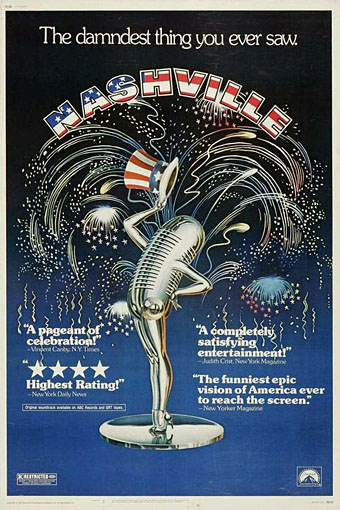
Nashville (1975)
This one is a stretch but Robert Altman is the director I think of as closest to Pynchon’s sensibility even if individual works are light on the Pynchon factor. His films are often rambling, quirky and satirical—especially when he goes the ensemble route—but never too comic to avoid a sudden lurch into the dark. The Long Goodbye might seem a more likely choice, given the way it points to subsequent Chandler variations like The Big Lebowski (see below) and Inherent Vice, but it’s still Chandler’s story. Nashville is pure Altman, the best of his ensemble entries and my choice for his best film of all, a portrait of America in the mid-1970s where someone can be loved by millions yet still be a target for assassination. It’s worth noting that the director of Inherent Vice, Paul Thomas Anderson, was the insurance standby when Altman was directing his final film, The Prairie Home Companion.
Is it serio-comic? Yes.
Is there detection? No.
Is there paranoia? No, although as a portrait of the USA in the 1970s it can’t avoid a lurking sense of unease.
Any songs? Lots of songs.
“They”? No.
Pynchon factor: 2


simon.jpg

Simon (1980)
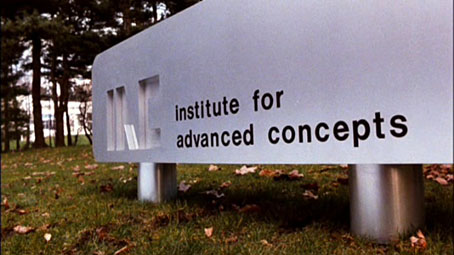
The debut feature from Marshall Brickman, Simon is an overlooked oddity with a great performance by Alan Arkin as a college professor, Simon Mendelssohn, who gets tricked by the Institute for Advanced Concepts into believing he’s an extraterrestrial. Parts of this play like a comic version of Altered States, which coincidentally was released the same year. Both films feature reckless quests for academic glory, flotation tank experiments (Simon includes a reference to Dr John Lilly), and regressions to earlier stages of evolution. Pynchonian moments include a church commune who worship the television, a gas that reduces intelligence, and a self-aware computer called “Mother” whose human interface is a giant phone receiver.
Is it serio-comic? Yes.
Is there detection? No.
Is there paranoia? A little.
Any songs? No.
“They”? The IAC are a small but powerful “They”, with carte blanche to foist their whims on an unsuspecting nation.
Pynchon factor: 2.5


tbl.jpg

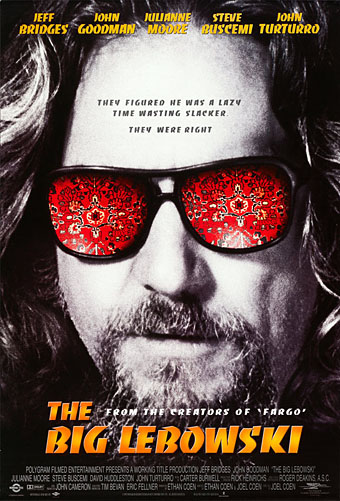
The Big Lebowski (1998)
When the book trailer for Inherent Vice appeared in 2009 (with narration by the author himself…or was it? etc), a common reaction was “This sounds just like The Big Lebowski“. If The President’s Analyst is the closest Hollywood gets to The Crying of Lot 49 then The Big Lebowski may be the closest to Vineland‘s story of the youth of the hippy era coping with life in a world that’s passed them by.
Is it serio-comic? Yes.
Is there detection? Yes.
Is there paranoia? A little. Most of the time The Dude is more concerned with trying to keep up with his continual changes of fortune.
Any songs? Lots of songs on the soundtrack, plus the Busby Berkeley-style dream sequence.
“They”? Yes.
Pynchon factor: 4.5


huckabees.jpg

I Heart Huckabees (2004)
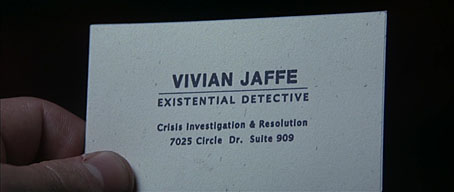
David O’Russell’s mélange of existential philosophy, environmentalism and coincidence is like Wes Anderson with a more political edge, and the kind of quirky comedy there was still space for in the Hollywood of the late 1990s/early 2000s. Jason Schwartzman is Albert Markovski, a poetry-writing environmental activist with a coincidence problem who turns to existential detectives, Vivian Jaffe (Lily Tomlin) and husband Bernard Jaffe (Dustin Hoffman), for a solution. “Everything is connected”, Bernard insists, so it’s no surprise that the presence of Lily Tomlin returns us to Nashville, while the pair require a little of Sidney Schaefer’s psychoanalysis to get to the bottom of Albert’s problems. Meanwhile, the Jaffes’ former pupil, Caterine Vauban (Isabelle Huppert), is lurking in the wings, tempting Albert with the attractions of sex and nihilist philosophy (shades of The Big Lebowski).
Is it serio-comic? Yes.
Is there detection? Yes.
Is there paranoia? A little. Albert is increasingly worried about losing control of his protest group.
Any songs? Shania Twain puts in an appearance but she doesn’t sing.
“They”? The Huckabees Corporation is a small-scale “They”, manipulating the environmentalists for their own ends.
Pynchon factor: 3.5


utsl.jpg

Under the Silver Lake (2018)
David Robert Mitchell’s surprising follow-up to the excellent It Follows is self-consciously Lynchian, and quite possibly self-consciously Pynchonian too. A long and rambling tale of burgeoning paranoia in the hip Los Angeles enclave of Silver Lake where slacker Sam (Andrew Garfield) discovers a web of interconnected mysteries after trying to find out why his attractive female neighbour has disappeared. It’s sinister, funny and bizarre, with mysterious deaths, hidden codes, treasure maps, chess games, pop music, Californian cults and more. Mitchell wisely avoids explaining too much which means the film now has a cult following determined to dredge its alleged secrets.
Is it serio-comic? Yes.
Is there detection? Yes.
Is there paranoia? Yes.
Any songs? Lots of songs, also a mysterious Songwriter character and an indie band, Jesus and the Brides of Dracula.
“They”? Multiple “Theys”.
Pynchon factor: 5


L49-01.jpg

Lodge 49 (2018–2019)
Several people recommended this TV series (thanks!) so here it is. And while Jim Gavin’s creation may not be a feature film it’s very definitely Pynchonian. See this post for details.
Is it serio-comic? Yes.
Is there detection? Yes.
Is there paranoia? A little. Dud and Ernie have a paranoid episode involving a drone.
Any songs? Yes, from the characters themselves and also from Broadcast and others on the soundtrack.
“They”? Once again, there are multiple “Theys”.
Pynchon factor: 49


Honourable mentions: WD Richter’s The Adventures of Buckaroo Banzai Across the 8th Dimension (1984) makes it to the Pynchon Zone via its appropriation of “Yoyodyne”, the name of the defence contractor from V. and The Crying of Lot 49. Despite this, and much as I like Buckaroo Banzai, I don’t think it’s Pynchonian enough for this list, although the writers at the defunct Pynchon site, Spermatikos Logos, might disagree. This archived page makes a case for the film, and also mentions a possible reciprocation from the author which I missed when I was reading Vineland.

Likewise, Richard Linklater’s debut, Slacker (1990), also came to mind. It has the requisite large cast of idlers and eccentrics (including a couple of conspiracy obsessives), plus a meandering yet connected structure, but it doesn’t otherwise seem Pynchonian enough.

Anything else I’ve missed?

Update 1: Added Lodge 49.
Update 2:
Further recommendations at Letterboxd.
Update 3: Finally added Under the Silver Lake.

Previously on { feuilleton }
Going beyond the zero
Pynchon and Varo
Thomas Pynchon – A Journey into the Mind of [P.]

Trip texts revisited

trip1.jpg

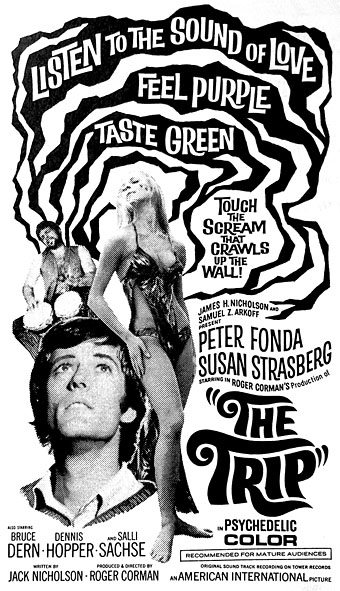
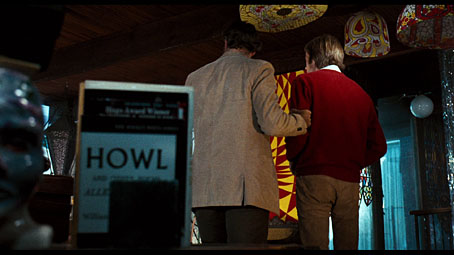
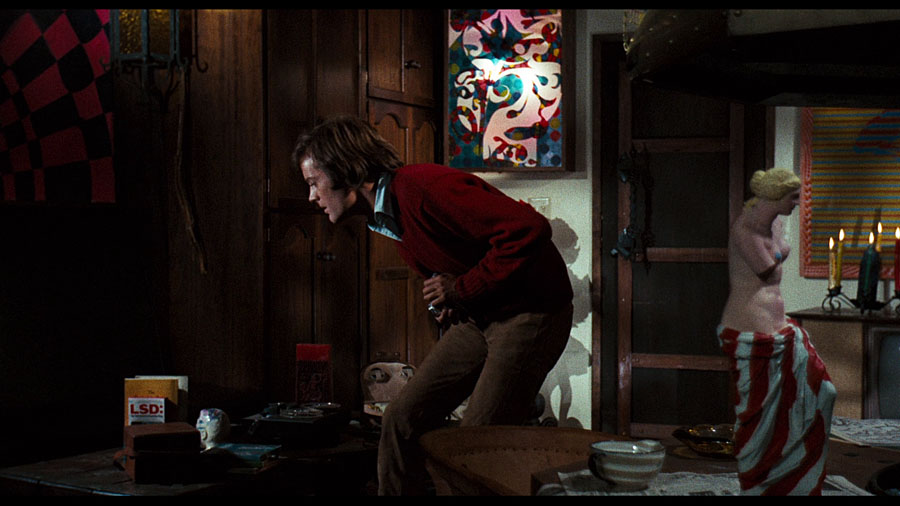
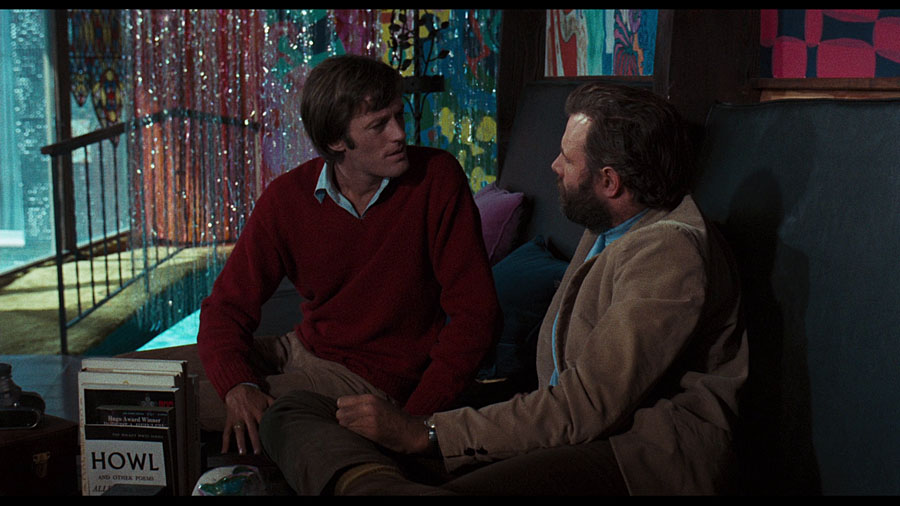
An update to a post from several years ago about the handful of significant books that appear in Roger Corman’s The Trip (1967). The earlier post was prompted by a DVD viewing; this update has been prompted by a re-viewing via blu-ray which yielded screen-grabs showing more detail. As I’ve no doubt said before, one of the pleasures of home viewing is being able to scrutinise film frames in this manner, something that was previously only possible if you were a writer with access to a cinema print.

trip2.jpg

Corman’s film is probably the only feature from American International Pictures that contains any kind of extraneous intellectual reference. The AIP ethic was always “shoot it fast and cheap”, a production rule that had no time for winking to the hip contingent of the audience with books, of all things. Leave that stuff to the French. The Trip was still shot fast and cheap but Corman had been stretching himself increasingly while making his cycle of Poe films, especially with The Masque of the Red Death which had a longer production schedule, a British cast and crew, and a symbolic finale that sets it apart from its rivals at Hammer and other studios. The Trip is as far-out as Corman gets, the cut-up shots of Peter Fonda stumbling in delirium around Sunset Boulevard wouldn’t be out of place in any underground film of the period.

trip3.jpg

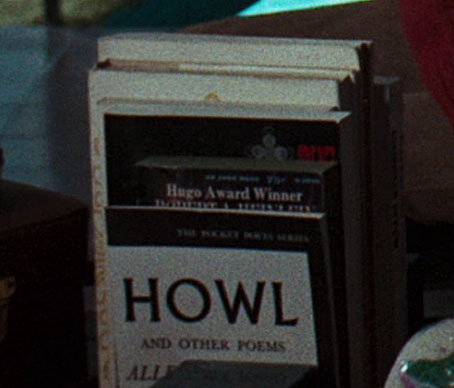
The surprising thing about the books that appear in the scene where Fonda’s character, Paul, drops his acid is that they’re perfectly appropriate items of set decoration but only two of them—the unmissable copy of Allen Ginsberg’s Howl, and David Solomon’s LSD: The Consciousness-Expanding Drug—would have been discernible to an audience. The latter inclusion is probably more to do with the three magic letters being so prominent on its cover than anything else, although it is the kind of book you’d find in a house owned by lysergic voyagers. The blu-ray detail now reveals more of the book hiding behind it although this one has eluded my attempts to search for a match: “The [something]….”? I thought it might be The Prophet by Kahlil Gibran but none of the editions prior to 1967 resemble the cover.

trip4.jpg

trip5.jpg

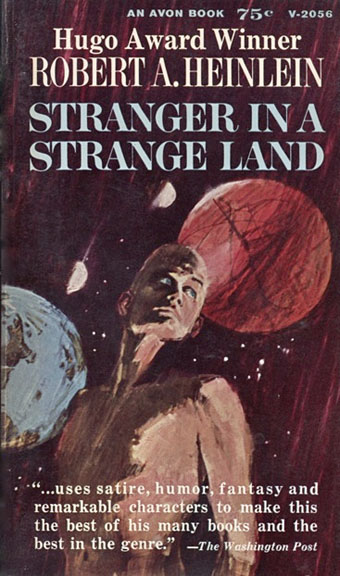
The main discovery this time round was finding a match for the book hidden by Howl, a title that I now confidently declare to be the 1962 Avon edition of Stranger in a Strange Land by Robert A. Heinlein. (The reds and blues of the cover art are more discernible in a full-frame shot.) When watching the DVD I thought those words might be “Hugo Award Winner” but couldn’t make out an author’s name, and “Award Winner” was a guess. The book might also have been written by someone named Hugo… Heinlein’s novel was a hippy favourite in the 1960s, one of several books together with The Prophet, Richard Brautigan’s novels and poetry, Herman Hesse’s Steppenwolf, etc, that were popular with turned-on readers. The irony of the author of Starship Troopers being mooned over by the love ‘n’ peace crowd wasn’t lost on the younger generation of SF authors but their criticisms didn’t travel outside genre circles. Heinlein could evade opprobrium for being one of the signatories of an ad in Galaxy for June, 1968, supporting the war in Vietnam because hippies en masse weren’t reading SF magazines.

heinlein.jpg

As noted in the earlier post, the book behind the Heinlein is a 1960 edition of The Tibetan Book of the Dead, which I was only able to identify because I own a copy of the same edition. Behind this there lurks another title whose identity is now going to nag at me. The cover decoration means it will be easy to find if it ever turns up somewhere. But will I remember it when it does? We’ll see.

Previously on { feuilleton }
Alice’s Adventures in the Horse Hospital
LSD-25 by The Gamblers
More trip texts
Trip texts
Acid albums
Acid covers
Lyrical Substance Deliberated
The Art of Tripping, a documentary by Storm Thorgerson
Enter the Void
In the Land of Retinal Delights
Haschisch Hallucinations by HE Gowers
The art of LSD
Hep cats

Weekend links 552

keen.jpg

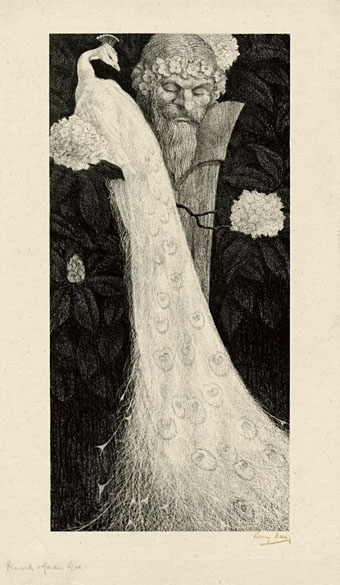
White Peacock and Garden God (c. 1922) by Henry Keen.

• “Though both writers confront some of the most unsavory and unjust dimensions of human life, Genet revels in moral ambiguity and coarse language, while Erpenbeck satisfies her audience’s desire for tidy ethical responses by using careful, equally tidy sentences. Genet’s world is dirty; Erpenbeck’s is clean.” Christy Wampole compares two newly-translated collections of non-fiction writing by Jean Genet and Jenny Erpenbeck.

• Gaspar Noé’s notorious, controversial (etc, etc) Irreversible receives the prestige blu-ray treatment from Indicator in April. Still no UK blu-ray of Enter the Void is there? I had to order a German release.

Stereolab release Electrically Possessed: Switched On Vol. 4 next month, the latest in their series of albums which collect singles, compilation tracks and other rarities.

• At Nautilus: Antonio Zadra and Robert Stickgold on how dreaming is like taking LSD.

• At Dennis Cooper’s: Bollo presents…Éliane Radigue (& The Lappetites).

• Playwriting & Pornography: Adam Baran remembers Jerry Douglas.

• At Spine: Vyki Hendy on the joy of monochrome book covers.

• Mix of the week: Subterraneans 2 by The Ephemeral Man.

John Boardley’s favourite typefaces of 2020.

• New music: Spirit Box by Blanc Sceol.

Life In Reverse (1981) by Marine | Reverse World (1995) by David Toop | Reverse Bubble (2014) by Air

Moirage, a film by Stan VanDerBeek

vanderbeek1.jpg

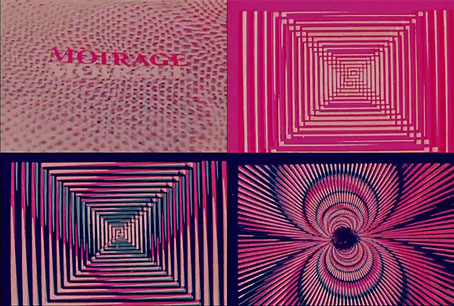
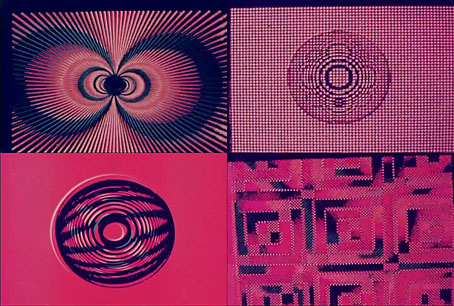
Further proof that if you wait long enough (almost) everything turns up eventually. In 2011 I mentioned a fruitless search for Moirage (1970), a short film by Stan VanDerBeek, and here it is, in a rather scratched print at the Internet Archive. The film proves to be as I expected, an abstract work that animates the kinds of patterns that would have been deemed Op Art in the few years before LSD use became widespread, but which were unavoidably psychedelic by the time VanDerBeek came to make his film.

vanderbeek2.jpg

The patterns were provided by Gerald Oster, a biophysicist who used his discoveries in photochemical research to create works of art. My Studio Vista guide to Op Art lists two Oster studies in its bibliography: a book, The Science of Moiré Patterns (1959), which included sheets of overlays for the reader to play with; and an article co-written with Yasunori Nishijima, Moiré Patterns, for Scientific American (May, 1963). (The magazine also had a moiré pattern as its cover illustration.) I was playing with moiré interference myself a few weeks ago so this discovery is a timely one. My experiments involved vector graphics, a much more versatile medium for creating these effects than the printed sheets that Oster and his colleagues had to create. I’d been thinking of using the patterns as part of a book design but haven’t decided yet whether they’re suitable.

Elsewhere on { feuilleton }
The abstract cinema archive