Eduardo Paolozzi’s Jet Age Compendium

paolozzi.jpg

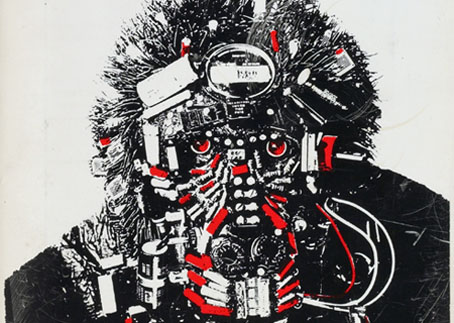
Detail from the cover of Ambit # 40, 1969.

A teenage enthusiasm for Pop Art meant I was familiar with the paintings and collages of Eduardo Paolozzi (1924–2005) long before I became aware of his association with sf magazine New Worlds, and his friendship with JG Ballard. Paolozzi was famously credited on the masthead of New Worlds as “Aeronautics Advisor”, a listing which impressed the relevant authorities when Brian Aldiss petitioned for an Arts Council grant and saved the magazine from collapse. Paolozzi’s work was featured in New Worlds now and then, and he provided a cover for issue 174, but it was to Ambit magazine one had to turn to see regular work by the artist.

paolozzi2.jpg

New Worlds #174, Aug 1967.

My favouritism towards New Worlds has always led me to see Ambit as NW-lite; frequent NW contributor JG Ballard was Ambit‘s fiction editor, and both stood to the side of the British literary scene, although Ambit editor Martin Bax didn’t share Michael Moorcock’s preference for pursuing generic or experimental means to Romantic or visionary ends. Quibbles aside, it’s good to see Paolozzi’s work for the magazine is now the subject of an exhibition, The Jet Age Compendium, at Raven Row, London, and also a book, The Jet Age Compendium: Paolozzi at Ambit from Four Corners Books. If you can’t see the former, the latter is priced £12.95 which strikes me as very reasonable.

The Jet Age Compendium runs until 1 November 2009. For an insight into the artist’s interests and attitudes, there’s a great Studio International interview here from 1971 with Paolozzi and Ballard talking to art critic Frank Whitford.

Previously on { feuilleton }
Sculptural collage: Eduardo Paolozzi
Revenant volumes: Bob Haberfield, New Worlds and others

The art of Michael Dotson

dotson.jpg

Dream House #3 (2009).

Many of Michael Dotson‘s vivid acrylic paintings would make good illustrations for JG Ballard books or for some of his more hallucinatory short stories. Not all of these stylised urban landscapes and empty sports arenas have the requisite latent menace to be truly Ballardian but the anomalous black pyramid in Dream House #3 carries a weight of sinister implication. Pseunami (2005), meanwhile, depicts a vibrantly abstracted catastrophe.

Via Core 77.

Previously on { feuilleton }
Ballard and the painters
AVAF at Mao Mag

Le Phallus phénoménal

denon.jpg

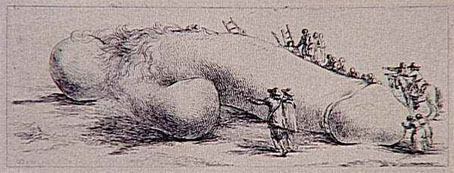
Le Phallus phénoménal (1793–1794).

This blurred and discoloured picture arrives following a discussion with Paul Rumsey in the comments for an earlier post about engravings of monstrous whales. The pictures there were by engraver Hieronymus Cock whose surname gives us an additional resonance when discussing Moby Dick and sperm whales. The picture I posted of Jan Saenredam’s stranded whale showed the dead creature’s considerable penis (another engraving does the same) which led Paul to alert me to Dominique Vivant’s mischievous play on these pictures, where the artist exchanges the whale for a Brobdingnagian phallus. Or perhaps it’s merely a Gulliverian phallus and those people are Lilliputians… Whatever the case, I then mentioned to Paul JG Ballard’s story ‘The Drowned Giant’ from Ballard’s Terminal Beach collection which concerns the body of an enormous human found washed on a beach and subject to similar scrutiny by townspeople as in the stranded whale pictures. The body is eventually dissected and sold off. Paul reminded me of the end of the piece where Ballard writes:

As for the immense pizzle, this ends its days in the freak museum of a circus which travels up and down the north-west. This monumental apparatus, stunning in its proportions and sometime potency, occupies a complete booth to itself. The irony is that it is wrongly identified as that of a whale…

…which brings us full circle. Perhaps fittingly, Ballard’s story was published in Playboy magazine in 1965 under the title ‘Souvenir’.

As for Dominique Vivant (1747–1825), aka the Baron de Denon, his prestigious career besides engraving included, among other things, the directorship of the Louvre. We’re told he also wrote an erotic novel, Point de lendemain, and produced a selection of pornographic etchings, of which Le Phallus phénoménal would seem to be a part. Let no one accuse the French of being prudes; the picture above is from a site where you can order framed prints should you have a sudden urge to hang a phenomenal phallus on your wall.

Elsewhere on { feuilleton }
The etching and engraving archive

Previously on { feuilleton }
Of the Monstrous Pictures of Whales
Jan Saenredam’s whale
The Whale again
Rockwell Kent’s Moby Dick
Phallic bibelots
Phallic worship
The art of ejaculation

Penguin science fiction

drought.jpg

The Drought, 1968; design by Richard Hollis, photography by Dr. J Comroe.

James Pardey contacted me earlier this week announcing his site devoted to Penguin Books’ science fiction covers. I posted some of my own dishevelled copies a while back and this news gives me an excuse to throw up another Ballard cover. Pardey’s site is just the kind of thing I enjoy seeing, with a comprehensive collection and detailed notes for each design. The front page is especially good since you can see immediately how the look of the titles evolved, from spare layouts and pictorial covers through to bold graphic design which culminates in David Pelham’s great run as designer during the 1970s. Creative Review posted a talk Pelham gave a couple of years ago which explores his work at Penguin and touches on the covers he did for Ballard. A shame they didn’t do a complete set of Ballard’s titles at the time, I’d have loved to see how he treated the other books.

Elsewhere on { feuilleton }
The book covers archive

Previously on { feuilleton }
Penguin Labyrinths and the Thief’s Journal
Penguin Surrealism
Penguin book covers