Punch and Judy, Michel de Ghelderode, and the Brothers Quay

punch1.jpg

The Quay Brothers’ first animated film, Nocturna Artificialia, was released in 1979. Prior to this there had been some short experiments but since these are always described as “lost” it’s doubtful that we’ll ever see them. The artistic success of Nocturna Artificialia prompted the Quays and producer-colleague Keith Griffiths to consider fresh outlets for their talents, and resulted in funding from Britain’s Arts Council for two arts documentaries combining live-action film with animated interludes. Nocturna Artificialia has long been available for home viewing on the various Quays DVDs but the two early arts films, Punch and Judy: Tragical Comedy or Comical Tragedy (1980) and The Eternal Day of Michel de Ghelderode, 1898–1962 (1981), are omitted from the reissue canon for reasons that have never been very clear. Both films have been impossible to see unless you’re an academic or film programmer, at least until now. Once again, YouTube has provided an outlet for exceptional rarities.
punch2.jpg

Punch and Judy: Tragical Comedy or Comical Tragedy

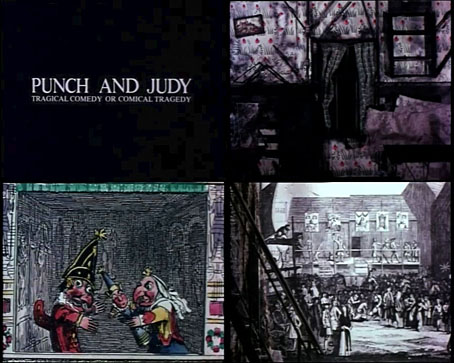
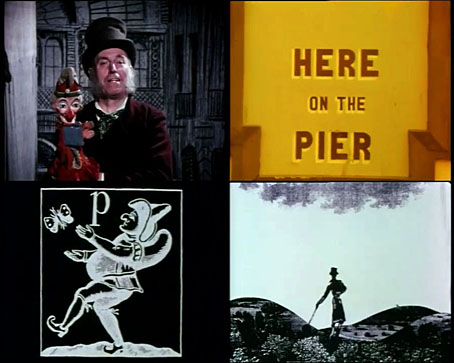
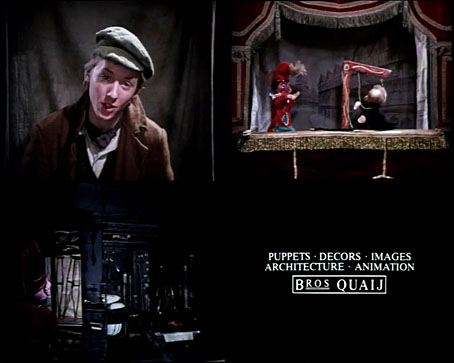
Now that finally I’ve watched these films it’s understandable why they don’t fit so easily with the Quays’ more personal output. Punch and Judy has obvious superficial parallels with Jan Švankmajer’s Punch and Judy (1966) but Švankmajer’s film is his own idiosyncratic interpretation of the murderous puppet. The Quays film is much more straightforward, devoting most of its running time to a history of Mr Punch and the other puppet characters. The story of Punch himself (narrated by Joe Melia) is intercut with a contemporary performance of the play by a genuine Punch and Judy man, Percy Press. Animated sequences are limited to small inserts between the documentary material before a lengthier section at the end that illustrates Harrison Birtwhistle’s Punch and Judy opera. This last section shows how much the Quays had developed their animation techniques since their first film, and is reminiscent of the opera sequences in their later film about Leoš Janáček. Animation aside, there’s little else that’s recognisably Quay until the credits which are lettered by the brothers. (For this film and the following one they credit themselves as the “Brothers Quaij”.) Punch and Judy: Tragical Comedy or Comical Tragedy was of sufficient quality to be screened by the BBC in 1981 as part of the Omnibus arts strand.
punch3.jpg

The Eternal Day of Michel de Ghelderode, 1898–1962
ghelderode1.jpg

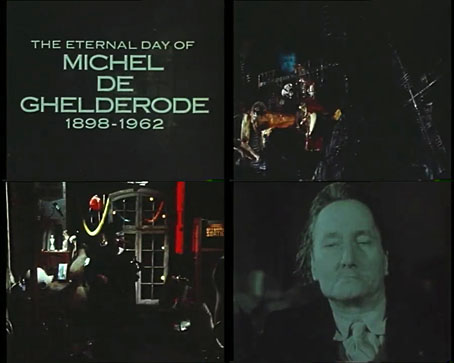
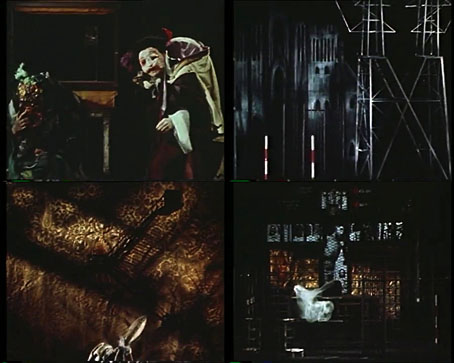
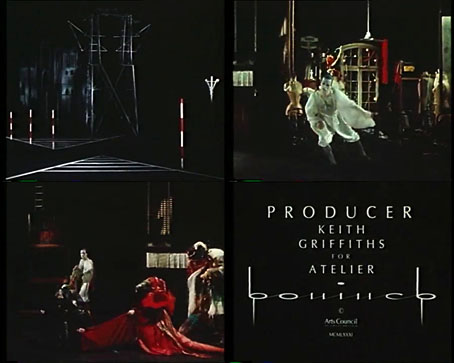
Michel de Ghelderode was a Belgian playwright whose grotesque and macabre works, many of which feature masks and puppets, are favourites of the Quays. This is a shorter film than the previous one (30 minutes rather than 45) but the territory is closer to the Quays’ own concerns. The animated sequences are fewer but they’re marvellous pieces, especially the longer central sequence which animates Ghelderode’s Fastes d’enfer (Chronicles of Hell). The figures in the latter piece may depict Ghelderode’s characters but the decor is 100% Quay, with a nocturnal cityscape and shadows from one of the trams that drift through their early films. A bonus for me was the music by Dome (Bruce Gilbert and Graham Lewis), a duo for whom the Quays later designed a record sleeve.
ghelderode2.jpg

The rest of the film consists of archive footage of Ghelderode wandering Belgian streets, and live performance of other scenes from his plays. All of this is strange and fascinating, only spoiled a little by the picture being very dark in places. (The screen shots here have been brightened.) Keith Griffiths says that this was a result of the film not being properly exposed, a consequence of the company still learning film-making as they went along. This may also explain why the film is missing from the official canon. If so, it’s a shame since it’s closer to the Quays’ own interests than some of their later commissions.
ghelderode3.jpg

Now that these films have surfaced there’s one more short from the early years that’s still unavailable. Ein Brudermord (1981) is based on a Franz Kafka short story, and runs for a mere 6 minutes. Meanwhile, I’m also hoping that someone may eventually post better copies of the Stravinsky and Janáček films, both of which have been prevented from DVD reissue by the copyrights on the music.

Elsewhere on { feuilleton }
The Quay Brothers archive

Weekend links 408

sasada.jpg

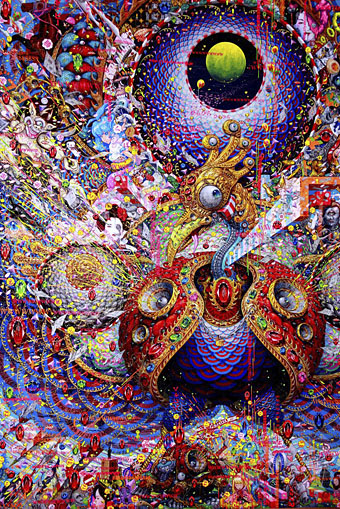
Kujaku (2018) by Yasuto Sasada.

• “The Ernst picture [Of This Men Shall Know Nothing] has also been interpreted as depicting sexual alchemy, which also ties in with much of Peter Grey’s writing on Babalon and the goddess’ connection to sexual magic and the three ‘Fs’: f(e)asting, flagellation and fucking!” Hawthonn’s Phil & Layla Legard talk to Folk Horror Revival about their superb new album, Red Goddess (of this men shall know nothing).

• South London “Psychic Circuit”: A walk with London writer Iain Sinclair inspired by cult writer Steve Moore—from Shooter’s Hill and the Shrewsbury burial mound to Charlton House then Maryon Park and the locations used in Antonioni’s Blow Up.

• Czech filmmaker Juraj Herz, director of The Cremator (1969) and Morgiana (1972), died last week. One of his later films, The Ninth Heart (1978), featured an animated title sequence by Jan Švankmajer and Eva Švankmajerova.

• The week in psychedelic visuals: Ben Marks on Bill Ham’s San Francisco light shows (a piece from 2016), and Dangerous Minds on Astralvision’s Electric Light Voyage (1979), a light show on Betamax tape.

• “From glaciers to nuclear bunkers, photographer Chloe Dewe Mathews descends into the dark heart of the Swiss mountains that inspired Mary Shelley.”

• Mix of the week: Secret Thirteen Mix 250 by Sote, and XLR8R Podcast 537 by SNTS.

When The Horses Were Shorn Of Their Hooves, new music by Dylan Carlson.

Emily Temple on Edward Gorey’s illustrated covers for literary classics.

Hidden Hydrology: Coil’s Lost Rivers studio sessions.

Tube: Minimalist YouTube search

Sukhdev Sandhu is In Wild Air

• Lost Roads (1988) by Bill Laswell | Lost Sanctum (1994) by Lull | Lost Ways (2016) by Pye Corner Audio

Richter’s “Anchor Blocks”

richters01.jpg

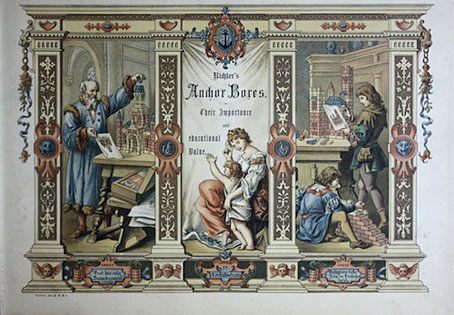
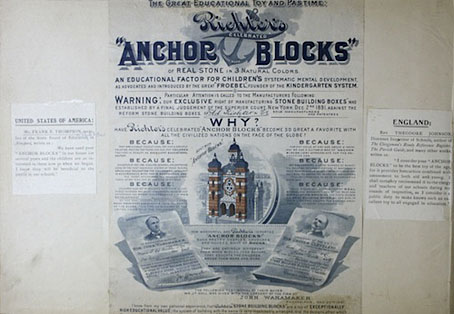
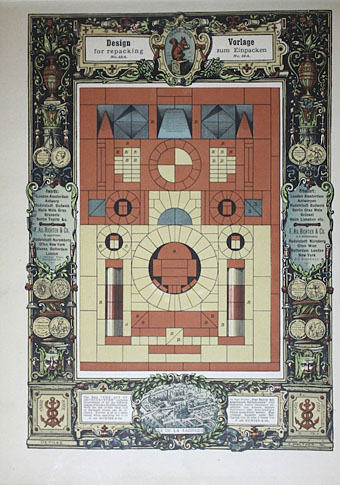
It’s safe to say that I wouldn’t have paid much attention to illustrations from a toy catalogue from 1880 if I hadn’t recognised the pictures from their fleeting appearance in Jan Švankmajer’s Jabberwocky (1971). One sequence in Švankmajer’s animated film has a battalion of toy soldiers emerging from the sleeves of a boy’s sailor suit. While the soldiers march around a table, a drawer opens and the wooden blocks within build themselves into a variety of architectural forms. Cut into this sequence are the pictures from Richter’s toy catalogues.

richters02.jpg

The latter have intrigued me ever since I spotted them in the film (the edits are typically brief) for their inadvertent Surrealism, a quality that may also have appealed to Švankmajer. Most catalogues devoted to toy blocks would display their potential constructions in a neutral space; Richter’s catalogue shows the block constructions as life-size architectural creations in otherwise realistic settings. The engraved renderings are rather fine as well, which adds to their strange atmosphere. There’s a definite Escher quality to some of the plates, in the shapes of the buildings—some of which resemble Escher’s famous fantasy constructions—and in the disparities of scale, a factor explored in this print.

richters03.jpg

The Internet Archive has two Richter catalogues here and here, both of which contain illustrations seen in Švankmajer’s film. Wikipedia has a short history of the blocks which notes that they also appear in Švankmajer’s Alice (1988).

Continue reading “Richter’s “Anchor Blocks””

Weekend links 306

midian.jpg

• The Midian Books Occulture catalogue launched this week sporting a cover that I pieced together for Midian’s Jonathan Davies. The design pastiches the look of the Process Church magazines of the early 1970s; inside there’s a haul of Process material on sale together with COUM/Throbbing Gristle ephemera (that’s Cosi Fanni Tutti on the right, as seen on her modelling business card), Kenneth Anger ephemera (that’s Bobby Beausoleil on the left) and much more.

• More occulture: Lost Envoy: The Tarot Deck of Austin Osman Spare launches on 11 May at Camden Arts Centre, Arkwright Road, London NW3 6DG, from 7–9pm. All are welcome.

• Out this week: Close To The Noise Floor – Formative UK Electronica 1975–1984: Excursions in Proto-Synth Pop, DIY Techno and Ambient Exploration.

• Mixes of the week: Spin Doctor’s All Vinyl Prince Tribute Mix, and the Rum Music Mix by Russell Cuzner.

David Gentleman’s illustrations for New Penguin Shakespeare books, 1967–1977.

• More electronica: Walberswick by Jon Brooks is now available in a digital edition.

• Blown up: Steve Rose on how cinema captured the dark heart of the swinging 60s.

• Six Quietus writers choose favourite Prince songs. Related: The A–Z of Prince

A Timeline of Slang Terms for Male Homosexuality by Jonathan Green.

Berenice Abbott’s views of New York streets then and now.

• Jan Švankmajer is crowd-funding his next film, Insects.

Laurie Anderson on the creation of O Superman.

• Blood Ceremony: The Great God Pan (2011) | Oliver Haddo (2011) | Ballad Of The Weird Sisters (2013) | Let It Come Down (2014)

Jan Švankmajer, Director

svankmajer.jpg

As I have always said, my aim is to make Surrealist documentaries. I want to show that our world is imaginative by nature, that you can look at it imaginatively. It has something that escapes the quotidian gaze. And it is possible to reveal it through the technique of animation. Animation thus becomes a sort of new alchemy.

Thus Jan Švankmajer whose production company, Athanor, is named after the furnace used by medieval alchemists. Jan Švankmajer, Director (2009) is an hour-long documentary by Martin Sulík, one of several films from Golden Sixties, a Czech television series about film directors. Švankmajer has been the subject of several documentaries following his rise to international prominence, one of which, Les Chimeres des Švankmajer (2001), may be found on the BFI’s DVD set of the complete short films. Martin Sulík’s documentary doesn’t cover as much ground as the French film—the focus is on the 1960s—but has an advantage by allowing Švankmajer to talk at length about his work. Topics include his discovery of the usefulness of animation, his approach to filmmaking (and art in general), and peripheral subjects such as the soundtrack music of Zdeněk Liška, and the activities of the Prague Surrealist group. (Via MetaFilter.)

Jan Švankmajer, Director: Part one | Part two | Part three | Part four

Previously on { feuilleton }
Don Juan, a film by Jan Švankmajer
The Pendulum, the Pit and Hope
Two sides of Liška
The Torchbearer by Václav Švankmajer