Firebirds

bilibin.jpg

Ivan Tsarevich Catching the Firebird’s Feather (1899) by Ivan Bilibin.

The firebirds are those that you find on the covers of recordings of Stravinsky’s Firebird ballet score, or on its popular distillation, The Firebird Suite. The latter has long been one of my favourite pieces of classical music, in fact it was one of the first I owned, via a cheap vinyl pairing with The Rite Of Spring that was mainly of interest for being conducted by Stravinsky himself. The cover photo showed a ballerina as the Firebird in a ballet performance, a common choice for the covers of Firebird recordings.
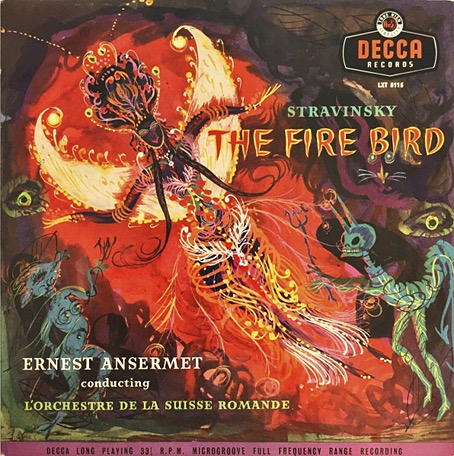
firebird-1955.jpg

No artist/designer credited, 1955.

Much better was the cover of Tomita’s Firebird album (see below) which I bought around the same time, an uncredited tapestry design which is also a better album cover than the painting used on the earlier Japanese release. Depicting the Firebird itself is the other obvious choice when designing Stravinsky albums, and the dazzling, magical bird has helped this particular opus fare better in the world of classical album design than many other recordings.
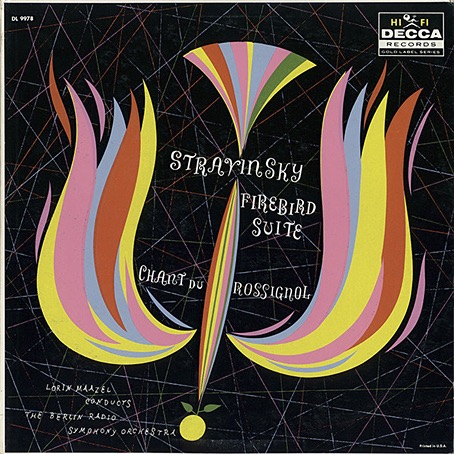
firebird-1958.jpg

No artist/designer credited, 1958.

It’s easy to cast aspersions at the designers or art directors of classical records when you see an uninspired cover design, but the format presents a number of difficulties. There’s no such thing as a fixed design for a classical album because classical albums have no fixed form. With the exception of albums devoted to a single long composition most classical albums are compilations, pairing longer works with shorter ones, often by two or more composers. This confusion of identity creates problems for the designer, as does the huge quantity of classical releases. Then there’s the problems posed by the music itself which is so often abstract; you can’t “illustrate” The Goldberg Variations. The default choice is to use a painting or a drawing or a photograph of the composer as a cover image, or a photo of the conductor or performer. The easiest assigments, as these Firebird covers demonstrate, are albums based around a composition with a well-defined theme that can be depicted visually. Nobody has ever had a problem designing a cover for recordings of Debussy’s La Mer, for example, the only difficulty is deciding what picture of the sea you want to use.
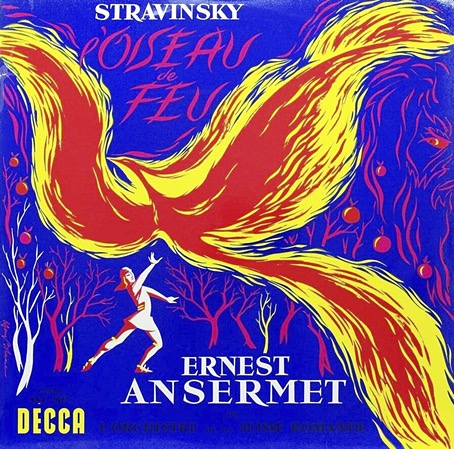
firebird-1960-1.jpg

No artist/designer credited, 1960.

I’ve never had the impression that classical devotees care very much about these issues, it’s the music and the performance they’re interested in. Record labels (or their marketing departments) do seem to pay attention to visual matters now and then, and you’ll find occasional attempts to create a new line of themed covers. (The Orphic Egg series was one of the more bizarre examples from the 1970s.) Deutsche Grammophon have a history of decent cover design but even they resort to using photos of the artist or conductor far too often. I’ve never been asked to design a classical release, and I’m not sure I’d relish the task, but the problems raised by the form fascinate me. This is a subject I’ll no doubt keep returning to.
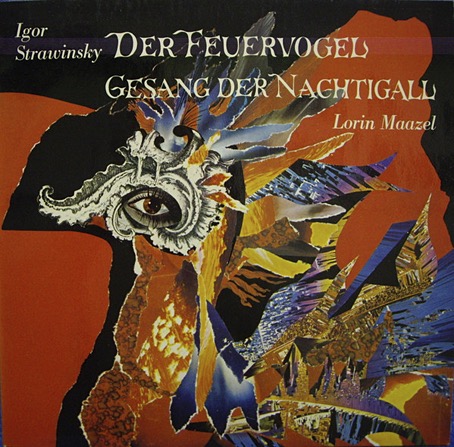
firebird-nd2.jpg

Irma Seidat, no date.

Continue reading “Firebirds”

Max Ernst album covers

ernst01.jpg

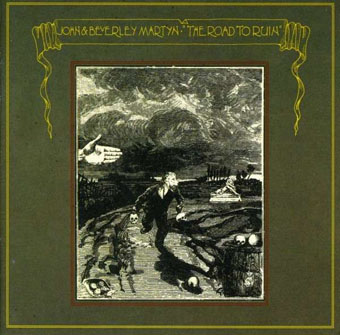
The Road To Ruin (1970) by John & Beverley Martyn. Art: Un Semaine de Bonté (1934).

Having already looked at cover art featuring the work of Salvador Dalí and René Magritte, a similar post for Max Ernst seemed inevitable. I did search for Ernst cover art after the Dalí post but at the time there were fewer examples. As usual there may be more than these since Discogs is the main search tool and they (or the albums) don’t always credit the artists. Despite having several books of Ernst’s work I’ve not been able to identify all the artwork so the Ernst-heads out there are welcome to fill in the gaps.

The Road To Ruin was John Martyn’s fourth album, and the second he recorded with wife Beverley. I’m surprised that this is the earliest example, I’d have expected a classical album or two to have predated it.

ernst02.jpg

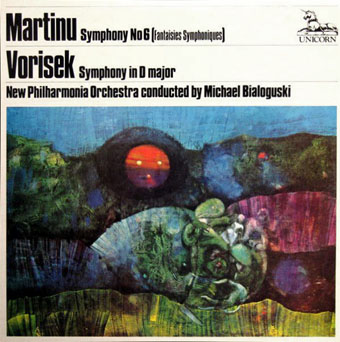
Martinu’s Symphony No. 6 (Fantaisies Symphoniques) / Vorisek’s Symphony In D Major (1971); New Philharmonia Orchestra, Michael Bialoguski. Art: Bottled Moon (1955).

ernst03.jpg

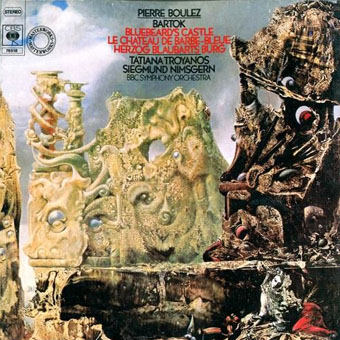
Bluebeard’s Castle by Béla Bartók (1976); Tatiana Troyanos, Siegmund Nimsgern, BBC Symphony Orchestra, Pierre Boulez. Art: The Eye of Silence (1943–44).

Bluebeard’s Castle is my favourite opera, and The Eye of Silence is my favourite Ernst painting, so this is a dream conjunction even if the match doesn’t work as well as it did for the cover of The Crystal World by JG Ballard. One to seek out.

Continue reading “Max Ernst album covers”

Weekend links 165

smart.jpg

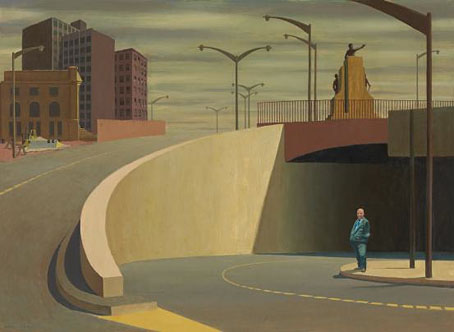
Cahill Expressway (1962) by Jeffrey Smart whose death was announced this week.

• “Russell Beale is awed by the beauty of the Roman silver Warren Cup showing men and youths making love, so startlingly erotic that the first time the British Museum was offered it in the 1950s, it turned it down flat. In 1999, when it came on the market again, the museum had to raise £1.8m to acquire it. ‘It’s just heaven, isn’t it?’ Russell Beale sighs.” Maev Kennedy on Same-Sex Desire and Gender Identity, a new exhibition at the British Museum.

• “The route to Tyburn Tree snaked through Holborn and St Giles, then went along Tyburn Road, today’s Oxford Street. It was dense with spectators.” Matthew Beaumont on the tiny memorial (Google view) for the estimated 50,000 people executed in the centre of London.

• Mixes of the Week: Bottoms Up by Staffan Lindberg for BUTT Magazine, and Electronic Ladyland, a collection of women with synths (and other instruments) from Bitch Media.

But the very thing that is valuable about diversity – the cultural and ideological clashes that it brings about – is precisely what many people fear. And that fear takes two forms. On the one hand you have the little Englander sentiment: immigration is undermining the national fabric, eroding our sense of British or Englishness, turning our cities into little Lahores or mini-Kingstons. And on the other you have the multicultural argument: that diversity is good, but it has to be policed to minimise the clashes and conflicts and frictions that diversity brings in its wake. And so we have to restrain speech, and police the giving of offence.

Kenan Malik on The Pleasures of Pluralism, The Pain of Offence.

L’Empire des Lumières is a great title for Anne Billson’s blog about Belgium. Tram-wire covered streets are one of my favourite things.

The Outer Church, 28 musical artists with an uncanny temperament collected by Joseph Stannard for Front & Follow.

His Heavy Heart, a film by Alan Moore & Mitch Jenkins, is looking for Kickstarter funding.

• In 1997 Quentin Crisp wrote about “Ten Wonderful Gangster Movies” for Neon magazine.

Raymond Chandler’s The Big Sleep redesigned for the Penguin Design Award, 2013.

• Out on DVD/Blu-Ray this month: The Curtis Harrington Short Film Collection.

A billion-pixel panoramic view of the planet Mars from the Curiosity Rover.

• In the TLS: Robert Craft on Stravinsky and The Rite of Spring.

Typophonic: Album cover typography.

The Owl Theremin is a thing.

LSD ABC

Spring Rounds From The Rite Of Spring (1975) by Alice Coltrane | Revenge Of The Black Regent (1999) by Add N To (X) | Sore Ga Afrirampo (2010) by Afrirampo

The Rite of Spring and The Red Shoes

redshoes1.jpg

The Red Shoes: Moira Shearer and Léonide Massine.

Emeric is often too easily accused of basing the principal male character of The Red Shoes on Serge Diaghilev, to which he replies: “There is something of Diaghilev, something of Alex Korda, something of Michael, and quite a little bit of me.”

Michael Powell, A Life in Movies (1986)

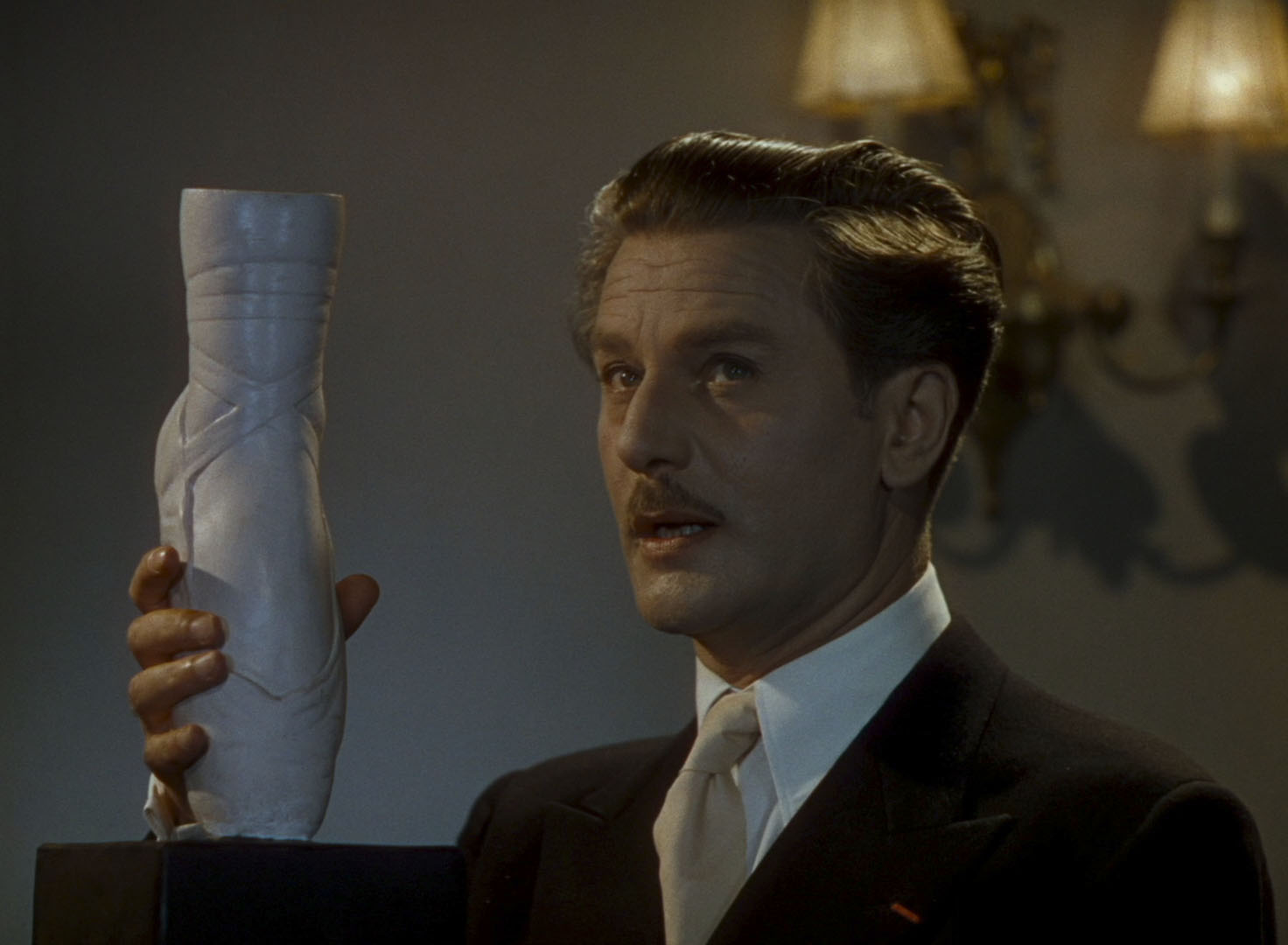
Despite Emeric Pressburger’s qualificatory comments, there’s a lot more of the Ballets Russes in Powell and Pressburger’s film of The Red Shoes (1948) than first meets the eye. Or so I discovered, since I’d known about the film via my ballet-obsessed mother for years before I’d even heard of Diaghilev or Stravinsky. The most obvious connection is the presence of Léonide Massine who took the leading male roles in Diaghilev’s company following the departure of Nijinsky. He also choreographed Parade, the ballet which featured an Erik Satie score and designs by Picasso. The fraught relationship between Diaghilev and Nijinsky forms the heart of The Red Shoes: Anton Walbrook’s impresario, Boris Lermontov, is the Diaghilev figure while the brilliant dancer who obsesses him, and for whom he creates the ballet of The Red Shoes, is Moira Shearer as Victoria Page. That the dancer happens to be a woman is a detail which makes the film “secretly gay”, as Tony Rayns once put it. Diaghilev and Nijinsky were lovers, and fell out when Nijinsky married; in The Red Shoes Lermontov demands that Vicky choose between a life of art or a life of marriage to composer Julian Craster (Marius Goring). She chooses love but ends up drawn back to art, with tragic consequences that mirror the Hans Christian Andersen story. That story, of course, ends with a young woman dancing herself to death after donning the fatal shoes, a dénouement that’s unavoidably reminiscent of The Rite of Spring.

redshoes2.jpg

Anton Walbrook as Lermontov.

Lermontov: Why do you want to dance?

Vicky: Why do you want to live?

Other parallels may be found if you look for them, notably the figure of Julian Craster who comes to Lermontov as a young and unknown composer just as Stravinsky did with Diaghilev. Craster’s music isn’t as radical as Stravinsky but The Red Shoes was already giving the audience of 1948 enough unapologetic Art with a capital “A” without dosing them with twelve-tone serialism. The film aims for the same combination of the arts as that achieved by Diaghilev, especially in the long and increasingly fantastic ballet sequence. This was another of Powell’s shots at what he called “a composed film” in which dramaturgy and music work to create something unique. The Red Shoes is a film that’s deadly serious about the importance of art, a rare thing in a medium which is so often at the mercy of Philistines. In the past I’ve tended to favour other Powell and Pressburger films, probably because I’ve taken The Red Shoes for granted for so long. But the more I watch The Red Shoes the more it seems their greatest film, even without this wonderful train of associations. The recent restoration is out now on Blu-ray, and it looks astonishing for a film that’s over sixty years old.

Seeing as this week has been all about The Rite of Spring, here’s a few more centenary links:

Stravinsky’s The Rite of Spring, Visualized in a Computer Animation for its 100th Anniversary
• George Benjamin on How Stravinsky’s Rite of Spring has shaped 100 years of music
Strange Flowers visits the Théâtre des Champs-Elysées

Previously on { feuilleton }
The Rite of Spring, 2001
The Rite of Spring, 1970
The Rite of Spring reconstructed

The Rite of Spring, 2001

preljocaj1.jpg

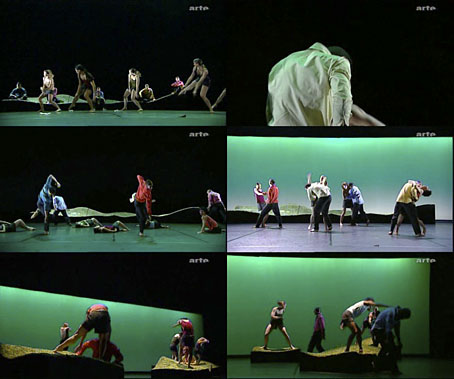
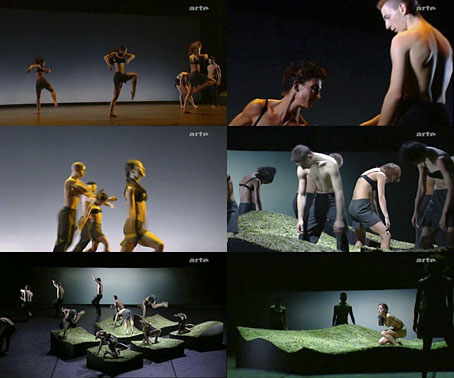
Now this one is fantastic… Angelin Preljoçaj’s modern dance interpretation is wildly energetic, and, after a century of the music becoming increasingly familiar, manages to return some of the shock value to the ballet. Preljoçaj dispenses with symbolism and brings the sexual nature of the material to the fore, with recurrent instances of coercion that will no doubt prove intolerable for some viewers. All one can say to that is that this is a ballet which has always been about primitive erotic rituals which culminate in a chosen sacrifice being forced to dance herself to death. (The third part of the ballet—Jeu du rapt—was bluntly translated on a recording I used to own as “Game of Rape”.) For the finale of Preljoçaj’s version the dancer (uncredited, I’m afraid) performs naked. The televised performance benefits a great deal by having a score courtesy of Daniel Barenboim and the Chicago Symphony Orchestra thundering away in stereo. It’s a thrilling piece which shows that a century on The Rite of Spring has lost none of its power when carefully staged. Kudos to Ubuweb for turning up the goods once again.

preljocaj2.jpg

Previously on { feuilleton }
The Rite of Spring, 1970
The Rite of Spring reconstructed