
Powell’s Bluebeard

bluebeard1.jpg

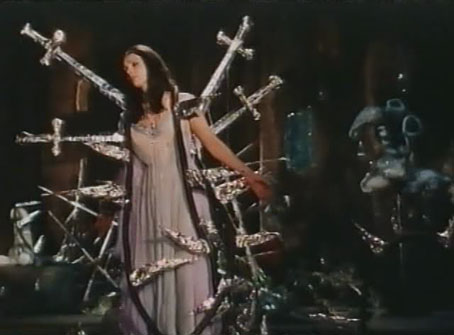
The subject of yesterday’s post, The Tales of Hoffmann, was the closest Michael Powell came to realising his concept of the “composed film”, a work intended to combine performance, music, lighting and set design thereby creating something which was unique to cinema. The central ballet sequence in The Red Shoes is another example of this, and Powell & Pressburger had plans to follow Hoffmann with similar works, including something based on The Odyssey that would have had contributions from Igor Stravinsky and Dylan Thomas. Their plans didn’t work out, unfortunately, Hoffmann was less successful than was hoped and the Archers partnership was eventually reduced to making dull films about the Second World War until P&P went their separate ways. The scandal of Peeping Tom in 1960 finished Powell’s career as a filmmaker in Britain, but he managed to return to the composed film concept in 1963 when production designer Hein Heckroth asked him to direct a production of the Bartók opera Bluebeard’s Castle for German television. Heckroth was responsible for the distinctive character of the later Archers films, including The Red Shoes and Tales of Hoffmann, but was working here with greatly reduced resources. Being a great Bartók enthusiast as well as a Powell aficionado it’s long been a source of frustration for me that this hour-long film is one of the least visible from Powell’s career. To date, the stills shown here are about the only visuals one can find.

bluebeard2.jpg

Bluebeard: Norman Foster.

Bluebeard’s Castle was Bartók’s only opera, a tremendous work and a lot easier to digest than some being a one-act piece for two singers: bass (Bluebeard) and soprano (Judith, his wife-to-be). The fairy tale of the murderous husband is turned into a psychodrama with Judith’s successive opening of the castle’s seven doors revealing more than she wants to know about her suitor’s personality. The libretto by Béla Balázs drops the last-minute rescue of the heroine by her brothers for a darker conclusion. The simple storyline and pronounced symbolism—the doors are often given different colours, while the rooms to which they lead each have a symbolic decor and import—lends itself to a variety of interpretations. Needless to say I’d love to see how Heckroth and Powell presented the drama. To whet the appetite further, one of the P&P sites has this account of a recent screening.
bluebeard3.jpg

Judith: Ana Raquel Sartre.

There are many other filmed versions of this opera, of course, and YouTube has the usual motley selection chopped into opus-ruining ten-minute segments. The BBC screened a fantastically gloomy version in 1988 by Leslie Megahey, director of many fine TV documentaries including the major Orson Welles edition of Arena in 1982 and a chilling adaptation of Sheridan Le Fanu’s Schalcken the Painter. His Bluebeard has been released on DVD in the US, and YouTube has an extract here.

Previously on { feuilleton }
• The Tale of Giulietta
• Diaghilev and the Ballets Russes
• Béla Bartók caricatured
Diaghilev and the Ballets Russes

diaghilev1.jpg

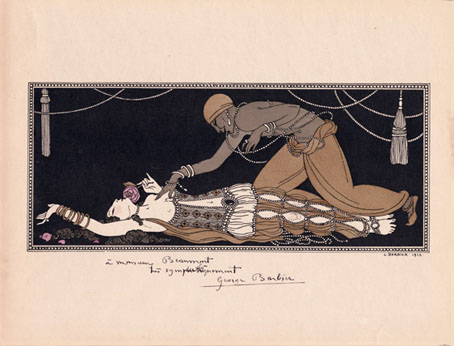
Ida Rubinstein as Zobeide and Vaslav Nijinsky as the Golden Slave in Schéhérazade (1913) by George Barbier.

Another great exhibition at the V&A, London, Diaghilev and the Ballets Russes gathers a wealth of costumes, stage designs, photographs and ephemera—including some of Stravinsky’s manuscripts—to present a history of the legendary ballet company and their visionary impresario. For those who can’t get to London the museum website shows some of the items which will be on display, and there’s also a blog about the installing of the exhibition. The enormous frontcloth from 1924 based on Picasso’s Two Women Running on the Beach received a flurry of attention in the press here but my own attention was caught by the picture of Natalia Goncharova‘s even more enormous backcloth for The Firebird. The exhibition runs to January 9, 2011.

diaghilev2.jpg

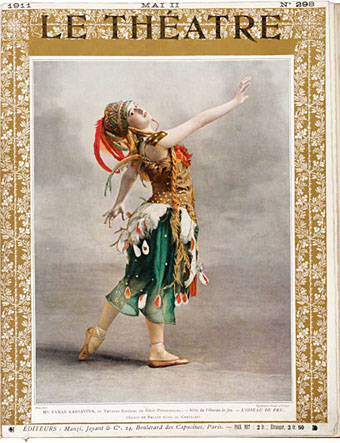
Cover of Le Théatre showing Tamara Karsavina in costume as the Firebird, May 1911.

While we’re on the subject, a new biography of the impresario, Diaghilev: A Life by Sjeng Scheijen, was reviewed last week in the New York Times:

Diaghilev loved beautiful young men, and at a time when the fashion in ballet was to exchange patronage for sex, his company provided a bounty. Scheijen dexterously plays his sources against one another to examine the erotic and professional dynamics between Diaghilev and his stars.

For a fictional (and necessarily heterosexual) account of those erotic and professional dynamics, I recommend Michael Powell & Emeric Pressburger’s The Red Shoes (1948) which not only has a central character based on Diaghilev but includes among the cast of real dancers Léonide Massine, dancer and principal choreographer of the Ballets Russes from 1915 to 1921.

See also:
• Russian Ballet History | An archive and documentary site.

Previously on { feuilleton }
• Pamela Colman Smith’s Russian Ballet
• The art of Ivan Bilibin, 1876–1942
• Jack Cardiff, 1914–2009
• Magic carpet ride
• Le Sacre du Printemps
• Images of Nijinsky

Alex Steinweiss: creator of the album cover

steinweiss2.jpg

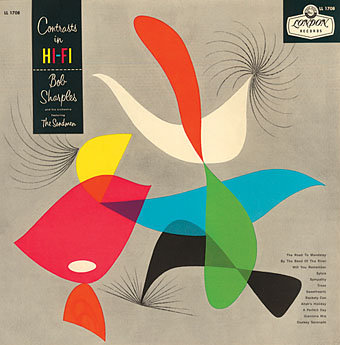
Contrasts in Hi-Fi by Bob Sharples.

A Tribute to Alex Steinweiss
The Creator of the Album Cover

Robert Berman Gallery announces an exhibition of Alex Steinwiss. Original album covers, paintings, and collages by Steinweiss, and special tribute by selected artists. Co-curated by Kevin Reagan and Greg Escalante.

In 1939, a 23 year-old graphic designer revolutionized the music industry. No longer would records come in plain brown wrappers. As Art Director at Columbia Records, Steinweiss created the ‘album package.’ His idea was to create a visual to complement the musical. It was an instant success, and spawned an entire new field of illustration and design: Album Cover Art. Steinweiss was the king of the genre; his covers are still regarded as icons.In his four decade career, Steinweiss created album covers for musical luminaries such as Louis Armstrong, Duke Ellington, Igor Stravinsky and Benny Goodman.

steinweiss1.jpg

The Miraculous Mandarin (circa 1977).

The Steinweiss exhibition will feature 50 of his original cover designs, plus 50 original ‘tribute’ works, created specifically for this show. Artists that are honoring Steinweiss in the show include: Clive Barker, Bill Barminski, Ron English, Mick Haggerty, Raymond Pettibon, Shag, and Glenn Wexler. The featured artists have created album covers for a wide range of musicians, including Black Flag, Dixie Chicks, Goo Goo Dolls, Supertramp, and Rob Zombie.

“Steinweiss is 90 years old this year; this tribute is long over-due. The art community is excited to have a chance to pay homage to Alex’s unprecedented contribution to album cover art,” says Kevin Reagan, three time GRAMMY winning Art Director.

“It’s amazing to discover this one man, this un-sung hero, who is responsible for inventing the album. Steinweiss should be a household name,” says Greg Escalante, curator of Juxtapoz, and co-founder of Copro-Nason Gallery.

“The opportunity to highlight ‘the art of music’ is exciting. You have the energy of two different genres, and their combination is explosive,” says gallery owner Robert Berman. “Just plain design didn’t mean a damn thing,” Steinweiss says. You had to know music. I had to find a way to bring out the beauty of the music and the story.” (dwell, 10/07)

Alex Steinweiss lives in Sarasota, Florida, where he continues to design and paint.

A Tribute to Alex Steinweiss
Gala Opening: January 19th
Show runs through February 12th, 2008

Robert Berman Gallery
Bergamot Station Arts Center
2525 Michigan Avenue, C2
Santa Monica, CA 90404

• Alex Steinweiss at the Art Director’s Club Hall of Fame
• For the Record: The Life and Work of Alex Steinweiss at Amazon
• Alex Steinweiss at Soundfountain

Elsewhere on { feuilleton }
• The album covers archive