Weekend links 720

moreau.jpg

The Poet and the Siren (1893) by Gustave Moreau.

• “Some books become talismans. Because they are strange, wildly different to the common run of literature; because they are scarce, and only a few precious copies are known to exist; because, perhaps, they liberate by transgressing the moral limits of the day; because their authors are lonely, elusive visionaries; because, sometimes, there is an inexplicable glamour about the book, so that its readers seem to be lured into a preternatural reverie. This book possesses all those attributes.” Mark Valentine in an introduction he wrote for a 1997 reprint of The Book of Jade (1901) by David Park Barnitz. The book’s author was an American writer who died at the age of 23 after publishing this single volume, a collection of poetry inspired by his favourite Decadent writers. Praise from HP Lovecraft, Clark Ashton Smith and Thomas Ligotti has since helped maintain the book’s reputation. The Book of Jade turned up recently at Standard Ebooks, the home of free, high-quality, public-domain texts. Also the home of an increasingly eclectic list of publications.

• At n+1: The Dam and the Bomb by Walker Mimms, a fascinating essay about the entangling of Cormac McCarthy’s personal history with his novels which makes a few connections I didn’t expect to see. Also a reminder that I’ve yet to read McCarthy’s last two books. Soon…

• The latest installation from teamLab is Resonating Life which Continues to Stand, an avenue of illuminated eggs on the Hong Kong waterfront.

• At The Wire: Symphony of sirens: an interview with Aura Satz, David Toop, Elaine Mitchener, Evelyn Glennie and Raven Chacon.

• At Unquiet Things: The Art of Darkness presents The Sleeper May Awaken: Stephen Mackey’s Unrestful Realms.

• RIP Marian Zazeela. There’s a page here with a selection of her beautiful calligraphic poster designs.

• At Spoon & Tamago: Tomona Matsukawa’s realistic paintings reconstruct fragments of everyday life.

• At Public Domain Review: Thom Sliwowski on The Defenestrations of Prague (1419–1997).

Trinity (2024), a short film by Thomas Blanchard. There’s a lot more at his YouTube channel.

• At Dennis Cooper’s: Lotte Reiniger’s Day.

Sirens (1984) by Michael Stearns | Sirens (1988) by Daniel Lanois & Brian Eno | Siren Song (2009) by Bat For Lashes

Weekend links 719

rimmington.jpg

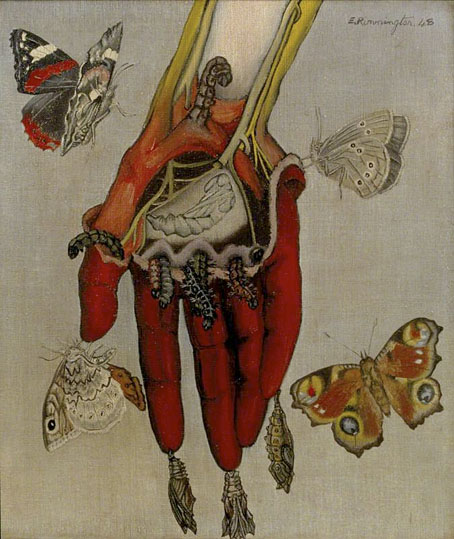
The Decoy (1948) by Edith Rimmington.

• “Among other things, [Dalí’s] storyboards involved [Ingrid] Bergman turning into a statue that would then break up into ants.” Tim Jonze talks to film scholar John Russell Taylor about the storyboards for Alfred Hitchcock’s films, including the ones for Spellbound which Taylor found in a bric-a-brac sale.

• “Of all the pop acts that proliferated in the early 80s, it was Soft Cell who retained punk’s sharp, provocative edges.” Matthew Lindsay on 40 years of Soft Cell’s This Last Night In Sodom.

• Coming soon from White Rabbit books: Futuromania: Electronic Dreams, Desiring Machines and Tomorrow’s Music Today by Simon Reynolds.

Anathema to many philosophical systems, or perhaps philosophy itself, Lovecraft’s philosophical project fundamentally holds that contemplations of higher reality or the nature of things can never be fully realised. Ultimately, the search for knowledge does not constitute some telos, some purpose, for humankind, but rather leads to the violent dissolution of the self. Higher reality is that which the limited human psyche can never fully comprehend.

Sam Woodward on the cosmic philosophy of HP Lovecraft

• At Public Domain Review: Grotesqueries at Gethsemane: Marcus Gheeraerts’ Passio Verbigenae (c.1580).

• “Here is a remarkable form of popular heraldry.” Mark Valentine on the mystique of old inn signs.

• At Bandcamp: Brad Sanders on where to begin with Lustmord’s cosmic ambient.

• New music: Eleven Fugues For Sodium Pentothal by Adam Wiltzie.

• At Aquarium Drunkard: Jason P. Woodbury talks to Roger Eno.

Gomorrha (1973) by Can | Sodom (1978) by Can | Spellbound (1981) by Siouxsie And The Banshees

Weekend links 715

hugo.jpg

Portrait d’Arthur Rimbaud (1933) by Valentine Hugo.

• Among the new titles at Standard Ebooks, the home of free, high-quality, public-domain texts: At the Mountains of Madness by HP Lovecraft.

Retro-Forteana is “Andrew May’s Forteana Blog, focusing on the weirder fringes of history (and other old-fashioned stuff)”.

• Mixes of the week Bill Laswell Mix No. 7: The Return of Celluloid by Voice of Cassandre, and Isolatedmix 126 by Saphileaum.

• At Bajo el Signo de Libra: The second part of a look at photographs by Herbert List of Italians and Italian life.

• New music: Worship: Bernard Herrmann Tribute by The Lord, and Cursory Asperses by Celer.

• At Wormwoodiana: Mark Valentine on the joy of obscure journals.

• At Dennis Cooper’s: Paul Clipson Day.

Persher’s favourite music.

At The Mountains Of Madness (1968) by HP Lovecraft | Mountains Of The Moon (2002) by Jah Wobble And Temple Of Sound | Mountains Crave (2012) by Anna von Hausswolff

Bugs Bunny meets Fantômas in the Aquarium of Love

porky.jpg

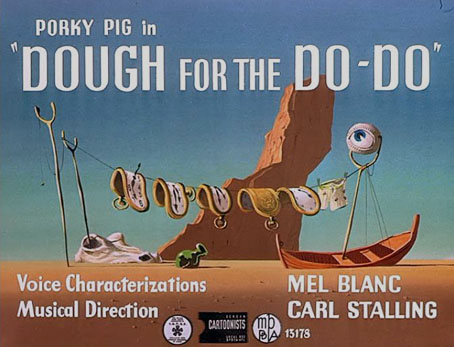
Pop Surrealism, 1949.

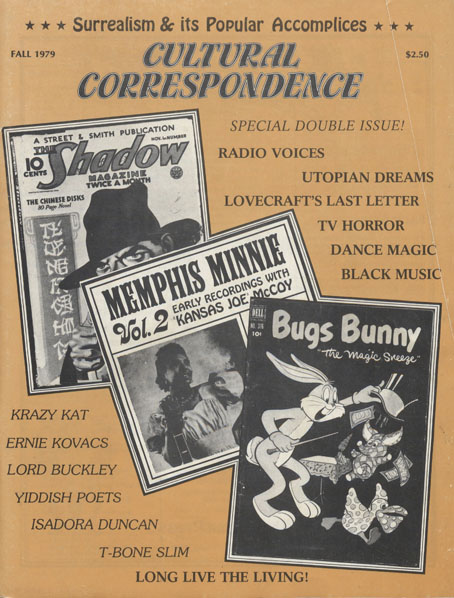
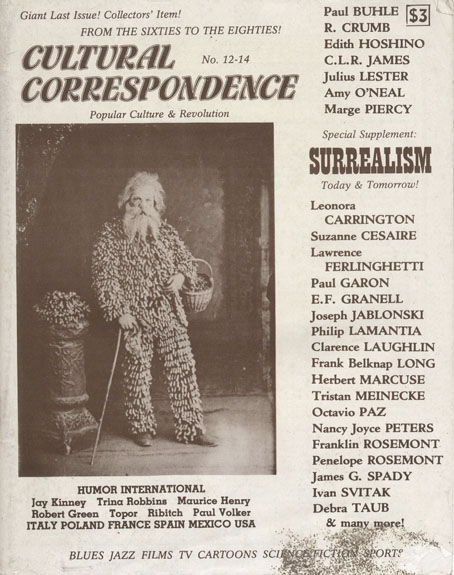
More from the Chicago Surrealists. The discovery of the first item comes via a comment from Paul (thanks!) in the post about Arsenal magazine which directed my attention to Monoskop where there’s another publication, Cultural Correspondence, related to the Chicago Surrealist Group. Cultural Correspondence was a US journal which ran for 14 issues from 1975 to 1981. Searching around for more information revealed an archive of the entire run at Brown University:

A journal born from the collapse of the New Left and hopes for a new beginning of a social movement, but also of left-wing thinking about culture, Cultural Correspondence was in many ways a unique publication.

Its founding editors, Paul Buhle and Dave Wagner, had both served on the editorial board of the journal Radical America, founded in 1967. Buhle had been the founder of that bi-monthly journal, creating it out of a network of activist-intellectuals in the Students for a Democratic Society; Wagner was officially “Poetry Editor,” but after its shift from Madison, Wisconsin, to the Boston area in 1971, he became a member of an expanded board of editors. Together they taught at the Cambridge-Goddard Graduate School, then Wagner left for Europe and Buhle left the editorial board, moving to Yonkers. An exchange of letters from these locations spawned the notion of a new publication. It was to be the first radical magazine put out by members of a generation that had since childhood watched television and appreciated as well as enjoyed a considerable portion of it, also films and “pulp” literature.

cc1.jpg

The issue at Monoskop was the penultimate one (numbered 10/11), guest-edited by Franklin Rosemont who took the opportunity to give the readers an exploration of “Surrealism and Its Popular Accomplices”. The final issue (numbered 12–14) continued the theme with a Surrealist supplement.

cc2.jpg

Even without the Surrealist content, Cultural Correspondence is an interesting magazine, closer to the era’s underground magazines than an arts publication, especially in its attention to the underground cartoonists. Given my general antipathy to arts magazines I find this very much in its favour. The Rosemont-edited issue shows a different side of the Chicago group when compared to the more pugnacious Arsenal, with no sign of the scowling ideologues that fill the pages of the Surrealist journal. HP Lovecraft turns up once again (musings about Surrealism from his very last letter), together with Rosemont’s beloved blues musicians. Rosemont also reprints the short essay about pulp fiction by Robert Allerton Parker, Explorers of the Pluriverse, which appeared in the catalogue for First Papers of Surrealism.

marvelous.jpg

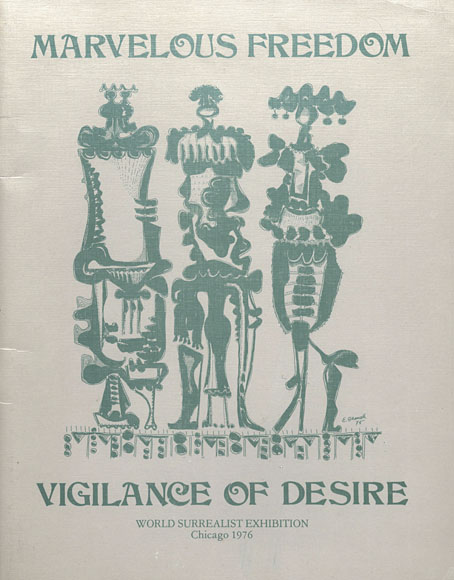
Meanwhile, at the Internet Archive there’s Marvellous Freedom, Vigilance of Desire, the exhibition programme for the World Surrealist Exhibition which was staged in Chicago in 1976. Penelope Rosemont refers to this event several times in Surrealist Women so it’s great to be able to see some of the artworks which are only described in brief in the book. Many exhibition catalogues are mere lists of pictures with an essay or two but this one looks like it took the First Papers of Surrealism catalogue as its model, being filled with essays, poems, small illustrations and so on. The early Surrealist exhibitions were never satisfied with scattering artworks around an otherwise empty room, several of them extended their themes into the exhibition space in early manifestations of the installation or environment concept. For the Chicago event the visitor passed through “Sleepwalker’s Hill” into the “Corridor of the Forgotten Future”, which led to the heart of the exhibition and eleven “Domains of Surrealist Vigilance” dedicated to significant figures: Lewis Carroll’s Alice, the Duchess of Towers (from one of Andre Bréton’s favourite films, Peter Ibbetson), Sade’s Juliette, Harpo Marx, T-Bone Slim, Peetie Wheatstraw, Robin Hood, Bugs Bunny, Alfred Jarry’s Doctor Faustroll, Melmoth the Wanderer, and the Surrealists’ favourite master criminal, Fantômas. The imperishable wise-cracking rabbit had already appeared in the pages of Arsenal, as well as on the cover of the first issue of Cultural Correspondence, but this is where he becomes a genuine Surrealist icon.

Elsewhere on { feuilleton }
The Surrealism archive

Previously on { feuilleton }
Arsenal: Surrealist Subversion

Arsenal: Surrealist Subversion

arsenal1.jpg

It’s the “S” word again. I said at the beginning of this month that I was looking forward to seeing where this interest led, and here we are. My recent reading has included Penelope Rosemont’s Surrealist Women (1998), a comprehensive study that I’d dipped into in the past but hadn’t gone through properly until now. In the section devoted to activities since the 1960s Rosemont mentions a magazine, Arsenal: Surrealist Subversion, which she produced with her husband, Franklin Rosemont, as part of their work with the Chicago Surrealist Group. Arsenal had more of an erratic schedule than most magazines, managing four issues that appeared in 1970, 1973, 1976 and 1989. I really didn’t expect there to be copies of such an obscure publication available anywhere but, once again, the invaluable Internet Archive has scans of the first three issues.

arsenal2.jpg

Arsenal proves to be a curious mix of the kind of material you’d expect from a Surrealist publication—poetry, essays, drawings, collages, significant quotes—together with chunks of Marxist politics and Freudian business that seem to have strayed in from another magazine. The latter material isn’t so unwarranted, being a reflection of André Breton’s original concerns, but committed Marxists of whatever stripe have never had much time for Surrealist art-creation and game-playing, while Freud himself was nonplussed by Breton’s attempts to interest him in the activities of the Parisian Surrealists. Breton casts a long shadow here; the Rosemonts had met him in Paris in the mid-60s, and many of the articles (also their combative attitudes) have a Bretonian cast.

arsenal3.jpg

Elsewhere, Arsenal breaks new ground with a Surrealist appraisal of blues musicians, music being a form that Breton and Louis Aragon had dismissed in the 1920s as “too confusing” for incorporation into the Surrealist project. The magazine also reprints a couple of comic strips, including a page of Little Nemo in Slumberland which may be the first acknowledgement from inside Surrealism of Winsor McCay’s dream-worlds as Surrealist precursors. And after posting Breton’s musings about “The Great Transparent Ones” these mysterious beings surface once again. Not only the Great Transparent Ones but also HP Lovecraft’s Great Old Ones in a piece by Franklin Rosemont about the Cthulhu Mythos. Rosemont draws attention to the obvious similarity between the names of Breton and Lovecraft’s beings, while also noting Lovecraft’s prowess as a transcriber of dreams. In doing so he complains about Lovecraft circumscribing his imagination by resorting to the story structures of the pulp magazines. Lovecraft was never a member of any avant-garde literary circle, however, unlike Clark Ashton Smith, who also receives further mention in these pages; if it wasn’t for Weird Tales we never would have heard of HP Lovecraft and there wouldn’t be a Cthulhu Mythos. This fault-picking is typical of many other pieces in the magazine, the book reviews in particular where a kind of petulant bad temper is the predominant tone. You probably can’t expect much else from a magazine that names itself after a store of weapons but the cumulative effect makes it seem that the road to the Marvellous must be paved with razor blades and broken glass. To their credit, the editors did print in the third issue some of the negative reviews they received for the previous two, including the inevitable dismissals from hardline Communists. Despite all this I’d still like to see how things developed (or came to an end) in the fourth and final issue.

• Further reading: I Could Dream In French: An Interview With Penelope Rosemont.

Elsewhere on { feuilleton }
The Surrealism archive

Previously on { feuilleton }
First Papers of Surrealism
The original Cabaret Voltaire
View: The Modern Magazine