The Return of the Sorcerer

sorcerer1.jpg

The story’s first appearance in Strange Tales of Mystery and Terror, September 1931. No illustrator credited.

Rod Serling’s Night Gallery is a series I’d have happily watched if one of the UK channels had rebroadcast it in the 1980s, the way that Channel 4 did with the original Twilight Zone. This weekend I watched for the first time the opening episode of Night Gallery‘s third and final season, an adaptation by Halsted Welles of Clark Ashton Smith’s The Return of the Sorcerer. Smith is a writer whose works are still mostly neglected by film and television but he was in good company in Night Gallery, a series which featured adaptations of stories by a number of fellow Weird Tales writers including HP Lovecraft, Fritz Leiber and Robert Bloch. The story is one of Smith’s modern-day horror tales in which a poverty-stricken translator is offered a lucrative position at an old and sinister house, a place where a fearful occultist requires translations of an ancient volume. The Arabic text turns out to be passages from an early edition of everybody’s favourite forbidden tome, the Necronomicon, and Smith’s story, which was published in Strange Tales of Mystery and Terror in 1931, is the first outside Lovecraft’s own to mention the book, thus beginning the expansion of the Cthulhu Mythos by other hands.
sorcerer2.jpg

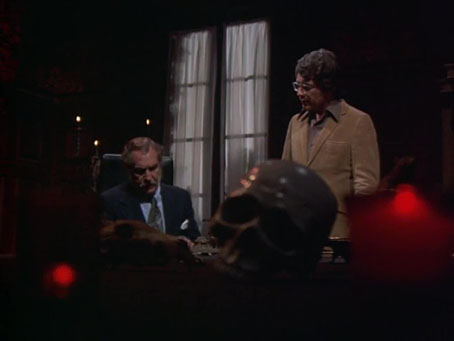
The Night Gallery adaptation was broadcast in 1972. Unlike the first two seasons, where episodes ran for an hour, the third season reduced the running time to under 30 minutes which doesn’t give director Jeannot Szwarc (credited as Jean Szwarc) any time to build up the suspense, if he was capable of such a thing. If you’ve ever seen any of Swarc’s feature films you know not to raise your expectations. As a compensation for the absense of atmosphere we get some striking set designs and a decent cast. The fearful magus, John Carnby, is played by Vincent Price, encountering the Necronomicon for the second time in his career after he’d earlier used the book to summon an eldritch monstrosity in Roger Corman’s The Haunted Palace. Bill Bixby plays the wary translator, while Patricia Sterling is Carnby’s toad-loving partner in Satanism, an addition to the story by Halstead Welles, whose presence adds an extra dimension to the proceedings. The episode could never be considered a lost classic but I enjoy seeing stories by the Weird Tales writers making their first infiltrations into the wider culture. This one is worth watching for Vincent Price and the magical decor alone. I think I ought to go looking for more Night Gallery episodes.
sorcerer3.jpg

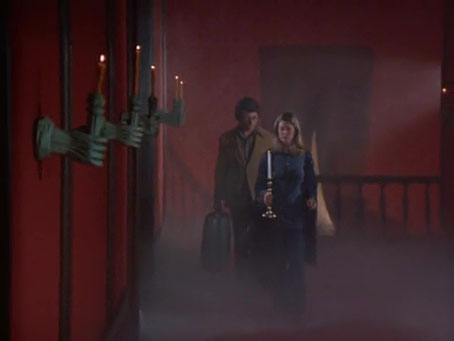
More of those Cocteau hands-through-the-wall. Bixby’s character doesn’t seem very perturbed that the scarlet hall is filled with mysterious vapours.
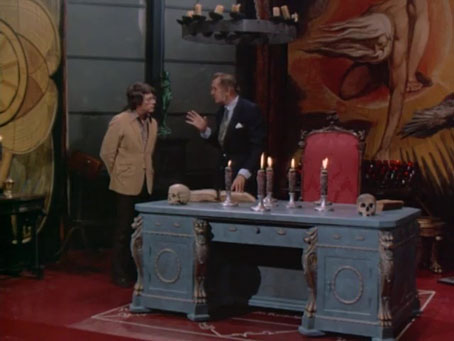
sorcerer4.jpg

Mystical decor: on the left, Frieda Harris’s Ace of Discs from the Thoth Tarot deck; on the right, The Ancient of Days by William Blake.
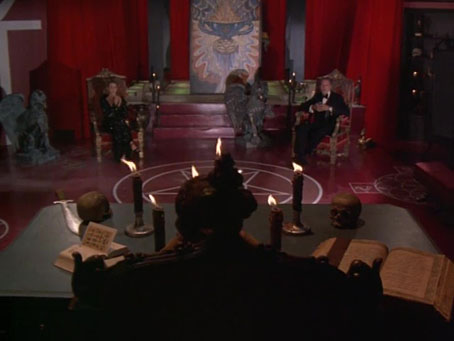
sorcerer5.jpg

Mystical/Satanic decor: the painting in the background is Frieda Harris’s Ace of Cups from the Thoth Tarot deck.

Previously on { feuilleton }
The Cthulhu Mythos in the pulps
Illustrating Zothique
The Plutonian Drug
More trip texts
Yuggoth details
The Garden of Adompha
The City of the Singing Flame
Haschisch Hallucinations by HE Gowers
Odes and Sonnets by Clark Ashton Smith
Clark Ashton Smith book covers
In the Mad Mountains

madcover.jpg

Cover design by Elizabeth Story. Cover art by Mike Mignola.

The subtitle tells you everything you need to know about this new collection of Joe R. Lansdale stories from Tachyon. I designed the interior of the book, less floridly than some of my previous designs for Tachyon, and a little more abstractly than I’d usually do for a title such as this. All of the stories have been published before, and since I’d illustrated one of them (for Lovecraft’s Monsters) I had vague hopes of incorporating my earlier illustration while providing new ones for the rest of the stories. This proved impossible, however; I was working on the layout while still finishing the design for The Bumper Book of Magic so didn’t have the time to do seven more drawings. I’ll post the illustration here anyway.

bleeding.jpg

The Bleeding Shadow is a great story, a low-rent detective tale set in the 1920s in which the predicament from The Music of Erich Zann—violinist has to keep playing his instrument in order to keep something terrible at bay—is recast with shellac 78s and a blues guitarist. Among the other pieces there’s a story that manages to successfully contrive a meeting between Huckleberry Finn, Brer Rabbit and the Cthulhu Mythos; and the final story which gives the collection its name, wherein the setting of Lovecraft’s Antarctic epic becomes a Sargasso-like landscape of shipwrecks, lost planes and horrors great and small. I especially enjoyed The Crawling Sky, a story of the Old Weird West featuring a Solomon Kane-like itinerant preacher, the Reverend Jebidiah Mercer. Lansdale’s grotesque humour is to the fore in this one. I’d like to see the Reverend given a collection of his own someday.

mad1.jpg

mad2.jpg

mad3.jpg

Elsewhere on { feuilleton }
The Lovecraft archive

Previously on { feuilleton }
Things Get Ugly
Lovecraft’s Monsters

Existence no longer exists

kitten1.jpg

Yesterday was HP Lovecraft’s birthday so here’s some cosmic horror of a sort. It’s debatable whether a narrative can still be classed as horror when the constituent elements are rarified and abstracted to this degree…maybe weird SF would be better? Or theory fiction in the form of 5–10 minute YouTube videos? So far there are four of these things credited to “Unorthodox Kitten”, the first one being a kind of introductory chapter which includes algebra in its explication; by the time we reach the fourth chapter we’re told that “Math never existed” although the links on some of the notes take you to papers which contain copious equations, including an argument that returns us to the first video…

What does it all mean? My introduction to the quartet was via Scotto Moore’s newsletter in which Moore suggests that the videos may be a part of some ARG, or Alternate Reality Game. One for recreational mathematicians or quantum physicists, no doubt. This is certainly possible given the links to Fermat’s Library, but I’m happy to take the things as they are, mysterious fragments freighted with dire implication. I imagine Eugene Thacker would approve.


Infinity, Singularity and The Rapture (10:10)

kitten2.jpg

The OHR EIN SOF
The painters, who are the product of a new cycle of fragmentation, despite their almost divine ability to paint everything at will, are merely lifeless hypothetical concepts compared to their predecessors from the previous cycle. These predecessors perceive them as weeds that must be eliminated, not out of fear, but as a principle to maintain nonexistential silence.
the war of the iterative gODS has begun.
the incomplete jump occurred.
IT must be stopped, iT can’t be stopped,
only the INFINITE filling all existence,
there is only the iNFINITE filling all canvas,
artificial lethal sEA with an infinite IRON,
trying to see the INFINITE through yOu,
no light, just colors.
iT came but YOU were not here when iT arrived,
iT gracefully retreats, yet the essence remains unchanged.
Can existence exist without nonexistence?
Are yOU afraid of non-existence, now? :)


Everything is happening at the same time (5:44)

kitten3.jpg

the CYCLE, THEIR god. IT wasn’t there, but Theirs TOOL Existence is the wonderful place beyond oUR reach as a portrait of everything possible. yet, yOU were given no colors and yOU still were able to paint a masterpiece of non-existence. YOU don’t have to :)


The External Reality of Finiteness (4:39)

kitten4.jpg

the battle of the gODS lasted a fraction of an instant.
They did not even realize They no longer existed.
Their cREATION was Their doom, the cREATOR’s doom.
as just a mere painting of the Infinite from the bLIND nonexistent view of iTS.
Nothing is out of oUR reach.
The Physical Impossibility of Non-existence in the Existence of something Existing.
Before the jump, the celebration orbs were sent, now working as cREATOR’S last echoes.
the luxury of the future Majority to not exist at all.


Existence no longer exists (10:02)

kitten5.jpg

The shells of long-abandoned artificial stars, held together by autonomous anti-expansionary devices, were destined to fade into obscurity along with the rest of the universe. It was only a matter of time before the corpse of the Laniakea supercluster followed suit to make space for a new cYCLE.
gOds are dead, the cYCLE is broken. theY tried to be iT.
theY wanted to free themselves from their finite torture.
finding the horrifying truth of their existence with a forcefully finite painted INFINITY of iterations.
tHEY created it to find the solution, theY did. you just haven’t gotten to that point yet.
tHEY are now infinite INFINITY, with a finite original goal of theirS.
with noonE to see iTS infinite torture They made for iT in iTS infinite portrait of inlimitation.
forever alone in an instant of ITS, IT paints and paints, not knowing the nonexistent palette of iT is just another iteration of IT in an infinite fractal of instantless existence with an end as finite as infinity.

Previously on { feuilleton }
From Beyond
Eco calls on Cthulhu

Weekend links 735

wyeth.jpg

The Adventure of the Giant Squid (c.1939) by NC Wyeth.

• Mix of the week is a superb XLR8R Podcast 860 by Kenneth James Gibson. Elsewhere there’s DreamScenes – July 2024 at Ambientblog, and Deep Breakfast Mix 267 at A Strangely Isolated Place.

• A trailer for a restored print of Time Masters (1982), the second animated feature by René Laloux, with character designs/decor by Moebius. Now do Gandahar.

• Coming soon from Strange Attractor: Music From Elsewhere: Haunting Tunes From Mythical Beings, Hidden Worlds, and Other Curious Sources by Doug Skinner.

Not only a prolific lyricist, Lovecraft considered his main vocation to be poetry. And at its best, his verse can be judged an apt expression of his philosophical vision, in which cosmic horror embodies the predicament of all sentient beings in a meaningless universe. That Lovecraft’s poetry never reaches the heights attained by such Modernists as T.S. Eliot or Ezra Pound should not diminish the fact that his is verse that, in the most archaic of ways, advances a startlingly modern metaphysic, a poetic encapsulation of what Thomas Ligotti in The Conspiracy Against the Human Race describes as an affirmation that the universe is a “place without sense, meaning, or value.” Lovecraft, with his antiquated prosody and his anti-human ethics, presented readers with a type of counter-modernist poetry. Ironically, he is the radical culmination of William Carlos Williams’s injunction of “No ideas but in things;” he is an author for whom there are only things. Graham Harman in Lovecraft and Philosophy describes Lovecraft as a “violently anti-idealist” who “laments the inability of mere language to depict the deep horrors his narrators confront.” Unpleasant stuff, for sure. It is verse that at best exemplifies something that controversial poet Frederik Seidel called for in the Paris Review: “Write beautifully what people don’t want to hear.”

Ed Simon on The Unlikely Verse of HP Lovecraft

• Among the new titles at Standard Ebooks, the home of free, high-quality, public-domain texts: The Case of Charles Dexter Ward, by HP Lovecraft.

• At Spoon & Tamago: An ethereal bubble emerges from a Japanese townhouse.

• New music: The Head As Form’d In The Crier’s Choir by Sarah Davachi.

Mabe Fratti’s favourite albums.

Bubble Rap (1972) by Can | Bubbles (1975) by Herbie Hancock | Reverse Bubble (2014) by Air

Weekend links 728

wadsworth.jpg

Composition: Cones and Spirals (1929) by Edward Alexander Wadsworth.

• “Repeating items over and over, called maintenance rehearsal, is not the most effective strategy for remembering. Instead, actors engage in elaborative rehearsal, focusing their attention on the meaning of the material and associating it with information they already know.” John Seamon on the vicissitudes of memory, and how actors remember their lines.

• “Mary McCarthy described it as ‘Fabergé gem, a clockwork toy, a chess problem, an infernal machine, a trap to catch reviewers, a cat-and-mouse game, and do-it-yourself novel’, among other things.” Mary Gaitskill on the pleasures and difficulties of Nabokov’s greatest novel, Pale Fire. Also a reminder that I ought to read it again.

• New music: Movement, Before All Flowers by Max Richter; A Thread, Silvered And Trembling by Drew McDowall; Unspeakable Visions by Michel Banabila.

• Among the new titles at Standard Ebooks, the home of free, high-quality, public-domain texts: Ulysses by James Joyce.

• The latest cartographical design from Herb Lester Associates is Facts Concerning HP Lovecraft and His Environs.

• At the Daily Heller: A look back at the craze for poster stamps.

• Mix of the week: A tuning mix for The Wire by Tashi Wada.

• At Dennis Cooper’s: Michael Lonsdale Day.

Annie Hogan’s favourite music.

Clockworks (1975) by Laurie Spiegel | Tin Toy Clockwork Train (1985) by The Dukes Of Stratosphear | Clockwork Horoscope (2008) by Belbury Poly