Weekend links 287

hugo.jpg

Cover by Valentine Hugo for Contes Bizarres (1933) by Achim d’Arnim. See Hugo’s interior illustrations here.

• “In spite of the blood-drinking pursuits of Rollin’s protagonists, there’s very little in the way of body horror to be found. His undead are sensual, romantic creatures that are frequently delicate of mind and body. These movies attempt to evoke nuanced emotional responses with their mixture of romance, loss, eroticism, and tragedy.” Tenebrous Kate on Sex, Death, and the Psychedelic Madness of Jean Rollin.

• “Late at night, [Melville] ‘turned flukes’ down Oxford Street as if he were being followed by a great whale, and thought he saw ‘blubber rooms’ in the butcheries of the Fleet Market.” Philip Hoare on Herman Melville’s time in London.

Haunted by Books, a new collection of writings by Mark Valentine, “explores the more curious byways of literature.” Full details at the home of the esoteric, Tartarus Press.

I am completely an elitist, in the cultural but emphatically not the social sense. I prefer the good to the bad, the articulate to the mumbling, the aesthetically developed to the merely primitive, and full to partial consciousness. I love the spectacle of skill, whether it’s an expert gardener at work, or a good carpenter chopping dovetails, or someone tying a Bimini hitch that won’t slip.

Art critic Robert Hughes quoted in a review by Siri Hustvedt of The Spectacle of Skill: Selected Writings of Robert Hughes

• “Art, art – I couldn’t give a crap about art.” Oscar Wilde’s nephew, Arthur Cravan, puts in another appearance at Strange Flowers.

• “The Tarot is utterly fascinating,” says Evan J. Peterson discussing his Tarot-inspired writing with Tarot Poetry.

Manuel Göttsching: “A lot of crazy music happened at the end of the ’60s, very strange, and very curious…”

• Mixes of the week: Secret Thirteen Mix 169 by Chra, and 28th November 2015 by The Séance.

Czech Artists’ Radical Book Designs of the Early 20th Century

• Ten things you might not know about Yayoi Kusama.

• More megaliths: Francis Pryor on ritual landscapes.

Peaches gets wild in the desert: Rub (uncensored).

Irmin Schmidt‘s favourite records (this week)

Mount Etna erupts

Rituals (1981) by Bush Tetras | Ballet For A Blue Whale (1983) by Adrian Belew | Etna (2006) by Boris & Sunn O)))

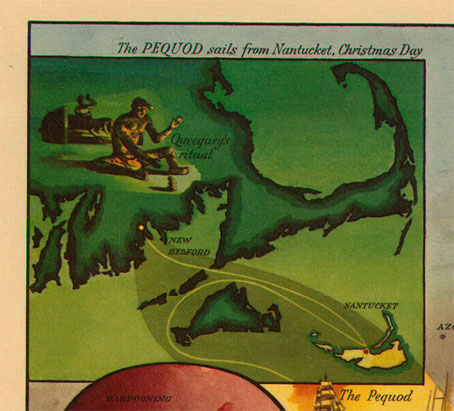
The Voyage of the Pequod

henry1.jpg

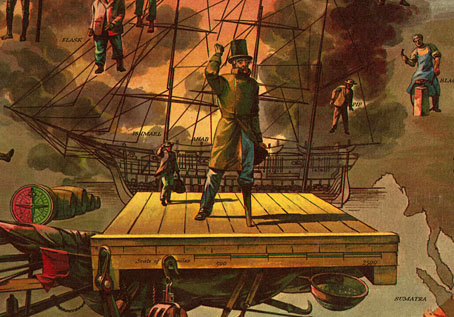
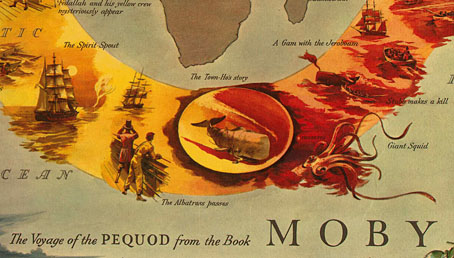
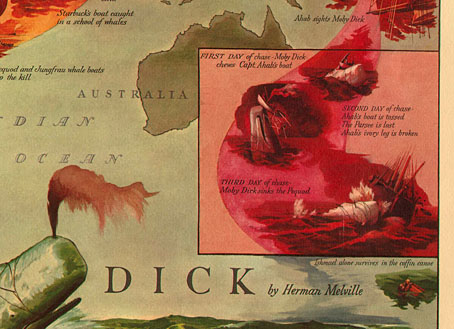
American illustrator Everett Henry (1893–1961) created several maps based on classic American novels but The Virginian and The Adventures of Huckleberry Finn lack the epic, globe-trotting qualities of Moby-Dick, one of the few novels where almost every scene takes place in a different part of the world. The linear nature of the voyage also aids Henry’s design with its graded colours and suitably bloody culmination. The use of vignettes in literary maps reminds me most of the charts drawn by Pauline Baynes for Tolkien’s books but there are plenty of other examples, some of which may be seen at VTS.

henry2.jpg

henry3.jpg

henry4.jpg

henry5.jpg

Elsewhere on { feuilleton }
The illustrators archive

Previously on { feuilleton }
Of the Monstrous Pictures of Whales
Jan Saenredam’s whale
The Whale again
Rockwell Kent’s Moby Dick
Pauline Baynes, 1922–2008

Weekend links 81

wittkamp.jpg

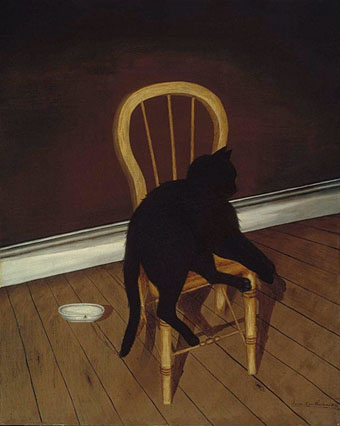
Black Cat on a Chair (1850–1860) by Andrew L Von Wittkamp.

• “A little bit of acid, lots of weed, and too much Castaneda and I was ready to move from the magical realm of Middle Earth into a world that was much stranger than any involving hairy dwarves and white wizards…” Too Much to Dream by Peter Bebergal, “a psychedelic American boyhood”.

This year’s Booker prize isn’t about the power of the new – there’s no experiment with form or strangeness of imagination. The winner may get on the bedside tables of middle England, but that’s not as important as changing the way that even one person dreams.

Jeanette Winterson throws the cat among the pigeons.

• 50 Watts continues to show us things you’d be hard-pressed to find elsewhere: illustrations by TagliaMani from a new edition of Les Chants de Maldoror, and War Is a Verb, collages by Allan Kausch.

• Don’t go in the swimming pool! Coilhouse directs us to Fantasy: music by French outfit DyE with a weird and nasty animation by Jérémie Périn.

• Ace album cover designer and photographic Surrealist Storm Thorgerson is having another exhibition at IG Gallery, London.

The Art of Leo and Diane Dillon, an art and illustration archive.

John Turturro reads a short story by Italo Calvino.

Spaceport America by Foster + Partners.

Your Body of Work by Olafur Eliasson.

Wonder-Cat cures all ailments.

Blogging Moby-Dick.

Krazy Kat (1927) by Frankie Trumbauer & His Orchestra with Bix and Lang | Pussy Cat Dues (1959) by Charles Mingus | Katzenmusik 5 (1979) by Michael Rother | Big Electric Cat (1982) by Adrian Belew | Purrfect (1996) by Funki Porcini.

Of the Monstrous Pictures of Whales

whale1.jpg

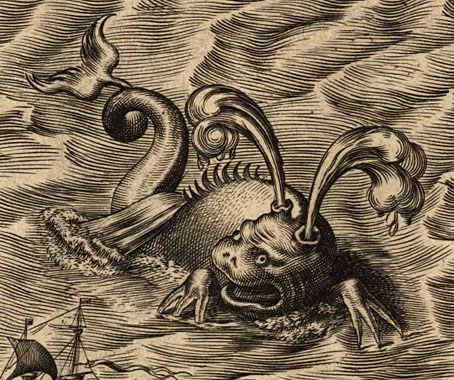
When Herman Melville complains in chapter 55 of Moby Dick about erroneous representations of whales, this is the kind of thing he had in mind. Among those he takes to task, however, I don’t recall any of them having two blow-holes like the creature above.

whale2.jpg

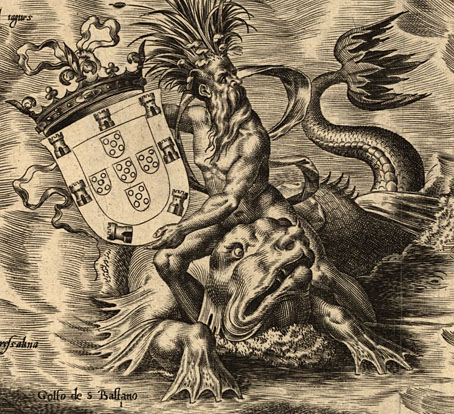
The coat of arms of Portugal.

These fanciful beasts are the work of (no sniggering, please) Hieronymus Cock (1510–1570), an Antwerp engraver, and they populate the seas as part of his marvellous map of America created with the assistance of Spanish cartographer Diego Gutiérrez.

Gutiérrez’s magnificent 1562 map of America was not intended to be a scientifically or navigationally exacting document, although it was of large scale and remained the largest map of America for a century. It was, rather, a ceremonial map, a diplomatic map, as identified by the coats of arms proclaiming possession. Through the map, Spain proclaimed to the nations of Western Europe its American territory, clearly outlining its sphere of control, not by degrees, but with the appearance of a very broad line for the Tropic of Cancer clearly drawn on the map.

The map is described in detail here while another part of the Library of Congress Map Collections site has an incredible high-resolution copy which is a delight to pore over. This is a really big image (10492 x 11908 pixels) but the huge size is just what I love to see. You can not only zoom into the myriad details—cannibals cooking a human feast in Brazil—but also admire the precision of the cross-hatching. Less than forty years separate these generic creatures from Jan Saenredam’s far more accurate rendering of a beached sperm whale.

whale3.jpg

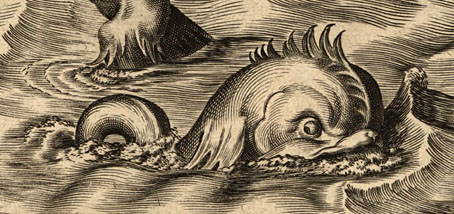
A dolphin (Melville classed dolphins and porpoises as small whales).

Elsewhere on { feuilleton }
The etching and engraving archive

Previously on { feuilleton }
Jan Saenredam’s whale
The Whale again
Rockwell Kent’s Moby Dick

Jan Saenredam’s whale

saenredam.jpg

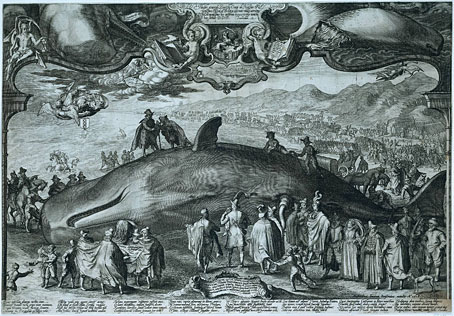
Still reading Moby Dick at a leisurely pace. After finishing Melville’s chapters on the representations of whales I thought I’d see if the pictures he most prefers are online anywhere. A vain search, as it turns out, but I did discover this splendid depiction, Stranded Sperm Whale, by Dutch artist Jan Saenredam (1565–1607).

On 19 December 1601, a sperm whale washed up near Beverwijk. Crowds of people came to see the sight. Among them Jan Saenredam, who made this print. He has depicted himself drawing on the left.

The description continues at the Rijksmuseum site from which this copy originates. Mr Peacay of BibliOdyssey has a very large copy on his Flickr pages which shows more of the fine detail. Melville is highly critical of poor depictions of whales but I suspect he would have liked this one. As well as the local colour and allegorical border elements, Saenredam faithfully renders his dead whale, even leaving space for the drooping scape of cetacean penis. In a similar, if more mundane manner, there’s this engraving by Jacob Matham.

Elsewhere on { feuilleton }
The etching and engraving archive

Previously on { feuilleton }
The Whale again
Rockwell Kent’s Moby Dick