Battersea Power Station

battersea.jpg

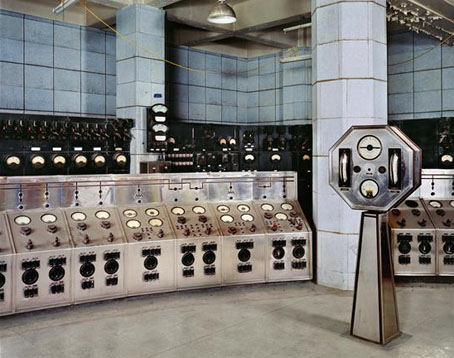
A photograph of the control room of Battersea Power Station, London, by Michael Collins, one of a series which will shortly be on display at the Royal Institute of British Architects.

The images show Battersea Power Station as what Collins describes as a “twentieth century ruined castle” – a building that was built to last, with a high quality structure and interior, including Art Deco walls and ceilings.

Giles Gilbert Scott’s enormous temple of heavy industry continues to sit decaying on the banks of the Thames while property developers come and go. The latest of these, Real Estate Opportunities, has fallen into debt which means proposals to develop the site are once again on hold. A part of me likes the idea of the building sitting there unused and purposeless year after year, like some vast Steampunk Stonehenge; Giles Gilbert Scott’s other Thames-side power station, Bankside, was successfully transformed as Tate Modern, but we know from various proposals that the fate of Battersea, whether as theme park or shopping centre, is likely to be a lot less edifying.
quark1.jpg

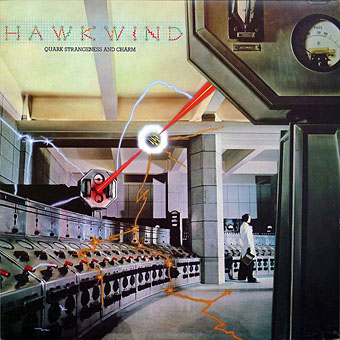
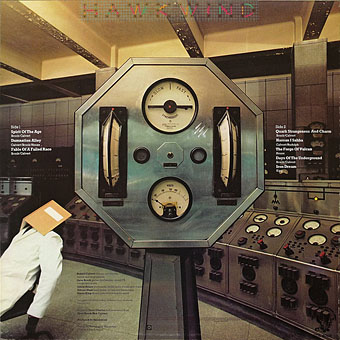
It took redevelopment to transform Bankside from temple of industry to temple of culture but Battersea’s unmistakable presence has a powerful cultural history of its own. Everyone knows the Hipgnosis sleeve design for Pink Floyd’s Animals (1977); less familiar is the photos of the control room which Hipgnosis used for Hawkwind’s Quark, Strangeness and Charm the same year. I tend to prefer the back cover of this sleeve to the front; that octagonal readout device is more interesting than the rather unconvincing sparks and exchanges of energy. And speaking of energy, my former employers are still active, unlike the rancorous Floyd.
quark2.jpg

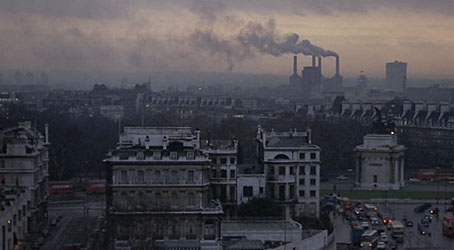
There’s a page here listing other uses of the power station, including its many film appearances which date back to the 1930s. That list mentions the control room’s use as a background for the “Find the Fish” sequence in Monty Python’s The Meaning of Life (1983) but they omit an earlier Monty Python appearance when you briefly see the building in operation during And Now for Something Completely Different (1971). It was closed down a few years later. So here it is, then, belching fumes over west London on a profoundly gloomy winter afternoon.
battersea2.jpg

Elsewhere on { feuilleton }
The album covers archive

Previously on { feuilleton }
The Sonic Assassins
The Bradbury Building: Looking Backward from the Future
Hawk things

hawkmask1.jpg

The Barney Bubbles revival continues with news of Space Ritual 09, a concert dedicated to BB by ex-Hawkwind members at the Roundhouse, London on March 8th. The headline band is a new version of Hawklords, notably sans Dave Brock who controls the Hawkwind name and hasn’t been too happy recently with Nik Turner’s revisionist activities. Quarrels aside it’s good to see them honouring Barney’s memory and the Roundhouse is the place to do it, being the venue where Hawkwind played a very stoned set in 1972 as part of the Greasy Truckers concert.

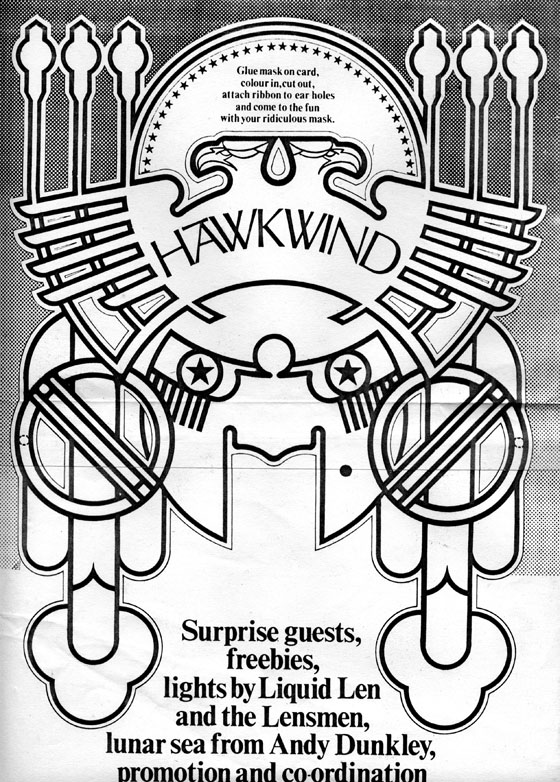
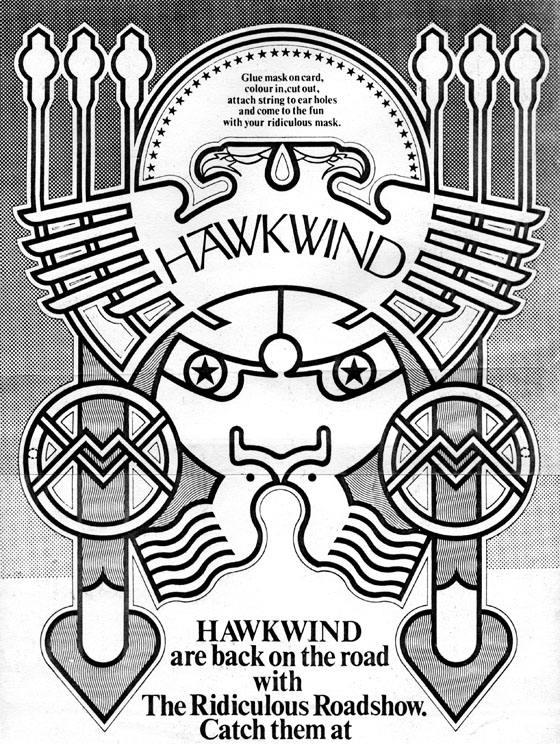
All of which had me searching in vain for a double-page ad from the NME for Hawkwind’s Urban Guerilla single; you can see the ad in a smaller vertical version on the original Barney Bubbles post. I was hoping to find the full thing and scan it for display here but it seems to have gone astray for the time being. As it was the search turned up these photocopies of some later Bubbles Hawkwind ads created for the band’s UK tour of winter 1973/74. A pair of typically meticulous ink and Letratone renderings and also another example of what you might call Barney’s interactive design since these instruct the reader to glue the masks to card, colour them in then cut them out and wear them to the gig. David Wills has featured some other examples along these lines, including this cut-out doll birthday card. Did anyone ever try wearing these masks? And if so, is there photo evidence?

hawkmask2.jpg

Previously on { feuilleton }
The Sonic Assassins
Reasons To Be Cheerful, part 2
Barney Bubbles: artist and designer

Designs on Doctor Dee

mindscape_cd.jpg

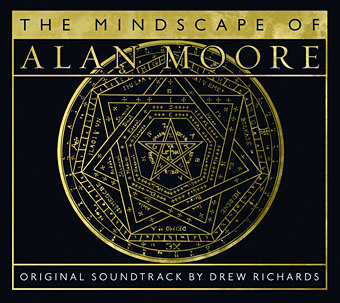
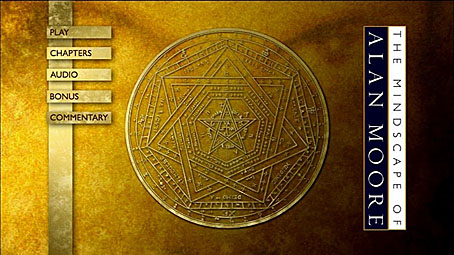
Some work news. I finished this CD design last year but, as is often the case with these things, it’s taken a while to make its way into the world. This was the final piece of the Mindscape of Alan Moore project and it’s probably the last thing I’ll do which makes use of the famous Sigillum Dei Aemeth of Doctor John Dee (1527–1608), wax versions of which can be seen in the British Museum. Alan Moore is a great Dee aficionado and since the sigil appears in the DeZ Vylenz documentary it made sense to use it for the DVD package and interface. This led in turn to a new poster design for the film (below) and—eventually—the soundtrack CD. The latter should be shipping shortly from Shadowsnake Films.

Lastly, and also design-related, the New York Times this week had a short piece about designer Barney Bubbles based around Paul Gorman’s Reasons to be Cheerful book. My quote about Barney’s Hawkwind work being “cosmic Art Nouveau” was borrowed from the book’s text and the piece features one of those slideshow selections the NYT does so well. Once again it’s great to see how Paul’s book is stimulating new interest and appraisal of work which was neglected for far too long.

mindscape_dvd.jpg

DVD menu.

Continue reading “Designs on Doctor Dee”

The Sonic Assassins

assassins1.jpg

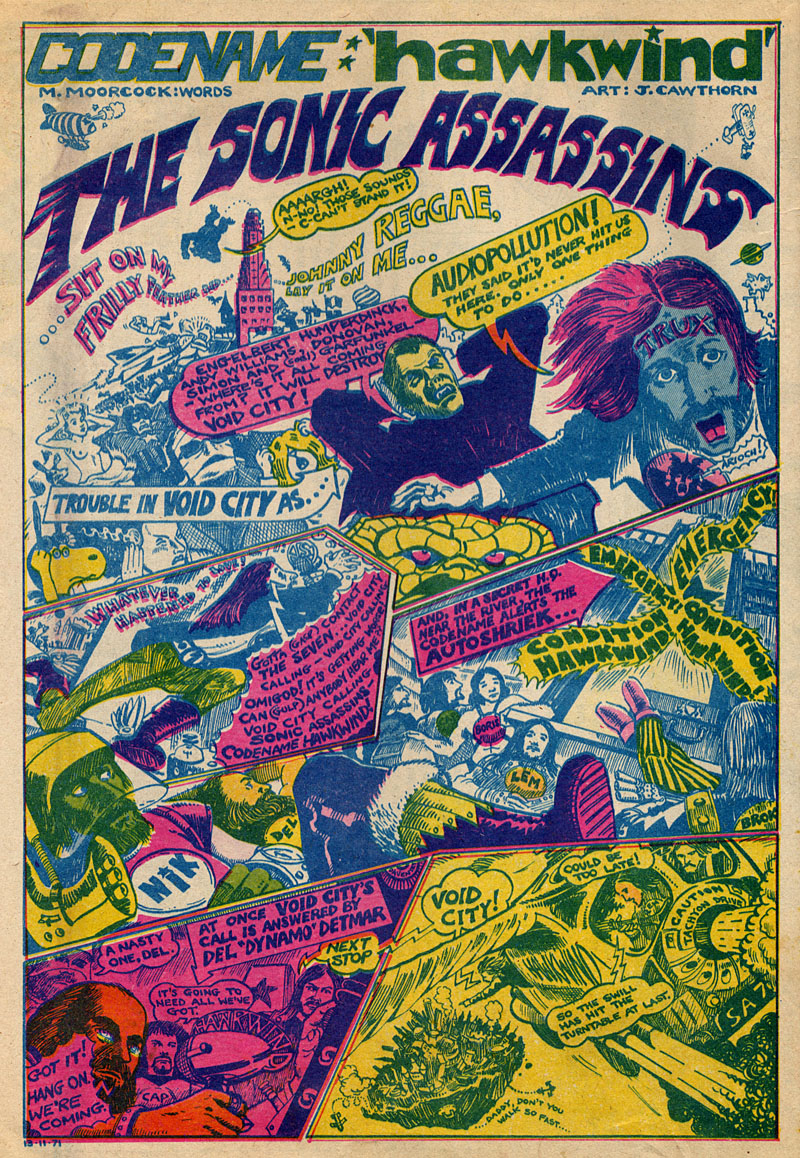
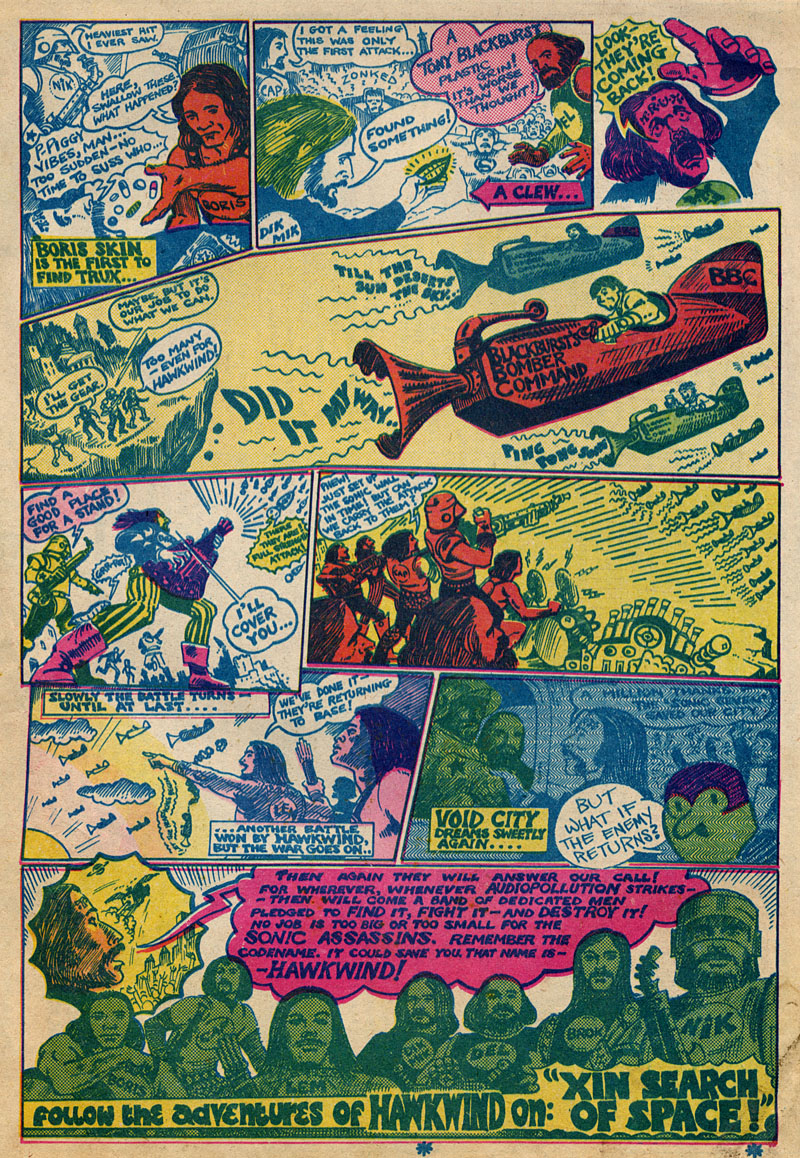
Searching through discs for scans of Jim Cawthorn art turned up this comic strip curio from a November 29th, 1971 issue of UK underground magazine Frendz. Cawthorn and writer Michael Moorcock present rock band Hawkwind as musical superheroes and although this is done largely as a promotional piece for that year’s new album, In Search of Space, the Sonic Assassins tag was one which stuck, becoming almost a secondary name for the band in later years. The name Void City also recurred later as the name of a track on the Choose Your Masques album. It may have been around this time that Cawthorn painted special T-shirt designs for Hawkwind; up to 1980 Dave Brock was still wearing his Baron Meliadus shirt on stage.

assassins2.jpg

Previously on { feuilleton }
Jim Cawthorn, 1929–2008
Design as virus #7: eyes and triangles
Barney Bubbles: artist and designer