Chess players

chess10.jpg

Chess Problem 25 (13th century), from El Libro de los Juegos.

Chess-playing in art. Some of it, anyway. I hadn’t realised until I went searching for examples how many paintings there are of people playing chess. The prompt for this was my current reading, The Flanders Panel, a novel from 1990 by the Spanish author Arturo Pérez-Reverte. Arturo likes his art mysteries, as you’ll know if you’ve read The Club Dumas, an excellent novel that was reworked for cinema as The Ninth Gate. The chess game in The Flanders Panel is the subject of a painting by a fictional Flemish artist, Pieter Van Huys. Pérez-Reverte presents a biography of the artist and the three people depicted in the painting, with special attention given to the game of chess which gives the painting its title, a game which may or may not provide clues to a 15th-century murder mystery. Pérez-Reverte describes the painting itself in detail; Julia, the main character is a picture restorer so the descriptions extend to physical materials. Some of the novel’s cover designs have attempted to depict Van Huys’s picture, with unsuccessful results. There’s also a 1994 film adaptation, Uncovered, which I haven’t yet seen.

chess06.jpg

The Chess Player (no date) by Isidor Kaufmann.

I’ll admit to not having thought very much about chess-playing in art until the conversation in the novel turned to the subject of the painted game, and the question of whether or not the position of the pieces had anything to say about the people in the picture. (Pérez-Reverte helpfully includes a diagram that shows the layout of the board.) There’s no reason why a game of chess shouldn’t be used for semiotic reasons even if this is only to indicate the power relationship within a picture by making one party the dominant player. Given the ease with which this can be done I’d guess there are many such examples that use the game to communicate something about the players beyond the fact that they enjoy playing chess. If you’re painting a chess game you’re always going to be faced with the question of how you position the pieces, a problem that leads in turn to decisions about who should be shown to be winning or losing via the number of pieces and their placement on the board. Western art is replete with pictorial symbolism involving animals, plants, birds, colours, and so on; if the very old and very familiar game of chess is added to the symbolic repertoire then we’re left to decide which paintings are using the game for incidental reasons, and which have something more to communicate.

chess09.jpg

An Interesting Problem (no date) by Adolphe-Alexandre Lesrel.

In making a picture selection I’ve looked for paintings that clearly show the position of the pieces on the board, as well as those which depict the game with some accuracy. It becomes apparent when you examine many paintings on this subject that some artists don’t seem too familiar with the details of the game, a common error being the mispositioned board. This could also have a symbolic meaning, of course, but I’ll leave that question for others to explore. As a final note, Marcel Duchamp had a thing for chess.

chess05.jpg

Ein schwieriger Zug Öl auf Holz (no date) by Albert Joseph Franke.

chess11.jpg

Die Schachspieler (Faust und Mephisto) (1834) by Moritz Retzsch.
Continue reading “Chess players”

Švankmajer’s cats

dtc1.jpg

Down to the Cellar.

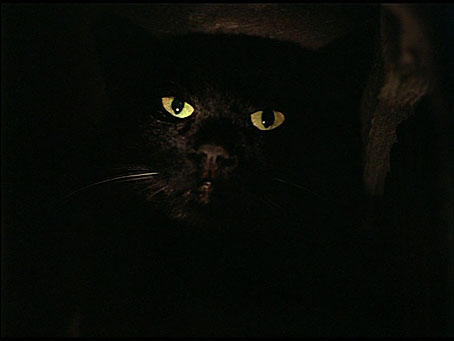
“Black cats are our unconscious,” says Jan Švankmajer in an interview with Sarah Metcalf for Phosphor, the journal of the Leeds Surrealist Group. I’ve spent the past few weeks working my way through Švankmajer’s cinematic oeuvre where black cats were very much in evidence, although for a director who describes himself as a “militant Surrealist” there are fewer than you might imagine.

jabberwocky.jpg

Jabberwocky.

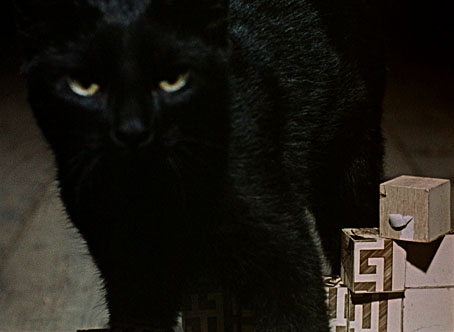
The first feline appearance is in Jabberwocky (1973), a difficult film for animal-lovers when almost all the cat’s appearances seem to have involved throwing the unwilling animal into a wall of building blocks. Each “leap” that the cat makes through the wall interrupts the progress of an animated line being drawn through a maze; when the line finally escapes the maze, childhood is over. Our final view of the cat is of it struggling to escape the confines of a small cage: the unconscious tamed by adulthood.

dtc2.jpg

Down to the Cellar.

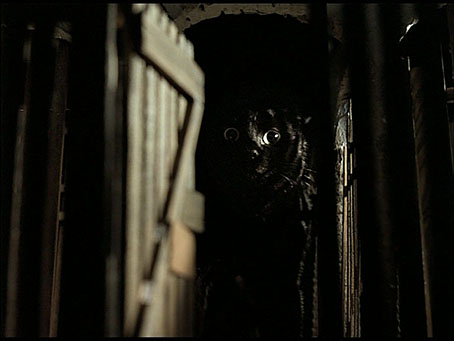
The black cat in Down to the Cellar is not only the most prominent feline in all of Švankmajer’s films, it’s also carries the most symbolic weight in a drama replete with Freudian anxiety. The cat guards the entrance to the subterranean dark where its growth in size corresponds to the mounting fears of a small girl sent by a parent to collect potatoes.

faust.jpg

Faust.

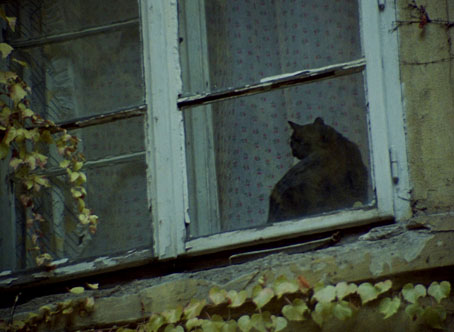
The cat seen at the beginning of Faust (1994) appears very briefly but nothing is accidental in Švankmajer’s cinema. Two separate shots show the cat in the window watching Faust on his way to meet Mephistopheles. As with Down to the Cellar, the cat oversees the threshold to another world, in this case the doorway to a labyrinthine building filled with malevolent puppets and the temptations they offer. The cat may also be the traditional symbol of ill fortune. Faust at this point in the story still has the option to turn back but he goes on to meet his fate. (I think there may also be another cat later in the film but I was too lazy to go searching for it. Sorry.)

little-otik.jpg

Little Otik.

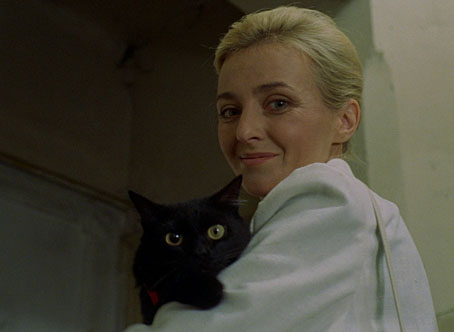
The cat that appears in the early scenes of Little Otik (2000) is a child substitute for a childless couple, its status reinforced by the scene of Bozena holding the animal like a baby. The arrival of the monstrous Otik usurps the cat’s position as the family favourite. Consequences ensue.

Švankmajer’s later features are catless. Insects (2018) is more concerned with arthropods and their human equivalents, while Surviving Life (2010) spends so much time inside the unconscious of its protagonist it doesn’t require a symbol. Lunacy (2005), on the other hand, is a combination of a story by Edgar Allan Poe—The System of Doctor Tarr and Professor Fether—and the philosophical views of the Marquis de Sade. Švankmajer had already adapted two of Poe’s stories prior to this but The Black Cat wasn’t among them. Given the cruelties in Poe’s story and many of Svankmajer’s films, Lunacy in particular, this may be just as well.

Previously on { feuilleton }
Jan Švankmajer: The Animator of Prague
Lynch dogs
Jan Švankmajer, Director
Don Juan, a film by Jan Švankmajer
The Pendulum, the Pit and Hope
Two sides of Liška

Weekend links 380

hasaka.jpg

Night Out, Shibuya, a photograph by Yoshito Hasaka. One of a remarkable series.

• Rixdorf Editions is a new publishing venture from Strange Flowers’ James Conway which “…aims to cast light on an era which is misunderstood to the extent that it is thought of at all. I speak of the German Empire, specifically the Wilhelmine period from 1890 to 1918.” The first two titles, both translated by Conway himself, are Berlin’s Third Sex (1904), a study of the city’s queer demi monde by the pioneering Magnus Hirschfeld; and The Guesthouse at the Sign of the Teetering Globe (1917), a collection of strange stories by Franziska zu Reventlow.

• Patrick McGoohan’s enigmatic TV series, The Prisoner, premiered 50 years ago this week. Among the series’ many stylistic hallmarks was the use of Berthold Wolpe’s Albertus typeface, as detailed at We Made This.

• Three of Bill Nelson’s home-produced instrumental albums from the 1980s—Sounding The Ritual Echo, Das Kabinet, and La Belle Et La Bête—are reissued in November.

Photos by Heinrich Klaffs of German group Faust performing live (for the first time?) in 1971. Klaffs’ other photos are worth looking at as well.

• Mixes of the week: XLR8R Podcast 509 by Laylla Dane, and Secret Thirteen Mix 231 by New Hip Tiki Scene.

• At Spoon & Tamago: Altered landscapes meticulously rendered in pencil by Shinji Ogawa.

• “Why are UK and US book jackets often so different?”asks Danuta Kean.

Samantha Manzella on eight of the world’s remaining gay bookstores.

• At greydogtales: F. Marion Crawford & the Screaming Skull.

Tunnel View, a previously unheard demo by Broadcast.

Zealandia: Earth’s Hidden Continent

Seeland (1975) by Neu! | Neu Seeland (1992) by Terminal Cheesecake | Osprey’s Odyssey (2010) by Seeland

Weekend links 295

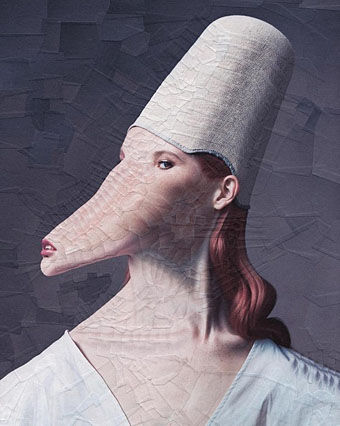
dupre.jpg

Untitled (2014) by Lola Dupré. Via.

Announcement of the week (if not the month/year) is the news that the BFI will be releasing all of the BBC dramas directed by Alan Clarke on DVD/Blu-ray in May. In addition to the long-awaited appearance on disc of Penda’s Fen (1974) we can expect a previously unseen director’s cut of Clarke’s last TV film, The Firm (1989), the DVD premier of Baal (1982) with David Bowie, plus many other works including some from the 1960s that were believed lost. (And it should be noted that this isn’t everything of Clarke’s; he also worked occasionally for ITV and later directed feature films for Channel 4.)

The BFI attention is a tribute to an exceptional director that’s overdue. Clarke has long been a cult figure among the British actors who worked with him, and among directors such as Harmony Korine and Gaspar Noé, but the tendency of TV to give one-off dramas a single screening has meant that much of his best work has been unavailable for years outside old VHS tapes. Clarke is important for having persistently chosen difficult subjects which he directed with a flair and intensity usually only found in cinema. When he died in 1990 the BBC repeated a handful of his films but the only ones given repeated DVD release have been the violent dramas with the big names attached: Scum (1979, with Ray Winstone), Made in Britain (1982, with Tim Roth), and The Firm (with Gary Oldman). Clarke’s oeuvre is much more than a parade of nihilistic villains, as will become evident later this year.

• A psychedelic video directed by Peter Strickland for Liquid Gate (ft. Bradford Cox) by Cavern of Anti-Matter. The debut album from Cavern of Anti-Matter, Void Beats/Invocation Trex, will be out later this month.

Celebrating Dusseldorf, the city that birthed Krautrock. (Article loses points for not mentioning producer Conny Plank.)

All Rivette’s features might be regarded as different kinds of horror films; Céline et Julie vont en bateau is his first horror comedy. The anxiety and despair of Paris Nous Appartient and La Religieuse, L’Amour Fou and Spectre seem relatively absent, yet they perpetually hover just beyond the edges of the frames. We still have no privileged base of ‘reality’ to set against the fictions, each of which is as outrageous as the other; and along with Borges, we can’t really say whether it’s a man dreaming he’s a butterfly or a butterfly dreaming he’s a man—although we may feel, in either case, that he and we are just on the verge of waking.

Jonathan Rosenbaum on work and play in the house of fiction: Jacques Rivette’s Out 1 and Céline and Julie Go Boating

• Mixes of the week: Finders Keepers Radio Show Krautrock Special, and The Ivy-Strangled Path Vol. XV by David Colohan.

• At Dangerous Minds: Super strange sculptures (by Shary Boyle) only the dark and demented could love.

• Beautiful Brutalites: S. Elizabeth questions Arabella Proffer about her paintings.

KTL is a musical collaboration between Peter Rehberg and Stephen O’Malley.

• Why study art when you can make it? The strange world of…This Heat.

Sarah Galo on the explicitly sexual female artists that feminism forgot.

Irmin Schmidt‘s favourite music (this week).

• LSD: My life-saving drug by Eric Perry.

The Occult Activity Book

Twenty Tiny Cities

Der LSD-Marsch (1970) by Guru Guru | Krautrock (1973) by Faust | Düsseldorf (1976) by La Düsseldorf

Harry Clarke and others in The Studio

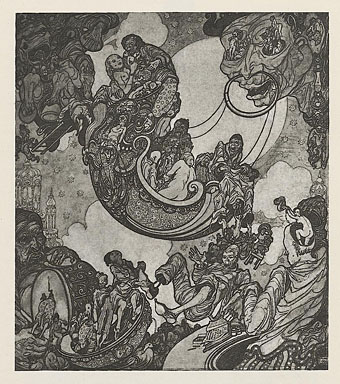
odle.jpg

The Swing by Alan Odle.

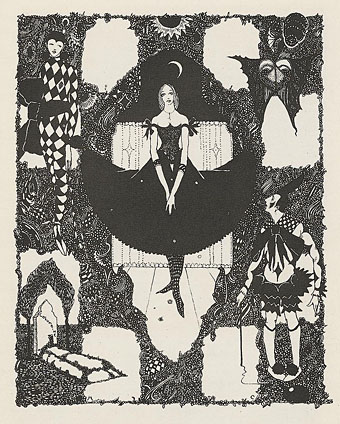
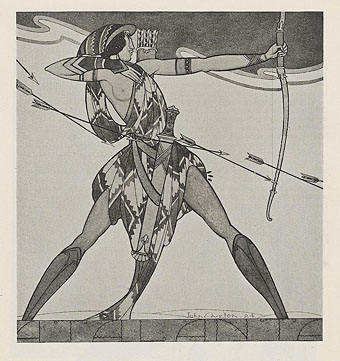
The University of Heidelberg has for some time now had several years of British art magazine The Studio in its archive but I’ve yet to delve fully into the later issues. These illustrations are from two articles from the volumes covering the year 1925, both of which feature the exceptional Irish artist Harry Clarke. In the first piece Clarke is present along with two contemporaries, John Austen and Alan Odle; the second is a review by novelist Dorothy M. Richardson (Alan Odle’s wife) of Clarke’s illustrations for Goethe’s Faust. All three artists owed an artistic debt to Aubrey Beardsley, and an earlier number of The Studio features a drawing by John Austen of Scheherazade in his Beardsley-derived style. (Thanks to Nick for the tip!)

clarke2.jpg

Columbine by Harry Clarke.

austen2.jpg

Atalanta in Calydon by John Austen.

Continue reading “Harry Clarke and others in The Studio”