Seven Songs by 23 Skidoo

23skidoo.jpg

Along with Elemental 7 by CTI, this was another Doublevision video release that I never got to see in its original videocassette form. Seven Songs is the first and arguably the best of the 23 Skidoo albums, released in 1982 on Fetish Records in a great sleeve by Neville Brody. Production was by “Tony, Terry & David” aka Ken Thomas, Genesis P-Orridge & Peter Christopherson. The latter two were still in Throbbing Gristle at the time so there’s a further connection with the CTI release. The video director was Richard Heslop who can be seen with his Super-8 camera on the inner sleeve of 23 Skidoo’s second album. Seven Songs is his first credited film work.

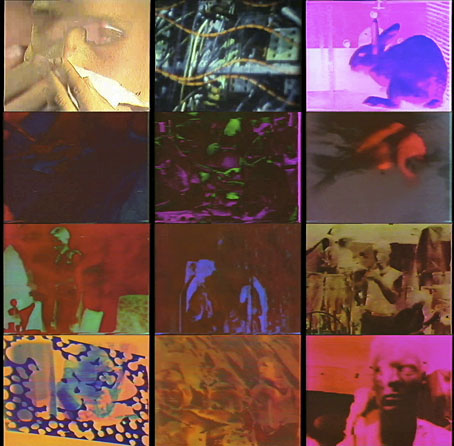
The videos are very much of their time, layered and cut-up images mixing footage from numerous sources—tribal rituals, totalitarian politics, animation, medical or scientific films, shots of the group performing, and so on—with the whole mélange processed through a video synthesiser. While it may look outmoded now, thirty years ago this degree of intensity and fragmentation was still radically unlike anything being offered by broadcast television. Pop video directors and ad agencies weren’t slow to adopt similar techniques for far more commercial ends. Richard Heslop went on to work with Derek Jarman, and recently directed a feature of his own, Frank. Low-quality bits of Seven Songs have been on YouTube for a while but Heslop posted the whole thing to Vimeo a few months ago along with the Tranquiliser footage that rounded out the original cassette release. 23 Skidoo are still active, and are playing a gig in London next Sunday with the former singer from Can, Damo Suzuki. Details about that event here.

Previously on { feuilleton }
Elemental 7 by CTI
Neville Brody and Fetish Records
Elemental 7 by CTI

cti1.jpg

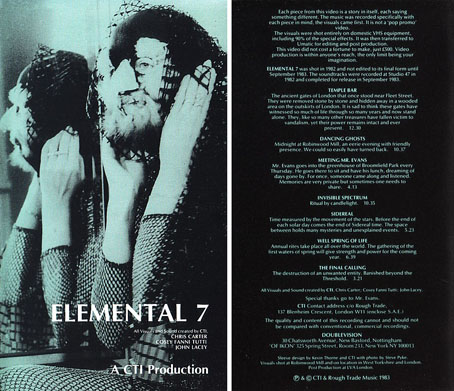
Design by CTI and Kevin Thorne.

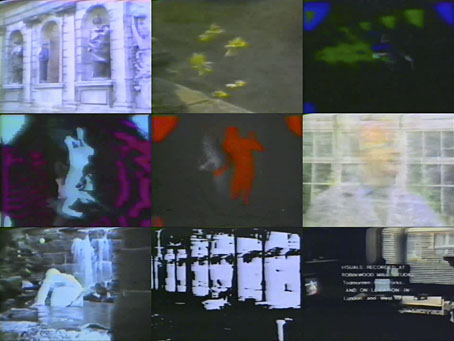
Yet another of those things I’ve known about for years but have only seen recently thanks to YouTube. Elemental 7 was an early music + video release by Chris Carter and Cosey Fanni Tutti following the split of Throbbing Gristle in 1981. They’d already recorded under the Chris & Cosey name but in 1983 formed CTI—Creative Technology Institute—a side project that allowed for the release of works such as this that differed from their usual electronic output. Elemental 7 is a 50-minute video that for want of a better term might be classed as ambient, the visuals being grainy, impressionistic or semi-abstract images by John Lacey with a soundtrack that’s on the whole less rhythmic than the C&C albums. The whole thing was made for £500, and the quality isn’t supposed to compete with broadcast television. In 1983 it was still a rare thing for groups to take control of their own video production. In the UK few people were doing this aside from Factory Records, who had their own Ikon video label, and some of the Industrial groups such as Cabaret Voltaire, Psychic TV and 23 Skidoo. Cabaret Voltaire released the tape and soundtrack album of Elemental 7 on their Doublevision label.

cti2.jpg

It’s a curious thing being able to see this after so long. I’m very familiar with the music (it was always good late-night listening) but, as with Cabaret Voltaire’s Johnny YesNo film and other Doublevision releases, I didn’t have any means of watching video tapes through much of the 1980s. Nothing this unusual ever appeared on TV, of course. The ritualistic sequences are reminiscent of the early films of Derek Jarman, not least In the Shadow of the Sun which had a soundtrack by Throbbing Gristle, while the opening sequence, Temple Bar, has some historical value in showing the stone gate of the City of London sitting abandoned in Theobalds Park before it was returned to the capital in 2003.

Elemental 7 has never been reissued since its tape release so this is the only way you’ll get to see it for now.

Elemental 7: part 1 | part 2 | part 3 | part 4 | part 5

1. Elemental 7 0:13
2. Temple Bar (The Forgotten Ancient Gates Of London) 12:30
3. Dancing Ghosts (Midnight At Robinwood Mill) 10:37
4. Meeting Mr. Evans (A Moving Experience) 04:13
5. Invisible Spectrum (Ritual By Candlelight) 10:35
6. Sidereal (Time Measured By Movement Of The Stars) 05:23
7. Well Spring Of Life (Gathering The First Waters Of Spring) 06:39
8. The Final Calling (Physical Exorcism) 03:21
9. CTI Credit Sequence 02.17

Previously on { feuilleton }
Gristleism
A=P=P=A=R=I=T=I=O=N
In the Shadow of the Sun by Derek Jarman

Patrick Procktor, Art and Life

procktor.jpg

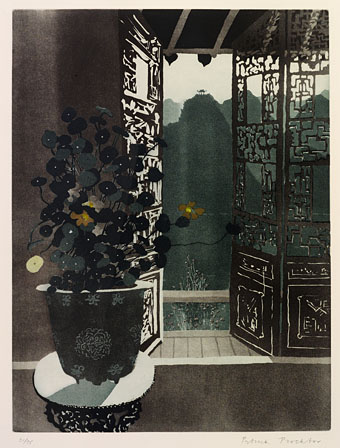
Nasturtiums, Wusih (1980) by Patrick Procktor.

Ian Massey was in touch last week to alert me to Patrick Procktor, Art and Life, an exhibition of Patrick Procktor’s art he’s curated at the Huddersfield Art Gallery in Yorkshire:

Patrick Procktor was part of a bohemian circle in 1960s and 1970s London that also included his great friends the artist David Hockney and the fashion designer Ossie Clark.

The focus of this exhibition is on the artist’s paintings on canvas and works on paper, and includes portraits of quintessential Sixties figures including Derek Jarman and Jimi Hendrix, alongside topographical pictures painted in countries such as India, Italy, Egypt and China.

I really like that nasturtiums print. For those who can’t get to Huddersfield there’s Ian’s monograph of the artist, also entitled Patrick Procktor, Art and Life, which was published by Unicorn Press in 2010. The exhibition runs to 10th November, 2012.

procktor2.jpg

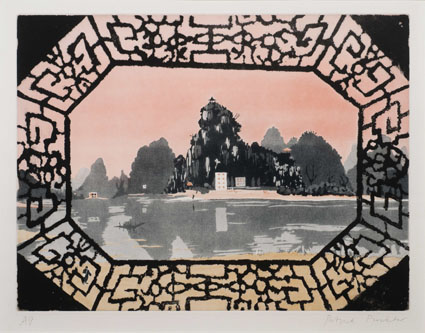
Da Miou Mountains, Kweilin, aquatint (1980).

Update: Ian says although the nasturtiums are on the gallery website they aren’t in the show because the print was sold just beforehand. He’s sent this print from the same series. The exhibition was reviewed by Charles Darwent in The Independent on Sunday.

Previously on { feuilleton }
Gervase and Patrick

Devils debris

devils.jpg

The Devils (1971).

There is only one English feature director whose work is in the first rank. Michael Powell is the only director to make a clear political analysis in his films, his work is unequalled. The Life and Death of Colonel Blimp is the finest English feature, and A Canterbury Tale and A Matter of Life and Death are not far behind. When he made these films he was heavily criticized for his treatment of serious themes. Blimp was banned by Churchill and remained in a savaged version for nearly forty years, a plea for tolerance and regard for the enemy as human made at the height of the war there is no more courageous English film. It is a tragedy he has made so few films in the last twenty years, none in the last ten, and a lasting condemnation of all those who make films. He was a major casualty of the spurious social realism of the sixties, whose practitioners have grown fat and invaded the media with their well-scrubbed minds.

Thus Derek Jarman writing in 1980. Ian Christie quoted Jarman’s sentiments in Arrows of Desire: the films of Michael Powell and Emeric Pressburger (1985), pointing to the shared attitudes of the two directors, especially their outsider stance. There were other correspondences: both maintained an abiding interest in the artistic scope of cinema; both were marginalised by the British film world during their lives then lauded after their deaths. Michael Powell for years attempted to produce a film of The Tempest; Derek Jarman, of course, succeeded.

return1.jpg

Return to the Edge of the World (1978).

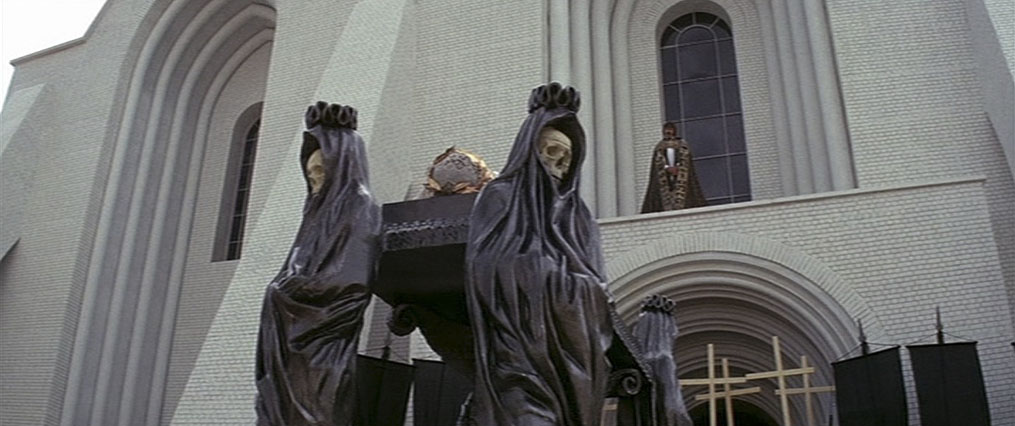
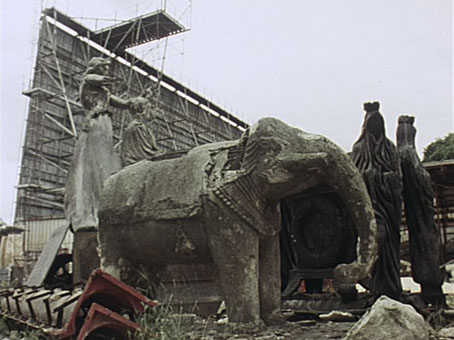
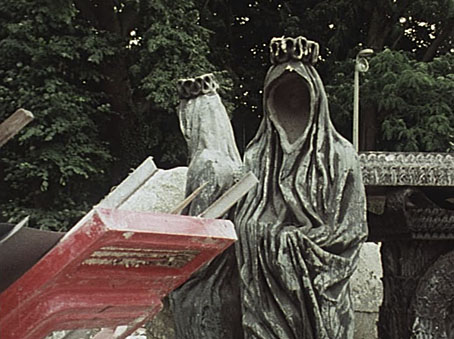
Then there’s this odd coincidence from Return to the Edge of the World, a short documentary made in 1978 in which Powell and actor John Laurie returned to the Scottish island of Foula where they’d made Powell’s first feature film, The Edge of the World in 1937. The film opens with shots of Pinewood studios and the very first things we see are this pair of abandoned statues which anyone who’s seen Ken Russell’s The Devils will recognise from an early scene. Derek Jarman was the production designer on The Devils so these would have been created according to his instruction. I only noticed this recently when watching Return to the Edge of the World again as it’s now an extra on the BFI DVD of Edge of the World. No need to dwell on the inadvertent symbolism of abandoned statues and languishing careers.

Powell and Pressburger’s marvellous The Life and Death of Colonel Blimp was reissued recently. John Patterson discussing its writer and director tells us why the most English of movies often benefit from an outsider’s perspective.

return2.jpg

Previously on { feuilleton }
Rex Ingram’s The Magician
The Devils on DVD
Derek Jarman’s music videos
Derek Jarman’s Neutron
Mister Jarman, Mister Moore and Doctor Dee
Powell’s Bluebeard
The Tale of Giulietta
The Tempest illustrated
In the Shadow of the Sun by Derek Jarman
The Angelic Conversation
The life and work of Derek Jarman

Lindsay Kemp’s Salomé

kemp1.jpg

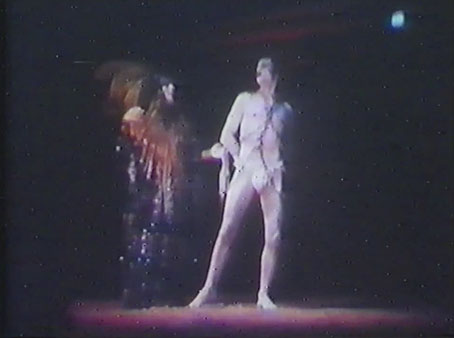
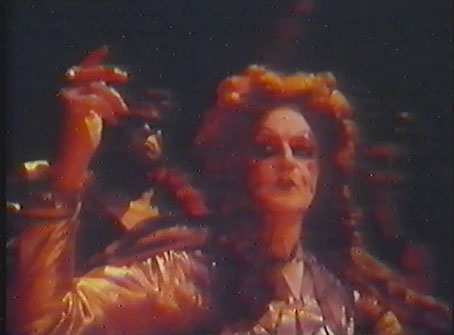
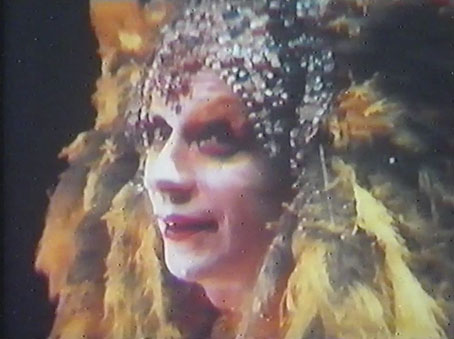
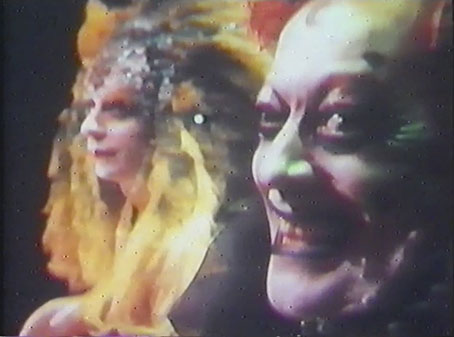
Fragments are all you get with this one, unfortunately, but how tantalising they are. Lindsay Kemp’s 1975 stage production of Oscar Wilde’s play was probably the queerest there’s been to date, with Kemp himself playing Herod’s doomed daughter under a heap of silks and feathers. These stills from a sequence of Super-8 shots of the performance arrive courtesy of Nendie Pinto-Duchinsky, director of the forthcoming Kemp documentary Lindsay Kemp’s Last Dance, a film whose title echoes Ken Russell’s film of the Wilde play. The connections circulate wildly (so to speak) around Kemp’s production: prior to this performance Kemp had acted for Ken Russell, while two of the other actors went on to work with Derek Jarman (as did Kemp). John the Baptist (above) was played by David Haughton who appeared as Ariel in Jarman’s Jubilee; Jack Birkett’s grinning features (bottom, right) appear in many of Jarman’s films. All the more reason to wish these clips were longer.

The Kemp documentary YouTube channel has a few more items related to Kemp’s stage work, notably another tantalising sequence of stills from Flowers (1974), an adaptation of Genet’s Our Lady of the Flowers that also featured Haughton and Birkett.

Update: Thanks to Suzanne in the comments for pointing to her video which includes further film moments including Salomé performing with a live snake à la Salammbô.

kemp2.jpg

kemp3.jpg

kemp4.jpg

Elsewhere on { feuilleton }
The Salomé archive

Previously on { feuilleton }
Mister Jarman, Mister Moore and Doctor Dee
Saint Genet