Weekend links 256

beardsley.jpg

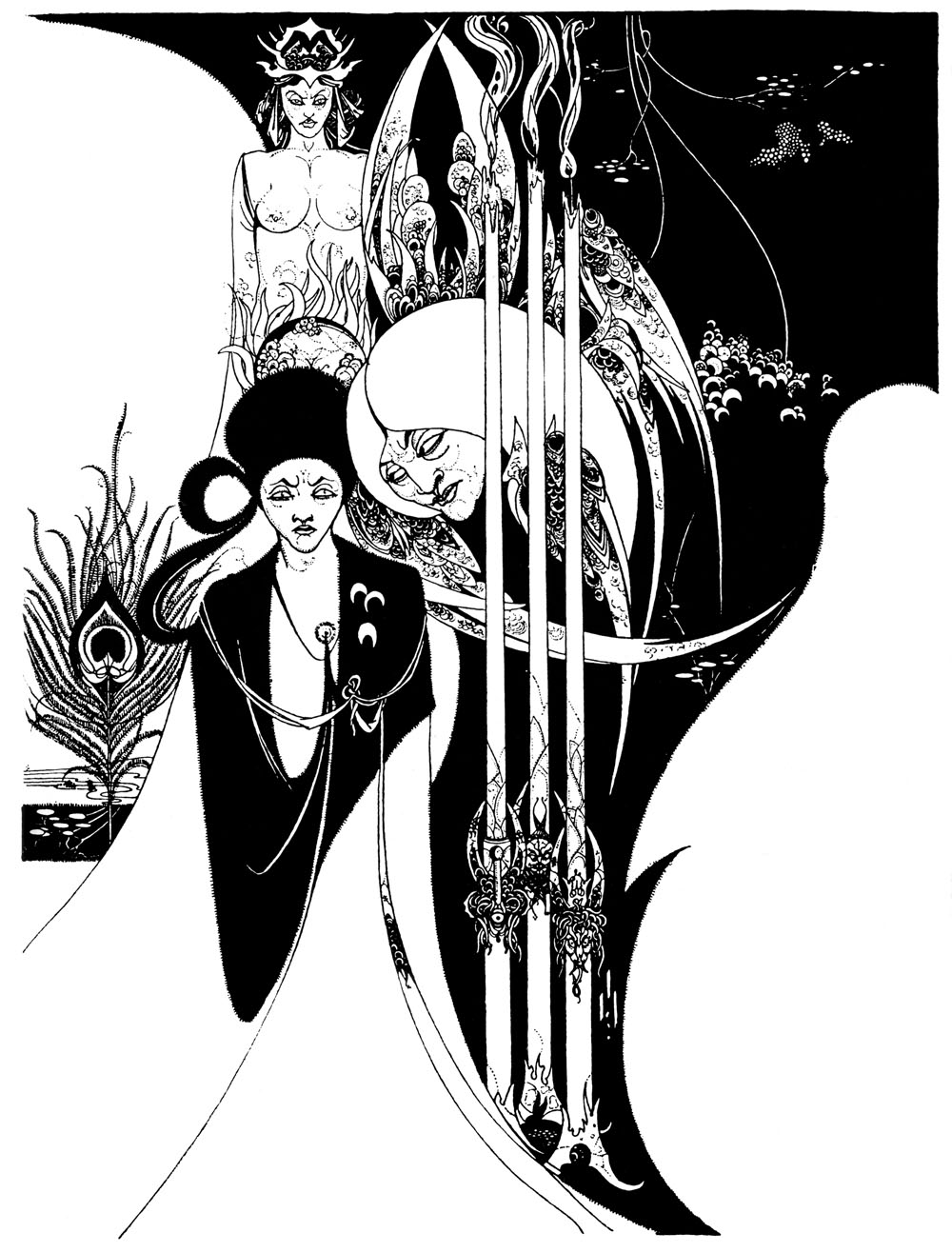
Of a Neophyte, and How the Black Art Was Revealed unto Him by the Fiend Asomuel. Aubrey Beardsley for the Pall Mall Magazine, 1893.

• The occult preoccupations of the 1970s appear to be in the ascendant just now. Whether this is mere nostalgia or something in the zeitgeist remains to be seen but BBC Radio 4 aired an hour-long documentary on the subject this weekend entitled Black Aquarius. The guest list implies an inevitable focus on film and television but Matthew Sweet covered a lot of ground, taking in the Hermetic Order of the Golden Dawn, Aleister Crowley, Dennis Wheatley, The Process Church, and Alex Sanders, the public face of British witchcraft in the 1960s and 70s. Earlier this week at AnOther the focus was on Maxine Sanders, High Priestess of the Alexandrian coven and putative fashion icon even though she was generally photographed naked. Maxine and husband Alex are unavoidable when reading about UK occultism in the 1970s; among other things they were occult advisors to Satanic rock band Black Widow, and also released an album of their own in 1970, A Witch Is Born. Of more interest is Sacrifice by Black Widow, a 55-minute concert for German TV’s Beat Club.

• Jacques Rivette’s OUT 1 (1971) is a film more talked about than seen, in part because of a running time that exceeds 12 hours. So news of a Blu-ray release later this year is very welcome.

• “Bruce LaBruce: taking zombie porn and gay homophobic skinheads to MoMA”. The director goes through his filmography with Nadja Sayej.

• “Art is anarchistic, and when it becomes categorized, it loses impact.” RIP Bernard Stollman, founder of the amazing ESP-Disk record label.

• Magickal (and pseudonymous) synth music by Mort Garson: Black Mass (1971) by Lucifer, and The Unexplained (1975) by Ataraxia.

Kevin Titterton on Angelo Badalamenti and the soundtrack that made Twin Peaks.

• Mix of the week: Secret Thirteen Mix 149 by Robert Aiki Aubrey Lowe.

Rare Decay, a free bonus track from Aurora by Ben Frost.

Alan Garner is celebrated in a new collection, First Light.

• At Dangerous Minds: The Residents’ radio special, 1977.

Black Sabbath (1969) by Coven | Black Sabbath (1970) by Black Sabbath | Her Lips Were Wet With Venom (Satan Oscillate My Metallic Sonatas 1 & 2) (2006) by Boris & Sunn O)))
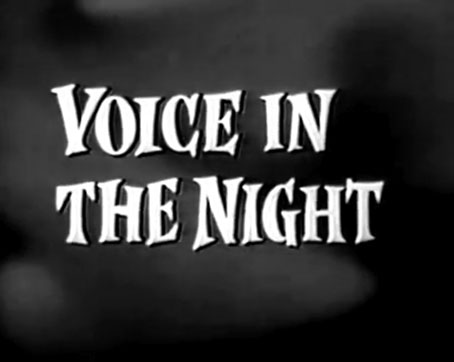
Suspicion: The Voice in the Night

voice1.jpg

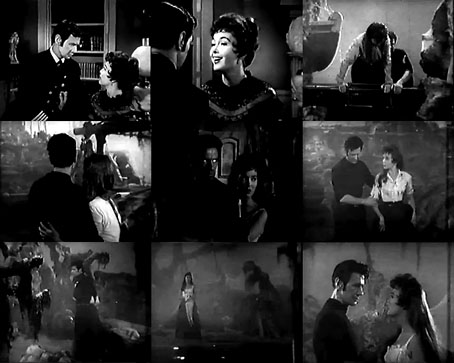
This isn’t the best quality at all but it’s worth noting for those of us intrigued by the very small number of film and television adaptations of William Hope Hodgson’s stories. The Voice in the Night (1907) is Hodgson’s most popular story with anthologists, a tale of fungal horror that features a number of the author’s familiar motifs: the derelict ship, the uncharted island, and the sea as a home of insidious menace. The story was filmed by Godzilla director Ishiro Honda in 1963 as Matango (aka Fungus of Terror, Curse of the Mushroom People and Attack of the Mushroom People) but I’ve never seen this so I can’t comment on it.

voice2.jpg

Hodgson aficionados evidently prefer the 1958 television film directed by Arthur Hiller and shown as part of NBC’s Suspicion series. The title on this copy is Alfred Hitchcock’s Voice in the Night although Hitchcock seems to have had nothing to do with the production. Stirling Silliphant adapted the story, and he does a good job of fleshing out the narrative without spoiling things. James Donald and Barbara Rush are the doomed shipwreck survivors who find a fungus-covered derelict, and beyond this, an uncharted and similarly fungus-covered island. Patrick Macnee and James Coburn play the two sailors to whom Thomason (Donald) narrates his tale, although their scenes in this copy are so murky and indistinct it might as well be a radio play. Quality aside, this is a very effective adaptation even if it does evade some of the more terrible details in the closing pages of the story. It’s closer to the spirit of Hodgson than The Horse of the Invisible or Dennis Wheatley’s Hodgsonian The Lost Continent. The Suspicion series doesn’t seem to have been released on DVD so for now YouTube is the only place you can see this film. (Big thanks to Ross for the tip!)

Previously on { feuilleton }
Hodgsonian vibrations
The Horse of the Invisible
Tentacles #2: The Lost Continent
Tentacles #1: The Boats of the ‘Glen Carrig’
Hodgson versus Houdini
Weekend links: Hodgson edition
Druillet meets Hodgson

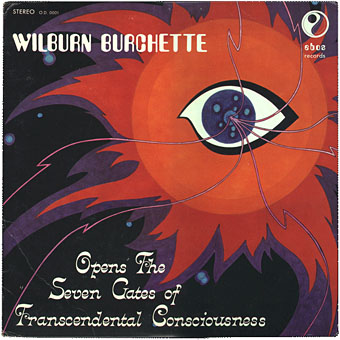
Opening the Seven Gates of Transcendental Consciousness

burchette1.jpg

Wilburn Burchette Opens The Seven Gates Of Transcendental Consciousness (1972). Art by Caren Caraway.

For the next two weeks I’ll be playing out the end of the year with a 2-CD compilation from Light In The Attic, I Am The Center (Private Issue New Age Music In America, 1950–1990), 20 tracks of ambient/meditation music, most of which has never been widely distributed before. The “New Age” label is a thing I’ve loathed for years so buying this has meant trashing a decades-long embargo; it helps to examine your prejudices now and then.

burchette2.jpg

New Age in the 1970s referred, among other things, to the oft-promised, seldom-evident “Age of Aquarius”, a term vague enough to be used on albums by Steve Hillage, Manuel Göttsching and others without referring to anything specific. In the 1980s it was taken up by publishers as a marketing label, a catch-all for anything “spiritual” or mildly occult. (I can’t imagine the Goetic Demons ever being called New Age, even if you sprayed them pink.) Out went all the witchy strangeness of the occult boom of the 1970s—spiky typefaces, magical primers sold like Dennis Wheatley novels—in came a profusion of pastel shades, airbrushed pyramids and sparkly, crystal things. Having a fondness for the witchy strangeness I wasn’t impressed. I was even less impressed when New Age became a prevalent label for a style of instrumental music which was too obtrusive to be ambient (in the Brian Eno sense of the word), and also too bland and unassertive to be either jazz or electronica. The popularity of labels such as Windham Hill meant that the large record chains started using New Age as another catch-all label, this time for anything that wouldn’t fit the rock, jazz or folk categories. Along with Windham Hill releases you’d find Eno’s ambient recordings, Harold Budd, Jon Hassell, various German things like Cluster, and anything else that resisted easy labelling. The way the music business tries to hammer everything into a small number of boxes has always been annoying but this seemed like a major insult, hence my loathing of the term.

burchette3.jpg

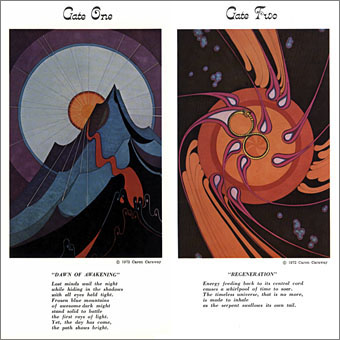
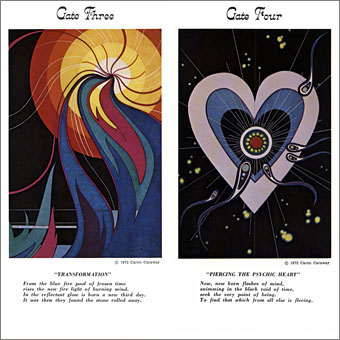
I Am The Center is a curious album in that it embraces both the recent New Age music label while also harking back to the spiritual yearnings of the 1970s. The general effect is of an impossible collision between the Harold Budd of Pavilion of Dreams, Steve Hillage’s Rainbow Dome Musick, and the lighter moments of Alice Coltrane. Many of the tracks are so good I’ve been searching through Discogs.com to discover more about the artists which is how I came across this album art from Wilburn Burchette. Witch’s Will is Burchette’s track on I Am The Center, from his Guitar Grimoire (1973) album. Looking through his discography, with its attention-grabbing titles and cover art, it’s surprising that his albums haven’t yet been reissued. This will no doubt change soon, especially when his music is like an American equivalent of Achim Reichel’s spacey guitar improvisations. The sleeve and booklet art for Wilburn Burchette Opens The Seven Gates Of Transcendental Consciousness is by Caren Caraway, and the album features notes by the indefatigable UFO/paranormal researcher Brad Steiger. They really don’t make them like this any more.

Joe Muggs enthused about I Am The Center last month for FACT. As I said about the Outer Church album earlier this year, compilations provide an invaluable service in concentrating the attention on overlooked or under-examined areas of music. I’m looking forward to seeing what emerges in the wake of this one.

Continue reading “Opening the Seven Gates of Transcendental Consciousness”

Hodgsonian vibrations

utpatel.jpg

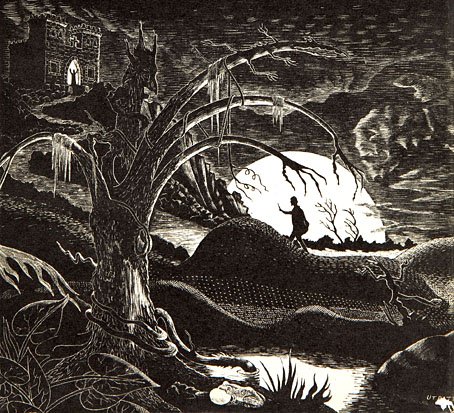
Illustration by Frank Utpatel from the 1947 Arkham House edition of Carnacki, the Ghost-Finder.

“Presently I got hold of myself a bit, and marked out a pentacle hurriedly with chalk on the polished floor; and there I sat in it almost until dawn. And all the time, away up the corridor, the door of the Grey Room thudded at solemn and horrid intervals. It was a miserable, brutal night.”

The Gateway of the Monster (1913) by William Hope Hodgson

“Word falling – Photo falling – Time falling – Break through in Grey Room”

The Ticket That Exploded (1962) by William S. Burroughs

Among other things, 2013 is the centenary of the first book publication of William Hope Hodgson’s collection of weird tales, Carnacki, the Ghost-Finder, and while I don’t believe that William Burroughs was referring to the supernatural eruption that occurs in Hodgson’s Grey Room it would be remiss of me to ignore the connection. Listening this week to Music for Thomas Carnacki by Jon Brooks (he of The Advisory Circle) had me wondering whether there’s any other Hodgson-derived music of note. Lovecraft has inspired hours of musical endeavour while Hodgson’s weird contemporaries, Algernon Blackwood and Arthur Machen, are referenced on some of the Ghost Box releases. Hodgson is the poor relation in these celebrations, often passed over despite the sonic potential of Carnacki stories such as The Whistling Room, The Horse of the Invisible, and especially The Hog, a tale whose manifestations are almost wholly perceived through the medium of sound. Searching around turned up the following examples.

tactile.jpg

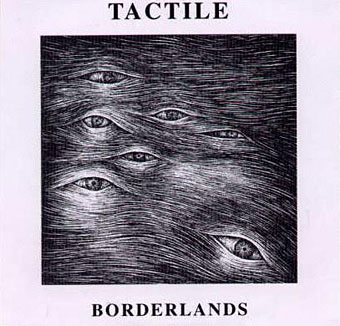
Borderlands (1999) by Tactile.

The House on the Borderland is the big favourite in this list, this album being a series of tracks by John Everall based on Hodgson’s novel. John Balance of Coil appears on the first track, Grief, reading the poem which opens the book.

Continue reading “Hodgsonian vibrations”

Tentacles #2: The Lost Continent

lost4.jpg

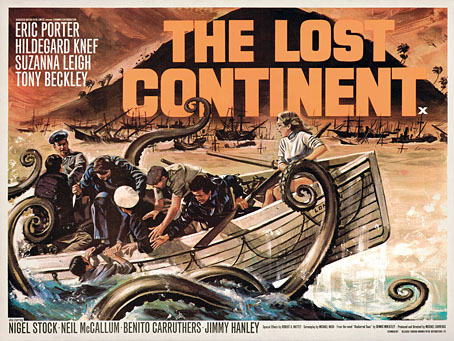
If William Hope Hodgson’s The Boats of the ‘Glen Carrig’ represents the Sublime of tentacular sea fiction then The Lost Continent, a 1968 Hammer film based on Dennis Wheatley’s 1938 novel Uncharted Seas, is the correspondingly Ridiculous end of the subgenre. The Lost Continent is an irritating film for Hodgson enthusiasts since it’s still the most Hodgsonian film out there, at least where the Sargasso side of things is concerned.

uncharted1.jpg

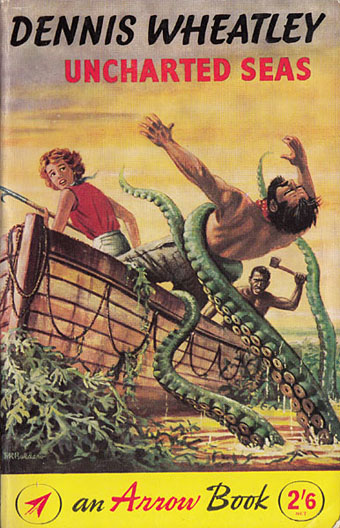
Illustration by SR Boldero (1960).

Despite its Wheatley origins the similarities to Hodgson’s sea stories are no coincidence: Wheatley chose two Hodgson titles—Carnacki, the Ghost-Finder and The Ghost Pirates—for the Dennis Wheatley Library of the Occult series that Sphere Books published in the 1970s. In the introductions Wheatley notes that Hodgson was a favourite writer whose work he discovered in the 1920s; he also mentions having collected a set of Hodgson first editions. Wheatley could have justifiably claimed that the “Weed-World” as a location wasn’t unique to Hodgson but Uncharted Seas also features the giant crabs, marauding octopuses and besieged castaways familiar from The Boats of the ‘Glen Carrig’ and the short stories.

Continue reading “Tentacles #2: The Lost Continent”