Home of the Brave

hotb1.jpg

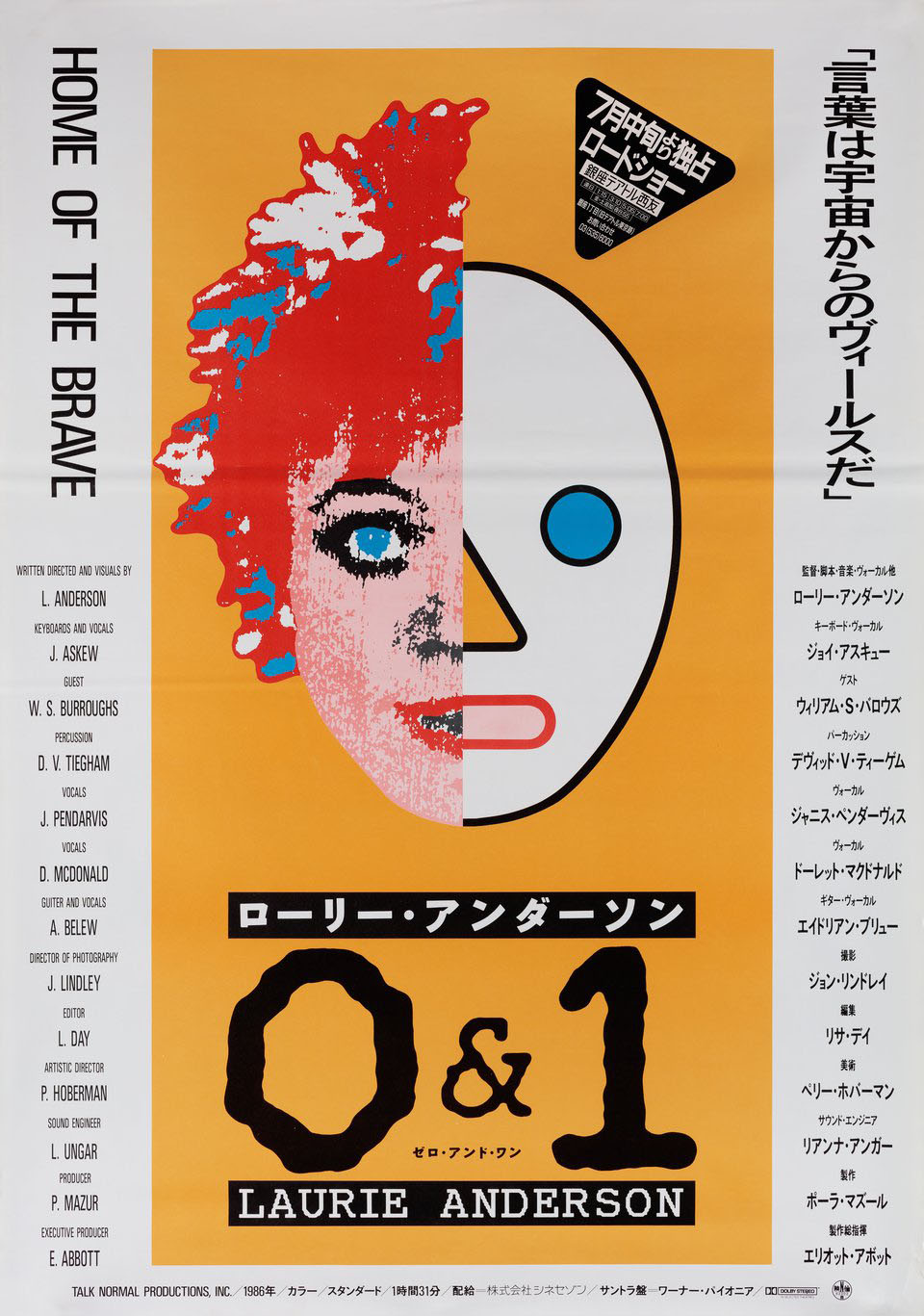
A Japanese poster.

Home of the Brave is a Laurie Anderson concert film from 1986 that more people might know about if it hadn’t been out of circulation for the past thirty years. The reason for the unavailability remains a mystery; Anderson announced a DVD release in 2007 but so far nothing has materialised. Whatever the explanation may be, this copy (which appears to be a Laserdisc rip) is better than the VHS transfers that circulate elsewhere.

hotb2.jpg

The concert itself is a 90-minute multimedia stage show built around the songs from Anderson’s second album, Mister Heartbreak. Between the album songs there are quirky, sketch-like interludes together with a reworked version of Language Is A Virus from her United States show, which was later reworked again for a single release. The album transcription extends to the projected visuals which incorporates graphics from Anderson’s design for the album cover, elements which show her to have been an early user of Macintosh computers. The Chicago font which was the default for the original Mac OS is a recurrent presence here, even being used for the title of the film on the posters and the cover of the soundtrack album. Another recurrent presence is William Burroughs, a friend of Anderson’s whose inimitable voice turns up on the last song on Mister Heartbreak, Sharkey’s Night. Burroughs’ first appearance in the film occurs when he and Laurie Anderson waltz across the stage, probably the first and last time that Burroughs was ever persuaded to dance in public.

hotb3.jpg

As for the music, if you’re as familiar as I am with Mister Heartbreak it’s good to see the songs from the album presented in live versions by some of the album’s musicians: Adrian Belew (playing guitar between stints in King Crimson), David Van Tieghem (percussion), and Dolette McDonald (backing vocals). This was Laurie Anderson’s first overtly pop-oriented outing (if you can call something “pop” that features William Burroughs and a song dedicated to Thomas Pynchon), but the stage show is filled with moments that aren’t so different to her earlier performances: solo keyboard spots, textual projections (one of which has her handwritten musings about the title of the show), unusual instruments (the tape-loop violin, body percussion, a keyboard tie), processed voices, and so on. The overall effect is simultaneously weird and playful, with the songs and general activity preventing the show from coming across like a low-key comedy act, the way United States often does. A proper reissue would be preferable but for now this is about the best you can get.

Previously on { feuilleton }
Going beyond the zero
Ear to the Ground

Weekend links 793

junichiro.jpg

Shinagawa, Tokyo Tower (Tokaido Station 1) (1967) by Sekino Jun’ichiro.

• “The historical figures who interested [Cormac] McCarthy the most, judging by the number of books he owned about them, were Albert Einstein (114 books), Winston Churchill (88) and James Joyce (78). Architecture is the dominant subject in the collection, with 855 books. The human being whom McCarthy most admired, Dennis confirms, was Ludwig Wittgenstein. The team catalogued a staggering 142 books by or about the philosopher, with a high proportion annotated.” Richard Grant for Smithsonian Magazine reports on the cataloguing of Cormac McCarthy’s personal library.

• The Real City of the Future: a long read by Charles T. Rubin taking in William Gibson’s urban fictions and Paolo Soleri’s towering Arcologies.

• At Colossal: “Atmospheric oil paintings by Martin Wittfooth illuminate nature’s timeless cycles.”

• Old music: White Souls In Black Suits by Clock DVA, receiving its first reissue since 1990.

• At the BFI: Carmen Gray on where to begin with Sergei Parajanov.

• At Ultrawolvesunderthefullmoon: The art of Sekino Jun’ichiro.

• At Dennis Cooper’s: Unica Zürn Day (restored and expanded).

• New music: Imploded Versions by The Bug vs. Ghost Dubs.

• The Strange World of…Van Morrison.

Dev Hynes’ favourite albums.

Carnival Of Souls (1989) by David Van Tieghem | All Souls (1989) by Opal | The Cult Of Souls (2011) by The Wounded Kings

Weekend links 708

nash.jpg

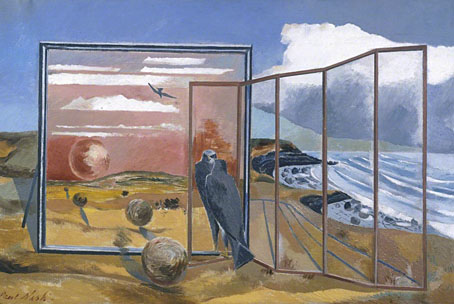
Landscape from a Dream (1936–38) by Paul Nash.

• “I was telling a close friend recently, ‘at my funeral, please play this record…’” Yu Su on her love of Laurie Anderson’s second album, Mister Heartbreak.

• “Surrealism is more of an attitude than an art movement,” says Mark Polizzotti, talking about his new book, Why Surrealism Matters.

• New music: Spinning by Julia Holter; The Night Dwells In The Day by Jozef Van Wissem; and The River Of Light And Radiation by Ben Frost.

• The late David J. Skal, author of Hollywood Gothic and others, is remembered at Swan River Press.

• At Colossal: Dizzying gifs by Etienne Jacob infuse mathematical equations into endless loops.

• At Public Domain Review: Charles Rabot’s Arctic photographs (ca. 1881).

• At Unquiet Things, S. Elizabeth says “Help me downsize my library!

Drone footage of the recent volcanic eruption in Iceland.

• Mix of the week is a mix for The Wire by Kavari.

• At Dennis Cooper’s: Robert Bresson Day.

Dance On A Volcano (1975) by Genesis | Volcano Diving (1989) by David Van Tieghem | Eye Of The Volcano (2006) by Stereolab

Weekend links 568

gekko.jpg

Dragon Rising to the Heavens (1897) by Ogata Gekko.

• “Electronic music of the past is often portrayed in a dreamy, magical light—a hazy historical landscape filled with misty, otherworldly sounds. But while the music of a bygone era may seem ineffable, it is not inaccessible.” Geeta Dayal reviews Reminded by the Instruments: David Tudor’s Music by You Nakai.

• Modular Therapy: Mute Records boss Daniel Miller and former snooker champ turned kraut-psych powerhouse Steve Davis discuss their love of modular synthesisers, ill-fated Jools Holland collaborations, commandeering Elton John’s ARP 2600 and more.

• “Some contemporary art is a little bit like an intellectual game…I’m not a big fan of this kind of stuff, because I’m a musician.” Ryoji Ikeda presents: point of no return.

One of the tunnels that Turrell has completed is 854 feet long. When the moon passes overhead, its light streams down the tunnel, refracting through a six-foot-diameter lens and projecting an image of the moon onto an eight-foot-high disk of white marble below. The work is built to align most perfectly during the Major Lunar Standstill every 18.61 years. The next occurrence will be in April 2025. To calculate the alignment, Turrell worked closely with astronomers and astrophysicists. Because the universe is expanding, he must account for imperceptible changes in the geometry of the galaxy. He has designed the tunnel, like other features of the crater, to be most precise in about 2,000 years. Turrell’s friends sometimes joke that’s also when he’ll finish the project.

Wil S. Hylton on an exclusive visit to James Turrell’s astronomical art complex at Roden Crater, Arizona. Related: 147 Orbiting 1 Through 6 for 5, Music for Roden Crater by Paul Schütze (with free download of an excerpt from the 5-hour piece)

• New music: The Black Mill Tapes, Volume 5 by Pye Corner Audio, and Interreferences by Richard Chartier.

• At Spoon & Tamago: Dense pencil drawings of retro-future worlds by Yota Tsukino.

“‘I’m bursting with fiction’: Alan Moore announces five-volume fantasy epic”.

• At Dennis Cooper’s: Lindsay Anderson Day.

Beverly Glenn-Copeland’s favourite music.

Volcano Diving (1989) by David Van Tieghem | Crater Scar (1994) by Main | Eye Of The Volcano (2006) by Stereolab

Ear to the Ground

tieghem.jpg

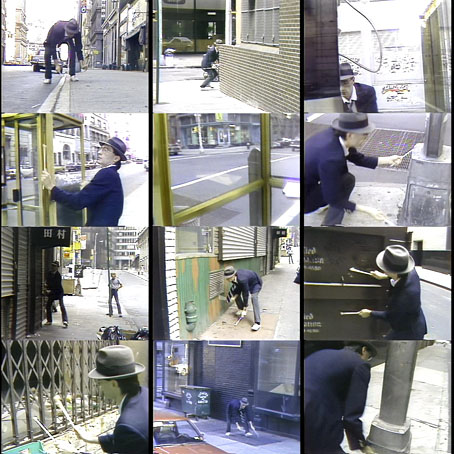
The name of percussionist David Van Tieghem won’t be familiar to most people, but if you’ve ever heard Eno & Byrne’s My Life In The Bush Of Ghosts, Speaking In Tongues by Talking Heads, any of Laurie Anderson’s early albums or Steve Reich’s Music For 18 Musicians then you’ve heard some of Van Tieghem’s session work.

For Ear to the Ground, a four-minute video piece by John Sanborn & Kit Fitzgerald, Van Tieghem leaves the recording studio to play the city streets of New York: pavements, fences, doorways, etc. This may be a typical product of the NYC art crowd of the late 1970s but it also seems prescient for the way it predicts the urban percussion/performance that would flourish a couple of years later in Europe, a micro-genre exemplified by Einstürzende Neubauten, 23 Skidoo, Test Department, the Bow Gamelan Ensemble and others. Watch Ear to the Ground at Ubuweb.