The fantastic and apocalyptic art of Bruce Pennington

pennington-pastel.jpg

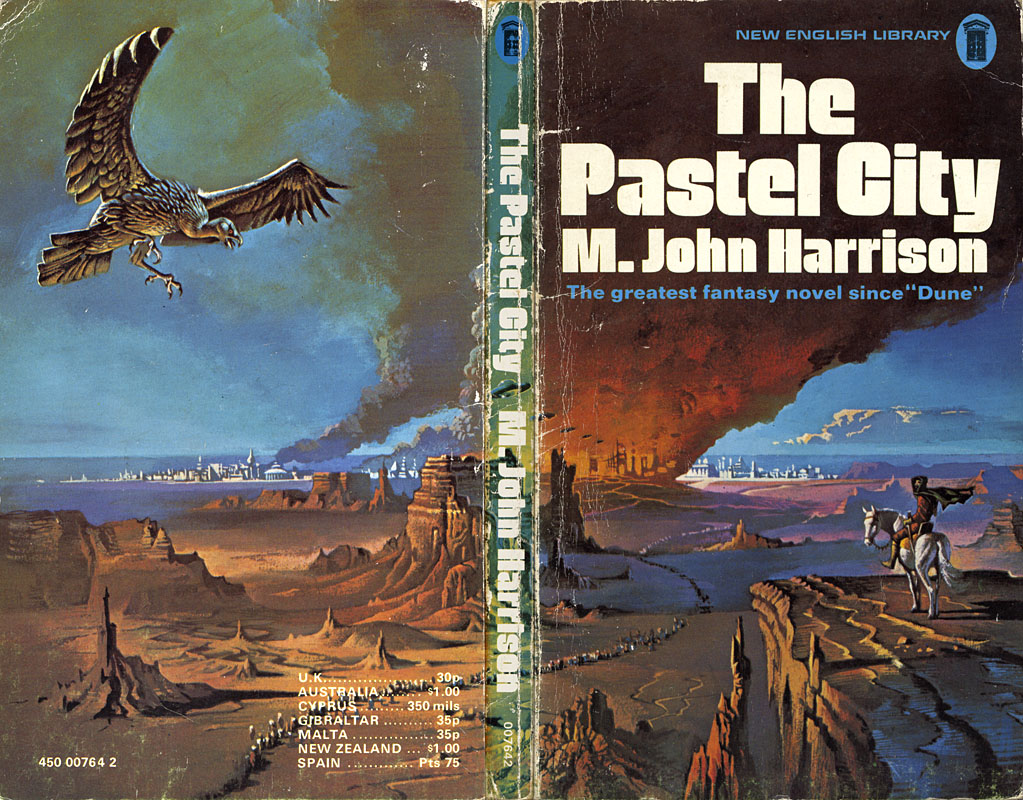
The Pastel City (1971), the first in M. John Harrison’s peerless series of Viriconium books.

Today’s post is another guest entry over at Tor.com. I’d been intending on writing something about Bruce Pennington‘s art for some time, having already covered the work of Ian Miller, my other favourite genre cover artist of the 1970s. (By coincidence both artists have illustrated the work of M. John Harrison and HP Lovecraft.) My hand was forced this month by the news of the first ever exhibition of Pennington’s paintings which is being held at Britain’s foremost occult book emporium, the Atlantis Bookshop in Museum Street, London. There’s a catalogue of the works on display here, many of which will be for sale. If I had the cash I’d consider buying one, Pennington’s work made a big impression on my imagination when I was reading many of the titles he’d illustrated for the first time. His art was unique for me in its occasionally Surrealist overtones, and as a cover artist he was unusual in working across a range of genres. Like Frank Frazetta his imagination and technique were able to suggest a great deal with a minimum of brush strokes.
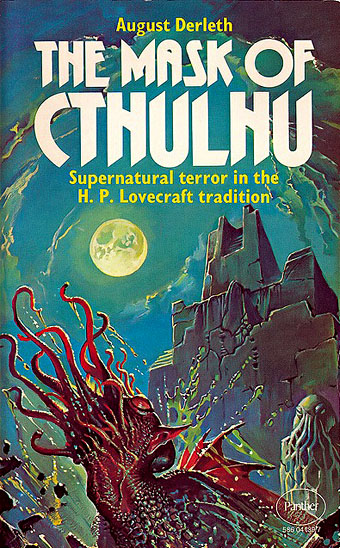
pennington-cthulhu.jpg

The Mask of Cthulhu (1976).

This post can be taken as an appendix to the Tor one which I didn’t want to overburden with pictures. The Derleth cover is purloined from Jovike’s excellent Flickr collection which includes several Pennington covers. Below are some pages from Pennington’s first book, Eschatus, a large-format collection of paintings interpreting the prophecies of Nostradamus as an apocalyptic science fiction narrative taking place in the 24th century.

Pennington has many examples of his work on his website, and there’s also a feature about his paintings in this month’s Fortean Times. The Atlantis exhibition runs to August 27th.

pennington-eschatus1.jpg

Eschatus (1976).

Continue reading “The fantastic and apocalyptic art of Bruce Pennington”
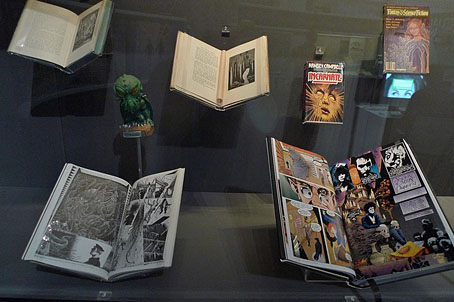
Cthulhu under glass

bl-exhibition.jpg

Having had two separate visitors to the British Library’s Out of this World exhibition tell me that some of my work was featured there, it’s been a good to finally discover what was on display. Many thanks to John Keogh for notifying me of his exhibition photo set which includes the above shot of the relevant display case. This is an odd collection for what’s been widely advertised as a science fiction event. Pages from my 1988 adaptation of The Call of Cthulhu are in there along with other fantasy and horror titles including Neil Gaiman’s Sandman, Incarnate by Ramsey Campbell, an edition of Fantasy & Science Fiction with Robert Holdstock’s Mythago Wood on the cover, and a Sidney Sime illustration for Lord Dunsany’s Gods of Pergana. Cthulhu originates out of this world, of course, and that phrase is general enough to encompass other genres.

coulthart-cthulhu.jpg

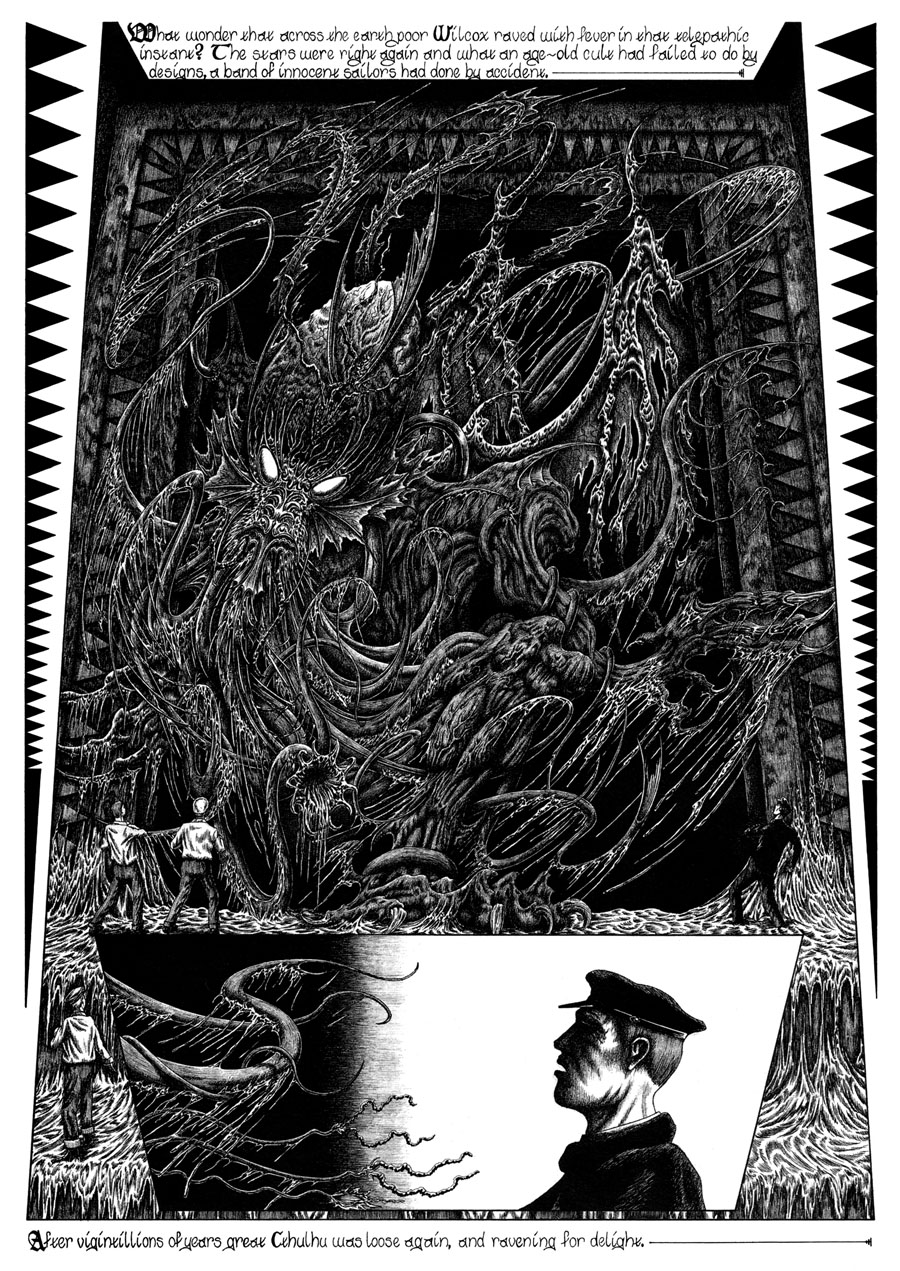
This page from the climax of Lovecraft’s story was the first drawing I made of the living Cthulhu, all earlier representations following Lovecraft’s scheme of the creature manifesting throughout history in different human artworks and religious icons. Since most of those representations are highly stylised I wanted to make the awful reality seem a lot more visceral and even incoherent, hence the mass of flailing tentacles and ropes of slime. This is also the only full view you receive, everything else is fragmentary and allusive so there’s space for the reader’s imagination. I think the book in the library display is the Lovecraft anthology The Starry Wisdom but The Call of Cthulhu is also present in my Haunter of the Dark collection which includes a couple more portraits of “the green, sticky spawn of the stars”.

Out of this World is a free exhibition which will run to September 25th, 2011.

Elsewhere on { feuilleton }
The Lovecraft archive

CthulhuPress

keepcalmcthulhu2.jpg

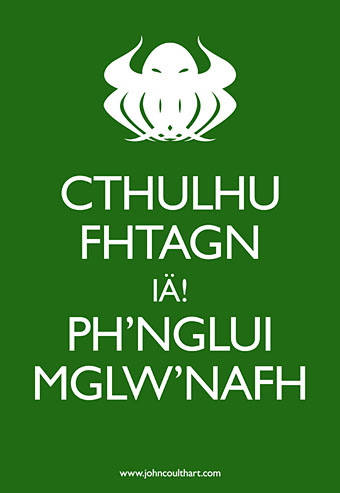
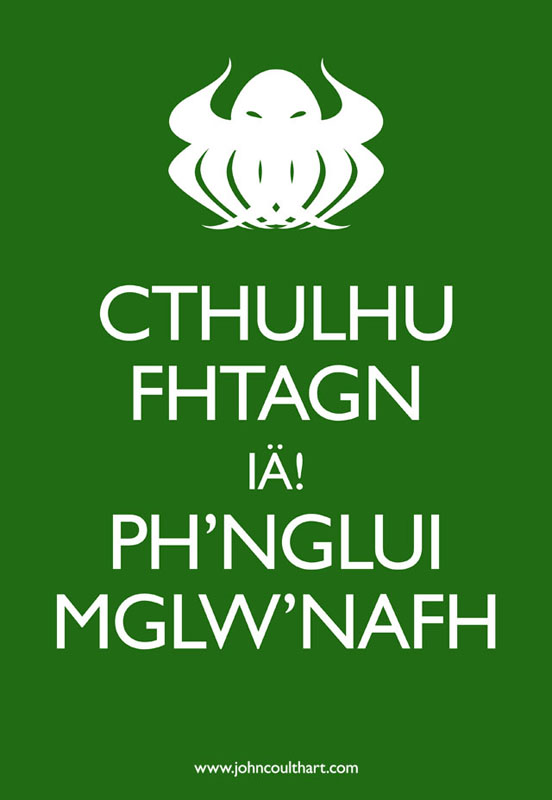
The Twitter consensus yesterday was that CafePress products based on this design were required so here they are. As usual I never know what people want from CafePress so I tend to throw the design on their entire range so long as it fits the requisite size and shape. This piece works better than most since it’s simple and direct, my more detailed and pictorial creations look better as prints. I keep feeling that someone must have made a design like this already, these variations on the “Keep Calm” poster have proliferated so much, but searching didn’t reveal anything so… The web address doesn’t appear on the CafePress things, that’s just for the images posted here if and when they drift into Tumblr’s Sargasso Sea of uncredited pictures.

coc.jpg

The Call of Cthulhu (1987–88).

While we’re on the subject of everyone’s favourite Great Old One, I may as well take the opportunity to remind those interested that these earlier renderings are also available as various CafePress products. The Call of Cthulhu piece above is the opening page of my comic strip adaptation of the story as seen in The Starry Wisdom anthology from Creation Books and my Haunter of the Dark collection.

cthulhu.jpg

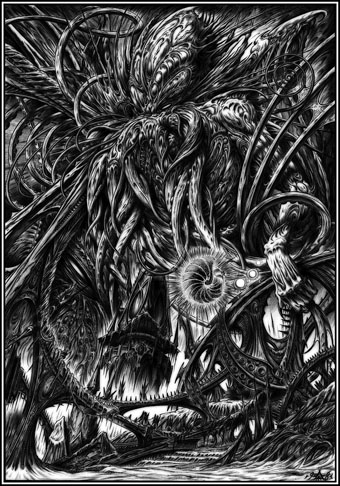
Cthulhu from The Great Old Ones (1999).

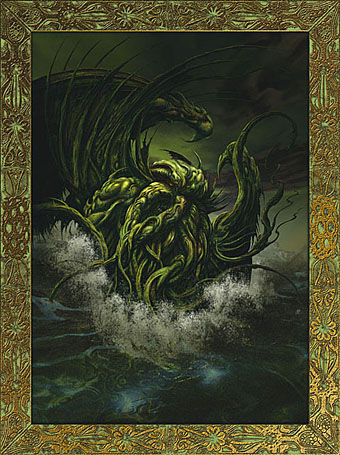
The Great Old Ones drawing was one of the plates from the series of the same name I produced with Alan Moore for the Haunter book. And Cthulhu Rising is the cover of that volume, of course, seen here with its Haeckel-derived frame. The Great Old Ones Cthulhu was drawn with a Biro pen then tweaked slightly in Photoshop. I don’t think I’ve ever posted a large version of it so here it is.

cthulhu2004.jpg

Cthulhu Rising (2004).

Elsewhere on { feuilleton }
The Lovecraft archive

Weekend links 45

sa4.jpg

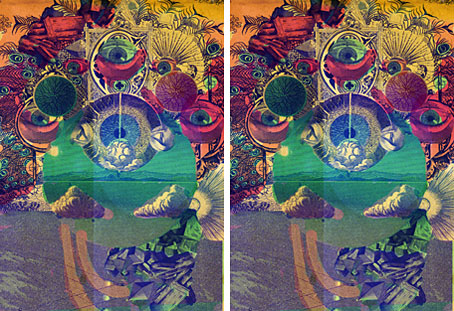
That essential journal of esoteric culture, Strange Attractor, announced a fourth number this week sporting a psychedelic cover which may be the work of Julian House (no credit is given on the SA site). As to the contents:

From Haiti and Hong Kong to the fourth dimension and beyond: discover the secrets of madness in animals; voodoo soul and dub music; ancient peacock deities; Chinese poisoning cults; the history of spider silk weaving; heathen mugwort magic; sentient lightning; Jesuit conspiracy theories; junkie explorers; Dali’s Atlantis; the resurgence of Pan (in London’s Crouch End); anarchist pirates on Madagascar; an ancient Greek Rip Van Winkle; French anatomical waxworks; Arthur Machen’s forgotten tales and Alan Moore’s unpublished John Dee opera.

Further details and the means to order a copy can be found here.

• Resonance FM’s Weird Tales For Winter has returned beginning with a presentation of The Gateway of the Monster, one of the better Carnaki tales by William Hope Hodgson. The story is read by Moon Wiring Club‘s Ian Hodgson (no relation) and the musical atmospheres are provided by The Advisory Circle. I ought to have posted this news yesterday since you’ll have missed the broadcasting of the first half but the second half will go out at midnight (UK time) on Monday. Details here, and the next release on the Café Kaput label in February will be the soundtrack, Music for Thomas Carnaki (Radiophonic Themes & Abstracts).

keepcalmcthulhu2.jpg

• The Keep Calm and Carry On Image Generator lets you work your own variations on the ubiquitous poster. It wouldn’t work for me, however, so I rolled up my sleeves and made my own. This may be good as a CafePress design, yes?

Interplay is an album by John Foxx and The Maths due to be released on March 21st. As with last year’s collection of Foxx instrumental pieces, DNA, the package design is by Jonathan Barnbrook. John Foxx first came to prominence as the lead singer in Ultravox (do I need to say “of course”? Okay…“of course”) and Ultravox’s debut album was part-produced by Brian Eno. It’s been painfully obvious recently (and it pains me to say it) that Foxx’s DNA was a far more accomplished and engaging work than Eno’s recent collection of over-hyped instrumentals. Related: Barnbrook Design’s albums of 2010.

Word Horde 2.0, “a substantial archive of manuscript material, correspondence, and books and printed matter, mostly signed” from the William Burroughs archives can be yours for $260,000. Related: William Burroughs’ Wild Boys photos. Also: Rudy Rucker on David Cronenberg’s Naked Lunch.

• “Nabokov described how ‘a modern taxonomist straddling a Wellsian time machine with the purpose of exploring the Cenozoic era’ would encounter the following series of events in the evolution of these butterflies…” The Royal Society confirms that a contentious theory of Vladimir Nabokov’s concerning the descent of butterfly populations was accurate.

• The work of Gérald Bertot aka Thomas Owen, a Belgian author of weird fiction, is explored at A Journey Round My Skull.

The Other Side of the Wind, Orson Welles’ unfinished film from 1972, may finally be given a release.

• Jon Savage celebrates Roy Harper and his extraordinary Stormcock album.

Philip Pullman wants the Tory philistines to leave our libraries alone.

• Rick Poynor takes a dérive through the arcades of Paris.

Space music new and old.

Young Savage (1977) by Ultravox | Clicktrack (2010) by John Foxx & Jonathan Barnbrook.

Outcrops

hvitserkur.jpg

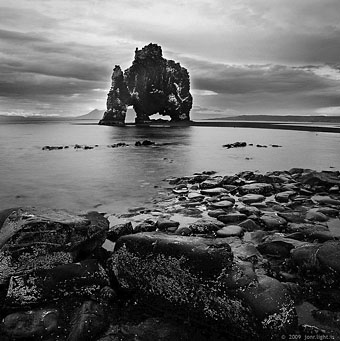
Hvítserkur, Vestur-Hunavatnssysla, Iceland. By Flickr user jónr.

I hadn’t come across this feature of north-west Iceland before until a view turned up in Flickr’s Explore. The place is a tourist site so there are many more such views.

ailsa_craig.jpg

Ailsa Craig by Flickr user atomicjeep.

Hvítserkur reminded me of Aisla Craig, a volcanic island a few miles from Girvan on the west coast of Scotland. I’ve seen Aisla Craig from the shore and can testify to its imposing presence, and also the way its appearance changes depending on the weather and time of day.

balls_pyramid.jpg

Both these pale into insignificance next to Ball’s Pyramid, a volcanic stack in the Tasman Sea which is 562 meters in height and looks like it might be Cthulhu’s second home. Flickr has further views of this spectacular eruption but not as many as you might hope.