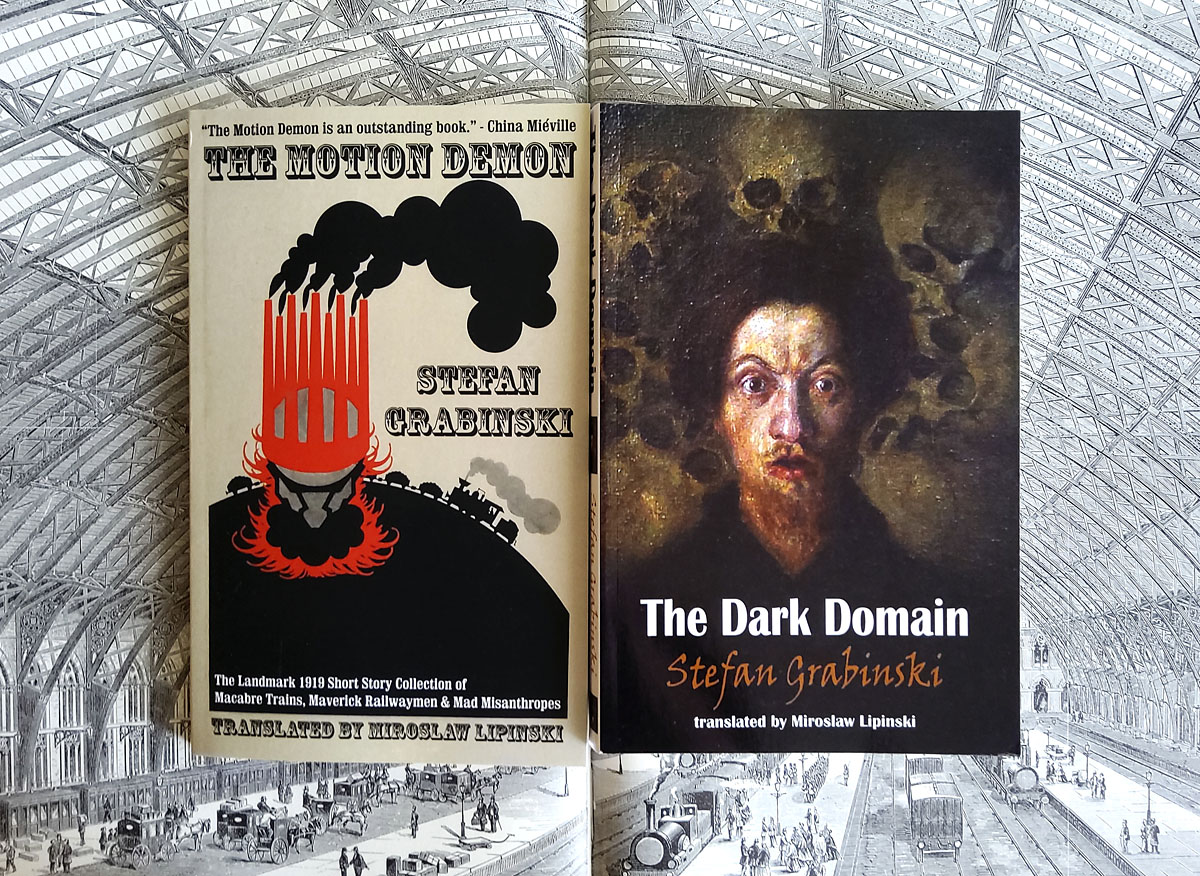
Demons by rail-light: Stefan Grabiński’s weird fiction

grabinski.jpg

Thanks to the demons of distraction it’s taken me a long time to find my way to these books by Polish author Stefan Grabiński (1887–1936) but I’m very pleased to have done so at last. Grabiński was one of several writers first drawn to my attention by Franz Rottensteiner’s The Fantasy Book: The Ghostly, the Gothic, the Magical, the Unreal (1978), a lavishly illustrated popular study that charted the history of fantasy and horror fiction. The book is inevitably dominated by Anglophone authors but Rottensteiner was looking at the genres from a global perspective, to an extent that some of the writers in the sections devoted to Continental Europe were either difficult to find or, as with Grabiński, hadn’t yet been translated into English. Robert Hadji’s Grabiński entry in the Penguin Encyclopedia of Horror and the Supernatural (1986) further stoked my curiosity. Neither Rottensteiner nor Hadji mention how they came to read these obscure tales but I’d guess it was in the two collections published in Germany under the Bibliothek des Hauses Usher imprint, Das Abstellgleis (1971) and Dunst und andere unheimliche Geschichten (1974); several covers from the imprint appear in Rottensteiner’s book. Wherever it was that they read the stories, both writers praised Grabiński as an overlooked master of weird fiction. Rottensteiner notes that he was a contemporary of HP Lovecraft, and with a similar biography—briefly married and suffering artistic neglect during his lifetime—but neither Rottensteiner nor Hadji use the common shorthand descriptions of Grabiński as “the Polish Poe” or “the Polish Lovecraft”. These labels are intriguing but misapplied.
grabinski2.jpg

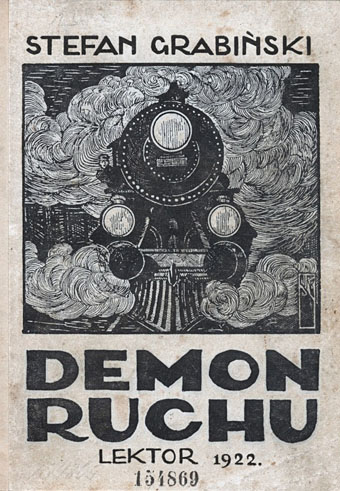
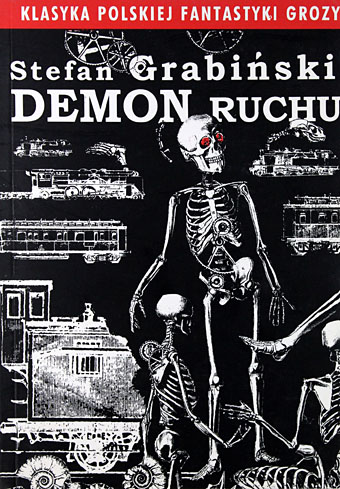
Bearing in mind that these stories are translated works, one of the surprises of finally reading them is how fresh they seem compared to so many British ghost stories from the same period. Grabiński was writing during the birth of Modernism but the stories of his Anglophone contemporaries can often read like the products of an earlier epoch. His economical prose lacks the ornamentation of Poe and Lovecraft, just as it lacks Poe’s morbid Romanticism and has nothing of Lovecraft’s cosmic scale. But there are recurrent themes, particularly that of possession, whether by the spirits of the dead, by inhuman elementals, or by idée fixe. The latter provides the subject of The Glance, a story that also demonstrates Grabiński’s knack of finding horror in the most mundane situations: a man whose wife died prematurely is troubled by the sight of an open door, the same door through which she walked out of his life, and subsequently, out of her own. The man’s obsession with the door grows into a fear of closed doors and the implicit tragedies they may conceal, an obsession that soon extends itself to anything that hides too much of the world: curtains, rugs, the sharp corners of city streets… Edgar Allan Poe was fond of cataloguing madness in this manner but Grabiński’s stories go beyond glib formulations of insanity. “Metaphysical” is a word often used in discussion of the Grabiński oeuvre; the fixations of his protagonists reveal truths about the world to which others are blind.
grabinski3.jpg

Continue reading “Demons by rail-light: Stefan Grabiński’s weird fiction”
Unearthly tones

belbury.jpg

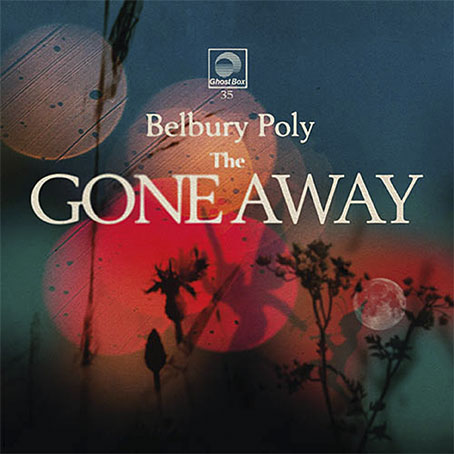
Design, as always, is by Julian House.

“…we shall only be delivered from our afflictions by sayings and doings that are altogether irrational, paradoxical, and magical: the wild songs of fairyland, sung to unearthly tones, are the only medicine for the heartache and the headache of humanity.”

Arthur Machen, A Note on Asceticism (The Academy, 27th May, 1911)

This quote from the Apostle of Wonder, which will appear on the forthcoming album from Belbury Poly, is one I hadn’t seen before; serves me right for not subscribing to Faunus where the piece was reprinted in 2017. It’s been a while since Machen’s name has appeared in association with Ghost Box even though the label originates from the same area of South Wales that was the writer’s birthplace, a detail that gave the early Ghost Box releases additional resonance. One of the attractions of the Ghost Box recordings was the intersection between quotes and titles from weird literature with electronic music derived from library albums and theme tunes from the 1960s and 70s; Witch Cults Of The Radio Age, as Broadcast & The Focus Group memorably put it. It was a beguiling mix which the label’s more recent releases have increasingly diluted: the rear-view musical themes are still in evidence but the weird quotient has been diminished, giving the listener a box without a ghost. (Pye Corner Audio, whose last album was an exploration of subterranean realms, is a notable exception.) I feel uncomfortable drawing attention to this since it’s tantamount to saying “Please don’t change!”. But it’s also the case that a label devoted solely to Basil Kirchin pastiches might never have attracted my attention in the first place.

The description of new Belbury Poly album, The Gone Away, reaffirms the label’s commitment to its weirder side:

The Gone Away’s 11 tracks are inspired by British fairy folklore, especially its recurrent themes of things that always seem on the point of leaving or vanishing. Also there’s the notion of things that can’t be seen head on but are only glimpsed from the corner of the eye. A scorned and neglected corner of folklore, beguiling and bonkers in equal measure. Of course, this being a Ghost Box record, these themes are received through the prism of old TV soundtracks, and the credulous beliefs and childhood obsessions of a pre-digital age.

Anyone who’s read Arthur Machen’s The Shining Pyramid will know that fairy folklore in his stories conceals a darker and more malevolent manifestation of the supernatural. His comment about “unearthly tones” suggests a different point of view. The Gone Away will be released on 28th August.

Previously on { feuilleton }
The White People by Arthur Machen
Ghost Box

A Czech Machen

machen.jpg

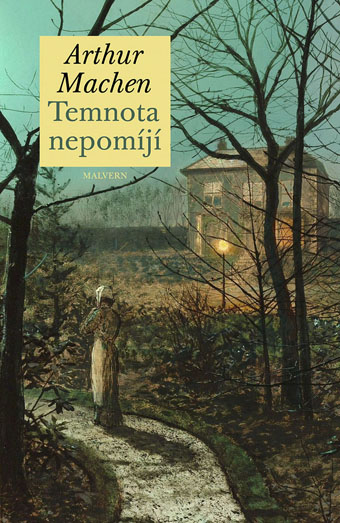
Cover art is a detail from A Woman on a Path by a Cottage (1882) by John Atkinson Grimshaw.

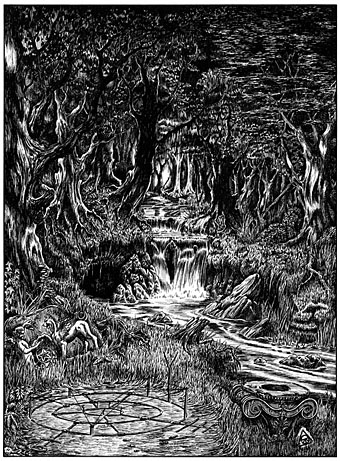
The fiction of Arthur Machen doesn’t inspire a great deal of illustration, probably because his best writing is more concerned with the description of particular places and the feelings those places evoke, rather than the depiction of illustratable scenes or events. I did make the attempt myself, however, when I started a series of illustrations in 1990 that were intended for a Savoy Books edition of The White People. This never materialised for a variety of reasons, and I never finished the series of drawings although the work did yield one picture (below), that I’ve always been pleased with.

whitepeople.jpg

Some of these drawings may now be seen in Temnota nepomíjí, an edition of Machen’s stories from Czech publisher, Malvern, almost all of which are appearing for the first time in translation. I’m told by the translator, Patrik Linhart, that the title in English would be “Darkness is undying”. As for the cover art, I approve the choice of John Atkinson Grimshaw, a painter whose sombre, autumnal views could cover an entire series of Machen books. His work is often seen today in connection with MR James but being a predominantly urban artist his work seems a better match for the Apostle of Wonder.

Previously on { feuilleton }
Ibrahim Ineke’s The White People
The White People
The Bowmen by Arthur Machen
Rex Ingram’s The Magician
The Great God Pan

Weekend links 469

X.jpg

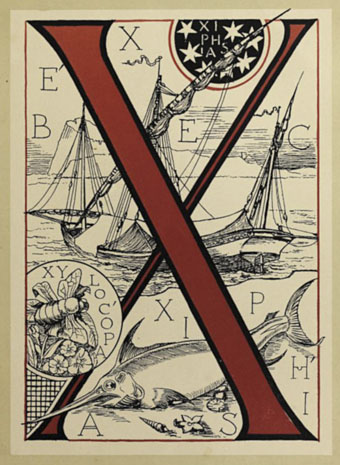
X from Theodore Howard’s ABC (1880) by Theodore Howard.

• “[Parade] has everything: joy and sadness, get-down and wistfulness, mourning and melancholia, group funk and Debussy interludes, echoes of Ellington, Joni, film music, chanson. It’s a perfectly realised whole.” Ian Penman on the enigmas and pleasures of Prince.

• “Mescaline reads like the culmination of a lifetime’s wanderings in the very farthest outposts of scientific and medical history.” Ian Sansom review’s Mike Jay’s history of the psychedelic alkaloid.

• The Day the Music Burned by Jody Rosen: “It was the biggest disaster in the history of the music business—and almost nobody knew. This is the story of the 2008 Universal fire.”

This willing constriction of intellectual freedom will do lasting damage. It corrupts the ability to think clearly, and it undermines both culture and progress. Good art doesn’t come from wokeness, and social problems starved of debate can’t find real solutions. “Nothing is gained by teaching a parrot a new word,” Orwell wrote in 1946. “What is needed is the right to print what one believes to be true, without having to fear bullying or blackmail from any side.” Not much has changed since the 1940s. The will to power still passes through hatred on the right and virtue on the left.

George Packer on what George Orwell’s Nineteen Eighty-Four means today

• Having spent the past week watching Jacques Rivette’s 775-minute Out 1, this interview with Rivette from 1974 was of particular interest.

• At Dangerous Minds: Donald Sutherland as “a sperm-filled waxwork with the eyes of a masturbator” in Fellini’s Casanova.

The Adventures of the Son of Exploding Sausage (1969): the Bonzo Dog Band getting it untogether in the country.

• Dark, velvety dark: Nabokov’s discarded ending to Camera Obscura, introduced by Olga Voronina.

• “Spotify pursues emotional surveillance for global profit”, says Liz Pelly.

• Mix of the week: Then Space Began To Toll by The Ephemeral Man.

• An interview with master of horror manga Junji Ito.

• Announcing the Arthur Machen Essay Prizes.

• RIP film-maker and author Peter Whitehead.

X is for…

X Offender (1976) by Blondie | X-Factor (1981) by Patrick Cowley | X-Flies (1997) by Mouse On Mars

Weekend links 466

maar.jpg

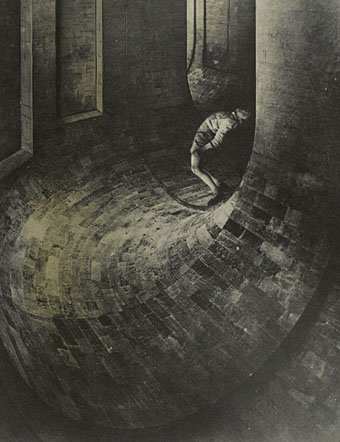
The Simulator (1936) by Dora Maar.

• Surprise of the week for me was the discovery of a new album, Kshatrya – The Eye Of The Bird, by cult French composer Igor Wakhévitch. This had been out for a while but I’d managed to miss the announcements. The music was recorded in 1999 so isn’t exactly new but it’s the first new Wakhévitch release (as opposed to a reissue or compilation) since Let’s Start in 1979. Very good it is too, almost completely electronic but not as discordant as his synth-dominated Hathor album.

• “Popol Vuh is a Mass for the heart.” Gerhard Augustin talks to Florian Fricke about Popol Vuh’s music in a “rare” (lost? previously unseen?) interview. Undated but the City Raga album is referred to as a recent release so it’s probably around 1995.

Brian Dillon on the voraciousness and oddity of Dora Maar’s pictures. Related: Rick Poynor on The Simulator by Dora Maar.

The Secret Ceremonies: Critical Essays on Arthur Machen, edited by Mark Valentine and Timothy J. Jarvis.

Juliette Goodrich on the tale of the Buchla synthesizer, the repair engineer, and a dormant drop of LSD.

Scott Tobias on Midnight Cowboy at 50: why the X-rated best picture winner endures.

• A Hidden History of Women and Psychedelics by Mariavittoria Mangini.

• Previews of Chords, the new album by composer Ellen Arkbro.

• Mix of the week: Secret Thirteen Mix 290 by Mark Stewart.

• “Somehow I became respectable,” says John Waters.

• At Dennis Cooper’s: Walerian Borowczyk Day.

• The Bandcamp Guide to Earth.

Gén #1 by Ray Kunimoto.

Secret Ceremony (Theme From Brond) (1987) by Scala (Bill Nelson & Daryl Runswick) | Healing Ceremony (1990) by African Head Charge | Ceremony Behind Screens (1995) by David Toop