Reflections of Narcissus

herman.jpg

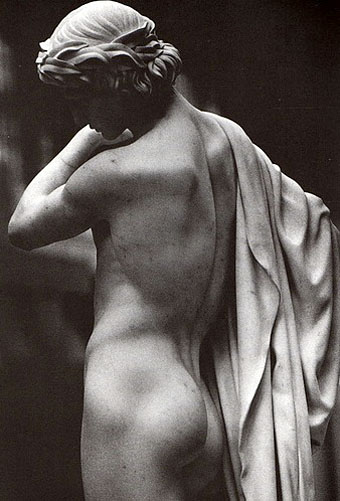
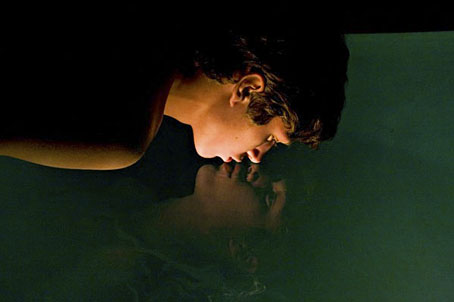
Untitled (Adrian Kissing) 2007.

The icon of male vanity returns again in a surreptitious form via this photograph by Brandon Herman from a new exhibition, My Vacation with a Kidnapper, which opens today at the Envoy Gallery, NYC, until April 19, 2008. Herman’s photography brings to the surface (so to speak) the homoerotic subtext of the Narcissus myth. Despite the most common rendering of the story being one concerning the romance between Narcissus and Echo, there are other versions:

An important and earlier variation of this tale originates in the region in Greek known as Boeotia (to the north and west of Athens). Narcissus lived in the city of Thespiae. A young man, Ameinias, was in love with Narcissus, but he rejected Ameinias’ love. He grew tired of Ameinias’ affections and sent him a present of a sword. Ameinias killed himself with the sword in front of Narcissus’ door and as he died, he called curses upon Narcissus. One day Narcissus fell in love with his own reflection in a spring and, in desperation, killed himself.

Some earlier (and favourite) artistic representations follow.
Continue reading “Reflections of Narcissus”

Sidney Sime and Lord Dunsany

sime1.jpg

‘We would gallop through Africa’ from A Dreamer’s Tales.

More from the book scans at the Internet Archive. Lord Dunsany was Edward John Moreton Drax Plunkett, 18th Baron of Dunsany and a writer of a number of fantasy tales beginning with The Gods of Pegana in 1905. His work is notable these days for having been a huge influence on the early stories of HP Lovecraft who once divided his literary output into his Poe pieces and his Dunsany pieces. Dunsany found an ideal illustrator in Sidney Sime who started out as a Beardsley pasticheur but developed his own slightly comical variant on the kind of exotica favoured by Edmund Dulac and Kay Nielsen.

Of the Dunsany/Sime books, Archive.org has The Sword of Welleran (1908), A Dreamer’s Tales (1910), The Book of Wonder (1912) and Tales of Wonder (1916). These stories are frequently too whimsical for my tastes—I’ve never been very keen on Lovecraft’s Dunsany pieces either—but they’re still worth a look for anyone interested in the lighter side of 20th century fantasy.

sime2.jpg

‘The City of Never’ from The Book of Wonder.

Elsewhere on { feuilleton }
The illustrators archive

Previously on { feuilleton }
HP Lovecraft’s favourite artists

Ballantine Adult Fantasy covers

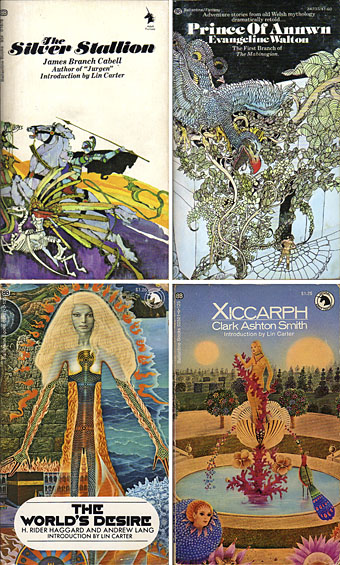
baf.jpg

top left: Bob Pepper (1969); right: David Johnston (1974).
bottom left: Mati Klarwein (1972); right: Gervasio Gallardo (1972).

I wrote about the classic line of fantasy paperbacks in the Ballantine Adult Fantasy series last year as part of the post about Bob Pepper’s illustration:

It was the success of the publication of The Lord of the Rings in America which inspired Betty Ballantine to publish a line of fantasy classics in the late Sixties. The series began its run in 1969 and continued until 1974. Lin Carter was commissioned as editor and given free reign to choose any title he thought might be suitable with the result that many of the books in the series—obscurities such as Lud-in-the-mist by Hope Mirrlees—received their first paperback publication. Carter also reprinted personal favourites which frequently shifted from fantasy to outright horror, such as the titles from HP Lovecraft and William Hope Hodgson. The range and scope of this line is what makes the series so notable today and the books have become highly-collectable as a result.

I’m fairly sure this page of cover scans of the BAF series wasn’t there when I was searching for Pepper covers. Whether it was or not, it contains a lot of Bob Pepper artwork I hadn’t seen before at large size, plus a substantial number of the other covers. I was never all that taken with Gervasio Gallardo’s work which took the lion’s share of the illustration duties but the passage of time has lent his paintings and their florid title designs the distinction of being emblematic of the era. And some of the rest are still pretty decent covers.

Elsewhere on { feuilleton }
The illustrators archive
The book covers archive

Previously on { feuilleton }
The art of Bob Pepper
Fantastic art from Pan Books

The art of Philippe Wolfers, 1858–1929

wolfers1.jpg

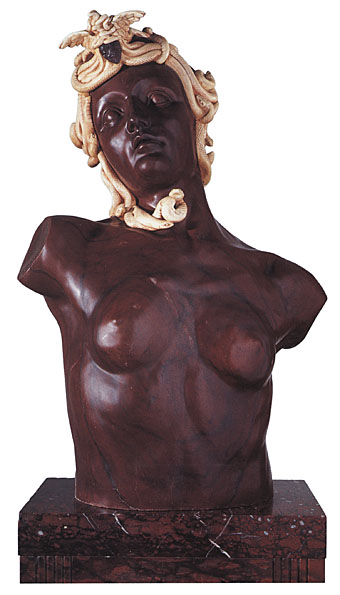
Maléficia (1905).

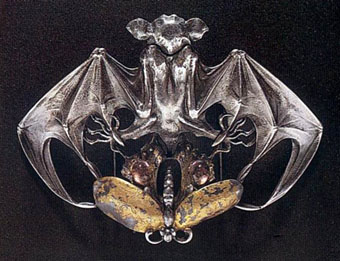
Much of the jewellery and sculpture produced by Phillipe Wolfers demonstrates the tendency of Art Nouveau and decorative Symbolism to evolve from Decadence to full-blown Gothic. The sinister recurs in Wolfers’ creations whether in the form of baleful females such as Malèficia and his Medusa pendant, or in the shape of bats, insects and the ubiquitous fin de siècle serpent. There’s more Wolfers on the web than there was a couple of years ago but still too little; I scanned Malèficia from a book and swiped the bat brooch belt buckle (also a book scan) from Beautiful Century.

wolfers2.jpg

Large dragonfly (1903–04).

wolfers3.jpg

Le Jour et la Nuit (1897).

Previously on { feuilleton }
Lalique’s dragonflies
Lucien Gaillard
The Masks of Medusa