Monsters in art

monstres1.jpg

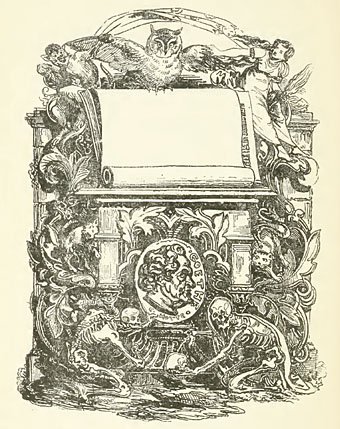
Frontispiece for Goethe’s Faust (c. 1843) by Eugène Delacroix.

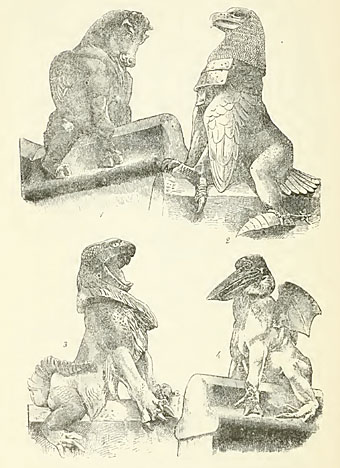
Or a couple of pages from Les monstres dans l’art; êtres humains et animaux bas-reliefs, rinceaux, fleurons, etc., a study of aesthetic teratogenesis by Edmond Valton from 1905. The Delacroix frontispiece gives a better view than the one at the Davison Art Center but they have more of the Faust lithographs. Emmanuel Frémiet’s animals were created to adorn the restored medieval Château de Pierrefonds for Napoleon III. The artist had smaller ceramic copies of the statues made later, of which the lizard is an improvement on the stone version.

monstres2.jpg

Fantastic animals (c. 1870) by Emmanuel Frémiet.

Previously on { feuilleton }
The House with Chimaeras
Frémiet’s Lizard

Liceti’s monsters

liceti1.jpg

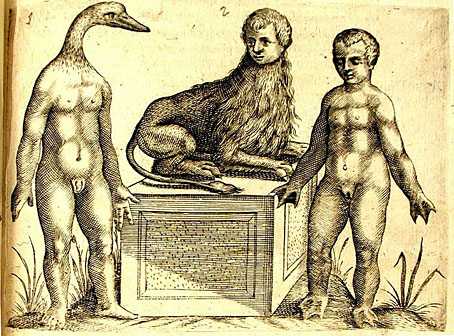
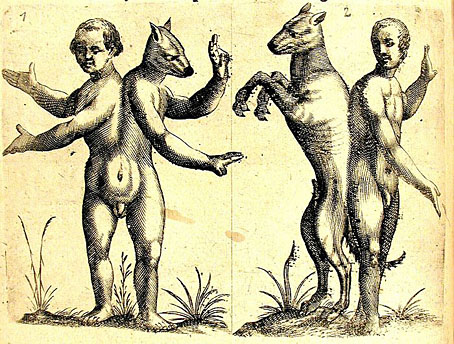
Illustrations from De monstrorum natura, caussis, et differentiis libri duo (On the nature, causes and differences of monsters, 1616) by Italian scientist Fortunio Liceti who we’re told has a crater on the Moon named after him. Further images from Liceti and his contemporaries can be found at Les Monstres de la Renaissance à l’âge classique, an online exhibition of assorted teratisms, prodigies and abominations. Via Monsieur Peacay, no monster he.

liceti2.jpg

Elsewhere on { feuilleton }
The etching and engraving archive

Dalí’s Elephant

burman.jpg

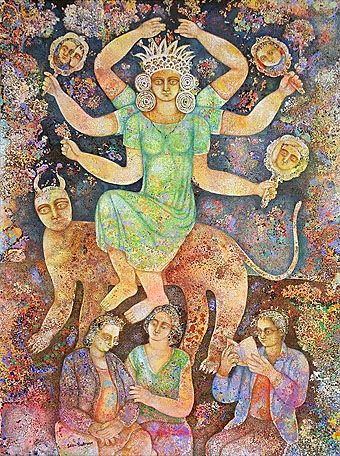
Madhav Reading Stories of Devi (2007) by Sakti Burman.

Dalí’s Elephant is a group exhibition at London’s Aicon Gallery that “traces the echoes of Surrealism in modern and contemporary art from the Indian Subcontinent.” The exhibition title refers to the gift ashtray which Salvador Dalí designed for Air India in 1967:

In 1967 Air India commissioned Salvador Dali to produce a limited edition ashtray which was to be given to a select group of lucky first-class passengers. Dali produced a small unglazed porcelain ashtray composed of a shell-shaped centre with a serpent around its perimeter. This was supported by three stands, two of which point in the same direction and resemble an elephant’s head. The third stand was inverted so that it resembled swan’s head. Dali was initially paid no more than a few hundred dollars for his design but when they received the design the airline bosses were so delighted that they made Dali the surprise gift of an elephant. Dali lived with the elephant for a few days at his Portligat home before donating the beast to the local zoo. (More.)

The Surrealist element is very much a trace in some of the works which seems surprising given the distinctive heritage of India’s religious imagery, as was demonstrated recently at A Journey Round My Skull. But I like the Sakti Burman paintings, especially the example shown here. Dalí’s Elephant runs to September 4th, 2010.

Previously on { feuilleton }
Marsi Paribatra: the Royal Surrealist
Dalí in Wonderland
Bollywood posters
Impressions de la Haute Mongolie revisited
Dalí and Film
The persistence of DNA
Salvador Dalí’s apocalyptic happening
Dalí Atomicus
Impressions de la Haute Mongolie

Weekend links 24

early.jpg

Delta-Wing (2009) by Chloe Early.

• “Feted British authors are limited, arrogant and self-satisfied, says leading academic”. Stating the bleeding obvious but it still needs to be said, apparently, especially when the announcement of the Booker list this year caused the usual confusion when Amis Jr. and McEwan weren’t included, as though the mere existence of their novels makes them prize-worthy. And as someone pointed out, the word “male” is missing from that headline.

Hero of Comic-Book World Gets Real: Alan Moore again, in the NYT this time. Related: a review of Unearthing live.

• Announcing The Hanky Code by Brian Borland & Stephen S Mills, a 40-poem book to be published next year by Lethe Press. For an explanation of the Hanky Code there’s this, and there’s also an iPhone app.

Folk—the ‘music of the people’—is now hip again, says (who else?) Rob Young who can also be heard on the archived podcast here. Related: the folk roots of Bagpuss. Related to the latter: The Mouse Mill.
zvorykin.jpg

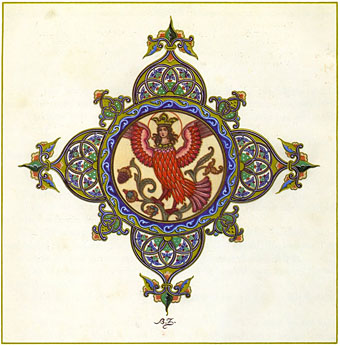
An endpiece from The Firebird and other Russian Fairy Tales by Boris Zvorykin.

‘Yes’ to Catastrophe: Roger Dean, Prog and SF. A lengthy and thoughtful analysis of Roger Dean’s early work.

Into the Media Web, the enormous Michael Moorcock book which I designed, is officially published this week.

Cassette playa: in praise of tapes. I’ve complained about tapes in the past but people continue to find them useful. Some technologies die harder than others.

Boy BANG Boy: “Quiet moments made suddenly very loud with the attitude and opinion of what it means to be a young male in an impossibly diverse world.” An exhibition opening at Eastgallery, London, on August 5th.

Empty your heart of its mortal dream: Alfred Kubin’s extraordinary novel, The Other Side.

Ghostly and Boym Partners devise a new way to deliver digital music.

Besti-mix #27: a great selection by producer Adrian Sherwood.

Agnostics are troublemakers. Amen to that.

• RIP Harry Beckett.

Acousmata.

Let Us Go In To The House Of The Lord by Pharoah Sanders (live, 1971): Part 1 | Part 2

The Lady Is Dead and The Irrepressibles

lady1.jpg

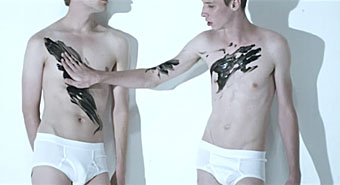
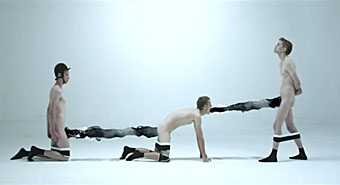
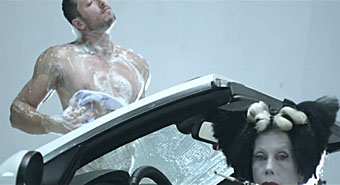
The lady may be dead but the art here is very much alive. The second great video of the week comes via the always essential Homotography, a short piece by director Roy Raz whose film features a pair of tattooed lesbians, a tennis match involving meat (or something), boys stripping out of their underwear to indulge in some peculiar—and for all we know, metaphysical—sexual congress, an elderly lady dancing round a piano, and a gang of luscious hunks who soap a car before sponging down their own bodies.

lady2.jpg

Do we have to worry about What It All Means? Of course we don’t, although the usual crowd of bewildered YouTube commenters struggle with comprehension like medieval rustics attempting to decipher so many signs and wonders. Think of it as the kind of thing Wes Anderson might create if someone dosed him with psychotropic chemicals that also turned him gay.

lady3.jpg

More important for me is the utterly fantastic song which Roy Raz uses, a number entitled In This Shirt by a ten-piece British group, The Irrepressibles, whose name I recognised but whose music I hadn’t heard until this. Lead singer Jamie McDermott’s voice is very reminiscent of Antony Hegarty which is no bad thing, although McDermott is probably weary of the comparison. Our musical culture would be greatly improved by more people taking their lead from Antony. The Irrepressibles’ site has a Soundcloud page where you can hear other songs from their recent Mirror, Mirror album, the CD of which is now on my shopping list. They also have a couple of videos showing their live performances which look rather spectacular. 2010 is turning out to be a good year for British music; when that music comes with cute guys attached it’s an added bonus.

lady4.jpg

Update: Roy Raz’s film is now also on Vimeo with other of his works.