Two films by Clive Barker: The Forbidden and Salome

forbidden1.jpg

The Forbidden.

Clive Barker announced late last month that arrangements were being made for a remake of Hellraiser. This isn’t the first time such an announcement has been made so we’ll have to wait and see what comes of that. I think I’m in a minority of people who’ve always been well-disposed to Barker and his works (the early stories in particular) but have never really enjoyed Hellraiser. I saw it when it was first released, and was disappointed that Barker and co. hadn’t manage to successfully negotiate the pitfalls of making a British film for demanding American producers. The soundtrack that Barker commissioned from Coil was dropped (a serious error); the film’s awkward mid-Atlantic tone makes suspension of disbelief difficult, and considering Barker’s success as a storyteller the narrative is often confused and disjointed. Without all the memorable imagery it’s doubtful it would have had much of a lasting reputation, or birthed so many sequels.

forbidden2.jpg

The Forbidden.

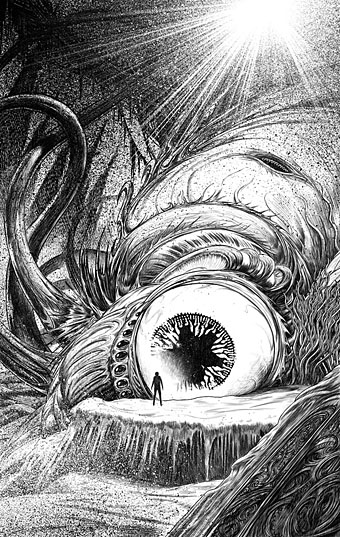
Barker and his theatre colleagues made The Forbidden in 1978, a 35-minute 16mm film of entirely negative images which shows how different Hellraiser might have been if fewer capitulations had been made to the marketplace, and to the clichés of horror cinema. Both films concern an occult ritual, an occult puzzle, and the subsequent consequences of the ritual. Where Hellraiser has to connect its most striking scenes with mundane business such as Julia’s murder spree and screaming teens, The Forbidden presents its imagery as raw data, leaving it to the viewer to piece together its fragments.

Barker’s work since Hellraiser has been almost completely generic so it’s surprising to see something of his that’s this open and abstract. In tone it’s closer to the films of Derek Jarman or Kenneth Anger than anything else, especially the sequence of Barker himself dancing with an erection, something which will ensure this doesn’t get many TV screenings. (Barker has referred to Kenneth Anger when discussing the film.) The final section, featuring a man being lovingly flayed by a number of scalpel-wielding hands, offers the same spectacle as Hellraiser‘s skinless Frank but without any of the accompanying frenzy. This won’t necessarily be on YouTube for very long so watch it while you can. The uploaded version is from the Redemption DVD, music included. Since the film is silent you can watch it with a score of your choice; I’d suggest Coil’s themes for Hellraiser.

salome.jpg

Salome.

Where The Forbidden is a successful piece of avant-garde cinema, Barker’s 17-minute dramatisation of Salome (1973) is closer to a well-made home movie. This is silent as well, and even has the quality and feel of a very old silent film. For an amateur work it still manages to convey a greater sense of dread than some of the other Salomé-related films which have been featured here, and I believe that’s the director himself playing the femme fatale.

Elsewhere on { feuilleton }
The Salomé archive

Previously on { feuilleton }
Clive Barker, Imaginer

An art competition

docstrange.jpg

Doctor Strange was one of the few superheroes I had any time for, at least when Frank Brunner was drawing the series in the 1970s. His art was a cut above the Kirby imitators, and his ability to convey an endless variety of sorcerous weirdness through inventive drawing and composition made for some memorable comics. This site shows the opening pages of the issue above.

Which preamble is tenuously connected to news that Minor Arcana Press are staging a cover art competition for Drawn to Marvel: Poems from the Comic Books, an anthology of superhero/villain-themed poetry edited by Bryan D. Dietrich and Marta Ferguson. In addition to the winner having their art featured on the cover there’s also a prize of $100. Runners-up will have their contributions printed inside. Multiple entries are accepted, and the deadline is 7th December, 2013. See here for entry details and other information.

Previously on { feuilleton }
Words and pictures

Wyrd Daze 1

wyrddaze.jpg

Wyrd Daze is a new digital zine edited by Leigh Wright, the first issue of which is now available via a subscription of $5 (Canadian) or about £3. For that you receive a 66-page pdf plus access to music mixes and podcast files. The contents are the kind of thing which finds particular favour here: the weird, the marginal, the spectral, the esoteric, and so on. In issue 1 there’s fiction from Gareth E. Rees and Phil Legard (aka Xenis Emputae Travelling Band), interviews with writers Berit Ellingsen and David Southwell (the latter talking about psychogeography and “strange England”), a piece about Laurel Halo and Demdike Stare, many curious photos and graphics, and a lot more. I may be contributing to a future issue so watch this space.

wyrddaze2.jpg

Artwork from issue 1 by Emma-Jane Rosenberg.

Previously on { feuilleton }
The Weird

Never Forever by Prince Rama

princerama1.jpg

Lily X. Wahrman’s 18-minute video for Prince Rama (Taraka and Nimai Larson) segues songs from the group’s Top Ten Hits Of The End Of The World album into a cosmic mindblast:

One day, they sat us down and asked us, “What is every wildest fantasy you ever wanted to see fulfilled in a movie?” And we were like, “Well, ok, first off we need 12 Abercrombie models lifting marble pyramids that sweat beads of mercury, a jacuzzi of blood that resurrects the lost faces of pop star avatars, two identical motorcycles driven by two blond identical twins with ripped t-shirts that read FOR EVER, live exotic animals, a miniature model of Stonehenge made from red velvet cake and leopard printed fake nails…” (more)

The HD version at YouTube is a treat.

princerama2.jpg

princerama3.jpg

Weekend links 185

rondelli.jpg

L’uomo che piantava gli alberi (2013) by Sofia Rondelli. Via Form Is Void.

• I’m looking forward to hearing the new album by Chrome Hoof, a band whose ambition and attitude makes many of their contemporaries seem lukewarm at best. Mick Middles gets to grips with Chrome Black Gold here. John Doran interviewed the group in 2010, a piece which includes a Chrome Hoof mix of tracks by other artists.

Jay Roberts: “I was a young Marine scout sniper, definitely his type. And for a single, unforgettable afternoon, Orange County’s most notorious serial killer coaxed me into a place from which many didn’t escape.”

Jonathan Meades: “Why I went postal … and turned my snaps into postcards.” “Meades isn’t your average architectural fanboy,” says Rachel Cooke who went to talk to him at his home in Marseille.

“Faced with a Nabokov novel,” Zadie Smith writes, “it’s impossible to rid yourself of the feeling that you’ve been set a problem, as a chess master sets a problem in a newspaper.” Certainly, while Humbert asks the reader “not to mock me and my mental daze”, the suspicion is that the power dynamic in his tale is a little different.

Tim Groenland on the difficulties of writing, publishing and reading Lolita.

Cosmic Machine is a double-disc collection of French electronic music from the 1970s & 1980s. Justice enthuse about the music here where you can also preview the tracks.

The Midnight Channel, Evan J. Peterson’s horror-poetry homage to the VHS era, is available now from Babel/Salvage. There’s a trailer here.

• “Our age reveres the specialist but humans are natural polymaths, at our best when we turn our minds to many things,” says Robert Twigger.

• Another musical Chrome: Richard Metzger on newly resurrected recordings by one of my long-time cult bands.

• Hermes Trismegistus and Hermeticism: An interview with Gary Lachman.

• A stunning set of photos of London in the sweltering summer of 1976.

Pye Corner Audio live at The Outer Church, Madrid, November 2013.

Judee Sill, the shockingly talented occult folk singer time forgot.

• Designer Jonathan Barnbrook answers twenty questions.

• Don’t trust the painting: Morgan Meis on René Magritte.

Laurie Anderson’s farewell to Lou Reed.

Philippe Druillet at Pinterest.

• The Chrome Plated Megaphone Of Destiny (1968) by The Mothers of Invention | March Of The Chrome Police (1979) by Chrome | Chrome (1981) by Debbie Harry